The main CSPO certification benefits are practical Product Owner skills, stronger career prospects, and a recognized credential with a clear growth path. The Certified Scrum Product Owner (CSPO) certification is awarded by Scrum Alliance after at least 14 hours of interactive training with a verified trainer. The training teaches you to shape product vision, order the Product Backlog, and maximize value.
Every Scrum team needs one person who is accountable for what gets built and why. That person is the Product Owner, and the CSPO course prepares you to take on that accountability with confidence. Below, you will find what the credential is, how you earn it, whether it is worth it in 2026, and the eight benefits it delivers.
What Is CSPO Certification?
The Certified Scrum Product Owner (CSPO) certification, offered by Scrum Alliance, is the first level of its Product Owner track. It is designed for professionals who want to deepen their understanding of Scrum, an agile framework for managing complex work, from the Product Owner's point of view.
The course teaches you how to create a product vision, manage and order the Product Backlog, work with stakeholders, understand customers, and help the team deliver maximum value. Scrum Alliance lists the full learning objectives on its Scrum Alliance CSPO page.
How Do You Earn the CSPO Certification?
You earn the CSPO by completing an approved course. There is no exam. Scrum Alliance sets the process:
- Choose an approved course delivered by a verified Scrum Alliance trainer.
- Complete at least 14 hours of live, interactive instruction. Most courses run over two days.
- Accept the license agreement and the Scrum Alliance code of ethics after the course.
- Receive your credential. Because there is no post-course exam, you are awarded the CSPO when you complete the course.
Is the CSPO Certification Worth It in 2026?
Yes, for most people moving into product ownership. CSPO certification gives aspiring and new Product Owners structured training in Scrum, a credential that hiring managers recognize, and a defined next step on the Scrum Alliance track. It does not replace hands-on experience, but it shortens the learning curve.
The course equips you to manage Product Backlogs, prioritize features strategically, and work confidently in agile delivery. In practice, that means stronger communication and leadership with your team and stakeholders. As with the broader agile certification benefits many professionals see, the credential proves your commitment to professional development and connects you with other agile practitioners.
What Are the Top Benefits of Becoming a Certified Scrum Product Owner?
Here are the eight key benefits, ordered by how directly they affect your day-to-day work and your career.
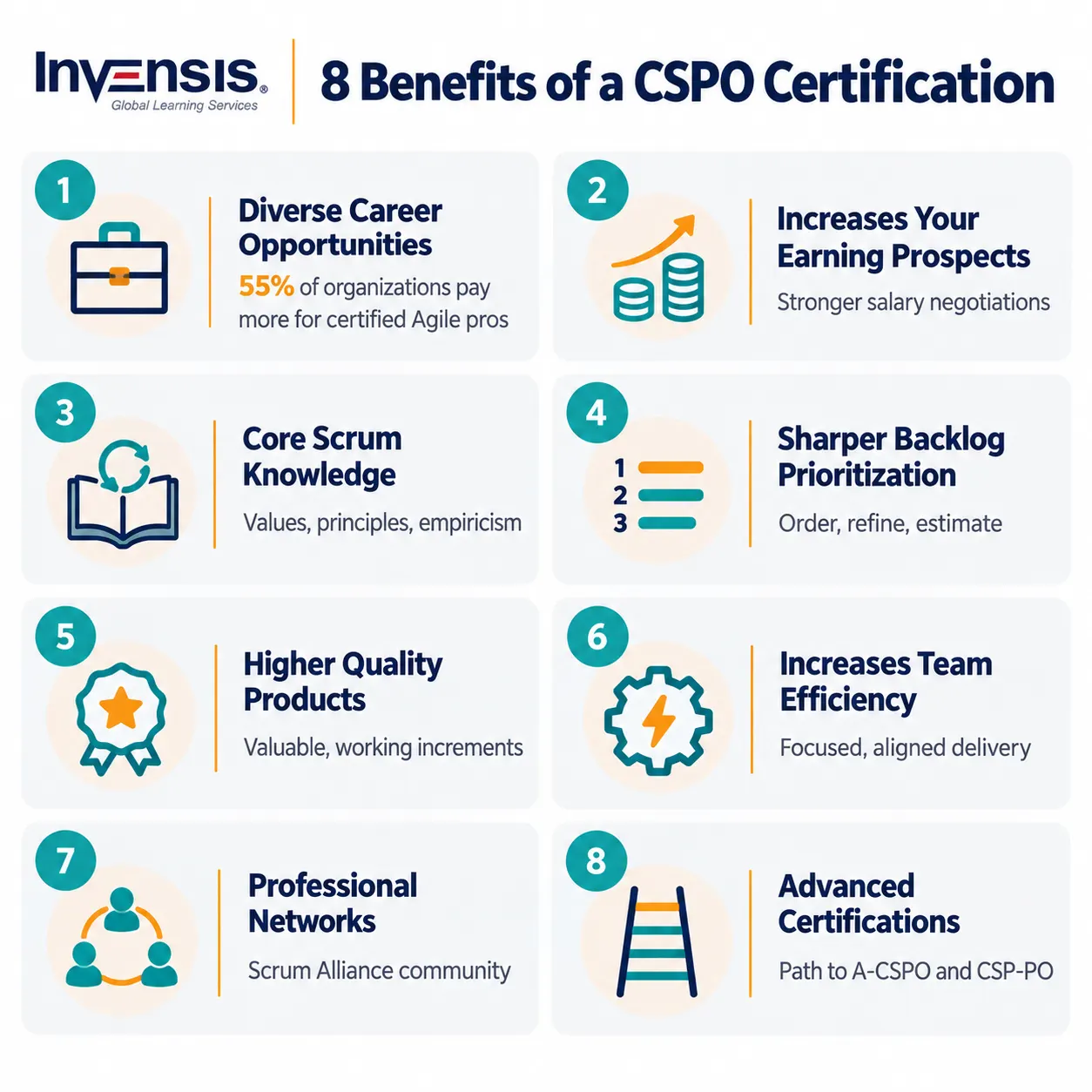
1. Demonstrates and Applies Core Scrum Knowledge
The CSPO certification validates your understanding of fundamental Scrum principles and practices. It equips you to perform the responsibilities of a Product Owner, including managing the Product Backlog, defining product vision, and ensuring successful product delivery. The certification also shows you can apply Scrum in real-world scenarios, which makes teams more efficient and productive.
2. Teaches You to Prioritize and Refine the Product Backlog
A key responsibility of a Product Owner is managing the Product Backlog. The CSPO course teaches you to order and refine backlog items as business needs and market conditions change. With this skill, the Developers always work on the most valuable items, and you make the best use of time and resources.
3. Opens Diverse Career Opportunities
A CSPO certification opens up a variety of career paths in Agile and Scrum. As organizations across industries adopt agile practices, they look for certified professionals to fill roles such as Product Owner, product manager, and business analyst on Scrum teams.
Agile adoption is now mainstream: Digital.ai's 17th State of Agile report (2024) found that 71% of respondents use Agile in their software development lifecycle. The credential makes you more marketable and gives you access to jobs in sectors such as IT, finance, healthcare, and manufacturing.
4. Increases Your Earning Prospects
A CSPO certification can raise your earning potential. Employers value certified Product Owners, and the credential can support higher salary offers and stronger roles in Agile and Scrum environments. For current figures by experience and region, see our product owner salary overview.
5. Increases Team Efficiency
The knowledge and skills you gain from CSPO certification help your team work more efficiently and productively. When you manage the Product Backlog well, order the work clearly, and communicate openly, the Developers stay focused and aligned with business goals. The results are smoother workflows, faster delivery, and more successful outcomes.
6. Delivers Higher Quality Products
Mastering the Product Owner role through CSPO certification teaches you to prioritize customer needs and deliver high-quality products. This involves effective backlog management, continuous stakeholder engagement, and iterative development that focuses on valuable, working products that meet or exceed customer expectations. These agile case studies show how this works in practice.
7. Prepares You for Advanced Certifications
The CSPO is the first step on the Scrum Alliance Product Owner track. With a solid foundation in Scrum, you are well prepared for the higher-level credentials that follow:
| Credential | Level | What It Adds |
|---|---|---|
| Certified Scrum Product Owner (CSPO) | Entry to intermediate | Core Product Owner skills: product vision, Product Backlog, stakeholders, and value |
| Advanced Certified Scrum Product Owner (A-CSPO) | Intermediate | Advanced Product Owner practice; requires the CSPO plus Product Owner experience |
| Certified Scrum Professional Product Owner (CSP-PO) | Advanced | Professional-level product ownership; requires the A-CSPO |
8. Builds Professional Networks
The CSPO connects you with a community of Scrum professionals and experts. This network opens opportunities for collaboration, knowledge sharing, and professional growth. Peers and mentors can offer useful insights, support, and resources that help your development and career.
Who Should Take the CSPO Course?
The CSPO course suits anyone who owns, or wants to own, product decisions in a Scrum environment. Scrum Alliance highlights these groups:
- Aspiring Product Owners who want a recognized credential for the role
- Product managers moving from traditional to Scrum-based delivery
- Business analysts taking on Product Owner responsibilities
- Project managers adopting agile who need the Product Owner perspective
- Data analysts working on Scrum teams
- Scrum team members who want to collaborate better with their Product Owner
If you are new to the role, our guide to essential Product Owner skills outlines the steps to get started.
If you would rather guide the team's process than own the product, compare the benefits of a Scrum Master certification before you choose.
Conclusion
CSPO certification benefits reach well beyond a line on your resume. The credential validates your Scrum knowledge, gives you practical Product Backlog and stakeholder skills, and opens a clear path to A-CSPO and CSP-PO. Agile delivery is now mainstream, and organizations need Product Owners who can turn a vision into a well-ordered backlog and deliver value steadily.
If you are ready to step into product ownership, start with an approved CSPO training course led by a verified trainer.
FAQs on CSPO Certification
Does the CSPO certification expire?
Yes. The CSPO certification is valid for two years. To renew it, you earn 20 Scrum Education Units (SEUs) and pay the Scrum Alliance renewal fee. Alternatively, you earn a higher Product Owner credential such as A-CSPO or CSP-PO, which renews your CSPO automatically.
Do you need experience or prerequisites to take the CSPO course?
No. Scrum Alliance sets no formal education or work experience prerequisites for the CSPO. Reading the Scrum Guide before the course helps you get more from the training, but it is not required.
How much does CSPO certification cost?
Scrum Alliance does not publish a single global price. The course fee varies by trainer, location, delivery format, and other factors, so compare what each approved course includes before you enroll.
How is CSPO different from Certified ScrumMaster (CSM)?
Both credentials come from Scrum Alliance, but they prepare you for different accountabilities. CSPO focuses on the Product Owner: product vision, the Product Backlog, stakeholders, and maximizing value. CSM focuses on the Scrum Master: helping the team and organization use Scrum effectively.
Does a CSPO certification guarantee a higher salary?
No credential guarantees a raise. Your salary depends on your experience, location, industry, and the scope of the role. The CSPO strengthens your case by proving formal Product Owner training, and it helps most when you pair it with hands-on product work.