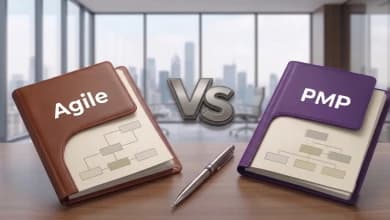
PMP vs PMI-ACP compares two Project Management Institute (PMI) certifications that are not competing credentials, and neither ranks above the other. PMP validates your ability to lead projects using any approach, predictive, agile or hybrid. PMI-ACP validates deep, hands-on expertise specifically in agile frameworks such as Scrum, Kanban, Lean and XP (see the Agile Alliance). Choose PMP for broad project leadership across industries. Choose PMI-ACP if your work is centered on agile delivery. Many experienced professionals eventually hold both.
This guide compares PMP and PMI-ACP on methodology, eligibility, exam format, cost, salary and career roles. It also covers the 2026 PMI-ACP updates, so you can decide which credential fits your role and goals, or whether both make sense.
What Is PMP?
The Project Management Professional (PMP) is PMI's flagship credential for experienced project leaders. It certifies that you can lead and direct projects using predictive, agile or hybrid approaches, which is why employers across almost every industry recognize it.
The PMP exam has 180 scenario-based questions in 240 minutes, across three domains: People (33%), Process (41%) and Business Environment (26%). The questions test judgment in real project situations, not memorization. To qualify, you need 35 hours of project management education plus 36 months of project leadership experience with a four-year degree, or 60 months with a secondary diploma. As of 2026, PMI reports more than 1.4 million active PMP holders worldwide. Structured PMP certification training prepares you for the exam and covers the required education hours.
What Is PMI-ACP?
The PMI Agile Certified Practitioner (PMI-ACP) validates deep, practical agile expertise across multiple frameworks, not a single method. It covers Scrum, Kanban, Lean, Extreme Programming (XP) and more, which sets it apart from single-framework certifications. It suits practitioners who work on agile teams and want a broad, methodology-spanning agile credential.
The PMI-ACP exam has 120 scenario-based questions in 180 minutes. It tests how you apply agile principles in real team contexts. Accredited providers deliver PMI-ACP certification training as a Premier PMI Authorized Training Partner (ATP ID 4177), aligned to PMI's current Exam Content Outline. If you are choosing between agile credentials, our comparisons of PMI-ACP vs CSM and PMI-ACP vs SAFe add useful context.
PMP vs PMI-ACP at a Glance
Both certifications come from PMI, but they validate different competencies. The table below compares the 2026 versions side by side.
|
Dimension |
PMP |
PMI-ACP |
|
Certification focus |
Project leadership across all approaches |
Agile delivery specialism |
|
Governing body |
PMI |
PMI |
|
Methodology |
Predictive, agile and hybrid |
Agile frameworks (Scrum, Kanban, Lean, XP) |
|
Experience required |
36 months (4-year degree) or 60 months (secondary diploma) |
2 years of agile experience in the last 5 years (general PM experience waived for PMP or PgMP holders) |
|
Training hours |
35 hours of PM education |
28 hours of agile training (increased from 21 in 2025) |
|
Exam questions |
180 |
120 |
|
Exam duration |
240 minutes |
180 minutes |
|
Exam type |
Scenario-based |
Scenario-based |
|
Domains |
3 (People 33%, Process 41%, Business Environment 26%) |
4 (Mindset 28%, Leadership 25%, Product 19%, Delivery 28%) |
|
Exam fee (member / non-member) |
$405 / $555 |
around $435 / $495 (verify current PMI pricing) |
|
Renewal |
60 PDUs every 3 years |
30 PDUs every 3 years |
|
US median salary (approx.) |
~$135,000 |
~$120,000 |
|
Best for |
Project and program leaders across industries |
Agile practitioners, Scrum Masters, agile coaches |
Fees and requirements change. Confirm current figures on PMI's official certification pages before you apply. Salary figures are approximate US medians from industry surveys and vary by country, industry and experience.
The Core Difference: Breadth vs Depth
The single most important distinction is scope. PMP is broad: it certifies that you can lead a project from start to finish using whichever approach the work demands, including agile. PMI-ACP is deep: it certifies specialist knowledge of agile ways of working across many frameworks.
Put simply, PMP proves you can run projects; PMI-ACP proves you can run agile. One is not a level above the other. They answer different questions employers ask, which is why the right choice depends on the work you do, not on prestige. For a related view, see our guide on Agile vs PMP.
What Is New in PMI-ACP for 2026?
PMI-ACP has been refreshed, and this is where many older guides are now out of date. Two changes matter most:
-
A new four-domain Exam Content Outline. The exam is now organized around Mindset (28%), Leadership (25%), Product (19%) and Delivery (28%), replacing the older seven-domain structure. The emphasis shifts toward agile mindset and leadership, not just tools and techniques.
-
Increased training hours. The formal agile-training requirement rose from 21 to 28 contact hours in 2025. Make sure any course you take reflects the current requirement.
The exam length is unchanged at 120 questions in 180 minutes, and it remains scenario-based. If you are preparing in 2026, study against the current outline rather than legacy materials, and confirm the exact requirements on PMI's website before applying.
Eligibility and Experience Requirements
PMP eligibility
You need 35 hours of project management education plus qualifying leadership experience: 36 months with a four-year degree, or 60 months with a secondary diploma, gained within the last 10 years under PMI's 2026 eligibility paths. PMI audits a share of applications, so keep records of your project hours and references.
PMI-ACP eligibility
You need a secondary degree, agile experience (commonly stated as two years of agile project work within the last five years), and 28 contact hours of agile training. If you already hold PMP or PgMP, PMI waives the general project-management experience portion. Because eligibility wording has changed, verify the current criteria on PMI before you apply.
Exam Format and Difficulty
PMP is the longer, broader exam: 180 scenario-based questions in 240 minutes, with two 10-minute breaks. PMI-ACP is shorter: 120 scenario-based questions in 180 minutes, with a break after question 60.
Neither is "easy." PMP is often considered harder because of its wider scope and its assumption of real leadership experience. PMI-ACP is narrower but demands genuine agile fluency, not textbook recall. Both reward candidates who have done the work and practiced situational questions.
What PMP and PMI-ACP Cost
The exam fee is only part of the cost. Factor in optional PMI membership, a preparation course and renewal.
|
Cost Component |
PMP |
PMI-ACP |
|
PMI membership (optional, annual) |
$139 |
$139 |
|
Exam fee (member / non-member) |
$405 / $555 |
around $435 / $495 (verify) |
|
Prep course (typical range) |
$500-$2,000 |
$300-$1,300 |
|
Renewal per 3-year cycle |
$60 / $150 + 60 PDUs |
$60 / $150 + 30 PDUs |
PMI membership pays for itself if you sit either exam, because the member discount usually exceeds the membership fee. Both credentials renew every three years, so budget for ongoing professional development. Verify current fees on the PMI certifications page before you commit.
Salary and Career Impact
PMP carries a well-documented premium. PMI's Earning Power salary survey has repeatedly found that PMP holders earn substantially more than non-certified project managers, and industry surveys put the US median around $135,000. PMI-ACP holders report a US median in the region of $120,000, though agile roles vary widely by sector.
The important point: PMI-ACP is not a lower-paying "junior" version of PMP. It is a parallel credential for a different kind of work. In agile-heavy technology and product organizations, PMI-ACP can be the more relevant qualification. For regional detail, see the PMP salary guide and the PMI-ACP salary guide.
Which Roles Need Which Certification?
Job titles map fairly cleanly to each credential. The table below shows the typical expectation.
|
Role |
Typical Credential |
Primary Focus |
|
Scrum Master |
PMI-ACP (or CSM / PSM) |
Facilitating an agile team |
|
Agile Coach |
PMI-ACP |
Coaching teams across frameworks |
|
Agile Delivery Lead |
PMI-ACP |
Iterative, value-driven delivery |
|
Project Manager |
PMP |
Leading projects end to end |
|
Program Manager |
PMP |
Multi-project, strategic oversight |
|
Hybrid or Portfolio Roles |
PMP (often with PMI-ACP) |
Blending predictive and agile delivery |
Explore where each credential leads in the PMI-ACP career path guide.
Which Certification Is Right for You?
Match the credential to your situation rather than to prestige. The table maps common profiles to the better fit.
|
Your Situation |
Recommended |
Why |
|
You lead traditional or hybrid projects across industries |
PMP |
Broadest recognition and methodology coverage |
|
Your work is centered on agile teams (Scrum, Kanban) |
PMI-ACP |
Validates the agile depth employers want |
|
You are a Scrum Master or agile coach |
PMI-ACP |
Credential matches the role |
|
You want the widest career optionality |
PMP |
Most commonly required PM credential |
|
You already hold PMP and work in agile |
PMI-ACP |
Adds agile specialism; experience partly waived |
|
You are unsure of your long-term direction |
PMP first |
Keeps the most doors open, then specialize later |
Should You Get Both PMP and PMI-ACP?
For many experienced professionals, the honest answer is yes, over time. The two credentials complement each other: PMP proves you can lead any project, and PMI-ACP proves you can do it the agile way. Together they signal that you are comfortable in predictive, agile and hybrid environments, which is exactly what many modern employers need.
A practical sequence is to earn the credential your current role requires first, then add the second as your work broadens. Holding PMP also simplifies PMI-ACP eligibility, since it waives the general project-management experience requirement. Getting both is an investment in time and PDUs, so weigh it against your career direction rather than collecting certifications for their own sake.
Common Misconceptions
-
"PMI-ACP is below PMP." False. They are parallel credentials for different work, not rungs on one ladder.
-
"PMP does not cover agile." False. PMP explicitly covers predictive, agile and hybrid approaches, and a meaningful share of the exam is agile and hybrid.
-
"PMI-ACP is only for Scrum." False. PMI-ACP spans many frameworks, including Kanban, Lean and XP, which is a key reason to choose it over a single-framework certification.
-
"You must get PMP before PMI-ACP." False. There is no required order. PMP simply makes PMI-ACP eligibility easier if you already hold it.
-
"The higher-paying certification is always the better choice." False. The right credential is the one that matches your role. A well-matched PMI-ACP holder can out-earn a mismatched PMP holder.
How to Get Started
For PMP
1. Confirm you meet the experience requirement: 36 months with a four-year degree, or 60 months with a secondary diploma.
2. Complete 35 hours of project management education.
3. Create a PMI account and submit your PMP application, ready for a possible audit.
4. Study for three to four months with a structured plan and practice exams.
5. Schedule and pass the 180-question exam.
For PMI-ACP
1. Confirm your agile experience and secondary degree meet PMI's current criteria.
2. Complete 28 contact hours of agile training through an authorized provider.
3. Submit your PMI-ACP application through PMI.
4. Prepare against the current four-domain outline with full-length mock exams.
5. Schedule and pass the 120-question exam.
PMI membership ($139/year) lowers the exam fee for both credentials. Practice with realistic questions using our PMI-ACP interview questions and answers.
Conclusion
PMP vs PMI-ACP is a question of fit, not ranking. Choose PMP if you lead, or want to lead, projects across methodologies and industries; it offers the widest recognition and a strong salary premium. Choose PMI-ACP if your work is agile and you want a credential that proves depth across frameworks. If your career spans both worlds, earning both over time is a sound investment. Whichever path fits, Invensis Learning offers accredited PMP and PMI-ACP training to prepare you for the exam.
Frequently Asked Questions
Is PMI-ACP harder than PMP?
Generally, no. PMP is usually considered harder because it is longer (180 questions vs 120), broader in scope, and assumes real leadership experience. PMI-ACP is narrower but demands genuine agile fluency. Difficulty depends on your background: agile practitioners often find PMI-ACP more natural, while broad project managers find PMP more aligned.
Which pays more, PMP or PMI-ACP?
PMP typically reports a higher US median salary, around $135,000 versus roughly $120,000 for PMI-ACP, based on industry surveys. However, PMI-ACP is not a lower-tier credential. In agile-focused technology and product organizations, PMI-ACP can be the more relevant and better-paid qualification. Pay depends on role, industry and location.
Does PMP cover agile?
Yes. The PMP exam explicitly covers predictive, agile and hybrid approaches, and a significant portion of questions involve agile or hybrid delivery. PMP certifies methodology-agnostic leadership, while PMI-ACP goes deeper into agile frameworks specifically.
Is PMI-ACP worth it in 2026?
Yes, for professionals working in or moving into agile delivery. The 2026 refresh, with its new Mindset, Leadership, Product and Delivery domains, keeps it aligned to how agile teams actually work. It is most valuable when your role is agile-centered rather than broadly predictive.
What changed in the PMI-ACP exam for 2026?
The Exam Content Outline moved to four domains: Mindset (28%), Leadership (25%), Product (19%) and Delivery (28%), replacing the older seven-domain structure, and the training requirement increased from 21 to 28 contact hours. The exam remains 120 scenario-based questions in 180 minutes.
How long are PMP and PMI-ACP valid?
Both are valid for three years. To renew, PMP holders earn 60 PDUs per cycle and PMI-ACP holders earn 30 PDUs, plus a renewal fee ($60 for members, $150 for non-members). PDUs come from courses, webinars and professional activities.