The PMI Construction Professional (PMI-CP) certification is the benchmark credential for professionals in the specific field of construction production management. The construction industry is valued $2.2 trillion annually in the United States alone. At the same time, the construction project management services market is projected to reach $296.1 billion by 2029. As the demand for certified and skilled professionals increases, the need for PMI-CP certified experts is more pronounced.
Many candidates underestimate the challenges ahead. PMI-CP Certification requires completing four mandatory prerequisite courses to sit for the exam, unlike any other management certificates. The cost of failure is much significant. Candidates invest $696 in total fees and spend 24-40 hours in prerequisite courses. They still face failures and professional disappointments.
This guide provides 10 essential tips to help you navigate the PMI-CP preparation journey. It will make you join the growing community of construction management leaders and avoid common pitfalls.
How PMI-CP Stands Out in Construction Management
PMI introduced the PMI Construction Professional (PMI-CP) certification in February 2023. They do represent the first credential tailored specifically to construction industry. Unlike other generalized project management certifications, the PMI-CP addresses numerous distinct challenges commonly faced in environmental projects and construction, including those related to contract administration, change orders, scope management, and risk mitigation.
Only a few thousand currently hold PMI-CP certificates. This certification positions you at the intersection of traditional construction expertise and modern project methodologies, which makes you indispensable in an industry undergoing significant digital transformation. Let’s move ahead and discuss tips to stand out in a professional exam.
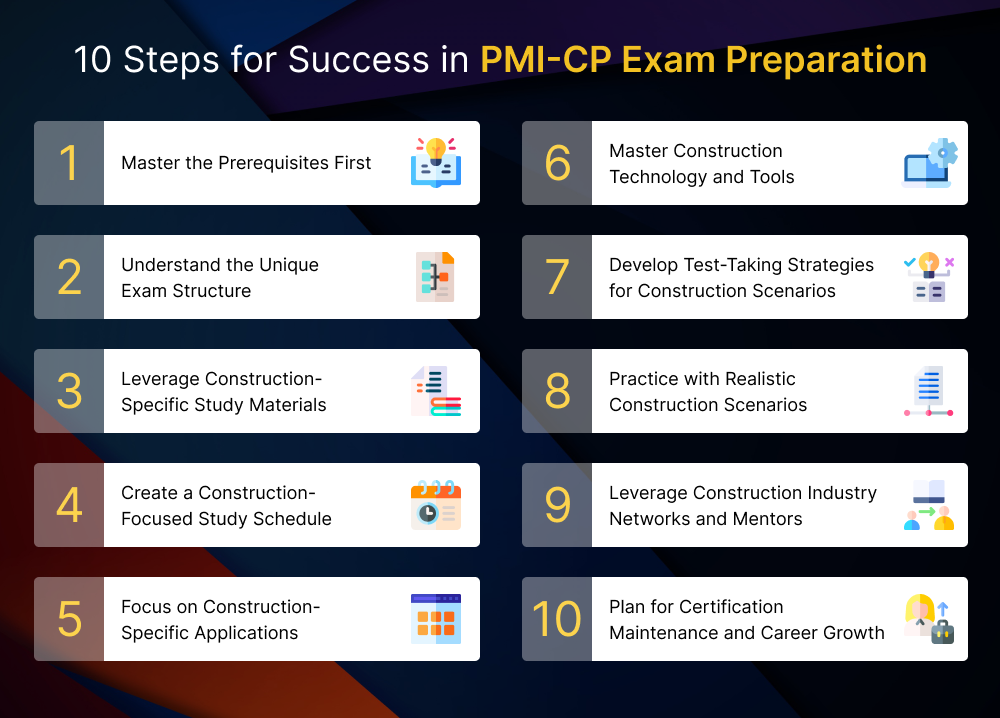
Tip 1: Master the Prerequisites First
PMI certifications, specifically PMI-CP, require the completion of four specific e-modules to be eligible for the exam. These courses form the foundation of the exam, and many successful candidates report that thorough engagement with accounts is a prerequisite for 60-70% of their exam preparation.
You'll need to complete Construction Project Communication (Course + Micro-credential for $140), Interface Management in the Built Environment ($69), Scope and Change Order Management in the Built Environment ($69), and Contract and Risk Management in the Built Environment ($69). Each module requires 6-10 hours of work. But do not rush through these courses thinking they are just checklists.
Before proceeding to the preparations, you must meet the eligibility criteria. The good news is that PMI is significantly simpler than other certifications.
You need
- 3 years of experience in the construction industry
- or a built environment project field within the last 10 years
After the competition, you need to submit your online application and provide details of your construction experience. You will typically receive a response in 1 or 2 business days. After that, schedule your exam at a Pearson VUE centre or online.
Tip 2: Understand the Unique Exam Structure
The PMI-CP exam reflects real construction challenges rather than generic project management theory. Understanding its structure helps you manage time, plan study sessions, and reduce surprises on exam day. You will answer 120 multiple-choice questions in 230 minutes (3 hours 50 minutes). Two optional 10-minute breaks occur after questions 40 and 80. Once you begin a break, you cannot return to previous pages, so review all marked questions carefully before stepping away.
| Total Questions | 120 multiple-choice |
| Total Time | 230 minutes (3 hours 50 minutes) |
| Breaks | Two optional 10 minute breaks after question 40 and question 80. Previous pages are locked once a break begins. |
| Question Style | Concept-based and scenario-driven, focused on construction-specific challenges rather than generic PM theory. |
| Experimental Items | None. All questions are scored. This is confirmed in the current PMI-CP Exam Content Outline. PMP exams sometimes include unscored items, but PMI-CP does not. |
Primary Exam Domains
- Project Integration Management in Construction Contexts
- Scope and Change Order Management
- Interface Management between construction trades and stakeholders
- Contract and Risk Management specific to construction projects
Why This Structure Matters?
Because every question counts, you should pace yourself at about 1.9 minutes per question. Scenario driven items will test your ability to apply construction knowledge to PMI’s framework, such as coordinating trades, sequencing work, or handling risk under realistic site constraints. Aligning your study plan with these four domains ensures you focus on the most heavily tested areas.
By mastering the format, timing, and content focus of the PMI-CP exam, you can prepare more effectively, simulate real exam conditions during practice, and enter the test center with greater confidence.
Tip 3: Leverage Construction-Specific Study Materials
Where candidates make most of their mistakes, we need to specialize in content-focused training material rather than general knowledge that generic PM resources don’t cover.
Start with the official PMI-CP Exam Content Outline (ECO), which is a definitive study roadmap. Your requisites should be known as study guides, not just a course that you completed. If you have a PMI membership, access the PMI construction knowledge for further insights.
To strengthen your PMI-CP preparation, begin with primary study materials that directly align with the exam. Use practice tests to simulate real exam conditions and review documentation for key construction management software. These resources help you understand the tools and processes used in modern construction projects:
- Procore
- Autodesk Construction Cloud
- PlanGrid
Equally important are established standards that form the foundation of construction governance and safety. Familiarity with these will prepare you for scenario-based questions on contracts, compliance, and risk:
- AIA (American Institute of Architects) contract documents
- FIDIC (International Federation of Consulting Engineers) contracts
- CSI (Construction Specifications Institute) standards
- OSHA safety regulations
In addition to core study materials, stay informed with industry references that provide current insights and case studies relevant to exam scenarios:
- ENR (Engineering News-Record)
- Constructor Magazine
Tip 4: Create a Construction-Focused Study Schedule
Start planning your PMI-CP study like you plan a construction project: with a clear timeline and focused tasks. Treat each week as a critical phase you must deliver on schedule. By following a structured plan, you will build knowledge layer by layer, stay on pace, and avoid last-minute cramming. Use the schedule below to guide your preparation and keep every milestone on track.
| Week | Focus Area | Study Time | Key Tasks |
|---|---|---|---|
| Week 1-2 | Prerequisite Modules & Basics | 15-20 hours/week | Complete prerequisite courses, review construction fundamentals. |
| Week 3 | Stakeholder Management & Communication | 15-20 hours | Practice communication scenarios, study project structures. |
| Week 4 | Scope & Change Management | 8-10 hours | Master change order processes and practice cost-effective scenarios. |
| Week 5 | Risk Management | 8-10 hours | Study construction contract types and understand risk management. |
| Week 6-7 | Practice & Focus on Weak Areas | 15-20 hours/week | Review practice questions, focus on weak areas. |
| Week 8 | Final Review & Rest | 5-8 hours | Final evaluation, light review, and rest to build confidence. |
Tip 5: Focus on Construction-Specific Applications
The PMI-CP exam emphasizes practical applications over theoretical knowledge. This is where your construction experience is your biggest asset. But you need to apply it through your PMI's framework. Interface management questions test your understanding of trade coordination, sequence design, and construction team integration, as well as stakeholder alignment across projects and communication protocols.
Think about the last major construction project you worked on. How did you coordinate between the electrical, plumbing, and HVAC trades? That is the kind of practical knowledge the PMI-CP exam tests.
To practice effectively, review actual orders, study real construction projects, analyze organizational charts, and work through management scenarios. The more you connect PMI’s methodology to real construction situations, the better you will perform on exam day.
Here are a few example question types you might see:
- BIM Clash Detection: You are reviewing a 4D BIM model and discover a clash between ductwork and a load-bearing beam scheduled for installation next week. What is your next step to prevent schedule delays?
- Interface Conflict: Two subcontractor teams dispute sequencing for overlapping tasks in a critical path activity. Which action best preserves scope and minimizes risk?
- Change Order Decision: Midway through a project, an owner requests a design modification that will impact concrete pouring schedules. How should you process this change to maintain governance and cost control?
- Risk Mitigation Choice: A key material shipment is delayed due to weather, threatening to stall multiple trades. Which mitigation strategy aligns with PMI’s construction risk management approach?
Including examples like these makes your preparation more realistic and helps you develop pattern recognition for construction-specific challenges that the PMI-CP exam emphasizes.
Tip 6: Master Construction Technology and Tools
Modern construction projects rely totally on heavy technology. The PMI-CP exam does reflect this reality. Understanding these software and tools isn’t only crucial, it is, in fact, beneficial. It's vital for exam success and your future career growth in an industry where the construction management software market is reaching USD 23.9 billion by 2031.
Building Information Modeling (BIM) knowledge is essential. You need to understand BIM coordination processes, including clash detection, 4D scheduling, and 5D cost modeling, as well as BIM collaboration workflows and integration with construction management platforms.
Construction management software programs encompass project scheduling tools, such as Primavera P6 and Microsoft Project, as well as field management platforms like Procore, PlanGrid, and Fieldwire. These platforms also include document control systems and RFI management, as well as mobile construction applications that offer real-time reporting capabilities. The exam may present scenarios where you need to choose an appropriate technology expert. The key is to connect technology to construction project management principles.
Tip 7: Develop Test-Taking Strategies for Construction Scenarios
PMI-CP presents complex question scenarios that require decision-making and analysis. You need a semantic approach to tackle this. Remember that you have an average of 1.9 minutes per question, accounting for breaks, so efficiency is critical. Start by reading the scenario carefully before attempting the question. Is this a design-build project or a traditional design-bid-build? Are we dealing with a general contractor-subcontractor relationship or direct owner management? These contextual clues help frame your analysis.
Next is that you identify the primary issue or any required decision. Consider construction as a specific factor that might not appear in generic project management scenarios. Safety requirements and OSHA compliance, regulatory approval processes, trade sequencing and interface management, weather and seasonal constraints, and material availability and supply chain considerations. These factors often determine the best answer in construction contexts.
Don't second-guess your construction expertise. If you have a choice that seems to violate basic construction knowledge or theory, it’s probably not the correct answer then.
Tip 8: Practice with Realistic Construction Scenarios
The most successful PMI-CP candidates are those who engage in scenario-based practice questions that show real construction project challenges. This isn't about memorizing facts, it's about developing pattern recognition for construction project management. High-quality practice materials, offering four full-length practice exams with 480 questions, and Process Exam PMI-CP Questions for free sample questions and study guides.
Structure your practice schedule. Track your performance benchmarks carefully. If you're scoring less than 60%, you need significant additional study. Scores between 60-70% indicate good progress but require focus on weak domains. Performance between 70-80% suggests you're well-prepared and should fine-tune specific areas. Above 80% indicates excellent preparation levels.
| According to a study by McKinsey & Company, 70% of large construction projects are delayed or exceed budget, with weak cost control and governance cited as major causes. Strong financial management is therefore a critical part of effective risk management and governance in construction projects. On the PMI-CP exam, questions on financial management often test whether you can identify cost risks, apply governance processes, and prevent budget overruns, key skills within the Contract and Risk Management domain. Preparing for these questions strengthens your ability to recognize and mitigate project risks before they impact scope or schedule. (McKinsey & Company, 2021) |
Tip 9: Leverage Construction Industry Networks and Mentors
The construction industry values relationships more than most other industries. It isn't just about study tips, but it's about connecting with a community of construction professionals who understand your challenges.
Professional organizations provide valuable resources and networking opportunities. Project Management Institute (PMI) chapters with a construction focus, as well as special interest groups, offer specialized knowledge-sharing opportunities. Professional development resources are available that focus specifically on construction managers.
One must develop mentorship relationships strategically. Identify successful PMI-CP holders in your organization or professional network, and request informational interviews about their preparation approaches. Try to join study groups with other construction professionals who understand the industry context.
Tip 10: Plan for Certification Maintenance and Career Growth
Earning PMI-CP is just the beginning of your advanced construction management project journey. Your certification maintenance requires 30 Professional Development Units (PDUs) every 3 years, with a focus on construction-specific learning and industry developments. You'll need to participate in PMI-approved educational activities and pay an annual certification maintenance fee to PMI.
Career advancement opportunities typically materialize within 12-18 months of certification. PMI-CP professionals commonly experience salary increases, gain access to senior leadership roles in construction, and achieve recognition as construction management specialists.
Conclusion
Earning your PMI Construction Professional certification represents more than passing an exam. It will position you at the forefront of the construction industry evolution.
The ten tips outlined in the above guide provide a comprehensive roadmap to success. Mastering the courses to develop construction-specific expertise, plan long-term career growth, and leverage industry networks. With construction projects becoming demanding, stakeholders are demanding construction project expertise.
PMI-CP certification shows your ability to navigate these challenges and positions you as a leader in construction project management. The path is challenging, but achievable with proper preparation. Industry focus are you ready to become a leader in this industry transformation?