DevOps Foundation certification benefits include higher earning potential, broader job access, cross-functional skills, and validated knowledge of DevOps principles, practices, and automation. Awarded by the DevOps Institute (now administered by PeopleCert), the DevOps Foundation (DOFD) credential is the entry-level certification in the DevOps Institute scheme. It proves foundational competence in continuous integration, continuous delivery, culture, and metrics. With over 80% of organizations now practicing DevOps, certified professionals are in strong demand across industries. Below are the seven most significant benefits of earning this credential in 2026.
What Is DevOps Foundation Certification?
DevOps Foundation is an entry-level certification from the DevOps Institute, administered by PeopleCert. It validates your understanding of DevOps concepts, terminology, core principles, and key practices. The certification covers eight learning topics: DevOps concepts and terminology, core principles, key practices, business and technology frameworks, culture and operating models, automation and toolchains, measurement and metrics, and sharing and evolving.
The exam consists of 40 multiple-choice questions, lasts 60 minutes, requires a 65% passing score (26 of 40), and is open book. No formal prerequisites are required, making it accessible to IT professionals at any career stage. The certification is valid for three years and can be renewed through PeopleCert's CPD program. For a structured preparation approach, review tips on how to pass the exam on your first attempt.
Why Does DevOps Foundation Matter for Your Career?
DevOps Foundation certification matters because it bridges the gap between development and operations, a skill set employers actively seek. The 2024 Accelerate State of DevOps Report by Google Cloud, based on responses from over 39,000 professionals, found that elite-performing teams deploy on demand, recover from failures within an hour, and maintain change failure rates near 5%. Organizations want professionals who understand these principles, and the certification proves that understanding.
For professionals exploring their long-term trajectory, a detailed DevOps career path overview outlines the roles and growth stages available after certification.
Top Benefits of DevOps Foundation Certification
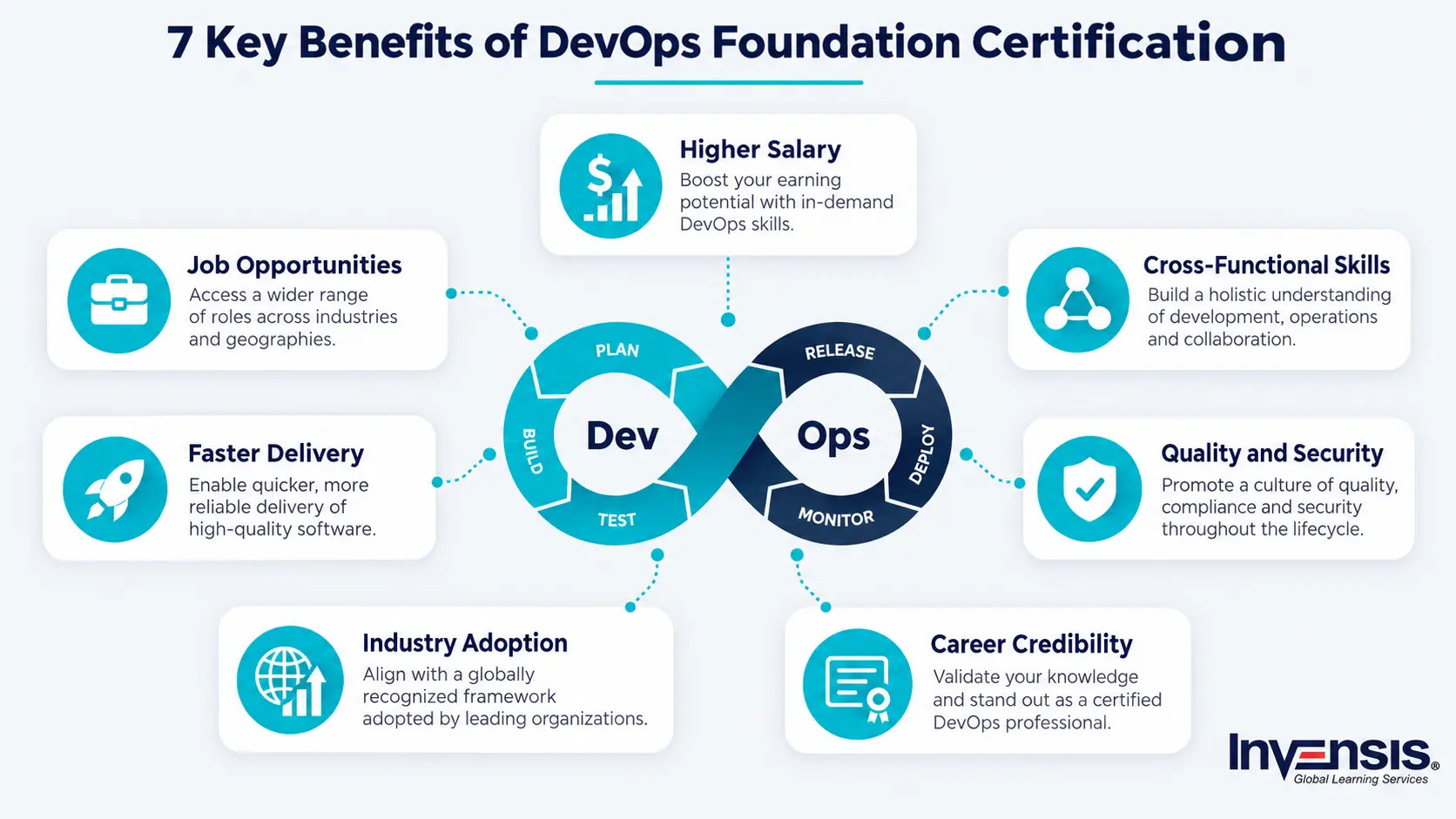
1. Higher Salary Potential
DevOps professionals command strong compensation. According to Salary.com, the average DevOps engineer salary in the United States is $134,599 per year as of 2026. Certified professionals typically earn 20 to 30% more than their non-certified peers in traditional IT roles.
For a detailed breakdown by experience level and region, see the full DevOps Foundation salary guide.
2. Stronger Job Opportunities
Major employers including Amazon, Microsoft, Google, Oracle, and Accenture actively hire DevOps-certified professionals. The certification opens doors to roles such as DevOps engineer, site reliability engineer (SRE), release manager, automation architect, and cloud infrastructure engineer. DevOps skills are in demand across finance, healthcare, retail, and technology sectors.
3. Broader Knowledge and Cross-Functional Skills
The DevOps Foundation curriculum covers Agile, Lean, and IT service management alongside core DevOps practices. This cross-functional knowledge helps engineers and developers move beyond siloed roles into positions that span development, operations, testing, and security. Mastering the key DevOps skills covered in this certification makes professionals versatile contributors who can collaborate across teams.
4. Shorter Production Cycles and Faster Delivery
One of the core principles taught in DevOps Foundation is the First Way: flow. By removing silos between development and operations, organizations shorten their production cycles significantly. The DORA research program shows that elite-performing teams achieve lead times of under one day from code commit to production deployment. Professionals who understand CI/CD pipelines, automated testing, and deployment strategies contribute directly to this speed.
5. Improved Product Quality and Security
DevOps practices embed quality and security throughout the development lifecycle rather than treating them as afterthoughts. Automated testing, continuous monitoring, and infrastructure as code reduce human error and deployment failures. Elite-performing DevOps teams maintain change failure rates near 5%, compared to roughly 40% for low performers according to Google Cloud's DORA research. DevOps Foundation teaches these quality-driven principles from the ground up.
6. Industry-Wide DevOps Adoption
DevOps is no longer optional for competitive organizations. Over 80% of organizations now practice DevOps, and the global DevOps market was valued at $10.46 billion in 2024, growing at a compound annual growth rate of 10.82% according to industry analysts. Companies across every major sector are hiring certified DevOps professionals to lead transformation initiatives. Earning the certification now positions you to meet this sustained demand.
7. Professional Credibility and Career Growth
The DevOps Foundation credential, backed by PeopleCert and the DevOps Institute, carries global recognition. It serves as the entry point to advanced certifications such as DevOps Leader, Site Reliability Engineering (SRE) Foundation, and DevSecOps Foundation. Having this credential on your resume signals to employers that you have verified, structured knowledge of DevOps rather than informal experience alone.
DevOps Foundation Exam at a Glance
|
Detail |
Value |
|
Questions |
40 multiple-choice |
|
Duration |
60 minutes |
|
Passing score |
65% (26 of 40) |
|
Format |
Open book |
|
Prerequisites |
None |
|
Delivery |
Web-based (PeopleCert online proctoring) |
|
Languages |
English, Chinese, French, German, Polish, Spanish |
|
Validity |
3 years (renewable via 60 CPD points) |
Who Should Pursue DevOps Foundation Certification?
DevOps Foundation is designed for a broad audience. The DevOps Institute lists the following target roles: IT business management, developers, operations staff, QA and testing professionals, consultants, engineers, architects, administrators, integrators, tool providers, and stakeholders. No prior DevOps experience is required, making it an ideal starting point for professionals transitioning from traditional IT, development, or project management roles.
Once certified, reviewing common interview questions can strengthen your job applications and help you prepare for technical screenings.
Enroll in certification training to gain structured, instructor-led preparation covering all eight exam topics with hands-on exercises.
Conclusion
DevOps Foundation certification benefits span salary growth, expanded job access, cross-functional expertise, and global professional recognition. With DevOps adoption exceeding 80% of organizations worldwide and the market growing steadily, this entry-level credential from the DevOps Institute validates the skills employers actively seek. Whether you are an IT professional, developer, or operations engineer, earning this certification in 2026 is a practical step toward a stronger career in DevOps.
Frequently Asked Questions
Is DevOps Foundation certification worth it in 2026?
Yes. DevOps Foundation proves foundational knowledge of DevOps principles, practices, and culture. With over 80% of organizations practicing DevOps and certified professionals earning 20 to 30% more than non-certified peers, the return on investment is strong for IT professionals at any level.
What are the prerequisites for DevOps Foundation certification?
There are no formal prerequisites. The DevOps Institute and PeopleCert require no specific education, work experience, or prior certification. Familiarity with basic IT concepts is helpful but not mandatory.
Is the DevOps Foundation exam open book?
Yes. The DevOps Foundation exam is open book. You may reference materials during the 60-minute, 40-question exam. A passing score of 65% (26 correct answers) is required.
How long is DevOps Foundation certification valid?
The certification is valid for three years from the date of issue. Renewal requires earning 60 CPD points through PeopleCert's continuing professional development program or enrolling in a different course from the same product suite.
What jobs can I get with DevOps Foundation certification?
Common roles include DevOps engineer, site reliability engineer, release manager, automation architect, cloud infrastructure engineer, and build/release engineer. The certification also strengthens applications for IT operations, QA, and software development positions that value DevOps knowledge.
Can I take the DevOps Foundation exam without training?
Yes. The DevOps Foundation exam has no mandatory training requirement. You can register directly through PeopleCert and sit the exam after self-study. However, attending an authorized training course improves your understanding of the eight exam topics and increases your chances of passing on the first attempt.