Lean Six Sigma Black Belt certification benefits professionals by validating advanced expertise in statistical analysis, DMAIC methodology, and process improvement leadership. Certified Black Belts lead complex quality improvement projects, mentor Green Belt teams, and drive measurable organizational results. In 2026, the LSSBB credential remains one of the most valued in quality management, with certified professionals earning significantly higher salaries and qualifying for senior leadership roles across manufacturing, healthcare, finance, and technology.
What Does a Lean Six Sigma Black Belt Professional Do?
A Lean Six Sigma Black Belt is an expert-level practitioner who leads cross-functional improvement projects using the DMAIC (Define, Measure, Analyze, Improve, Control) framework. Black Belts apply advanced statistical tools to identify root causes of defects, reduce process variation, and eliminate waste. They also coach and mentor Green Belt professionals, manage project timelines and budgets, and present data-driven recommendations to senior leadership.
The IASSC Certified Lean Six Sigma Black Belt (ICBB) credential, governed by the International Association for Six Sigma Certification (IASSC) through PeopleCert, is one of the most recognized certifications in this space. The key Black Belt vs Green Belt distinction is the Black Belt's ability to lead full-scale projects independently and apply advanced analytical methods at the highest cognitive levels.
Why Pursue LSSBB Certification in 2026?
Organizations across industries continue to prioritize operational efficiency and data-driven decision making. Black Belt certified professionals fill this need by leading transformation programs that reduce costs, improve quality, and increase customer satisfaction. The certification signals to employers that you have mastered both the technical and leadership dimensions of Lean Six Sigma, making it a strong differentiator in a competitive job market.
Top Benefits of Lean Six Sigma Black Belt Certification
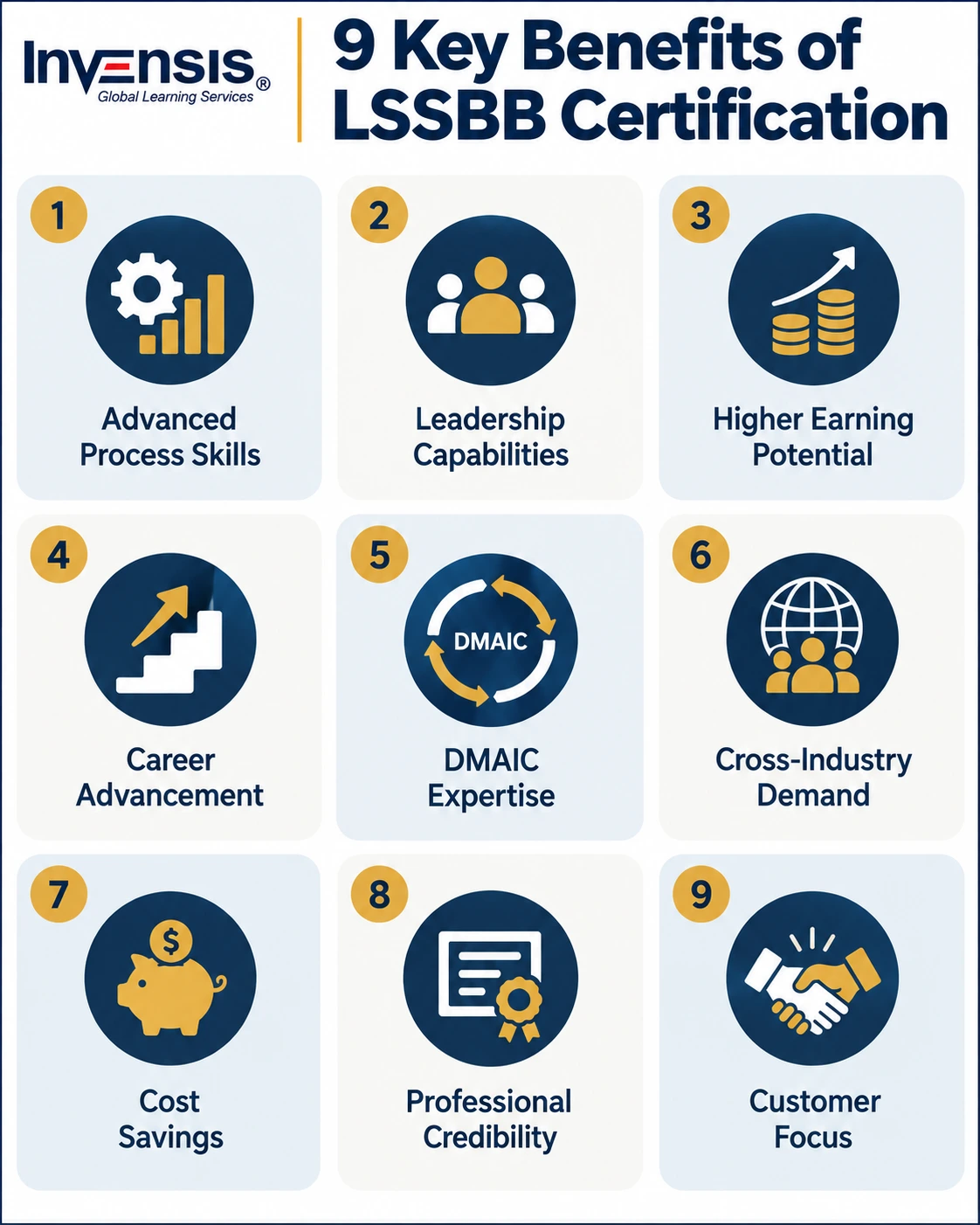
1. Advanced Process Improvement Skills
Black Belt training equips you with a comprehensive skill set in statistical process control, hypothesis testing, regression analysis, design of experiments (DOE), and failure mode analysis. These skills go beyond basic quality tools and enable you to tackle complex, multi-variable problems that Green Belt professionals cannot address independently.
Specific capabilities gained through LSSBB certification include:
-
Developing and analyzing advanced process maps
-
Applying statistical software (such as Minitab) for data analysis
-
Designing and running experiments to optimize processes
-
Evaluating measurement systems and data collection procedures
-
Implementing control plans to sustain improvements
2. Leadership and Team Management Capabilities
LSSBB certification prepares you to lead project teams, assign roles based on team members' strengths, and manage cross-functional initiatives. Black Belts serve as the bridge between executive strategy and operational execution, translating business goals into measurable project outcomes. This combination of technical depth and leadership capability positions you for managerial and director-level roles.
3. Higher Earning Potential
Certified Black Belt professionals command premium salaries. According to Salary.com (October 2026), the average Six Sigma Black Belt salary in the United States is $132,800 per year. ZipRecruiter reports a national average of $129,499 per year as of September 2026 for Lean Six Sigma Black Belts specifically. For a detailed breakdown by role, experience, and region, see the full Black Belt salary guide.
4. Career Advancement Opportunities
LSSBB certification opens doors to senior roles such as Continuous Improvement Director, Quality Assurance Manager, Operations Director, and Senior Business Process Analyst. Professionals who hold a Green Belt can move from team contributor to project lead, while Black Belts can further advance to Master Black Belt or executive positions. Explore the full Lean Six Sigma career path for a complete roadmap of progression options.
5. Deep DMAIC Methodology Expertise
The IASSC Black Belt Body of Knowledge covers all five DMAIC phases at the highest cognitive level (Bloom's Taxonomy level: Create). This means certified professionals can not only apply DMAIC tools but also design new approaches, evaluate competing solutions, and create original frameworks for unique business challenges. The PeopleCert Syllabus (Version 1.0, June 2021) allocates the heaviest exam weight to the Analyze phase (26.5%), followed by Control (22.0%) and Measure (21.5%).
6. Cross-Industry Demand
Lean Six Sigma Black Belt skills transfer across virtually every industry. Manufacturing, healthcare, financial services, technology, logistics, government, and defense sectors all employ Black Belt professionals to drive operational improvements. This versatility means a single certification can support career moves across sectors without requiring additional credentials.
7. Organizational Impact and Cost Savings
Black Belt projects typically deliver substantial financial returns. Organizations report savings through reduced defect rates, shorter cycle times, lower rework costs, and improved resource utilization. For real-world examples of how companies have applied Lean Six Sigma to achieve measurable results, review documented Six Sigma case studies.
8. Professional Credibility and Recognition
The IASSC Black Belt credential is recognized globally as an independent, third-party validation of Lean Six Sigma knowledge. Unlike in-house training certificates, this certification demonstrates that you meet a universal standard set by the governing body, not just a provider's internal benchmark. This credibility carries weight with hiring managers, clients, and industry peers.
9. Stronger Customer Focus
At the Black Belt level, professionals are trained to connect process improvements directly to Voice of the Customer (VOC) requirements and Critical to Quality (CTQ) characteristics. This customer-centric approach ensures that projects deliver outcomes that matter to end users, not just internal efficiency gains. As a senior practitioner, you serve as the link between quality outcomes and customer satisfaction.
Common Job Roles for Black Belt Certified Professionals
LSSBB certification qualifies you for a range of senior roles across industries. The table below lists common positions held by certified professionals:
|
Job Role |
Typical Focus |
|
Six Sigma Black Belt Project Manager |
Leading improvement projects end to end |
|
Continuous Improvement Manager |
Driving ongoing process optimization |
|
Quality Assurance Manager |
Overseeing product and process quality standards |
|
Operations Director |
Managing operational strategy and execution |
|
Business Process Engineer |
Designing and optimizing workflows |
|
Lean Six Sigma Manager |
Managing a portfolio of Six Sigma projects |
|
Senior Quality Engineer |
Applying advanced statistical methods to quality |
|
Business Excellence Manager |
Aligning quality initiatives with business strategy |
How to Earn the IASSC Black Belt Certification
The IASSC Black Belt (ICBB) exam consists of 150 multiple-choice questions with a 4-hour time limit. Candidates must score at least 70% to pass. The exam fee is $450, and it can be taken online through PeopleCert proctoring or at PearsonVue test centers in over 165 countries. There are no formal prerequisites, though real-world experience and structured training are strongly recommended.
The certification is valid for 3 years, after which a 75-question recertification exam ($235) is required to maintain "Current" status. For a complete preparation strategy, see the guide on passing the Black Belt exam.
Conclusion
Lean Six Sigma Black Belt certification benefits professionals in 2026 by combining advanced statistical skills, DMAIC expertise, and leadership capabilities into one globally recognized credential. From higher earning potential and career advancement to cross-industry demand and measurable organizational impact, the LSSBB certification is a strong investment for quality and process improvement professionals. Invensis Learning's LSSBB certification training provides structured preparation to help you earn this credential and advance your career.
Frequently Asked Questions
What is the average salary of a Lean Six Sigma Black Belt in 2026?
According to Salary.com, the average Six Sigma Black Belt salary in the United States is approximately $132,800 per year as of October 2026. Actual earnings vary based on industry, location, experience, and the specific role held.
Does LSSBB certification require work experience or prerequisites?
The IASSC Black Belt exam has no formal prerequisites. You do not need prior work experience, a specific degree, or a lower belt certification to sit for the exam. However, real-world experience in process improvement is strongly recommended to understand the advanced concepts covered.
How long does it take to prepare for the Black Belt exam?
PeopleCert recommends approximately 120 hours of total preparation time for the Black Belt exam. With structured training and dedicated study, most candidates complete preparation within 8 to 12 weeks.
Is Lean Six Sigma Black Belt certification recognized globally?
Yes. The IASSC Black Belt certification is recognized internationally as an independent, third-party validation of Lean Six Sigma knowledge. The exam can be taken online or at PearsonVue centers across 165 countries.
What is the difference between Green Belt and Black Belt certification?
Green Belts work as team members on improvement projects and apply basic to intermediate statistical tools. Black Belts lead entire projects, mentor Green Belts, and use advanced statistical methods including design of experiments and multivariate analysis. The Black Belt exam also tests higher cognitive levels up to Bloom's Taxonomy level of Create.
How long is the LSSBB certification valid?
The IASSC Black Belt certification is valid for 3 years from the date of certification. To maintain "Current" status, you must pass a 75-question recertification exam before the expiration date. Professionals certified before March 1, 2017 are grandfathered and retain "Current" status indefinitely.