Lean Six Sigma Green Belt certification benefits professionals by validating their ability to lead process improvement projects using the DMAIC (Define, Measure, Analyze, Improve, Control) framework. Recognized globally by employers across manufacturing, healthcare, finance, and technology, this credential signals expertise in reducing waste, lowering defect rates, and driving measurable operational gains.
The Green Belt sits at the intermediate level of the Lean Six Sigma hierarchy, bridging foundational Yellow Belt knowledge with advanced Black Belt mastery. Below, we cover eight core advantages of earning this certification and what it means for your career in 2026.
What Is Lean Six Sigma Green Belt Certification?
The Lean Six Sigma Green Belt (LSSGB) is an intermediate credential governed by the International Association for Six Sigma Certification (IASSC), now part of PeopleCert. It validates proficiency in the DMAIC methodology combined with Lean principles for waste elimination.
The IASSC Green Belt exam has 100 multiple-choice questions, a 3-hour time limit, and a minimum 70% passing score. There are no formal education, experience, or training prerequisites, making it accessible to professionals at various career stages. Green Belt holders lead small to mid-scale improvement projects and work within cross-functional teams, often reporting to Black Belts on larger initiatives. For a full overview of progression options, see the Six Sigma career path.
Why Is Green Belt Certification Worth Pursuing in 2026?
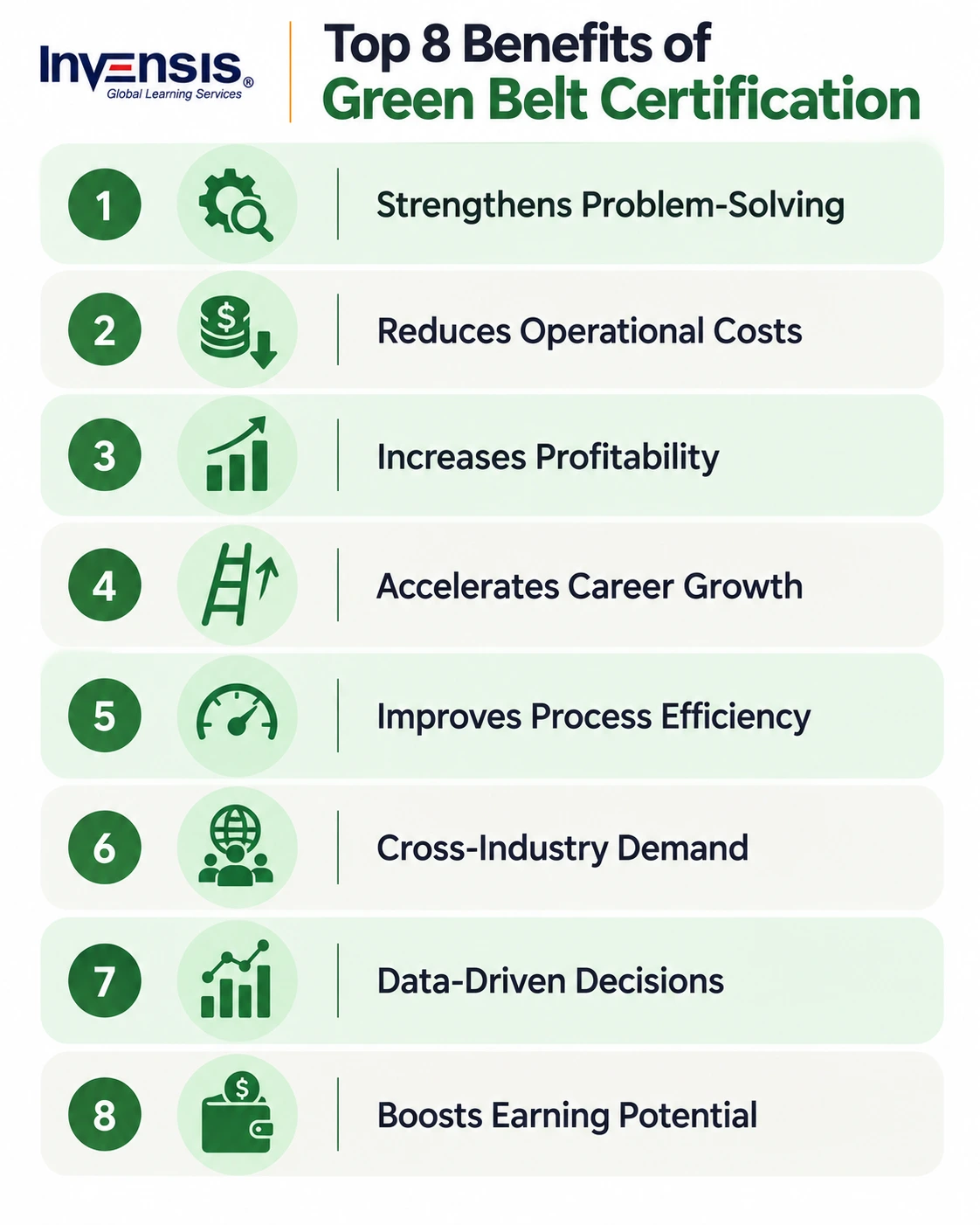
Green Belt certification delivers both personal skill growth and measurable organizational value. These eight benefits explain why the credential continues to attract professionals across roles and sectors.
1. Strengthens Problem-Solving Through DMAIC
The Green Belt curriculum centers on DMAIC, a five-phase method for diagnosing and fixing process problems. You learn to define project scope, measure baseline performance, analyze root causes with statistical tools, implement targeted improvements, and establish controls that sustain gains over time.
This structured approach replaces guesswork with evidence-based decision-making. Certified professionals build proficiency in root cause analysis, hypothesis testing, Pareto analysis, and process mapping, skills that translate directly to operational challenges in any setting.
2. Reduces Operational Costs
Green Belt training teaches you to identify and eliminate the seven wastes recognized in Lean methodology: overproduction, waiting, transport, overprocessing, inventory, motion, and defects. By systematically targeting these waste categories, certified professionals reduce cycle times, lower defect rates, and cut unnecessary spending.
Organizations applying Lean Six Sigma principles consistently report meaningful cost reductions through streamlined processes, fewer rework cycles, and more efficient resource allocation.
3. Increases Organizational Profitability
Cost reduction feeds directly into higher margins. Green Belt holders help organizations streamline production workflows, eliminate bottlenecks, and deliver products or services faster without sacrificing quality. The result is higher throughput at lower cost per unit.
Because Green Belt projects focus on measurable outcomes, each improvement initiative produces quantifiable financial returns, making the certification a strategic investment for both individuals and their employers.
4. Accelerates Career Growth
Employers across industries recognize the Green Belt as proof of structured problem-solving ability and project leadership skills. Certified professionals qualify for roles that carry broader scope and higher responsibility, including:
-
Lean Six Sigma Consultant
-
Quality Engineer
-
Process Improvement Manager
-
Operations Manager
-
Continuous Improvement Manager
-
Process Engineer
-
Business Process Analyst
-
Reliability Engineer
-
Project Manager
-
Quality Systems Manager
Preparing for common Six Sigma interviews can help you convert this credential into your next role.
5. Improves Process Efficiency
Green Belt professionals apply statistical process control, value stream mapping, and 5S techniques to identify bottlenecks and non-value-added steps. The goal is maximizing output while minimizing time, materials, and effort.
These efficiency gains compound over time. As improved processes become standard operating procedure, organizations see sustained reductions in lead times, inventory carrying costs, and customer complaints.
6. Meets Demand Across Industries
Lean Six Sigma Green Belt certification is not limited to manufacturing. Healthcare systems use it to reduce patient wait times, financial institutions apply it to streamline compliance workflows, and technology companies leverage it to optimize software delivery pipelines.
Job postings requiring Lean Six Sigma skills grew roughly 33% between 2020 and 2024, and Green Belt remains one of the most in-demand Six Sigma credentials in 2026. This cross-industry applicability means certified professionals can transition between sectors without losing the value of their credential.
7. Builds Data-Driven Decision-Making Skills
Green Belt training covers foundational statistical analysis, including control charts, capability analysis, and regression. These tools enable you to move beyond intuition and make decisions backed by measured data.
Data literacy is increasingly valued across all business functions. Professionals who can translate process data into actionable insights hold a competitive advantage whether they work in quality assurance, supply chain management, or strategic planning.
8. Boosts Earning Potential
Green Belt holders consistently earn more than their non-certified peers. Salary.com's 2025 data places the average U.S. salary for Lean Six Sigma Green Belt professionals at approximately $118,330 per year, with higher figures in industries like healthcare and financial services. For a detailed breakdown by role and region, explore the full Green Belt salary data.
How to Get Green Belt Certified
The path to Green Belt certification involves three steps. First, build foundational knowledge of Lean Six Sigma principles through a structured training program. Second, study the IASSC Green Belt Body of Knowledge, which covers all five DMAIC phases at up to the Evaluate level of Bloom's Taxonomy. Third, pass the IASSC certification exam (100 questions, 180 minutes, 70% minimum score, $350 exam fee).
For a step-by-step preparation strategy, review tips on Green Belt exam prep. To decide which belt level fits your goals, compare the Black Belt vs Green Belt.
Conclusion
Lean Six Sigma Green Belt certification benefits professionals by combining practical DMAIC skills with a globally recognized credential that employers actively seek. From reducing operational costs and improving efficiency to unlocking higher salaries and cross-industry career mobility, the certification delivers measurable returns for both individuals and organizations.
As process improvement and data-driven decision-making become standard expectations across industries in 2026, the Green Belt credential positions you to lead meaningful change. Enroll in Invensis Learning's Green Belt training to build the skills that set you apart.
FAQs on Lean Six Sigma Green Belt Certification Benefits
1. How valuable is a Lean Six Sigma Green Belt certification?
A Green Belt certification is highly valued because it validates practical skills in process improvement and data analysis. It is recognized across manufacturing, healthcare, finance, IT, and logistics, giving certified professionals a portable credential that employers actively seek for quality and operations roles.
2. What is the passing score for the IASSC Green Belt exam?
The IASSC Lean Six Sigma Green Belt exam requires a minimum score of 70%. The exam consists of 100 scored multiple-choice and true/false questions with a 3-hour time limit. Up to 10 additional unscored pretest questions may appear on some exam forms.
3. Are there prerequisites for Green Belt certification?
The IASSC Green Belt exam has no formal prerequisites. No specific education, work experience, or prior training is required. However, IASSC recommends training through a qualified institution and real-world application experience to improve your chances of passing.
4. How long does it take to earn Green Belt certification?
Most professionals complete Green Belt training in 4 to 6 weeks of part-time study or through an intensive program spanning 4 to 5 days of full-time instruction. Preparation time varies based on prior familiarity with statistical concepts and process improvement principles.
5. What industries hire Green Belt certified professionals?
Green Belt professionals work across manufacturing, healthcare, banking and financial services, information technology, logistics, telecommunications, government, and consulting. Any industry that relies on repeatable processes and seeks to reduce waste or improve quality values Lean Six Sigma expertise.
6. How long is the Green Belt certification valid?
IASSC Green Belt certification remains in Current status for 3 years from the date of certification. After that, you must pass a 50-question recertification exam ($175 fee, 1.5-hour time limit, 70% passing score) to maintain your status. Professionals certified before March 1, 2017 are grandfathered and remain current indefinitely.