In today's fast-paced era, the concept of "change" is not merely a fact of life but an essential aspect of survival. Developments and priorities within an organization change so quickly; thus, understanding the definition of change management minimizes the risk of falling behind in updating skills.
Whether installing new software, adapting to customer requirements, or restructuring the business for efficiency, a business needs to understand why organizational change is essential.
Organizational Change Management – Definition!
The organizational change management definition refers to changes in business processes that can significantly impact the entire organization. Various factors could lead to change within the organization, including company goals, service operations, and other aspects.
Organizational change management mainly focuses on improving employee productivity and enhancing sales. Ultimately, change management helps employees adapt to and implement change in their day-to-day work.
Why Does Organizational Change Management Matter?
Organizational change management is a necessity for every business in the present scenario. Every now and then, new employees are hired, and a few leave the organization. New departments emerge as the company grows, and new technologies and strategies are gradually adopted to stay ahead in the competitive business landscape. To successfully implement the change management process in an organization, it is advisable to inform all employees about the change and how it will affect them.
Types of Organizational Change Management
Before you develop any change management plan, determine the type of change plan you wish to have that yields the best possible results.
Here is a diagram showing the types of organizational change strategies that companies follow:
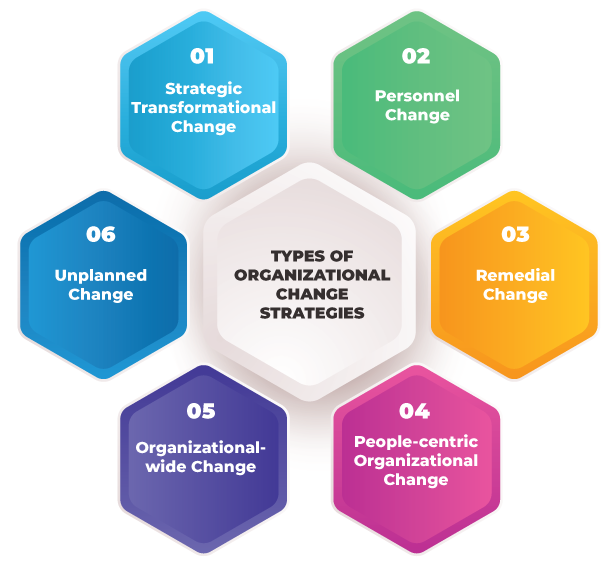
Strategic Transformational Change
Minor changes made to the existing organizational policies would affect certain aspects of the organization but don't redefine the entire business. On the other hand, significant change implementation could transform the organizational function.
Designing an efficient plan to attain the desired goal requires some serious planning. The final transformation could be positive or disastrous, and the entire thing depends on the change strategies prepared.
Personnel Change
Personnel change can happen when organizations face layoffs. The concept of layoffs has created fear and anxiety among the employees. From the organization's point of view, the organization needs to move ahead towards growth and motivate the employees to work through difficult times.
Hiring new employees is indeed a sign of growth, which makes the organization susceptible to changes. Hiring new staff also involves training them as per the organizational requirement. If this change is not handled correctly, it can lead to inefficiency and hampers further organizational growth.

Remedial Change
The concept of remedial change comes into existence when there is a need to address the organization's poor performance. You can customize remedial changes as you come across the issues and incorporating efficient change management strategies would be more effective.
People-centric Organizational Change
People-centric changes mainly focus on hiring new employees or implementing new policies for employees. These changes are mainly prone to emotional responses. The organization should take up the responsibility of preparing the employees for this emotional transition phase and guide the team accordingly.
Organizational Wide Change
The term "organizational-wide change "involves large-scale transformation affecting the entire organizational policies. This change explains how a policy that has been in existence for a long time has become outdated. Employees can easily make out such large-scale changes.
Attaining large-scale changes requires comprehensive planning and communication throughout the process. The result of the change depends on the strategies and the way you implement them.

Unplanned Change
It's difficult to predict unplanned changes within the organization and you need to handle in a systematized way. In case of any security breach or disruption or chaos, implementing unplanned changes can minimize the chances of unplanned risks.
Change Management Models
When change becomes an essential aspect of organizational development, it should adopt appropriate approaches to implement those changes. Implementing effective change management strategies rather than relying on random methods will surely improve your odds of success. That's where the concept of change management models comes in.
Change management models provide best practices and guidelines for organizations, helping them throughout the change management planning and implementation phases. Implementing a suitable change management model for your project/organization would help you collect essential stakeholder data. It also facilitates a change management workflow for implementing the new change.
Top Change Management Models to Consider
There are various change management models, each with a unique approach to better fit the organization's transformation. Let's take a look at the change management models that drive better organizational transformation:
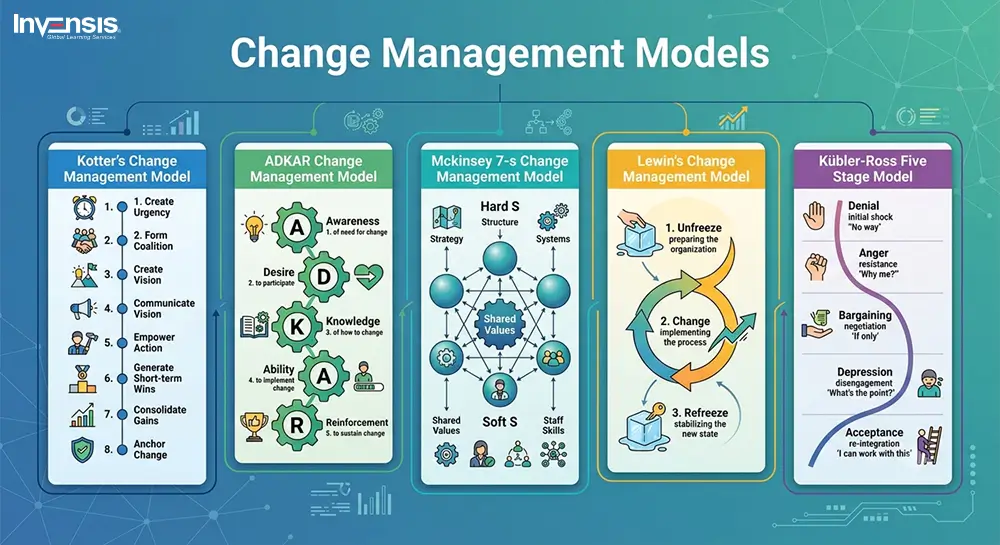
Kotter's Change Management Model
Kotter's change management model is named after Harvard Business School professor, author, and entrepreneur John P. Kotter. This widely accepted model emphasizes change and the people who will be affected by the change.
The model is divided into 8 phases, each focusing on the employee's response to the change.
-
Create urgency - The first step in the process is to create urgency among the people to move towards their planned goals
-
Build the right team - Build a team with suitable skill sets, personalities, and commitment, which would help to drive change within the organization
-
Form the right vision - Create a suitable change vision by considering not just the strategies but also creativity, objectives, and emotional connection
-
Enlist the team - Ensure to get everyone involved in the team onboard to know about their roles
-
Enable the action by removing obstacles - Identify and eliminate the roadblocks for effective change management
-
Generate short term goals - Focus on short-term goals, which in turn would help to attain success without any stress
-
Sustain - Regardless of the challenging things you might come across, never give up during the change management process
-
Incorporate change - Identify the new changes made and help the employees to adjust throughout the process
ADKAR Change Management Model
ADKAR change management model was coined by Jeff Hiatt, the founder of Prosci. This model is used to identify gaps in the process and to suggest relevant training for employees to support successful change management. The process can be broken down into parts to determine where change is necessary and where it is not.
Though the model focuses on business-oriented goals, it is also useful for employees to adapt quickly to the change process. It also provides the capability to identify why changes made are not working as expected and delayed results.
ADKAR model stands for:
-
Awareness - Everyone in the organization is aware of the change
-
Desire - Bring the required change to the team
-
Knowledge - Regarding how to drive change
-
Ability - Ensure that the team members possess all the capability and skills to incorporate change regularly
-
Reinforcement - Continue to work with the employees, even after the change is implemented
Mckinsey 7-s Change Management Model
The McKinsey 7S change management model was developed in the 1980s by consultants at McKinsey & Company. It targets all the business aspects that need to be well defined before implementing the change strategy. The model also includes emotional and practical components essential for the employees to deal with the change quickly.
There are seven components to focus on:
-
Strategy - Change management plan comprising a stepwise structure
-
Structure- The way organization activities are categorized or structured
-
Systems - Resources used to complete the assigned tasks regularly
-
Shared values - Means core values of the organization
-
Style - Manner in which change is implemented
-
Staff - People involved in the change process
-
Skills - Skills that will help implement change
Lewin's Change Management Model
Lewin's change management model is an efficient yet straightforward model that helps us understand the structured change process through various ice block states. Kurt Lewin coined the model's name in the 1950s, and it is one of the most significant change management models to date. It is broken into three smaller and manageable steps:
-
Unfreeze - The initial phase in which the organization must prepare for the change. During this stage, most people resist change, and the organization should explain the need for change to the employees. The main target of this stage is to overcome the team's resistance to the change process.
-
Change - Real change transition occurs at this stage and takes time to complete, as employees need time to adapt to new changes and developments. At this phase, having good leadership, reassurance, and effective communication make the change process easier for the people involved
-
Refreeze - The refreeze phase is where change is accepted and implemented by the people. The organization returns to a stable stage again. People involved in the change process should adopt the change even after the required objectives are met/ achieved. Gradually, employees get confident and comfortable with the changes made to the process
Kübler-Ross Five Stage Model
The Kubler-Ross Five-Stage model was coined after the world-renowned scientist Elisabeth Kübler-Ross. She is also the creator of "Change Curve" and "The Five Stages of Grief."
This model targets employees who are ultimately responsible for the change. It helps individuals to accept the change physically and emotionally. This model can be applied to job loss scenarios, change in work, and less serious health issues. The following stages are associated with this model:
-
Denial - In this phase, employees are unable to accept the news of change. They might come across a sense of shock and numbness as they resist the change and may not want to believe the happenings around them
-
Anger - Once the news of change is accepted, the first reaction is anger. When the employees realize that the change process will affect them, it gets converted into anger
-
Bargaining - This stage entails the best possible solution to avoid ending up with the worst-case scenario
-
Depression - This stage occurs when bargaining is of no worth; employees end up moving into a state of depression with a hopeless mindset. There are various symptoms to observe in the depression stage of a person. Some of them are low motivation, lack of interest or happiness, non-commitment, and low energy
-
Acceptance - When the employees realize that there is no use in fighting for change or being depressed, they may have to accept the change and gradually adapt to it
What is a Change Management Plan?
In the era of digitization, organizations need to assess what's provided to the customers, how processes are implemented, and who is responsible for process improvements. Often, the success of an organization depends on the trial-and-error techniques it implements. Thus, businesses have to be agile in adapting to change to survive in this fast-paced digital era. In this regard, having a change management plan increases the likelihood of successful implementation.
A change management plan is a document that outlines the roles and activities that require greater attention during project execution. The plan also ensures proper control of scope, communication, budget, schedule, and resources. A proper plan minimizes the negative impact of change on the business, stakeholders, and employees.
|
"You need a change management plan because strategy and processes are always perfect in their conception, but as time goes on these elements of business become living, breathing, and changing entities. Change management plans help you remain agile, adapt to challenges along the way, monitor success metrics, and track milestones." - Amy Kauffman, Founder of Strategic Moxie |
How to Write a Change Management Plan?
Change is worth making for a business to reach newer heights; subsequently, it's equally worth investing your time to craft a desirable change management plan. There are various steps involved in creating a suitable change plan for your organization and preparing the employees for the change process.
Define Change
Before taking up any change management step for your organization, recognize what change you need for your business. What would be the result of change and its impact on the employees? What are the important initiatives businesses need to consider to make the changes happen? The answers to these queries will help everyone in the organization to work towards the same goal.
Scope for Change
The scope for change can be due to scheduling, quality, budget, and still more. Ensure to define these reasons clearly in the change management plan. Also, specify when the change activities will be carried out and who will implement them.
Change Management Roles
People involved in change management roles should support the project goals, good communicators, and share organizational developments. They act as change agents for the entire change management plan activities and authorize it. They should be familiar with the change management models and adapt themselves to the change to make the entire change management process smooth.
Communication Plan
Creating a pertinent communication plan is crucial to keep the employees and stakeholders informed regarding the same. During the process, keep all the employees within the ongoing feedback loop and various communication channels. It would be better to be open and honest during the entire change process else; it leads to insecurities amongst the employees.
Change Request Form
The change request form captures the essential data required for the change and analyzes its impact on the entire process. Thus, it is essential to have a change request form for a proper change management process. It also ensures that the change process is implemented smoothly without impediments.
A change request form should be shared with the entire team, as it helps clarify what type of change your organization is undergoing, its impact on your project, and its benefits. Having a change plan without a proper change request form is sure to create chaos in the process.
Key Performance Indicators
The significant advantage of having Key Performance Indicators is that they set milestones toward change objectives. So, ensure you establish a proper plan to measure it, rather than just what you want to measure the project's progress by.
Activity Log
Activity log helps you identify the changes made, requests documented, and keep track of all the other changes, including change management activities for all the employees. This is an easy way to identify to check the progress of the project.
Must-Known Change Management Plan Activities
Having a successful change management process within the organization is almost impossible without involving the employees. It is essential to involve all employees in the adoption of the change management plan to accomplish the change. Some will embrace the change, others will resist, and a few will be upset by it.
Here are a few essential change management plan activities to consider while you implement the one for your organization:
Identification
At the initial phase, categorize the employees affected by the change process and design a different communication approach for each employee category.
Engage
Engaging employees throughout the process is indeed very helpful in advancing organizational change management. Using apt games, exercises, and simulations to demonstrate change will help tackle any resistance and emotional barriers to the process.
Set Goals
To easily track progress and manage change more effectively, split the entire transition into activities, phases, and stages. This helps create milestones that the team can celebrate.
Conclusion
Change is not something organizations can avoid, it is something they have to manage well. From understanding the different types of organizational change to applying proven models like Kotter's 8-Step Process, ADKAR, McKinsey 7-S, Lewin's model, or the Kübler-Ross framework, having the right approach in place makes the difference between a smooth transition and a disruptive one.
A strong change management plan, backed by clear roles, open communication, and measurable KPIs, gives your organization the structure it needs to adapt with confidence rather than resistance. But building that capability takes more than reading about frameworks; it takes the skills to apply them in real business situations.
If you are looking to build or strengthen your change management expertise, Invensis Learning's Change Management Certification training can help you master these models and lead organizational change with confidence. Gain the practical skills to plan, communicate, and drive change initiatives that stick, and position yourself as the professional your organization turns to when transformation is on the horizon.
FAQs
1. What is the definition of organizational change management?
Organizational change management refers to the structured approach businesses take to manage changes in processes, systems, or strategies that significantly impact the entire organization. It focuses on helping employees adapt to and implement change in their day-to-day work while minimizing disruption to productivity and operations.
2. What are the main types of organizational change?
The main types include strategic transformational change, personnel change, remedial change, people-centric change, organizational-wide change, and unplanned change. Each type requires a different approach, since a minor policy adjustment demands far less planning than a large-scale transformation or an unplanned event like a security breach.
3. What is the most effective change management model?
There is no single "best" model, since each one suits different situations. Kotter's 8-Step Process works well for large-scale organizational transformation, ADKAR is effective for individual-level adoption, the McKinsey 7-S model suits complex structural changes, and Lewin's model offers a simpler framework for smaller, more contained changes.
4. What should a change management plan include?
A strong change management plan should define the change itself, its scope, the roles and responsibilities of change agents, a communication plan, a change request form, key performance indicators, and an activity log to track progress. Together, these elements ensure proper control over scope, budget, schedule, and stakeholder communication throughout the change.
5. Why do employees resist change?
Employee resistance often stems from fear of the unknown, concerns about job security, or a lack of clear communication about how the change will affect them. Models like the Kübler-Ross Five Stage Model help explain this resistance as an emotional process, moving through denial, anger, bargaining, and depression before employees reach acceptance.
6. How long does organizational change take to implement successfully?
There is no fixed timeline, since it depends on the scale of the change and the model being used. For example, Lewin's model treats change as a three-stage process (unfreeze, change, refreeze), where the refreeze stage alone can take time, since employees need to grow comfortable and confident with the new way of working before the change is considered fully adopted.
7. Who should be responsible for managing change within an organization?
Successful change management typically requires designated change agents or a change management team who are good communicators, understand the chosen change model, and can guide the organization through each phase of the transition. Having a certified change management professional on the team, or partnering with one, can significantly improve the odds of a smooth transition.