DevOps has modified the IT industry by improving how teams operate and cooperate in the method chain and workflow. In fact, according to a recent survey, 63% of companies reported experience improvement in the quality of their software deployments after adopting DevOps.
By now, most companies will have completed some stages of DevOps implementation in their software development process. However, while there are several companies that are receiving some benefits of adopting DevOps, many companies still haven’t unlocked its full potential.
The most common error around DevOps selection continues to remain, i.e,
‘Getting it as a journey or a goal’.
This is where the ‘DevOps Maturity Model’ comes in. Read the article below to get an in-depth understanding of what the DevOps Maturity model is and how it can help you.
Understanding DevOps Maturity
By description, DevOps Maturity is defined as a pattern that determines an organization’s position in the DevOps course along with deciding what more to be performed to obtain the aspired outcomes.
Understanding that the adoption of DevOps ‘as a continuous journey, not a destination’ is crucial to managing DevOps maturity.
The DevOps maturity design manages growth through constant training from both sides and organizational aspects. More the aptitudes and skills, more will be the capacity to handle problems of scale and complexities.
The Abilities Required For DevOps Maturity
1. Culture and Strategy
DevOps has to be recognized as a culture-driven program that draws different teams, pushing them towards a mutual goal. Transition to DevOps involves a change in the organization’s working culture, supported by a set of methods and frameworks. So, that requires proper planning and comprehensive procedure.
2. Automation
Automation is code to continuous delivery and continuous deployment tools in the DevOps method. By automating monotonous tasks, the automation process helps Development, experimentation and production in a DevOps series, thus preserving time and improving resource efficiency.
3. Structure and Process
Modern-day IT functioning is process-oriented and includes the overall steps of the Software Development Life Cycle (SDLC). This has developed in a DevOps context, where all platforms are a set of plans in line with corporate policies and business intentions.
4. Collaboration and Sharing
This is the most significant aspect of DevOps culture. Collaboration and sharing are essential to DevOps and teams in the same location, or a different location will need to join tools and resources towards reaching common aims and objectives.
According to a Forbes study, organizations usually find themselves in one of the following steps as a part of their DevOps course:
- Unconscious inadequacy: Organizations neglect to learn DevOps and its benefits
- Conscious incompetence: Organizations still see siloed methods even after 12-18 months of DevOps course by some industrialization
- Conscious competence: Following four years of DevOps course and reliable automation, organizations concentrate on collaboration over teams and streamline distribution mechanism
- Unconscious skill: Here, organizations are all hovered with structured frameworks, in-depth collaboration, the actual method for efficient sharing
What Does a DevOps Maturity Model Entail?
A complete DevOps maturity model defines DevOps maturity in three ways:
- Evaluation of the modern state of skills
- Identifying measures of growth
- Outlining steps to reach wanted DevOps aims
In line with these three levels, the DevOps maturity block supports maturity in developing, deploying and testing stages across the form, and data and infrastructure levels:
1. DevOps Maturity for Application
This defines DevOps maturity by the security in code development from Development to the Production stage. Achieving this entails having builds, tests, code coverage, security scans and monitoring as automated elements of the deployment pipeline.
2. DevOps Maturity by Data
This defines DevOps maturity by the ability to take courses to automate changes to data and verify functionality automatically, by DataOps.
3. DevOps Maturity by Infrastructure
This defines DevOps maturity by the capacity to ease infrastructure handling skills around automation, streamlining, and facilitating self-service to store environments, with other businesses.
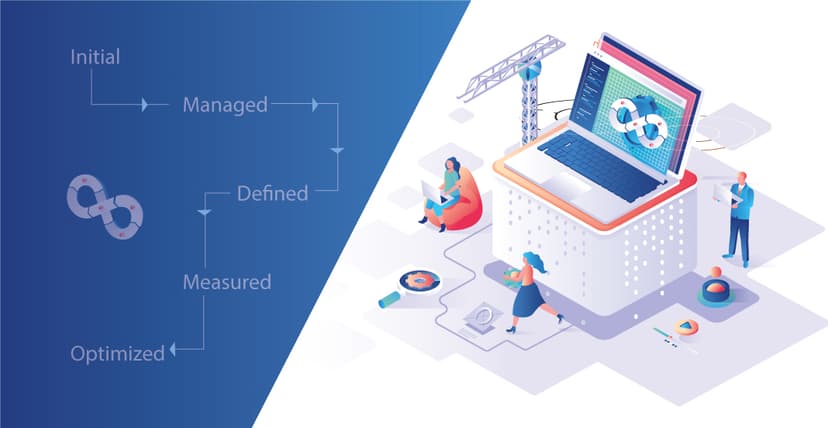
Summarized, DevOps Maturity model includes five transformation stages:
1. Stage-1: Initial
A traditional setting with Dev and Ops departed is handled.
2. Stage-2: Managed
Origin of innovation mindset concentrated on activity in Dev and initial automation in Ops, with stress on collaboration.
3. Stage-3: Defined
Organization-wide change begins with established rules and secured automation.
4. Stage-4: Measured
A better understanding of purpose and automation, accompanied by continuous Development.
5. Stage-5: Optimized
Actions are visible, team gaps leave, and employees get credit.
While these 5 steps make a whole DevOps maturity model, enterprises must keep checking their maturity at every stage, and eventually recognize critical areas to address to achieve enterprise-wide DevOps maturity.
What to Include in a DevOps Maturity Model?
There are several parameters to be held at every step of the DevOps Maturity Model to establish an organization’s level of DevOps maturity. These projects ideally define the way the organization is developing in its DevOps journey. They are:
- Number of finished designs and the discharge frequency should preferably high result in ROI
- Percentage of secure deployments should have the edge over broken ones
- Mean Time To Recovery (MTTR) from a fantastic incident/failure from the time of experience, should be zero or as low as feasible
- Lead generation, from Development of code to deployment in return, should be quite
- Deployment number of limiting the frequency of new code deployments
The stage-wise method and the above parameters represent an organization’s DevOps maturity success.
DevOps Maturity Connected to Security
DevOps maturity is right linked to DevOps security. As organizations grow in DevOps journey, the competitive edge becomes a vital market calling for quicker release cycles, and digital discovery demands a strong pitch.
This is where the test of security starts growing more severe, and which is why DevOps culture calls for a rethinking of security systems.
Ultimately, organizations will have to address security as an essential part of their DevOps method and take it closer to all application development platforms.
DevOps specialists work with security staff for new security integration at the maturity level over all parts of the Software Development Lifecycle.
This can occur through active DevSecOps implementation. Solutions like Containerization can also attend to any extent in labeling issues continuously by checking the exposed resources.
Business Advantages of DevOps Maturity
Providing a full picture of an organization’s DevOps position, the DevOps maturity guide presents a wide variety of business advantages:
- Faster flexibility to develop
- Ability to tap events
- Identifying areas of fulfillment
- Increased scalability
- Operational performance
- Increased delivery activities
- Enhanced quality
More such goods are part of the DevOps Maturity model that provides you with the ability to observe the full DevOps potential.
In Conclusion
DevOps Maturity improves your overall organizational workflow, improves release rate and reduces time-to-market, thus providing you with a sharp edge. But, achieving DevOps maturity is certainly not an easy task. It takes top-bottom commitment from the management to achieve the business objectives. Individuals and enterprise teams need to get trained in industry-recognized DevOps Courses to gain a comprehensive understanding of DevOps best practices and how to utilize the same to achieve DevOps maturity.
Some of the popular Devops Certifications are:
- DevOps Foundation Certification
- Observability Foundation Certification
- DevOps Master Certification
- DevOps Professional Certification
- DevOps Continuous Delivery Architecture Certification