Streamlining an organization's approach to business activities offers many benefits, including cost reductions, increased efficiency, and better resource management. When a business is looking to introduce better management methods, they needs to tackle concerns at both a granular and bird's eye level. This can be enabled by introducing program management plans and methods.
Program management and project management are two different but interrelated processes. Project management handles the individual undertakings of a business to generate revenue and meet other objectives. However, program management is broader in terms and covers multiple project undertakings by an organization.
The goal of program management is to ensure the organization can handle multiple projects with maximum returns and minimal wastage. Program management explains how projects need to be prioritized based on benefits to the organization and stakeholders, interdependencies between projects, and resource needs. With 9.9% of every dollar made by an organization lost to poor project management, introducing a program management system could be the start of better business practices.
What Is A Program Management Plan?
A program management plan works as the blueprint for all information regarding the changes introduced by the new management practice. The document offers an in-depth explanation regarding processes, rules for execution, and general policies. It is a culmination of multiple documents. All stakeholders are encouraged to contribute to this plan actively.
Purpose Of The Program Management Plan
This dynamic document manages all processes and activities. This formal, detailed manual introduces management, control, and execution guidelines to ensure organizations stay on track. The plan contains various components that contribute to the overall success of all business activities. It also includes the implementation of budgets, timelines, resources, and strategies. A program management plan's dynamic nature comes from its ability to be edited and adapted to new decisions. As new information is gathered by executing the plan's various aspects, alterations to the plan are made. This ensures business objectives are the number one priority of the plan's decisions no matter what internal or external circumstances arise.

Components Of A Program Management Plan
A number of documents and collaterals form the base for a program management plan. This includes but is not limited to information from senior leadership, case studies, internal analysis and auditing reports, governing bodies, project/program scopes, sponsors, and other stakeholders.
A framework or preliminary plan is made to act as a mockup and to get a clear understanding of key factors like costs and benefits. The document is then submitted to review for further improvement. As the feedback and the new information surface, the plan evolves to fit the same. Before concluding the program, final changes to implement are decided upon with a detailed report. The final stage is to create a repository of important business documentation for later reference by the organization.
The format of a program management plan must include:
- A comprehensive program definition that explains the scope of the project, strategies implemented, and a detailed overview of the plan
- A deep dive into the resources needed to ensure the program's success
- Information regarding how business objectives will be met and managed
- A detailed roadmap of the flow within the program
- Rules and regulations to maintain program governance
- Maps detailing the organization's hierarchical structures
- Frameworks for planning elements within the program, including contingency plans
- Frameworks for the management of control elements within the program flow
- Execution pathways and details, including managing project components, introducing timelines and schedules, communication flow, and how activities need to be carried out
- Instructions and suggestions to ensure a smooth transition into the program management plan
- Regulations on how projects must be concluded
- Information regarding all critical deliverables in both short and long-term capacities
- Comprehensive information regarding variable factors that could be risks or assumptions to be considered
A Sample Program Management Plan
The program management plan begins with a program overview. This streamlines the vision for the plan, the value in terms of reaching business goals, and often a program scope. It then moves into schedule management. This covers all aspects of implementing and managing time frames, along with organizational roles and their responsibilities. The change management section provides clear details on how the new systems and regulations introduced in the plan can be implemented. It covers the actions to be implemented and how to monitor decision-making components.
The communications management section contains all information regarding chains of command along with the scope and required frequency of interactions. To define resource requirements, cost management, and staffing management, it defines detailed budgets, staff allocation, timeframes, and monitoring guidelines. A procurement management heading explains how external stakeholders, such as vendors, are to be maintained and managed. The plan's final three headings cover how to manage internal stakeholders, how to approach risks, and how overall maintenance of goals and activities will be handled.
Risk management specifies how any perceivable threats are to be handled by an organization. It details who handles these issues and offers assessment mechanisms. Stakeholder management identifies all individuals and entities that are affected by meeting business goals and objectives. A system is implemented to ensure that all their feedback is carefully considered when making changes or additions to the plan. Finally, Program Governance outlines the ethical aspect of the plan. This closing section outlines clear-cut reporting flows, along with mandatory rules and regulations to be followed.
Program management plans also include management tools like Gantt charts, Risk logs, Work Breakdown structures, Milestone charts, and Change control forms.
Program Management Best Practices
Rapidly developing technology offers ever-growing frameworks that can be incorporated into business practices. With the best program management practices, you will be able to adapt to unexpected changes and developments. Two core management methods that produce positive results are;
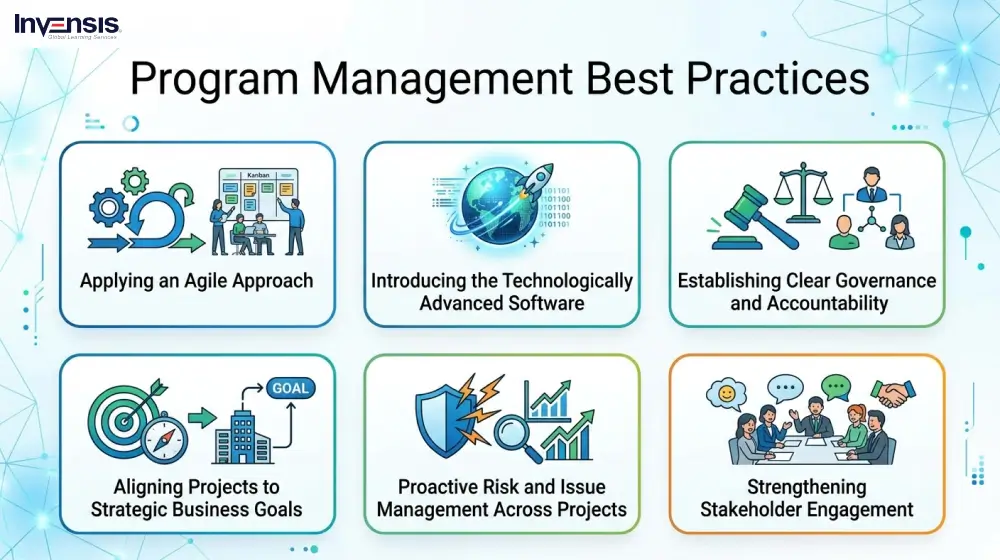
Applying an Agile Approach
Introducing further flexibility into the work environment will assist with development and adaptation. Agile methods offer program managers an opportunity to increase the value deduction from their decisions. This happens through:
-
Continuous result delivery in smaller pieces - Sharing feedback and insight ensures consistent feedback, allowing for problems to be sifted out as soon as they arise. This also allows for causes of problems to be detected with pinpoint accuracy and addressed without having to use failed results as a measure
-
Introducing more frequent and regular meetings - Consistent communication patterns allow for ideas to be exchanged and developed. Employees and stakeholders alike can offer their perspectives on business activities, and new ideas could be exactly what the organization needs.
-
Preparation for changes that occur unexpectedly - Flexibility is the core of agile methods. Prior planning for best case, worst case, and/or any other case in between allows organizations to adapt as needed. Introducing many adaptation methods prevents last-minute decision-making that could implode budgets, resources, timeframes, and stakeholders' expectations.
Introducing the More Technologically Advanced Software and Tools
Program management has become a point of concern for all organizations. Introducing software management solutions should be a priority for companies seeking more diverse yet accurate data and insights. With the market saturated with document-sharing tools such as Dropbox, editing tools such as Google Docs, task-management software like Trello, and communication apps such as Zoom, picking the right cocktail of software is key.
Project managers need to spend time assessing their organization's requirements. Asking what real-time collaboration requirements are, whether any project management or task management tools are required, and the extent to which communication features need to be developed is essential. After this, a testing period is implemented to assess the success of the decision and, finally, training is introduced as required.
Establishing Clear Governance and Accountability
A program with no clear ownership quickly becomes a program with no clear direction. Defining who is accountable for what, from the program manager down to individual project leads, ensures decisions are made quickly and nothing falls through the cracks between projects.
-
Assigning a single point of accountability - Every workstream within the program should have one clearly identified owner responsible for outcomes, rather than shared or ambiguous ownership that slows down decision-making
-
Defining escalation paths in advance - Knowing who to go to when an issue exceeds a project manager's authority prevents delays and keeps problems from getting stuck at the wrong level
-
Documenting decision-making authority - Clarifying which decisions can be made independently at the project level and which require program-level sign-off keeps the plan moving without unnecessary bottlenecks
Aligning Projects to Strategic Business Goals
Not every project within a program contributes equally to business objectives. Regularly reassessing how individual projects ladder up to the program's overarching goals ensures resources are not wasted on initiatives that no longer serve the organization's priorities.
-
Prioritizing based on business value - Ranking projects by their impact on strategic objectives helps allocate limited resources where they matter most
-
Reviewing alignment at regular intervals - Business priorities shift, and a project that made sense at the program's outset may need to be re-scoped or deprioritized as circumstances change
-
Maintaining traceability between projects and goals - Keeping a clear line of sight from each project deliverable back to a business objective makes it easier to justify decisions to stakeholders and sponsors
Proactive Risk and Issue Management Across Projects
Risks within a program rarely stay contained to a single project. A risk in one project can easily cascade into delays or budget overruns in another, which makes program-level risk visibility essential.
-
Maintaining a centralized risk register - Tracking risks across all projects in one place makes interdependencies and cumulative impact easier to spot early
-
Conducting regular cross-project risk reviews - Bringing project leads together periodically to discuss emerging risks helps catch issues before they escalate into program-wide problems
-
Building in contingency at the program level - Reserving buffer time, budget, or resources at the program level, not just within individual projects, provides flexibility to absorb unexpected setbacks without derailing the entire program
Strengthening Stakeholder Engagement
Programs typically involve a wider and more diverse group of stakeholders than individual projects, spanning executives, sponsors, project teams, and external partners. Consistent, tailored engagement keeps everyone informed and invested in the program's success.
-
Segmenting stakeholders by influence and interest - Not every stakeholder needs the same level of detail or frequency of updates, so tailoring communication accordingly keeps engagement efficient and relevant
-
Creating consistent reporting cadences - Regular status updates, whether weekly, biweekly, or monthly, build trust and reduce the need for ad hoc check-ins
-
Closing the feedback loop - Actively showing stakeholders how their input shaped program decisions encourages continued engagement and buy-in throughout the program lifecycle
Conclusion
A program management plan is a somewhat complex but increasingly beneficial endeavor undertaken by organizations seeking to "do better." It is a comprehensive document that requires careful planning and research to put together. The detailed structures within the plan, from program overview and schedule management to risk and stakeholder management, allow companies to understand their costs and benefits on a granular level. It also enables a set of governing principles to be implemented to ensure that business activities contribute positively to overall missions, visions, and objectives.
A well-built plan, however, delivers results only when backed by strong execution. The best practices covered above- establishing clear governance and accountability, aligning projects to strategic business goals, managing risk proactively across projects, strengthening stakeholder engagement, applying agile methods, and using the right tools and software- give program managers the practical edge needed to keep multiple interdependent projects moving in the same direction. Various contributors and stakeholders offer many perspectives that can be used to improve activities and execution from different angles, thereby enhancing the overall quality of business activities and delivering increased long-term benefits to the organization.
Building this level of expertise takes more than a well-written plan and a checklist of best practices; it takes a program manager equipped with the right frameworks and hands-on skills to lead complex, multi-project initiatives toward a shared business outcome. If you are looking to formalize and advance your program management capabilities, Invensis Learning's PgMP Certification training can help you master governance, stakeholder management, risk oversight, and strategic alignment across complex programs. Gain the globally recognized credential that positions you to lead high-stakes, multi-project initiatives with confidence.
FAQs
1. What is a program management plan?
A program management plan is a comprehensive document that serves as the blueprint for how an organization will manage a group of related projects. It outlines processes, execution rules, governance policies, and various components such as budgets, timelines, and resources, and it evolves as new information surfaces throughout the program.
2. What is the difference between a program management plan and a project management plan?
A project management plan covers the scope, timeline, and resources for a single undertaking, while a program management plan covers multiple interrelated projects working toward a shared strategic goal. Program management focuses on how these projects are prioritized, coordinated, and resourced collectively, rather than managing each project in isolation.
3. What are the key components of a program management plan?
Core components include a program definition and scope, resource planning, a governance framework, a roadmap of the program flow, risk and contingency planning, execution and communication pathways, and information on critical deliverables. Together, these elements ensure that every aspect of the program, from planning through execution, is documented and controlled.
4. What tools are commonly used in program management?
Common tools include Gantt charts, risk logs, work breakdown structures, milestone charts, and change control forms, alongside broader software solutions for document sharing, task management, and communication. The right combination of tools depends on the organization's specific collaboration and reporting needs.
5. What are the best practices for effective program management?
Key best practices include establishing clear governance and accountability, aligning projects to strategic business goals, managing risk proactively across projects, strengthening stakeholder engagement, applying agile methods, and using the right technology and software. These practices work together to keep multiple interdependent projects moving in the same direction rather than operating as isolated efforts.
6. Who is responsible for creating and maintaining a program management plan?
The program manager holds primary responsibility for developing and maintaining the plan, but it is typically built collaboratively with input from senior leadership, project leads, sponsors, and other key stakeholders. Because the plan is a dynamic document, it also requires ongoing review and updates as the program progresses.
7. How do I build the skills needed to manage a program effectively?
Building strong program management skills requires a combination of practical experience and structured learning in areas like governance, risk management, and stakeholder engagement. Pursuing a globally recognized credential, such as the PgMP Certification, can help formalize this expertise and prepare you to lead complex, multi-project initiatives with confidence.