Every successful organization knows that scaling impact requires more than just completing projects; it requires managing them as part of a bigger vision. That’s where program management comes in. It connects multiple initiatives, aligns teams around strategic goals, and ensures that every effort contributes to meaningful business outcomes.
In this blog, we’ll unpack the core principles of program management, explore its key activities and examples, and outline how it drives consistency, efficiency, and long-term value across complex business portfolios.
What is a Program?
A single project is a set of tasks that are used to deliver a product or a service to the end-user. It involves various tools and processes and a number of team members for execution, and the project manager is considered to be the leader and the one responsible for all the activities that are related to the execution of the project.
When it comes to a group of projects that are all related to each other, it becomes a program. A project then becomes a part of the bigger picture, which is the program. The projects are combined to deliver either a group of services that are all related to each other or a single consolidated service or product. The program manager is responsible for all the projects involved in this package.
For example, imagine a digital transformation program in a global bank. It might include projects such as upgrading legacy systems, launching a customer analytics platform, and implementing new cybersecurity protocols. Each project has its own goals and teams, but collectively, they advance the bank’s strategic vision for digital modernization.
This is where program management in project management becomes essential, it provides structure, governance, and strategic alignment across multiple projects. In other words, a program transforms individual project successes into enterprise-wide progress.
What is Program Management?
Managing a group of projects or a program so that the final delivery aligns with the business's strategic goals is known as program management. It involves working on multiple projects that are all relevant to each other in a consolidated manner. It is a group effort to deliver multiple projects under a single threshold.
|
“Program management is the application of knowledge, skills, tools, and techniques to a program to meet its requirements and obtain benefits and control not available by managing projects individually.” |
Let’s take an example. Imagine a company launching a new clothing brand. To make it successful, several projects must run simultaneously, building the website, designing packaging, creating marketing campaigns, and developing the mobile app. Each project delivers different outputs, but under program management, they are synchronized to achieve one strategic goal: a successful brand launch.
Program management involves working with teams executing projects within the same program simultaneously. It means all project managers will work with the program manager to ensure each project is completed to the highest quality and on time.
Now that you are clear on what program management is, let us explore its key factors.

Key Factors of Program Management
Effective program management depends on how well strategy, execution, and communication come together. The following key factors define successful programs and ensure every project under them drives measurable business outcomes.
Align the Strategic Goals with Resources Being Deployed
The program manager needs to make the program's strategic goals abundantly clear to the teams involved. Each project will have a separate list of goals, requirements, tasks, and deliveries they are responsible for, which means there will be a separate list of required resources as well. All resources required across all projects need to be discussed before resource allocation takes place. This will ensure that the projects are aligned with the main strategic goals of the program and work together to achieve them.
Make Sure there is Active Communication Throughout the Program’s Lifespan
Organizations need to use the tools and applications they have in place for project and program management to communicate effectively. Since some related projects are involved, there is a high risk of miscommunication.
|
Poor communication can cost large enterprises more than $62 million per year, a hefty price to pay. |
The easiest way to resolve this problem is to communicate frequently and in detail. All teams working on all projects, as well as the stakeholders involved, need to be regularly informed about the program’s progress. Daily and weekly progress updates are key. Lack of communication on any changes made can result in failure of delivery of a project which can impact the entire program.
Set all Goals and Expectations Before Beginning the Program
Requirements for each project, along with a clear-cut set of goals and timelines, need to be established before starting the projects or program. This ensures everyone responsible is fully aware of their roles and deadlines, and can then create a timeline for each project accordingly. This will ensure the timely delivery of all projects, which is key to successful program management.
Create Accountability with all the Project Managers and Team Managers
Every project manager on board and all their respective team members need to have full ownership and accountability of their tasks. The program management process spans a long period, so the only way it will succeed is if everyone is accountable for their tasks and delivers them on time. Empowering the program managers to empower all project managers, who will then empower their teams, will yield desirable results.
Make Sure the Project Teams do Not Change During their Lifespan
To ensure all processes run on time and maintain the same high quality, the team needs to remain the same. Training new project managers or team members can delay delivery, leading to program failure. To avoid this, it is advisable to keep the project teams the same throughout the project's lifecycle.
The Importance of Program Management
In an environment where businesses run multiple projects simultaneously, program management ensures that every initiative supports the company’s larger strategy, not just short-term deliverables. It bridges the gap between strategy and execution, helping leaders turn long-term goals into coordinated, measurable outcomes.
Key Benefits of Program Management:
- Strategic Alignment: Ensures all projects collectively contribute to business objectives.
- Optimized Resource Utilization: Prevents duplication and maximizes the ROI on time, tools, and talent.
- Better Risk Mitigation: By having a holistic view, program managers can identify cross-project risks early.
- Improved Communication: Centralized governance fosters transparency among teams and stakeholders.
- Higher Efficiency: A Wellingtone study found that organizations using integrated program management tools save an average of 498 hours per employee annually through improved coordination.

Program Management Lifecycle
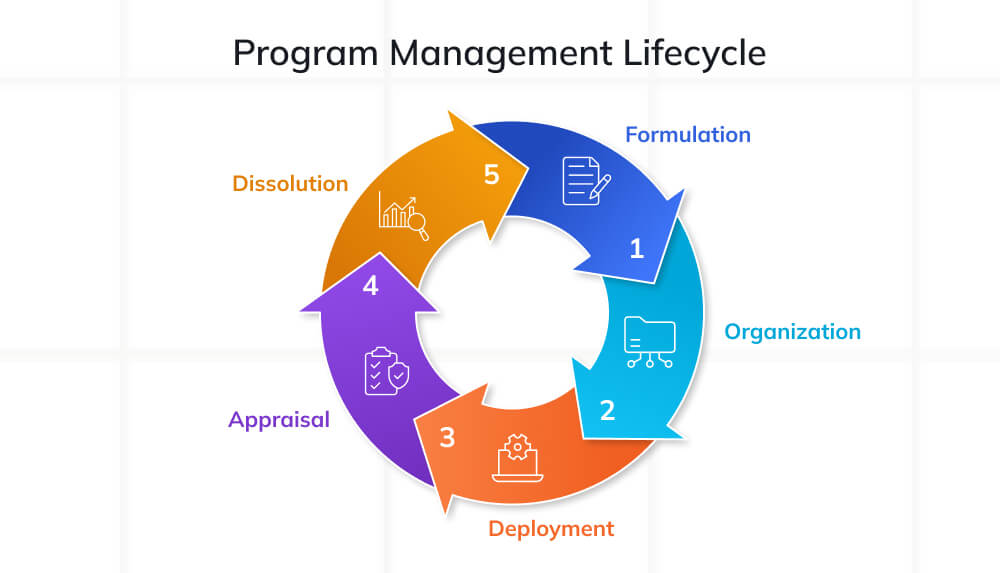
The program management lifecycle can be divided into five main stages: formulation, organization, deployment, appraisal, and dissolution. They are discussed in more detail below:
|
Stage |
Description |
Core Activities |
|
1. Formulation |
Define the program's strategic intent and secure stakeholder buy-in. |
Identify objectives, assess feasibility, and outline program scope. |
|
2. Organization |
Establish governance, assign roles, and plan interdependent project timelines. |
Build the program roadmap, allocate resources, and finalize charters. |
|
3. Deployment |
Execute projects under the program umbrella while maintaining alignment with overall goals. |
Oversee execution, manage dependencies, monitor KPIs. |
|
4. Appraisal |
Review progress and performance after each iteration or milestone. |
Conduct stakeholder reviews, manage change requests, optimize efficiency. |
|
5. Dissolution |
Close the program once objectives are achieved and benefits are realized. |
Transition deliverables, evaluate outcomes, and capture lessons learned. |
By mastering program management activities in each phase, professionals can manage complexity, reduce inefficiencies, and consistently deliver enterprise-level value.
Program Management Tools
47% of organizations that have implemented some form of technological intervention, particularly software, claim their business greatly benefitted from the investment. Applications in this field often take manually conducted tasks such as creating GANTT and PERT charts into a virtual space. This ensures both information provided for input and output are the most accurate to assist with pinpoint business decision making.
Microsoft Project
The world-renowned IT giant offers a quick and easy-to-use solution to manage multiple projects. The software is particularly useful for projects that depend on multiple teams within the organization. Benefits include:
-
Being able to track all changes and developments within a project or multiple projects
-
Scheduling software is extremely flexible and can be customized as per project requirements
-
Prediction and risk prevention are easily managed with the use of the software
-
Creating reports and records for auditing purposes or general organization can be easily conducted
Teamweek Review
For organizations looking for structuring that is more visually dynamic, Teamweek Review may be the right kind of investment. Corporate behemoths like Disney and Netflix use the software. Benefits include:
-
Drag and drop options for task allocations and project management
-
Timelines can be monitored based on projects, the grouping of projects, or by the employees working on the same
-
For the organization of a smaller number of smaller-scale projects, this is a significantly easier interface to use
-
Timelines can be easily shared with team members and other stakeholders
Monday.com
Philips and the Discovery channel use this popular management tool to handle their projects. The easy-to-use interface is simple to adopt within organizations and is considered one of the best software to use with auditing and quality control. Benefits include:
-
An entirely customizable project dashboard to ensure you're getting the information you want first.
-
Integration with 3rd party applications and tools to expand on the software abilities
-
Simple to use timeline tracking tools
-
Considered the best project management software to use for comprehensive data views
Projectmanager.com
This tool offers the highest level of customization provided by program management software on the market. The program allows you to customize your IT solution to include elements that your organization feels are relevant. Benefits include:
-
Integrates with G Suite allowing for seamless use across Google Calendar, Gmail, Google Hangouts, etc
-
Management of usually manual tools such as Gantt charts and WBS diagrams integrated into the software
-
Software platform dedicated to managing multiple projects simultaneously, i.e., program management
-
Team workload distributions are available in a simple-to-understand format
Real-World Program Management Case Studies
Understanding program management in theory is valuable, but seeing it in action is what truly demonstrates its impact. The following program management examples illustrate how organizations across various industries have leveraged program-level coordination to achieve strategic results at scale.
Below are two credible examples of program-level coordination across multiple projects:
1. Agile Development Program with Multi-Team Coordination
Over four years, 12 development teams worked on a large-scale agile effort. The study reveals how coordination mechanisms evolved, e.g., shifting from rigid structures to more feedback-driven modes, tighter communication loops, and adaptive governance controls. The program tackled the complexities of managing interdependent modules and changing priorities.
Key Lessons for Program Management:
- Coordination practices must evolve as the program matures (what worked in Year 1 may not work in Year 4).
- Feedback loops and informal communication channels are as crucial as formal governance.
- Interdependency risks grow as the number of projects/teams increases.
2. IT Program in a Financial Services Firm
A financial services company ran a program encompassing multiple IT projects, including analyzing existing systems, designing new architecture, deploying infrastructure, running tests, and documenting outcomes. The program achieved its goals on schedule, enabling improved operational integration and supporting revenue growth without needing additional staffing.
Key lessons for program management:
- Maintaining alignment across technical and business workstreams is critical.
- Robust oversight and phased rollouts help manage risk in complex environments.
- Effective documentation and governance ensure smooth handovers and operational stability.
Concluion
Program management plays a central role in helping organizations deliver results that align with their strategic goals. Whether you call it program management or programme management, its importance remains the same, ensuring that every project, resource, and activity contributes to measurable business value.
By managing a group of related projects as one cohesive unit, organizations gain better visibility, control, and coordination. From the key factors that drive successful programs, strategic alignment, active communication, clear accountability, and stable project teams, to the five stages of the program management lifecycle, formulation, organization, deployment, appraisal, and dissolution, these program management activities help turn business strategy into real-world outcomes. The right tools and real-world examples covered above further show how organizations across industries put these principles into practice to achieve enterprise-level results.
Mastering program management, however, is not something that happens by accident. It takes a structured understanding of governance, risk, stakeholder coordination, and strategic alignment across multiple interdependent projects. If you are ready to build these skills formally, Invensis Learning's PgMP Certification training equips you with the globally recognized credential and practical expertise to lead complex, multi-project programs with confidence, and position yourself as the professional organizations trust to turn strategy into measurable business value.
Frequently Asked Questions
1. What is program management?
Program management is the process of managing a group of related projects in a coordinated way so their combined delivery aligns with an organization's strategic goals. Rather than managing each project in isolation, it applies knowledge, skills, tools, and techniques across the entire group to obtain benefits and control not available when projects are managed individually.
2. What is the difference between a program and a project?
A project is a single set of tasks aimed at delivering a specific product or service, led by a project manager responsible for its execution. A program is a group of related projects managed together to deliver a consolidated outcome, with a program manager overseeing all the projects involved and ensuring they collectively support a broader strategic goal.
3. What are the key factors for successful program management?
The key factors include aligning strategic goals with the resources deployed, maintaining active communication throughout the program's lifespan, setting clear goals and expectations before the program begins, creating accountability among project and team managers, and keeping project teams stable throughout the program's duration. Together, these factors help ensure every project under the program contributes to measurable business outcomes.
4. What are the stages of the program management lifecycle?
The program management lifecycle consists of five stages: formulation, organization, deployment, appraisal, and dissolution. These stages take a program from defining its strategic intent and securing stakeholder buy-in through execution, performance review, and finally closing the program once its objectives are achieved.
5. What tools are used in program management?
Common program management tools include Microsoft Project, Monday.com, Projectmanager.com, and Teamweek, each offering different strengths such as scheduling flexibility, visual task tracking, or third-party integrations. The right tool depends on factors like team size, need for real-time collaboration, and how many projects need to be tracked simultaneously within the program.
6. Why is program management important for organizations?
Program management ensures that every initiative supports an organization's larger strategy rather than functioning as an isolated, short-term deliverable. It improves strategic alignment, optimizes resource utilization, enables earlier risk identification, strengthens communication, and, according to industry research, can save organizations hundreds of hours per employee annually through better coordination.
7. How can I build a career in program management?
Building a career in program management typically requires a combination of hands-on experience managing multiple interdependent projects and formal training in governance, risk, and stakeholder coordination. Earning a globally recognized credential, such as the PgMP Certification, can help formalize this expertise and position you as a professional organizations trust to lead complex, multi-project initiatives.