Choosing between PgMP and PfMP is not really about picking the “higher” credential. It is about identifying where you create value in the organization. PMI positions PgMP for professionals who manage multiple related projects in a coordinated way to deliver benefits and align outcomes with organizational goals, while PfMP is aimed at executive or senior-level practitioners who manage portfolios of projects, programs, and operations to ensure the organization is doing the right work.
What Are PgMP and PfMP?
The Program Management Professional (PgMP) certification validates advanced capability in managing multiple related projects as a program, especially when work spans functions, organizations, regions, or cultures. PMI also frames program management as a discipline focused on turning related initiatives into benefits that exceed the sum of their parts.
The Portfolio Management Professional (PfMP) certification validates advanced experience in managing a portfolio of projects, programs, and operations aligned to organizational strategy. In practical terms, it is less about delivering one coordinated transformation and more about deciding which investments deserve resources, governance attention, and continued funding.
How Do Program Management and Portfolio Management Actually Differ?
Program management and portfolio management sit at different decision layers. PMI’s guidance describes portfolio management as a strategic activity that optimizes return while balancing risk and return across investments. Program management, by contrast, strengthens the link between projects and their intended benefits and provides a structure for controlling strategic, financial, and operational risk in major undertakings.
|
“A leader charts the course, translating strategy into workable plans; sets high expectations and raises the bar continuously; inspires others by creating a winning atmosphere; faces reality and adjusts to keep commitments; delivers results and does not rationalize shortfalls.” Former Chairman, President, and CEO, Boeing |
 |
A simple way to think about it is this: a program manager asks, “How do I coordinate related initiatives so the organization gets the promised outcomes?” A portfolio manager asks, “Which initiatives should the organization fund, sequence, continue, pause, or stop to best serve strategy?” That is why PgMP tends to suit transformation leaders, while PfMP tends to suit enterprise decision-makers.
PgMP and PfMP: A Detailed Explanation
Who Should Choose PgMP?
PgMP is the stronger choice if you already operate above the single-project level but are still close to execution and benefits realization. PMI specifically ties PgMP to managing multiple related projects, handling complex work across business boundaries, and aligning results to organizational goals.
You should lean toward PgMP if your current or target role looks like this:
- You lead large, multi-project initiatives with shared outcomes.
- You are accountable for benefits realization, stakeholder alignment, and governance.
- You manage interdependencies across business units, vendors, regions, or delivery teams.
- You want to move from senior project management into enterprise program leadership.
- Your organization values coordinated execution of strategic change.
There is also a career signal attached to the credential. PMI reports that nearly half of surveyed PgMP holders experienced increased responsibility and larger programs after certification, while also reporting higher earnings and salary growth. That does not guarantee a raise, but it does show that the market often associates PgMP with bigger-scope leadership.
Who Should Choose PfMP?
PfMP is the better option if your value comes from enterprise prioritization rather than direct orchestration of delivery. PMI describes PfMP as the right choice for executive or senior-level practitioners managing portfolios aligned with organizational strategy and focused on making sure the organization does the right work.
|
PfMP Career Perspective In PMI’s Looking back to move forward, the author describes the PfMP journey as a reflection on years of enterprise portfolio leadership, including building an EPMO, structuring portfolios around organizational value, and sustaining engagement across the enterprise. That reinforces an important point: PfMP is not simply a bigger version of PgMP; it reflects a different level of business leadership centered on strategic portfolio decisions. Source: PMI |
You should lean toward PfMP if your current or target role looks like this:
- You decide which programs and projects align with strategic goals.
- You evaluate trade-offs across investment options, risk, and capacity.
- You oversee portfolio governance, performance, and strategic communication.
- You work in executive PMO, enterprise transformation, strategy execution, or portfolio leadership roles.
- You influence funding and prioritization decisions across the organization.
|
Research Insiht PMI also highlights the organizational value of mature portfolio management. On the PfMP certification page, PMI states that organizations with mature project portfolio management practices complete 35 percent more of their programs successfully. That statistic reinforces the fact that PfMP is for leaders whose work affects strategic throughput, not just delivery efficiency. |
How Do Eligibility Requirements and Exam Paths Compare?
Both credentials are designed for experienced professionals, and both include a panel review before the multiple-choice exam. That alone tells you these are not entry-level certifications. However, the experience profiles are different: PgMP emphasizes project and program leadership, while PfMP emphasizes business experience and portfolio leadership.
| Area | PgMP | PfMP |
|---|---|---|
| Core focus | Coordinating related projects to deliver benefits | Governing portfolios to align investments with strategy |
| Secondary diploma path | 48 months of project management experience or PMP plus 84 months of program management experience | 96 months of business experience plus 84 months of portfolio management experience |
| Four-year degree path | 48 months of project management experience or PMP plus 48 months of program management experience | 96 months of business experience plus 48 months of portfolio management experience |
| GAC-accredited degree path | 36 months of project management experience or PMP plus 36 months of program management experience | 96 months of business experience plus 36 months of portfolio management experience |
| Evaluation path | Panel review + exam | Panel review + exam |
| Exam format | 170 multiple-choice questions, 240 minutes | 170 multiple-choice questions, 240 minutes |
| Renewal | 60 PDUs every 3 years | 60 PDUs every 3 years |
Both certifications are advanced, and both require substantial experience. Neither is designed for early-career professionals. However, the experience expectations reflect the nature of each credential.
For PgMP, PMI requires a combination of project management experience and program management experience. The official handbook states:
- With a secondary diploma, you need 48 months of project management experience or PMP, plus 84 months of program management experience
- With a four-year degree, you need 48 months of project management experience or PMP, plus 48 months of program management experience
- With a GAC-accredited degree, you need 36 months of project management experience or PMP, plus 36 months of program management experience
For PfMP, the requirement structure is different. PMI emphasizes business experience plus portfolio management experience:
- With a secondary diploma, you need 96 months of professional business experience plus 84 months of portfolio management experience
- With a four-year degree, you need 96 months of professional business experience plus 48 months of portfolio management experience
- With a GAC-accredited degree, you need 96 months of professional business experience plus 36 months of portfolio management experience
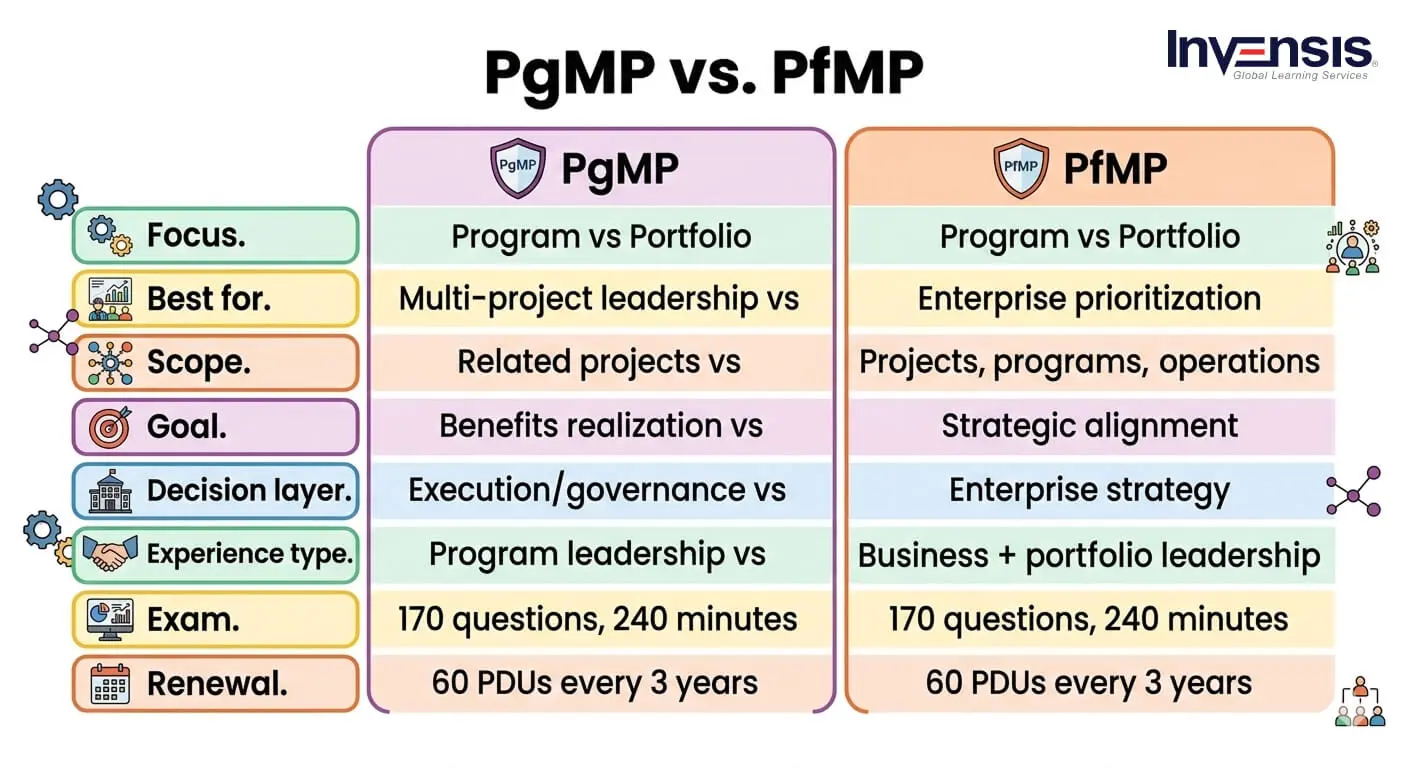
The pattern is clear: PgMP expects hands-on leadership across programs, while PfMP expects broader business maturity plus portfolio oversight. If your background is stronger in coordinated delivery, PgMP is usually more accessible. If your background is stronger in enterprise prioritization and business governance, PfMP is a better alignment.
How Do the Exam Processes Compare Between PgMP and PfMP?
Both PgMP and PfMP follow a two-step evaluation model. The first stage is a panel review, where experienced practitioners assess your application and experience summaries. Only after passing that review do you move to the exam. The second stage is a 170-question multiple-choice examination, and a total duration of 240 minutes.
The same two-stage process applies to PfMP. Candidates go through a panel review of their portfolio management experience and then sit for a 170-question, four-hour exam. This similarity often leads people to assume the certifications are equivalent, but the exam content differs because the job roles do.
Both credentials also require 60 PDUs every 3 years to maintain certification. That means PMI treats them as living credentials that require continued professional development, not one-time achievements.
What Skills Does the PgMP vs. PfMP Exams Emphasize?
PgMP Exam
The PgMP exam blueprint shows where PMI expects program leaders to be strongest. According to the PgMP handbook, the exam domains are:
- Program Life Cycle – 44%
- Stakeholder Management – 16%
- Strategic Program Management – 15%
- Governance – 14%
- Benefits Management – 11%
This domain mix tells a strong story. PgMP is deeply focused on how a professional governs and leads related work from initiation to benefits realization. The credential expects fluency in managing dependencies, stakeholder ecosystems, governance structures, and value delivery over time. It is designed for leaders who make complex change happen in an organized, sustainable way.
PfMP Exam
The PfMP exam blueprint is more strategic and investment-oriented. The official PfMP handbook lists these domains:
- Strategic Alignment – 25%
- Portfolio Performance – 25%
- Governance – 20%
- Portfolio Risk Management – 15%
- Communications Management – 15%
This blueprint makes the purpose of PfMP very clear. It is built for professionals who operate at the enterprise level, where the biggest challenge is not necessarily delivering one program successfully, but governing a whole landscape of initiatives so that investment choices match business priorities. Strategic alignment and portfolio performance carry the highest weight because that is where portfolio leadership creates the most value.
How Can You Decide Between PgMP and PfMP?
If you are still unsure, ask yourself these five questions:
| Question | If your answer is “yes,” lean toward |
|---|---|
| Do I lead multiple related projects toward one business outcome? | PgMP |
| Am I accountable for benefits realization across coordinated initiatives? | PgMP |
| Do I help decide which programs and projects the organization should invest in? | PfMP |
| Do I work at the strategic governance or enterprise prioritization layer? | PfMP |
| Is my role closer to delivery integration or portfolio decision-making? | PgMP for integration, PfMP for decision-making |
That simple exercise often resolves the confusion. If your work is about making interconnected initiatives succeed together, PgMP is probably right. If your work is about choosing the right mix of initiatives for the business, PfMP is probably the better fit.
Which Certification for Your Career Makes More Sense Right Now?
Choose PgMP if your career is moving horizontally across complex initiatives. It is ideal when your authority grows through cross-functional leadership, governance across related projects, benefits tracking, and stakeholder influence around major business outcomes. It is especially relevant for senior project managers, transformation leads, program directors, and PMO leaders with strong delivery ownership.
Choose PfMP if your career is moving upward into enterprise prioritization. It is the better fit when your responsibility includes deciding where money, people, and executive attention should go across portfolios of work. It is particularly relevant for portfolio managers, enterprise PMO leaders, strategy execution professionals, and senior leaders responsible for strategic investment governance.
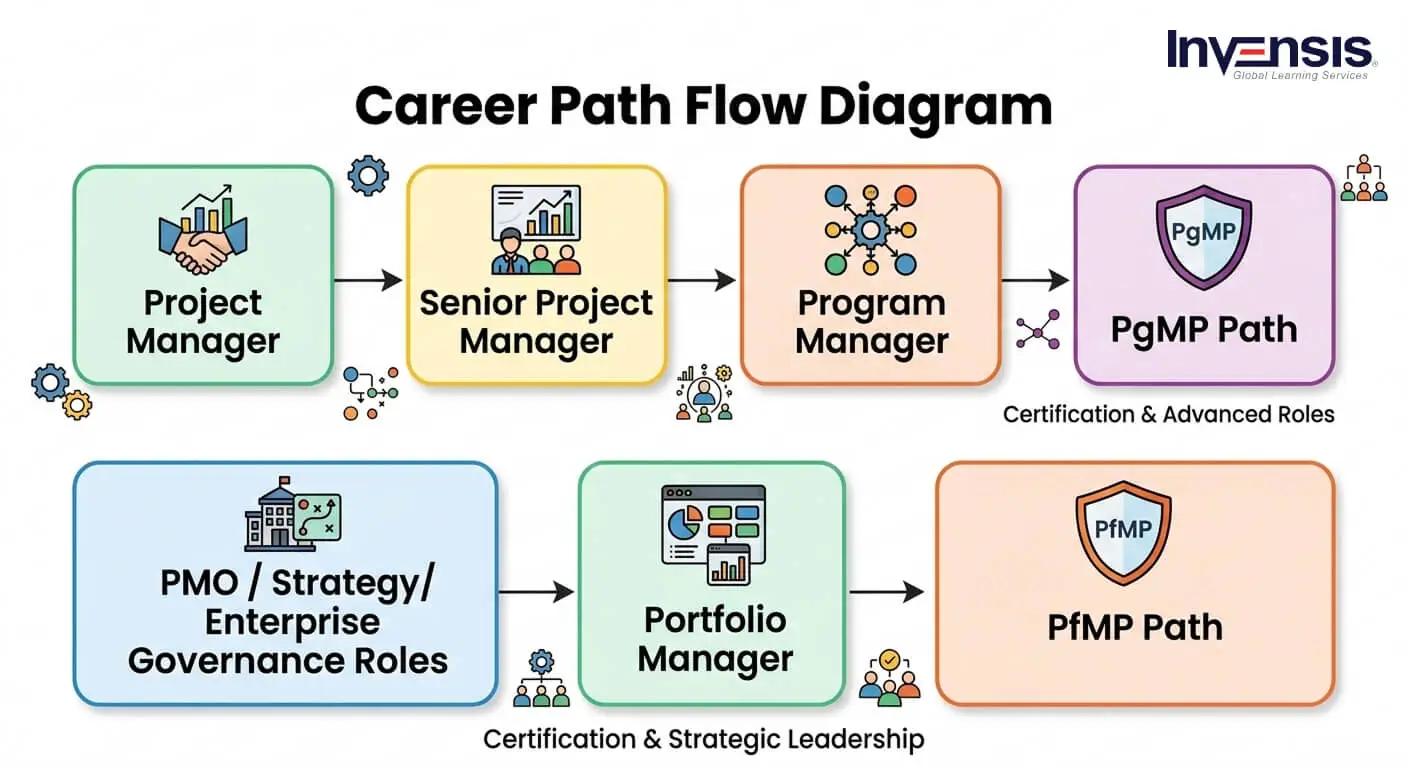
If you are still torn, ask yourself one practical question: Are you primarily measured by the success of a coordinated set of initiatives, or by the quality of enterprise investment decisions? If it is the first, PgMP is usually your answer. If it is the second, PfMP is usually the smarter move.
|
Career Path Insight PMI literature shows that career progression in enterprise delivery leadership often moves from project management to program management and then to portfolio management, with each level requiring a broader shift in decision-making, governance, and business alignment. In simple terms, PgMP typically fits professionals expanding from complex delivery leadership, while PfMP fits those moving further into enterprise prioritization and strategic investment oversight. Source: PMI |
What Should You Do Next?
PgMP and PfMP are both elite PMI credentials, but they validate different kinds of leadership. PgMP proves you can guide related projects as one program and convert complexity into realized benefits. PfMP proves you can evaluate, govern, and optimize a portfolio of work so the organization invests in the right priorities. Neither is universally “better”; the right one is the one that matches the scope of decisions you already own or want to own next.
If you want the shortest decision rule possible, use this: PgMP for benefits-led multi-project leadership, PfMP for strategy-led portfolio governance. That framing is simple, memorable, and fully aligned with how PMI defines the two certifications.
Conclusion
PgMP and PfMP are both prestigious PMI certifications, but they serve very different purposes in leadership development. PgMP is the right fit for professionals who manage multiple related projects, drive benefits realization, and lead complex cross-functional initiatives toward a shared outcome. PfMP, on the other hand, is designed for senior professionals who focus on portfolio governance, strategic alignment, investment prioritization, and ensuring the organization is funding the right work. The right choice depends less on which credential sounds more advanced and more on the level at which you create value.
If your role is centered on coordinating delivery and turning related initiatives into measurable business outcomes, PgMP is the stronger choice. If your responsibilities include evaluating enterprise priorities, balancing risk and return, and guiding strategic investment decisions, PfMP is the better fit. Choosing a certification that aligns with your actual scope of work will make your learning more relevant, strengthen your professional credibility, and support the next stage of your leadership journey.
Frequently Asked Questions
1. Is PgMP harder than PfMP?
PgMP and PfMP are both advanced PMI certifications, but they are difficult in different ways. PgMP is more focused on managing complex programs, benefits realization, governance, and stakeholder coordination across related projects. PfMP is more strategic, emphasizing portfolio alignment, investment prioritization, governance, and balancing organizational risk and return. The harder option depends on whether your experience is stronger in program leadership or portfolio decision-making.
2. Can I pursue PfMP after PgMP?
Yes, many professionals may pursue PfMP after PgMP if their careers progress from program leadership to enterprise portfolio governance and strategic decision-making. PgMP and PfMP are not competing certifications in every case; they can reflect different stages of leadership growth depending on your role and responsibilities.
3. Which certification is better for senior project managers: PgMP or PfMP?
For most senior project managers, PgMP is the more natural next step because it focuses on leading multiple related projects, coordinating stakeholders, and delivering business benefits. PfMP is generally better suited to professionals who already work at the strategic portfolio level and are involved in prioritization, governance, and investment decisions across the organization.
4. Does PfMP require portfolio management experience?
Yes, PMI requires portfolio management experience for PfMP eligibility. In addition to professional business experience, candidates must demonstrate hands-on portfolio management experience that aligns with the eligibility criteria set by PMI.
5. Does PgMP require PMP certification first?
No, PMP certification is not mandatory to apply for PgMP. However, PMI allows candidates to use PMP as part of the project management experience requirement pathway. What matters most is whether you meet the required combination of project and program management experience.
6. Is PgMP or PfMP better for PMO leaders?
It depends on the PMO role. If the PMO leader is focused on coordinating major change initiatives, benefits delivery, and program governance, PgMP may be the better fit. If the PMO leader is responsible for enterprise prioritization, portfolio governance, and strategic investment oversight, PfMP is usually more relevant.
7. What is the difference between PgMP and PfMP in terms of career outcomes?
PgMP supports careers in program leadership, transformation delivery, and cross-functional initiative management. PfMP supports careers in enterprise portfolio governance, strategy execution, and investment prioritization. The difference in career outcome depends on whether your role is closer to coordinated delivery or enterprise-level decision-making.
8. Should I choose PgMP or PfMP for strategy-focused roles?
If your role is truly strategy-focused and involves deciding which programs, projects, or initiatives should receive funding, priority, and oversight, PfMP is the better choice. PgMP is better suited for leaders responsible for executing coordinated initiatives and delivering intended business outcomes.