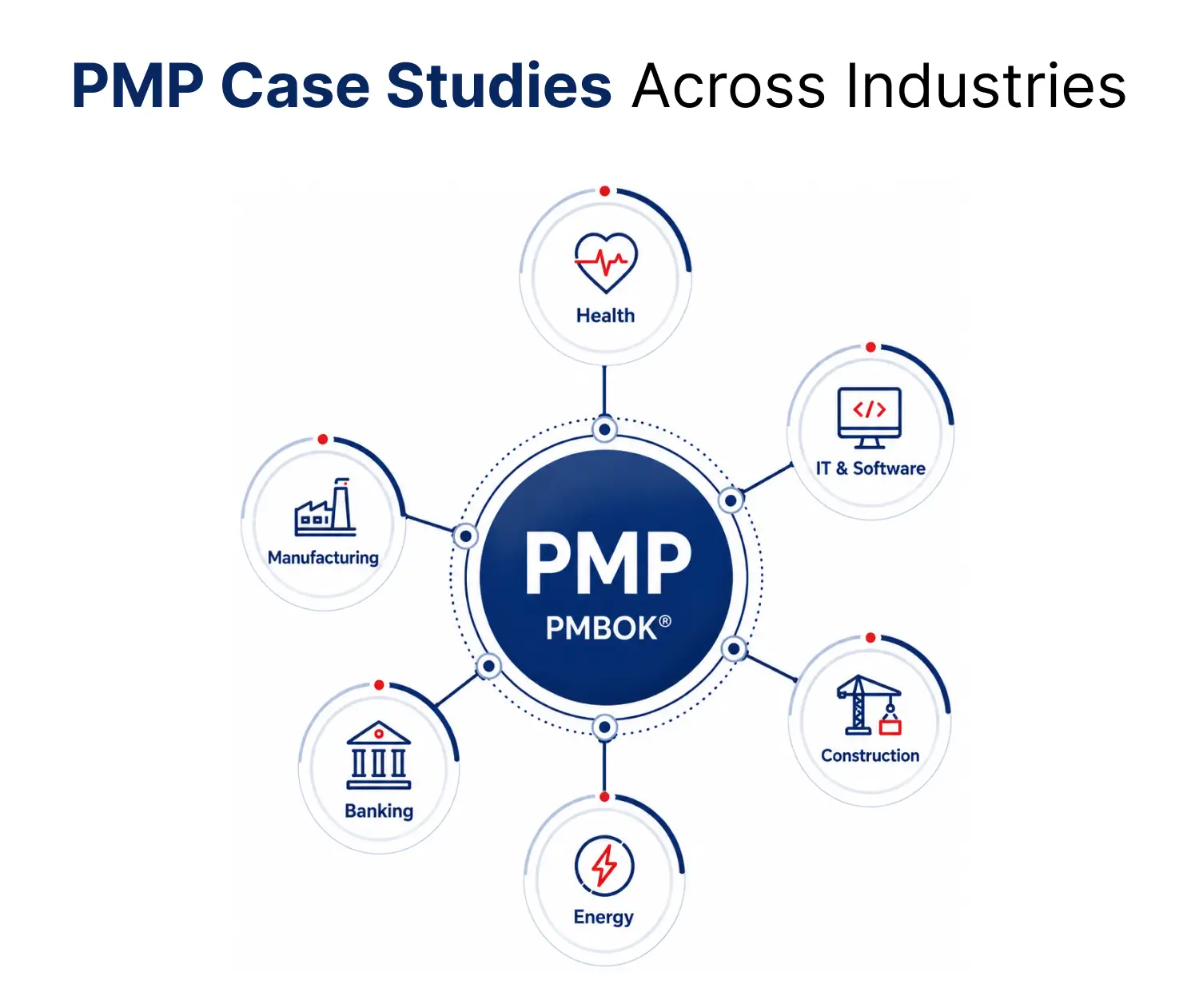
One project-management framework, six very different battlegrounds. This detailed guide walks through a full PMP case study in construction, IT, healthcare, manufacturing, banking, and energy, each mapping the PMBOK knowledge areas to real decisions, worked metrics, and a measured recovery. According to PMI's Pulse of the Profession, organizations that undervalue project management report 67% more project failures, and only 58% of projects are completed within budget. These six cases show what closing that gap looks like on the ground.
Every case in this guide is an illustrative composite built for teaching. Company names, figures, and outcomes are realistic and internally consistent but represent no real project, organization, or PMI endorsement. Use the numbers to follow the reasoning, not as benchmarks.
Ask two project managers, one pouring concrete, one migrating a bank’s core systems, what they do all day and you’ll hear two different languages. Ask what actually went wrong on their last troubled project and you’ll hear the same short list: scope that changed without control, a schedule that slipped before anyone measured it, a risk everyone saw coming and nobody owned. That is the quiet case for a universal framework: the discipline is portable even when the domain isn’t.
A PMP case study analyzes a project through the PMBOK knowledge areas, showing which ones drove the outcome and why. It walks through the project setup, the failure point, the recovery levers, the measured results, and the transferable lesson, giving practitioners a structured way to connect exam concepts to real-world application.
This pillar takes that approach and drops it into six industries, each as a detailed case study example rather than a headline. Every case follows the same arc: the setup, the problem, the knowledge areas that carried the recovery, the numbers, and the one lesson that travels, so you can see both what makes each industry distinct and what makes the underlying method the same everywhere.
The Shared Framework: Ten Knowledge Areas
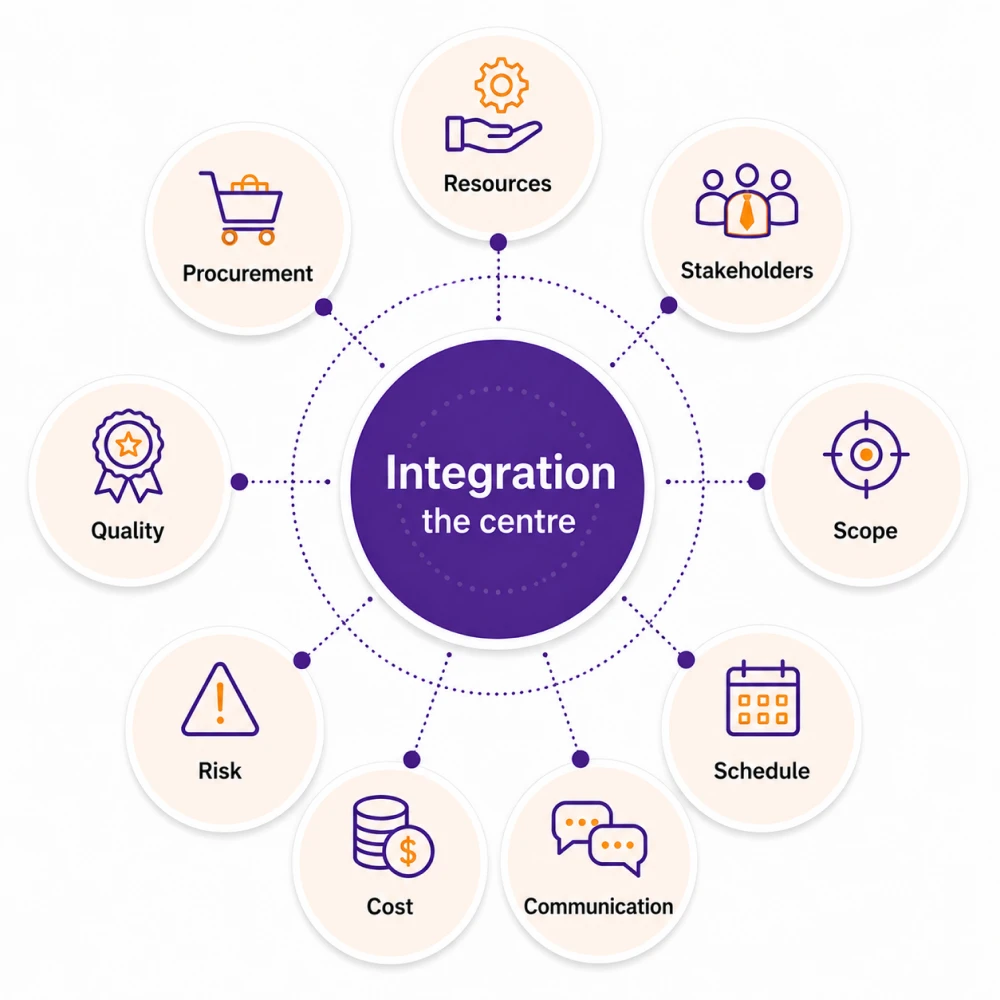
PMP is built on the PMBOK knowledge areas that apply to any project, coordinated by integration management at the center. What differs by industry is which area becomes the primary battleground: a construction project lives or dies on procurement and schedule; a software project on scope and change; a hospital rollout on risk and stakeholders. The skill is diagnosing where your industry’s variance concentrates and pointing the discipline there.
| Knowledge area | What it controls |
|---|---|
| Scope | Deliverables; preventing uncontrolled growth |
| Schedule | Sequencing, critical path, recovery |
| Cost | Baselines, forecasting, control |
| Risk | Identify, score, respond before impact |
| Quality | Standards, assurance, defect control |
| Procurement | Vendors, contracts, supply-chain risk |
| Stakeholders | Aligning sponsors, users, regulators |
| Integration | Coordinating all areas into one plan; change control |
| Resources | Team acquisition, development, management |
| Communications | Status reporting, stakeholder information flow |
The PMBOK Guide was updated to its 7th edition in 2021 (published by PMI), shifting from a process-based framework (6th edition) to a principle-based approach built around value delivery. The ten knowledge areas above remain widely used as a practical reference, and this guide maps each case study to them.
Earned Value: Key Terms Used Throughout This Guide
| Abbreviation | Term | Definition |
|---|---|---|
| PV | Planned Value | Budgeted cost of work scheduled to date |
| EV | Earned Value | Budgeted cost of work actually completed |
| AC | Actual Cost | What has actually been spent to date |
| CPI | Cost Performance Index | EV ÷ AC. Above 1 = under budget; below 1 = over |
| SPI | Schedule Performance Index | EV ÷ PV. Above 1 = ahead; below 1 = behind |
| EAC | Estimate at Completion | BAC ÷ CPI. Forecast final cost if current efficiency holds |
| TCPI | To-Complete Performance Index | The efficiency the remaining work must hit to finish on budget |
PMP ECO Domain Mapping
The PMP exam is structured around three domains: People (42%), Process (50%), and Business Environment (8%). Since the July 2026 update, the exam includes scenario-based case study questions that require candidates to analyze a project situation and choose the best action. Each case study below exercises all three ECO domains but concentrates differently, giving you practice with the same kind of analysis the exam now tests.
| Case study | People | Process | Business Environment |
|---|---|---|---|
| Construction | Resource leveling, 2nd shift crew | EVM, schedule compression, CCB | Procurement, vendor management |
| IT & Software | Product owner structure, stakeholder alignment | Hybrid delivery, backlog freeze, MoSCoW | MVP release strategy |
| Healthcare | Clinician adoption, super-users, at-elbow support | Phased go-live, QA hold points | HIPAA/HITECH compliance, clinical governance |
| Manufacturing | Cross-functional team, training | DMAIC root cause, quality control | Supplier quality clauses |
| Banking | War room, multi-vendor coordination | Dress rehearsals, rollback plan | Basel regulatory deadline, governance |
| Energy | Grid operator liaison | Backward scheduling, front-loaded procurement | NERC standards, HSE, external regulatory dependency |
1. Construction - Recovering a Stalled Commercial Build
Meridian Business Park, Phase 2: An 8-story, ~12,000 m² Class-A office building · $24M budget (BAC) · 20-month baseline · design-bid-build · peak workforce ~120.
The Setup
Two baseline facts set up the whole story. The curtain-wall envelope sits on the critical path, and is also the longest-lead package (16 weeks). And performance is measured monthly with earned value. The project has an early-warning system, if anyone reads it. The baselines live in the project management plan, built from an approved charter and a decomposed WBS.
WHERE IT COMES FROM
The Critical Path Method was developed by James E. Kelley Jr. (Remington Rand) and Morgan R. Walker (DuPont) in 1957, first proven on plant-shutdown scheduling.
Source: PMI, “Origins of CPM”
The Problem
By the end of Month 9 (~45% planned), several ordinary failures compounded at once:
- Procurement delay: The curtain-wall supplier slipped four weeks, and because it’s on the critical path, the delay flowed into MEP and fit-out.
- Unmanaged design changes: A lobby upgrade and revised MEP layout were built on site with no cost or schedule update: textbook scope creep.
- Subcontractor clashes and unforeseen rock: At foundations ate the early float, and with no single source of truth, stakeholders each held a different version of “where we are.”
The Diagnosis, Earned Value
Rather than push crews harder, the manager measured. Earned value integrates scope, schedule and cost into a forecast (see the EVM glossary in the framework section above).
WHERE IT COMES FROM
Earned value was formalized by the US Department of Defense in its 1967 Cost/Schedule Control Systems Criteria, and set out for practitioners by Quentin W. Fleming and Joel M. Koppelman in Earned Value Project Management.
Applied to Meridian at the end of Month 9:
Earned Value Snapshot, End of Month 9
| Metric | Value |
|---|---|
| Planned Value (PV) | $10,800,000 |
| Earned Value (EV) | $9,000,000 |
| Actual Cost (AC) | $10,500,000 |
| SPI = EV ÷ PV | 0.83 |
| CPI = EV ÷ AC | 0.86 |
| Forecast at completion (EAC = BAC ÷ CPI) | ≈ $28.0M |
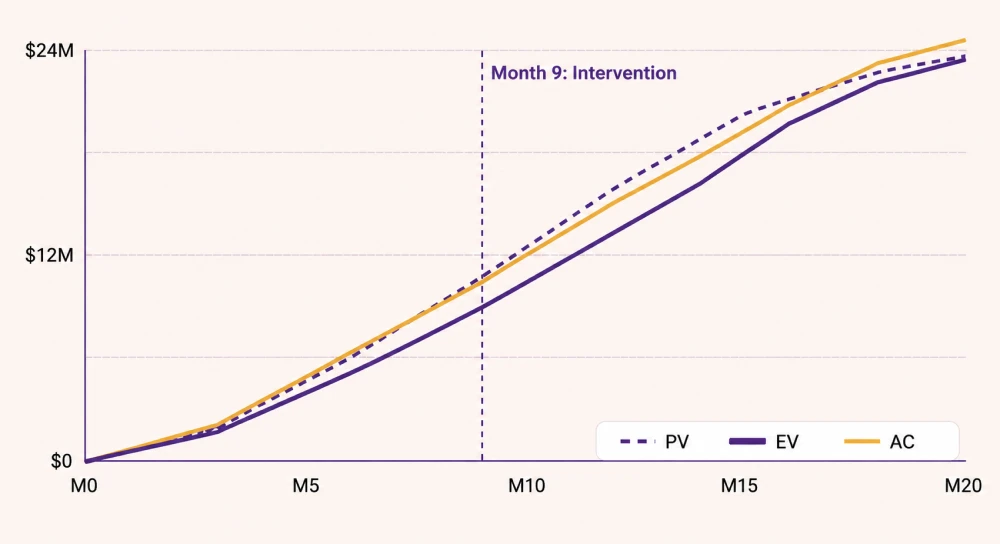
In plain English: an SPI of 0.83 means the project earns 83 cents of scheduled progress per planned dollar, about six weeks behind. A CPI of 0.86 means 86 cents of value per dollar spent. Unchecked, the trajectory forecasts a $4M (16.7%) overrun. That gap is the case for action.
The knowledge areas that carried the recovery- Scope & change: Undocumented work was frozen and every change routed through a Change Control Board. 14 ad-hoc changes became 9 formally approved and 5 rejected.
- Schedule: The team fast-tracked interior work in parallel with the envelope and added a second structural shift, then re-baselined with client sign-off. OSHA safety requirements were maintained throughout the compressed schedule.
- Cost: Control shifted to EVM forecasting and deliberate drawdown of a contingency reserve sized from the risk register via expected monetary value.
- Procurement: The remaining curtain wall was dual-sourced and long-lead items moved onto the schedule baseline.
Risk Register (Extract)
| Risk | Prob. | Impact | Response | Owner |
|---|---|---|---|---|
| Curtain-wall further delay | High | High | Dual-source + expedite; buffer | Procurement |
| Adverse weather | Med | High | Re-sequence to interior; weather days | Site Mgr |
| Further MEP design change | High | Med | Design freeze at 60%; CCB | PM |
| Steel-fixer shortage | Med | High | Pre-qualify 2nd sub; 2nd shift | Construction |
| Fall-from-height incident | Low | V.High | Safety plan; PPE audits | HSE |
Before vs. After
| Metric | Before (M9) | Action | After (M16) |
|---|---|---|---|
| Schedule (SPI) | 0.83 | Fast-track + 2nd shift | 0.99 |
| Cost (CPI) | 0.86 | EVM + dual-source | 0.97 |
| Overrun vs BAC | +16.7% (proj.) | Change control + contingency | +3.75% |
| Uncontrolled changes | 14 | CCB | 0 |
| Open quality NCRs | 38 | ITP + hold points | 7 |
LESSON THAT TRAVELSPut long-lead procurement on the schedule baseline and the risk register on day one, the critical-path item nobody is actively de-risking is the one that sinks the plan. Construction PM phases →
2. IT & Software - An ERP Rollout Drowning in Scope
Helios Retail ERP: a 14-month, group-wide ERP across finance, supply chain and HR · ~$6M · fixed-scope waterfall plan · 40+ business stakeholders.
The Problem
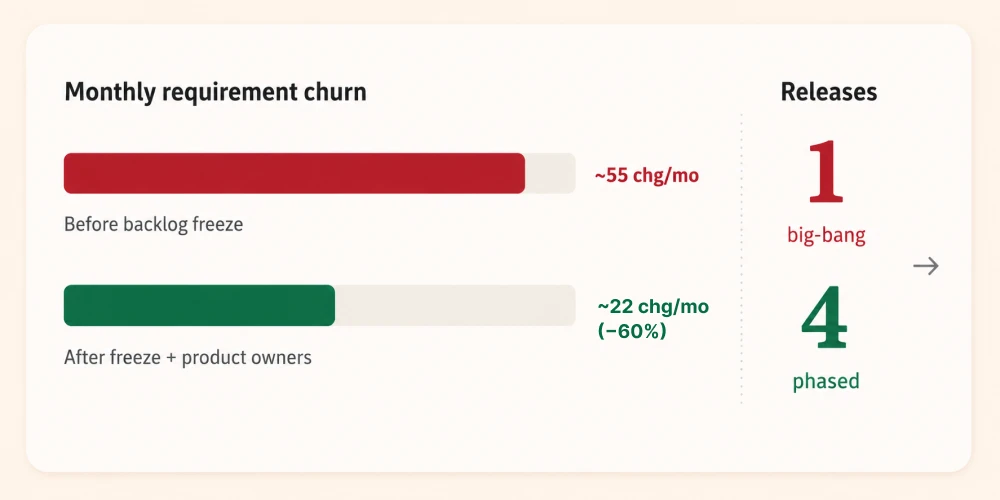
A “big-bang” waterfall plan met a business whose requirements kept evolving. Every department added must-haves, the scope baseline eroded week by week, integration testing slipped, and the go-live date became a number nobody believed. Unlike a building, software requirements are expected to change, the failure was pretending they wouldn’t.
The knowledge areas that carried the recovery
- Scope & integration: The manager stopped absorbing changes silently and reshaped the delivery model itself, a hybrid approach with a predictive backbone for budget and milestones and agile increments for the build.
- Requirements: Reprioritized with MoSCoW and a rolling-wave plan replaced false precision.
- Delivery: An MVP release shipped the finance module first, converting an all-or-nothing bet into four staged releases, the agile vs waterfall tension turned into a deliberate blend. Sprint velocity stabilized at 34 story points per iteration after the backlog freeze, up from an erratic 18-42 range.
- Stakeholders: A product-owner structure gave each domain a single voice, ending the free-for-all that drove churn.
WHERE IT COMES FROM
The agile approach here follows the 2001 Agile Manifesto, drafted by Kent Beck, Martin Fowler, Jeff Sutherland and 14 other practitioners at Snowbird, Utah. MoSCoW prioritization was created by Dai Clegg for the DSDM framework.
Risk Register (Extract)
| Risk | Prob. | Impact | Response | Owner |
|---|---|---|---|---|
| Requirement scope creep | High | High | Backlog freeze; product owners; CCB | PM |
| Cross-module integration failure | Med | High | Integration test env; phased releases | Tech Lead |
| Legacy data-migration errors | Med | High | Reconciliation + dry runs | Data Lead |
| User adoption resistance | Med | Med | Training + super-users | Change Mgr |
Before vs. After
| Metric | Before | After |
|---|---|---|
| Delivery model | Big-bang waterfall | Hybrid, 4 releases |
| Requirement churn | ~55 / month | ~22 / month |
| First value to users | Month 14 (planned) | Month 6 (MVP) |
| Go-live confidence | Slipping, unknown | Staged & on track |
LESSON THAT TRAVELS
Match the method to the uncertainty. High-change environments need a controlled way to absorb change, not a plan that pretends it won’t happen. IT project management guide →
3. Healthcare - A Hospital EHR Go-Live with No Room for Error
St. Aster Health: rolling out a new electronic health record (EHR) across a three-hospital network · strict clinical governance · ~2,400 clinical users.
The Problem
Unlike a delayed building, a botched clinical go-live risks patient safety. Three pressures collided: clinicians resisted the workflow change, regulatory and clinical-governance requirements were non-negotiable, and a single big-bang cutover across all three sites concentrated enormous risk into one weekend. Early testing already showed order-entry defects that, uncorrected, could reach a patient.
The knowledge areas that carried the recovery
This was a risk- and stakeholder-led program.
- Quality: Compliance and clinical-safety gates were built into every phase, with defined hold points before each site could go live and a formal defect log tied to corrective actions (quality management in healthcare). All data-handling workflows were validated against HIPAA and HITECH requirements before pilot launch.
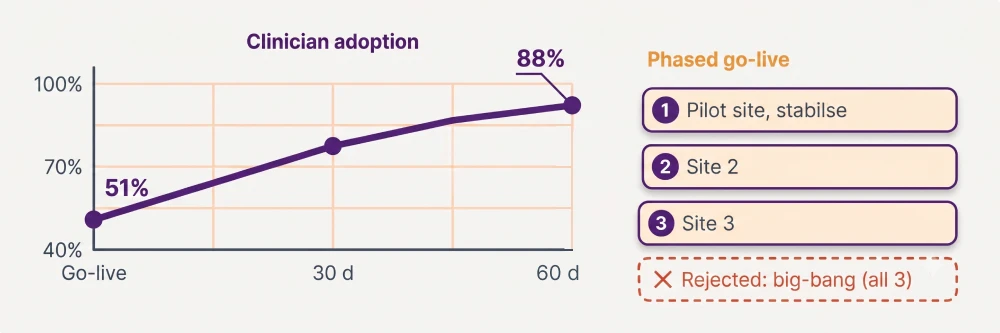
- Risk: The big-bang was replaced by a phased go-live: one pilot site, stabilize, then the others, each with a tested rollback plan.
- Stakeholders & change: Clinician adoption was treated as change management, not an afterthought: super-users on every ward, at-elbow floor support during go-live, and feedback loops that fed fixes back into the build. The clinical project manager owned the human side as deliberately as the technical one.
WHERE IT COMES FROM
Treating adoption as change management draws on Kurt Lewin’s unfreeze-change-refreeze model and John Kotter’s eight-step framework from Leading Change.
Source: Kotter, The 8-Step Process
Risk Register (Extract)
| Risk | Prob. | Impact | Response | Owner |
|---|---|---|---|---|
| Safety-critical defect reaches a patient | Low | V.High | Clinical-safety hold points; phased go-live | Clinical Safety Officer |
| Clinician non-adoption | High | High | Super-users; at-elbow support | Clinical PM |
| Regulatory / governance non-compliance | Low | V.High | Compliance gates; audit trail | Compliance Lead |
| Patient-record migration integrity | Med | High | Validation + reconciliation; rollback | Data Lead |
Before vs. After
| Metric | Before / planned | After |
|---|---|---|
| Cutover strategy | Big-bang, all 3 sites | Phased, pilot-first |
| Patient-safety incidents | At-risk | 0 at go-live |
| Clinician adoption (60 d) | 51% | 88% |
| Open safety-critical defects | High | 0 unresolved at each gate |
LESSON THAT TRAVELS
When the cost of failure is safety or compliance, phase the risk and manage the humans, adoption is a deliverable, not an afterthought. PM in healthcare →
4. Manufacturing - A Production Line Bleeding on Scrap
Vertex Components: Commissioning a new automotive-parts line targeting 5,000 units/day · new equipment · three material suppliers.
The Problem
At ramp-up the line physically ran, but a high defect and scrap rate turned every shift into rework. Supplier material variation and equipment-integration issues were driving the cost of poor quality straight through the budget, and management’s instinct to push for more volume would only multiply defective output.
The knowledge areas that carried the recovery
Here quality and cost management led.
- Quality & cost: The project plan was paired with a Six Sigma DMAIC effort to find the root cause of the defects rather than chase symptoms.
- Procurement: Tightened supplier quality clauses and incoming-inspection in the procurement plan.
- Schedule/resource: Re-sequenced the ramp to stabilize the process before scaling volume. Cost control tracked the CPI back toward 1.0 as rework fell.
WHERE IT COMES FROM
Six Sigma was coined by Motorola engineer Bill Smith in 1986 and scaled into a global standard by Jack Welch at GE. Its “stabilize before you scale” ethos traces to the Toyota Production System of Taiichi Ohno, named “Lean” for the West by James Womack and Daniel Jones.
Sources: ASQ, Six Sigma · Lean Enterprise Institute
Risk Register (Extract)
| Risk | Prob. | Impact | Response | Owner |
|---|---|---|---|---|
| High defect / scrap rate | High | High | DMAIC root-cause; stabilize before scaling | Six Sigma Lead |
| Supplier material variation | Med | High | Incoming inspection; supplier-quality clauses | Procurement |
| Equipment integration / breakdown | Med | High | Commissioning tests; preventive maintenance | Engineering |
| Line safety incident | Low | V.High | Lock-out/tag-out; guarding; training | HSE |
Before vs. After
| Metric | At ramp-up | After |
|---|---|---|
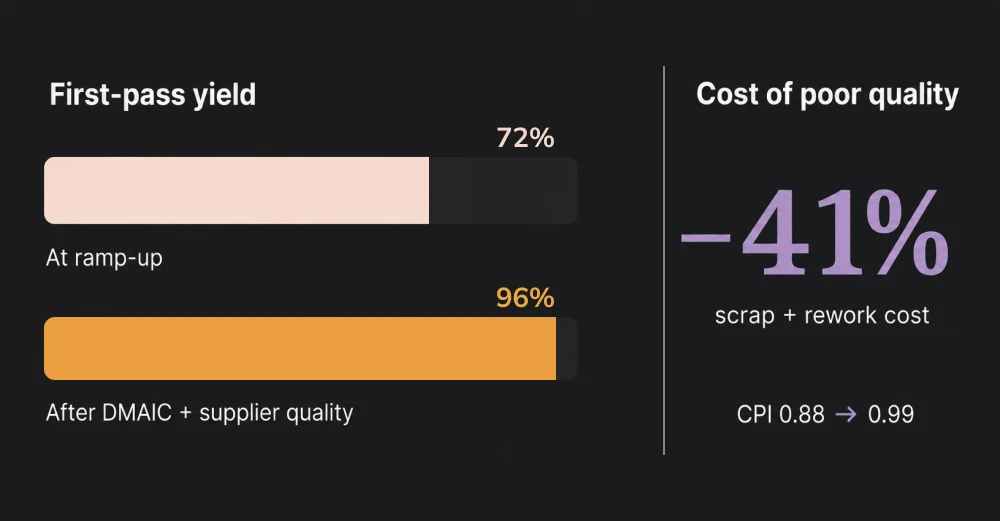
| First-pass yield | 72% | 96% |
| Cost of poor quality | Baseline | −41% |
| Cost Performance Index | 0.88 | 0.99 |
| Approach | Scale first, fix later | Stabilize, then scale |
LESSON THAT TRAVELSDon’t scale an unstable process, fix quality at the source first, because volume multiplies defects as fast as it multiplies output. Manufacturing PM →
5. Banking & Finance - A Core Migration Against an Immovable Deadline
Corvus Bank: migrating to a new core banking platform under a fixed regulatory reporting deadline · multi-vendor · complex data migration.
The Problem
Every degree of freedom a project manager usually has was gone. The deadline could not move (a regulatory mandate), the scope was largely fixed, the data migration was intricate, and multiple vendors had to synchronize. A failed cutover would mean a regulatory breach and customer-facing outages, the definition of unacceptable, under intense governance scrutiny.
The knowledge areas that carried the recoveryWhen scope and date are fixed, risk and readiness are the plan.
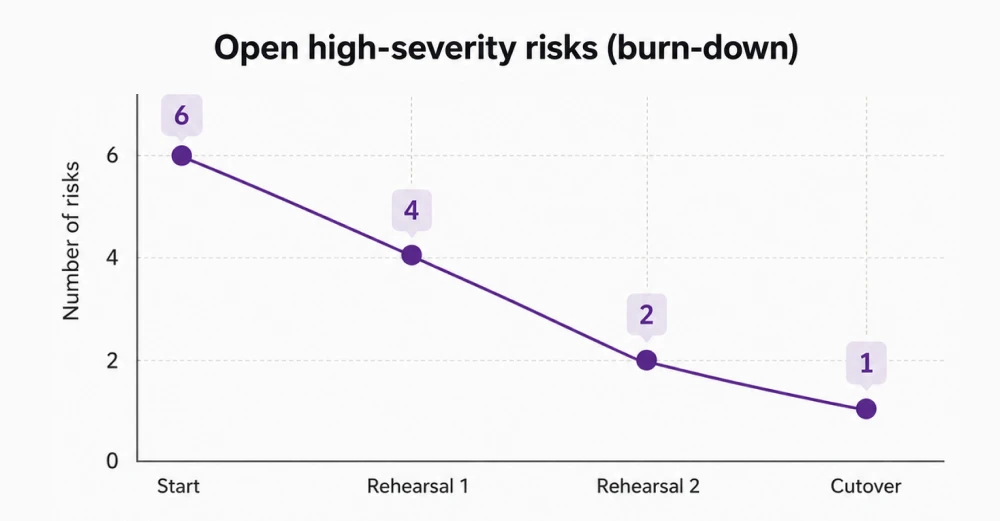
- Risk register: A live risk register with owned responses and a weekly burn-down tracked every open item to closure.
- Dress-rehearsal cutovers: The team rehearsed the migration in full to surface failures in practice, not in production.
- Rollback plan: Built and tested so “abort” was a real option, not a theoretical fallback.
- Governance: A hybrid cadence kept banking industry stakeholders and the regulator continuously informed, with Basel operational-risk reporting baked into every status cycle.
Contingency was reserved, not hoped for.
Risk Register (Extract)
| Risk | Prob. | Impact | Response | Owner |
|---|---|---|---|---|
| Failed cutover / regulatory breach | Low | V.High | Dress rehearsals; tested rollback | Program Director |
| Data-migration corruption | Med | High | Reconciliation; parallel run | Data Migration Lead |
| Multi-vendor desynchronization | Med | High | Integrated master schedule; joint war room | PMO |
| Customer-facing outage | Med | High | Off-peak window; comms plan | IT Ops |
Before vs. After
| Metric | Before | At cutover |
|---|---|---|
| Open high-severity risks | 6 | 1 |
| Dress-rehearsal cutovers | 0 | 3 (full) |
| Rollback plan | Untested | Tested & ready |
| Regulatory deadline | At risk | Met, no rollback |
LESSON THAT TRAVELSWhen the date is fixed, you manage everything else, risk, readiness, and a rehearsed fallback are the plan, not the contingency. Banking PM →
6. Energy - A Solar Farm Tied to a Grid-Connection Date
Solaris One: A 150 MW utility-scale solar PV farm · contracted grid-connection milestone · remote site · long-lead inverters and modules.
The Problem
The finish line belonged to someone else. A contracted grid-connection window, controlled by the grid operator and regulator, could not be moved, yet the project depended on long-lead inverters and modules, a remote site with logistics constraints, weather exposure, and a hazardous construction environment. Miss the window and the revenue clock (and penalties) started against the project.
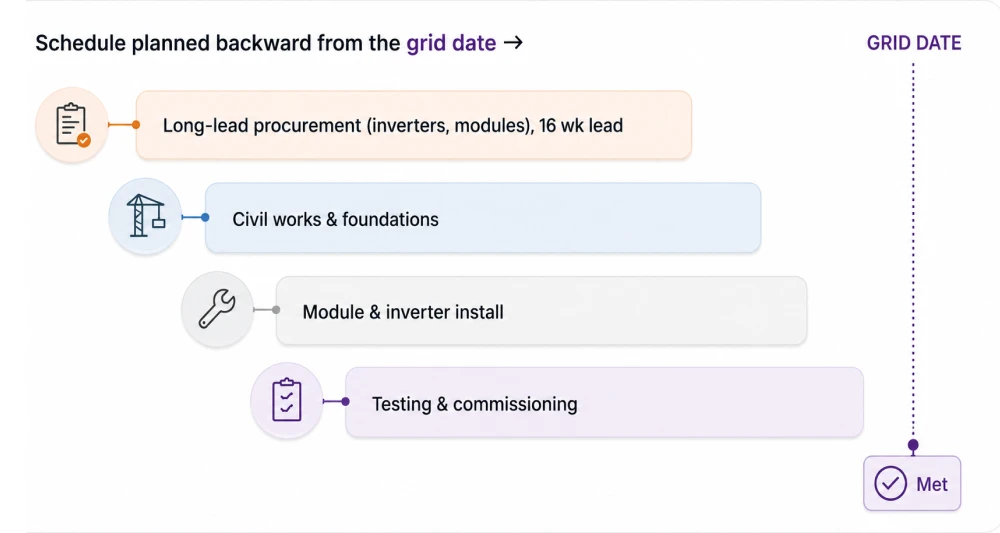
The knowledge areas that carried the recovery- Schedule & procurement: The manager mapped the critical path backward from the grid date and front-loaded long-lead procurement, ordering inverters 16 weeks ahead of need with milestone-based contracts. The project finished with a CPI of 1.04 and 11 days of schedule buffer remaining at grid connection.
- Stakeholders: The grid operator and regulator were managed as first-class stakeholders with their own communication cadence, because their approvals were on the critical path. All milestone submissions were aligned to NERC reliability standards and local grid-code requirements.
- Risk & HSE: A strict health-and-safety program governed a hazardous site, the discipline behind engineering project management.
Risk Register (Extract)
| Risk | Prob. | Impact | Response | Owner |
|---|---|---|---|---|
| Long-lead inverter / module delay | High | High | Order 16 wks ahead; dual-source | Procurement |
| Grid-connection approval delay | Med | V.High | Early application; grid-operator liaison | Stakeholder / PMO |
| Remote-site logistics constraint | Med | High | Staging area; buffer stock | Logistics |
| Working-at-height / electrical incident | Low | V.High | HSE plan; permit-to-work | HSE |
Results
| Metric | Approach / result |
|---|---|
| Grid-connection milestone | Met on the contracted date |
| Long-lead procurement | Ordered 16 weeks ahead; off the critical path |
| External stakeholders | Grid operator + regulator managed on their own cadence |
| Lost-time safety incidents | 0 |
LESSON THAT TRAVELSWhen your finish date belongs to someone else, schedule backward from their milestone and treat external parties as stakeholders you actively manage. Energy PM →
The Pattern Across All Six Industries
Line the six up and the thesis of this guide becomes concrete: PMP in different industries uses the same knowledge areas every time, but each industry concentrates its variance somewhere different, and the winning move is to aim the discipline there.
| Industry | Where variance concentrates | Signature PMP lever | Bellwether metric |
|---|---|---|---|
| Construction | Long-lead procurement on the critical path | EVM + schedule compression | CPI / SPI |
| IT & software | Requirement churn / scope creep | Hybrid delivery + change control | Scope stability / release cadence |
| Healthcare | Compliance + user adoption + safety | Risk + phased go-live + QA gates | Adoption / safety incidents |
| Manufacturing | Quality, defects & scrap | Quality mgmt + DMAIC + cost control | First-pass yield / CoPQ |
| Banking & finance | Fixed regulatory deadline + cutover risk | Risk-led planning + cutover readiness | Risk burn-down / on-time compliance |
| Energy | Procurement + external grid/regulatory dependency | Procurement + stakeholder + HSE | Milestone adherence / TRIR |
Real Projects That Prove the Point
The patterns in our six illustrative cases are not hypothetical. The same knowledge areas play out in publicly documented mega-projects:
- Heathrow Terminal 5 (2008): BAA’s £4.3 billion build is widely studied for the rigorous risk management and partnering contracts that delivered the structure on time and on budget. Yet the opening-week baggage-system collapse showed how a software go-live and user-readiness gap can undo months of construction discipline. The case is widely analyzed in project management literature, including Brady and Davies' "From hero to hubris" study in the International Journal of Project Management.
- Sydney Opera House (1973): Designed by architect Jørn Utzon, the Opera House is the textbook scope-and-estimation cautionary tale, opening a decade late at 14 times its original budget. The project exposed what happens when design and construction overlap without adequate scope control or cost baselining (documented in the NSW Government's 2017 Utzon Archives and the Australian Institute of Architects records).
- HealthCare.gov recovery (2013): After a catastrophic launch, a "tech surge" team applied triage-style project management, daily stand-ups, ruthless backlog prioritization, and incremental releases to stabilize the platform within weeks. It is one of the clearest modern examples of agile recovery under political and public scrutiny.
- Denver International Airport baggage system (1995): Built by BAE Automated Systems, the automated baggage handler became a classic lesson in scope creep and integration complexity, running 16 months late and $560 million over budget before the fully automated concept was scaled back.
These are real, publicly documented projects; the six cases above distill the same forces into teachable form. For more documented examples, see our project management case studies collection.
How to Diagnose Your Own Project in Five Steps
The through-line of all six cases is a repeatable diagnostic. Before reaching for a tool, run your project through these questions; the answers tell you where to point the discipline.
- Name the fixed constraint. Which of scope, time, cost, or quality genuinely cannot move? In banking it was the regulatory date; in healthcare, patient safety. Everything else flexes around it.
- Find where your variance concentrates. Look at your last three troubled projects: which knowledge area caused the biggest overruns? That is your pressure point.
- Pick one leading indicator. Choose a number that warns before the deadline, EVM (CPI/SPI) for delivery-heavy work, requirement churn (or the four DORA metrics that Nicole Forsgren, Jez Humble and Gene Kim validated in Accelerate) for software, risk burn-down for compliance, first-pass yield for production.
- Install a change gate. Route every change through a change-control board so nothing hits scope, schedule, or cost unassessed, the one fix common to all six recoveries.
- Set a data-based communication cadence. One credible status view and a clear RACI defuse the stakeholder friction that reassurance inflames.
Lessons That Generalize Everywhere
- Diagnose where your variance concentrates. Before choosing tools, ask which knowledge area your industry punishes hardest, then point the discipline there.
- Measure early with a leading indicator. EVM in construction, requirement churn in software, risk burn-down in finance, every industry has a number that warns before the deadline does.
- Control change everywhere. Scope creep is the one failure mode common to all six. A change process you actually enforce beats a plan you defend.
- Integration is the meta-skill. No lever moves alone: schedule, cost, risk, and quality decisions ripple into each other in every sector.
- Right-size the method. Predictive, agile, or hybrid, the delivery approach should match the industry’s uncertainty, not a template.
- Communicate with data. One credible, metric-based status view defuses the stakeholder friction that reassurance inflames.
Which Certification Fits Your Industry
Every case here rests on the same core discipline, which is why PMP certification is the common denominator across all six. What changes is the specialization worth pairing with it, based on where your industry concentrates its risk.
| Industry | Specialize with | Why this pairing |
|---|---|---|
| Construction | PMI-CP · Primavera P6 | Long schedules and EVM-heavy tracking need construction-specific scheduling tools |
| IT & Software | PMI-ACP · PRINCE2 Agile | Hybrid delivery blends predictive budgeting with iterative builds |
| Healthcare | PMI-RMP | Clinical safety and compliance gates make risk the dominant knowledge area |
| Manufacturing | Lean Six Sigma | Quality-at-source and defect reduction are the core recovery levers |
| Banking & Finance | PMI-RMP · PRINCE2 | Immovable regulatory deadlines demand structured risk and governance |
| Energy | PMI-CP · Primavera P6 | Grid-date constraints and long-lead procurement need critical-path precision |
The Bottom Line
Six industries, six very different failure modes, and one recovery pattern underneath them all: measure early, control change, and manage the whole as one system. The PMBOK knowledge areas don't promise you won't hit trouble; they give you the fastest way to see it, diagnose it, and act before a drift becomes a runaway. Master that, and the framework travels with you into any sector you choose.
Frequently Asked Questions
Can PMP be applied to any industry?
Yes. PMP is built on the PMBOK knowledge areas, integration, scope, schedule, cost, quality, resources, communications, risk, procurement, and stakeholders, which are industry-agnostic. What changes between sectors is which area carries the most risk, not whether the framework applies.
How does project management differ by industry?
The framework stays constant; the pressure points move. Construction is dominated by procurement and schedule, software by scope and change, healthcare by compliance and adoption, manufacturing by quality, finance by fixed deadlines and cutover risk, and energy by long-lead procurement and external dependencies.
Does PMP work for agile or software projects?
Yes. Modern project management is method-agnostic, predictive, agile, and hybrid delivery all sit within it. Software teams commonly run a hybrid model: a predictive backbone for budget and milestones with agile increments for the build, as in the IT case above.
Are these real case studies?
No. All six are illustrative composites created for teaching. The scenarios and figures are realistic and internally consistent but do not represent real projects, companies, or outcomes.
How do PMP case studies map to the PMP exam ECO domains?
Each case exercises all three ECO domains (People, Process, Business Environment) but concentrates differently. Construction and manufacturing are Process-heavy, driven by schedule compression, EVM, and quality control. Healthcare and banking are Business Environment-heavy, shaped by regulatory compliance and governance mandates. IT emphasizes People through stakeholder alignment, product-owner structures, and change management. See the ECO domain mapping table in the framework section above.
Does the 2026 PMP exam include case study questions?
Yes. The PMP exam updated in July 2026 includes scenario-based case study questions that present a project situation and ask you to choose the best action. The cases in this guide map to the same ECO domains (People, Process, Business Environment) the exam tests, so working through them builds the analytical habit the new format rewards.
How should I analyze a project management case study?
Use a five-part framework:
(1) identify the fixed constraint the project cannot change,
(2) find where variance concentrates, which knowledge area is causing the biggest overruns,
(3) name the knowledge areas involved in both the failure and the recovery,
(4) evaluate the intervention against alternatives, and
(5) extract the transferable lesson you can apply to your own projects.