
PMP Application Process: A Detailed Guide
Applying for the PMP can feel harder than preparing for the exam itself. Many candidates are not confused about whether they have project experience; they are confused about how to present it correctly. That is why understanding the pmp application process, the current pmp application requirements, and strong pmp experience examples matter so much before you submit your form. PMI’s official roadmap shows that the application asks for your education, experience, and exam details, and the certification handbook makes clear that all applications are subject to audit selection, even though only a percentage are actually audited.
This guide walks you through the PMP application from start to finish, explains what counts toward eligibility, shows how to write your project descriptions, and helps you avoid the most common mistakes that delay approval. If you are planning to apply soon, this article will help you do it with more confidence and fewer revisions.
What Is The PMP Application Process?
The pmp application process is the formal eligibility and approval workflow that candidates complete before scheduling the PMP exam. According to PMI’s candidate roadmap, the journey begins with checking eligibility, creating or logging in to a MyPMI account, opening the application, entering education and training details, documenting project experience, selecting exam details, and submitting the application. After submission, PMI reviews the application, may select it for audit, and once approved, the candidate pays the exam fee and schedules the exam.
This process is important because the PMP exam is not open-enrollment. PMI expects candidates to demonstrate that they already meet the education and project leadership background needed for the credential. That is why your application is not just administrative—it is a qualification document.
What Are The Current PMP Application Requirements?
The most important part of the process is understanding the current pmp application requirements. Based on PMI’s official certification page, candidates must meet one of the following eligibility paths before applying:
Option 1: Four-Year Degree Or Higher
If you hold a bachelor’s degree or higher, PMI requires:
- 36 months of experience leading and managing projects within the past eight years.
- 35 hours of project management education or training, or CAPM certification PMI.
Option 2: Secondary Diploma Or Associate-Level Equivalent
If you have a high school diploma, secondary school diploma, or associate-level equivalent, PMI requires:
- 60 months of experience leading and managing projects within the past eight years.
- 35 hours of project management education or training, or CAPM certification.
PMI’s candidate roadmap also confirms that if you already hold the CAPM certification, you do not need the separate 35 training hours to be eligible for PMP.
This means the application is built around three proof areas: your highest level of education, your project leadership experience, and your formal project management training or CAPM status.
Research Insight PMI reports 1.5M+ PMP certification holders worldwide, highlighting the scale and recognition of the credential globally. |
What Information Does PMI Ask For In The PMP Application?
PMI’s roadmap says the application has three main parts: Education, Experience, and Exam Options. In the education section, candidates indicate their highest level of education, the years studied, and the country where they studied. In the experience section, PMI asks for the name of each project and details about the candidate’s role on that project. PMI explicitly advises candidates to focus more on their role and responsibilities than on describing the project itself. The final part includes exam preferences, such as the testing method and any needed accommodations.
That guidance is more important than many candidates realize. PMI is not mainly evaluate whether your project sounded impressive. It is evaluating whether you led and managed work in a project environment. So your descriptions should emphasize planning, leading, coordinating, monitoring, stakeholder interaction, delivery, and outcomes, rather than only technical details or departmental tasks.
How Should You Document Project Experience Correctly?
This is where many candidates struggle. The safest approach is to describe your experience in a way that shows you led or managed project work, even if your official job title was not “Project Manager.” PMI’s certification page uses the phrase “experience leading and managing projects,” which is broader than holding a specific title.
When documenting experience, make sure each project entry clearly shows:
- The project context
- Your role
- What you led
- How you coordinated people or work
- What result the project achieved
Avoid turning your application into a job description. PMI wants project-based examples, not a list of routine responsibilities. Also, do not focus too much on the company’s success story while leaving your own contribution vague.
What Should Good Project Descriptions Emphasize?
Good descriptions usually emphasize:
- Initiating or organizing work
- Defining scope or requirements
- Building schedules or plans
- Leading teams or stakeholders
- Monitoring progress, risk, or budget
- Handling changes
- Delivering outcomes
That structure makes your role easy to understand and aligns with how PMI frames project leadership capability.
|
Pro Tip Write your project descriptions as if you are providing leadership, not just participation. “Supported project activities” is weak. “Led planning, coordinated stakeholders, tracked milestones, and delivered implementation” is much stronger. |
What Are Good PMP Experience Examples?
Candidates often search for pmp experience examples because they want to know how detailed or leadership-focused their descriptions should be. Below are practical sample formats you can adapt. These are illustrative writing examples, not official PMI templates.
PMP Experience Example For A Software Implementation Project
Project: CRM Implementation For Sales And Support Teams
Role: Project Lead
Description: Led a cross-functional CRM implementation project for sales and support teams across multiple locations. Defined requirements with business stakeholders, coordinated vendor and internal technical teams, developed the project schedule, tracked milestones and risks, facilitated status reviews, managed scope changes, and supported user readiness activities through rollout. Delivered the solution on schedule and improved visibility into customer interactions.
PMP Experience Example For A Process Improvement Project
Project: Procurement Cycle Time Reduction Initiative
Role: Operations Project Coordinator
Description: Managed a process improvement project aimed at reducing procurement turnaround time. Gathered baseline performance data, facilitated stakeholder workshops, identified bottlenecks, developed an implementation plan, coordinated process owners, tracked progress against milestones, and monitored post-implementation performance. The project reduced delays and improved internal service efficiency.
PMP Experience Example For An Infrastructure Upgrade Project
Project: Network Upgrade Across Regional Offices
Role: Infrastructure Lead
Description: Directed planning and execution activities for a regional network upgrade across multiple office locations. Worked with business stakeholders and technical teams to define rollout needs, built the implementation schedule, managed dependencies, coordinated communication plans, monitored risks and issues, and oversaw deployment readiness and transition support. The project improved network reliability and reduced recurring service disruption.
These pmp experience examples work better because they focus on leadership actions, coordination, planning, monitoring, and delivery. They do not just say “worked on” or “helped the team.”
What Are The Exact Steps In The PMP Application Process?
The pmp application process is more than filling out an online form. It is a structured eligibility workflow designed by PMI to verify that candidates meet the education, training, and project leadership requirements before they can schedule the exam. According to PMI’s official roadmap, candidates move through a sequence that begins with eligibility checks and ends with exam scheduling after approval and payment. Understanding each step in advance can save time, reduce confusion, and help you avoid mistakes that lead to delays or audit stress.
Step 1: Confirm That You Meet The PMP Eligibility Criteria
Before you even open the application, verify that you satisfy the current pmp application requirements. If you have a four-year degree or higher, you need 36 months of experience leading and managing projects within the past eight years, along with 35 hours of project management education or training, or CAPM certification. If you have a secondary diploma or associate-level equivalent, you need 60 months of experience plus the same training or CAPM alternative. This first step matters because the application review is based on these requirements, not on your intention to prepare later.
Step 2: Create Or Log Into Your MyPMI Account
PMI’s roadmap identifies your MyPMI account as the dashboard for the entire certification journey. This is where you open the application, submit your details, receive status updates, complete payment, and eventually schedule your exam. Think of it as your central PMP control panel. If you do not already have an account, setting it up is the first operational step before entering any application details.
Step 3: Enter Your Education And Training Information
The application then asks for your academic background and your qualifying training. PMI’s candidate roadmap says you must indicate your highest level of education, the years in which you studied, and the country of study. You also need to provide details of your qualifying project management education unless you already hold the CAPM certification, which PMI recognizes as satisfying the PMP training requirement. This section is usually straightforward, but it is important to enter it accurately because the same details may need to be supported if your application is selected for audit.
Step 4: Document Your Project Experience Carefully
This is the most important part of the pmp application process and usually the part that takes the most time. PMI asks you to provide the name of each project and details about your role on that project. Its roadmap specifically advises candidates to focus on their own role and responsibilities, not just on the project background. That means you should explain how you led or managed work, coordinated stakeholders, handled schedules, monitored progress, addressed issues, or drove delivery outcomes. This is the section where strong, leadership-focused writing makes a real difference.
A good way to approach this step is to prepare your projects in advance outside the form. Gather the project name, dates, your position, and a concise summary showing your leadership contribution. Candidates often get delayed here because they try to write directly into the form without organizing their experience first. If you prepare your project descriptions beforehand, the actual submission becomes much smoother.
Step 5: Select Your Exam Details And Accommodations If Needed
After entering your education and experience, you complete the exam-related portion of the application. PMI’s roadmap notes that this includes details such as where and how you plan to take the exam and whether you need testing accommodations. At this stage, you are not yet scheduling the exam date, but you are completing the application settings that support the next part of the process. It is also a good time to start thinking about whether you prefer a test center or online proctored testing.
Step 6: Review Everything And Submit The Application
Once all sections are complete, review your entries before you click submit. This is the moment to check dates, wording, training details, and project descriptions for consistency. PMI’s handbook makes clear that by submitting the application, you agree to comply with the audit process and the certification agreement. That means submission is not just administrative; it is your formal declaration that the information is complete and accurate.
Step 7: Wait For PMI To Review Your Application
After submission, PMI reviews the application and notifies you by email regarding the next steps. In many cases, this leads directly to approval, but some applications are selected for audit. PMI states that all applications are subject to audit, though only a percentage are chosen. This means candidates should treat every application as if it may be reviewed more deeply and keep supporting records ready from the start.
Step 8: Complete The Audit If Your Application Is Selected
If your application is selected for audit, PMI notifies you before payment. According to the handbook, you then have 90 days to submit the requested documentation. This may include proof of degree or diploma, signatures or verification for experience, and evidence of the required training hours. PMI says the audit review generally takes about 5 to 7 business days once your documentation is received. While candidates often worry about this step, it is manageable when your application has been prepared honestly and your records are organized.
Step 9: Pay The Exam Fee After Approval
Once your application is approved, the next step is payment. PMI’s handbook explains that after the certification fee is paid, you receive your PMI Eligibility ID, which is needed to schedule your exam appointment. This means application approval alone does not book the exam; payment is the gateway to scheduling.
Step 10: Schedule Your Exam And Lock In Your Timeline
After payment, you can schedule your PMP exam. PMI allows candidates one year of eligibility after approval and payment, and within that one-year period, you may take the exam up to three times. PMI’s roadmap also encourages candidates not to wait too long to schedule, because having an exam date helps create focus and structure for the study plan. In practical terms, this is the transition point at which the application phase ends and exam preparation becomes the main priority.
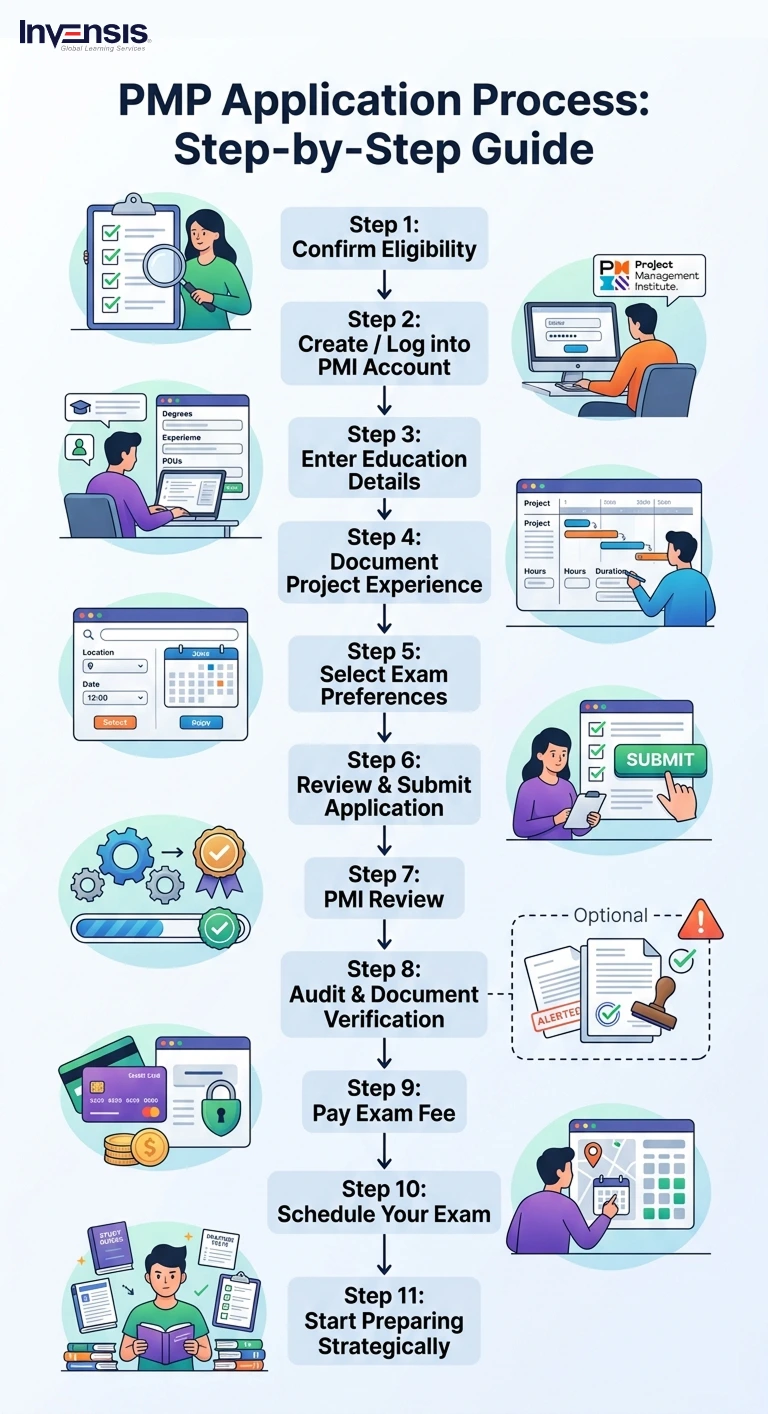
Step 11: Start Preparing Strategically Once Your Application Is Accepted
Although not technically part of form submission, this is a vital part of the real-world process. PMI’s roadmap suggests building your study plan while your application is in progress and committing to it once accepted. If you still need structured prep support, PMP Certification Training can help candidates meet the training requirement while building exam readiness. For candidates who do not yet qualify for PMP, CAPM Certification Training can be a useful alternative starting point.
What Happens If Your PMP Application Is Audited?
An audit is not a rejection. It is a verification step. PMI’s handbook says that if your application is selected for audit, you will be notified before you pay the certification fee. You then have 90 days to submit supporting documentation, which may include proof of degree or diploma, signatures verifying project experience, and proof of training hours from the education provider. PMI says the audit review takes approximately 5 to 7 business days once the documentation is received.
The most important thing here is preparation. If you document your projects honestly, keep your training records organized, and make sure your experience can be verified, an audit is manageable. PMI also notes that by submitting the application, candidates agree to comply with the audit process and the certification agreement.
What Mistakes Commonly Delay PMP Application Approval?
The first common mistake is writing vague descriptions of experience. If the reviewer cannot see how you led or managed project work, your experience may look too operational or functional.
The second mistake is focusing on the project itself rather than on your role. PMI explicitly advises candidates to describe their own role and responsibilities, not just the project background.
The third mistake is misunderstanding training eligibility. Some candidates assume any informal learning counts, but the requirement is specifically 35 hours of project management education or training unless CAPM already satisfies that requirement.
The fourth mistake is waiting too long after approval. PMI gives you one year of eligibility after approval, and you can take the exam up to three times during that year.
How Can You Prepare Before Starting The PMP Application?
The best approach is to gather everything before you log in. That includes:
- Your degree details
- Your training certificate or CAPM details
- A list of qualifying projects
- Start and end dates
- Your role on each project
- Concise leadership-focused descriptions
You should also think about the path after approval. PMI’s roadmap encourages candidates to begin planning their study approach while the application is under review.
If you still need the required training hours, PMP Certification Training from a PMI-authorized provider can help satisfy the education requirement while also preparing you for the exam. Invensis Learning presents its PMP course as a structured, PMI-aligned training option designed to build practical understanding of project management processes and to prepare for the exam.
For broader options, you can also explore Project Management Certification Courses or strengthen your fundamentals through Project Management Fundamentals Training.
Conclusion
The pmp application process is not just a formality. It is the stage at which you demonstrate that your education, training, and project leadership background align with PMI’s standards. The key to success is understanding the official pmp application requirements, preparing documentation in advance, and writing clear, leadership-focused project descriptions.
If you remember only one thing, make it this: PMI wants evidence that you led and managed projects, not simply that you worked in a project environment. That is why reviewing good pmp experience examples, organizing your records, and aligning your wording with real project responsibilities can make the difference between a smooth approval and a frustrating rewrite.
Frequently Asked Questions
1. What Are The PMP Application Requirements?
The main pmp application requirements are based on your education level. With a four-year degree or higher, you need 36 months of experience leading and managing projects within the past eight years plus 35 hours of project management education or training, or CAPM certification. With a secondary diploma or associate-level equivalent, you need 60 months of experience plus the same training or CAPM alternative.
2. Does CAPM Count Toward The PMP Training Requirement?
Yes. PMI states that CAPM certification can satisfy the 35 hours of project management education requirement for PMP eligibility.
3. What Should PMP Experience Examples Include?
Good pmp experience examples should show that you led or managed project work. That means describing planning, stakeholder coordination, execution oversight, risk or issue management, monitoring, and delivery outcomes, not only listing routine job tasks.
4. What Happens If PMI Audits My Application?
If selected for audit, PMI notifies you before payment. You have 90 days to submit supporting documentation, and PMI says audit processing typically takes 5 to 7 business days after they receive the documents.
5. How Long Do I Have To Take The PMP Exam After Approval?
Once your application is approved, PMI gives you a one-year eligibility period. You can take the exam up to three times within that one-year period.
6.What If I Do Not Yet Meet PMP Eligibility?
If you do not yet meet the PMP experience threshold, CAPM can be a smart intermediate credential. Invensis Learning describes CAPM as an entry-point certification for aspiring project management professionals who want to build foundational PMI-aligned knowledge.
Popular Training Categories
Popular Courses
- PMP Certification
- PRINCE2 Certification
- Change Management Certification
- ITIL Foundation Certification
- CAPM Certification
- Lean Six Sigma Green Belt Certification
- Lean Six Sigma Black Belt Certification
- Root Cause Analysis Training
- Lean Fundamentals Training
- Six Sigma Awareness Training
- Kaizen Training
- VSM Training
- DevOps Foundation Certification
- COBIT 5 Certification
- SIAM Certification
- MS Project Training
- Project Management Fundamentals Training
- Lean Project Management Training
- Scrum Fundamentals
- CSM Certification
- CSPO Certification
- PMI®, PMP®, CAPM®, PMI-ACP®, PMBOK are registered marks of the Project Management Institute. Inc.
- ITIL® is a registered trade mark of AXELOS Limited, used under permission of AXELOS Limited. All rights reserved
- PRINCE2® is a registered trademark of AXELOS Limited, used under permission of AXELOS Limited. All rights reserved
- PRINCE2™ Agile are trade marks of AXELOS Limited, used under permission of AXELOS Limited. All rights reserved
- The Swirl logoTM is a trade mark of AXELOS Limited, used under permission of AXELOS Limited. All rights reserved
- DevOps Foundation® is registerd mark of the DevOps institute®
- CSM, A-CSM, CSPO, A-CSPO, and CAL are registered trademarks of Scrum Alliance
- Invensis Learning is an Accredited Training Provider of EXIN for all their certification courses and exams