



In today’s complex business environment, where 93% of organizations report that executives lack understanding of PMO value, the role of a PMO Director has never been more critical. As organizations face increasing pressure to deliver projects that align with strategic objectives while maximizing resource efficiency, PMO Directors serve as the linchpin connecting executive vision with operational execution.
The PMO Director stands at the intersection of strategy and delivery, responsible for establishing governance frameworks, optimizing portfolio performance, and demonstrating tangible business value. With only 61% of PMOs currently cited as successful by project practitioners, the need for skilled PMO Directors who can navigate organizational complexities and drive meaningful outcomes has reached unprecedented levels.
This comprehensive guide explores the multifaceted responsibilities of PMO Directors, from strategic planning and governance development to stakeholder management and continuous improvement. Whether you’re aspiring to become a PMO Director or looking to enhance your current performance, you’ll gain actionable insights into what it takes to excel in this pivotal leadership role.
Table Of Contents
- Understanding the Project Management Office (PMO) Director Role
- Core Responsibilities of a Project Management Office (PMO) Director
- Essential Skills and Competencies
- Challenges Faced by PMO Directors
- Best Practices for PMO Directors
- Career Path and Professional Development
- The Future of the PMO Director Role
- Conclusion
- Frequently Asked Questions
Understanding the Project Management Office (PMO) Director Role
What is a Project Management Office (PMO) Director?
A PMO Director is a senior executive responsible for leading the Project Management Office (PMO) and establishing the strategic direction for project and program delivery across the organization. Unlike project managers who focus on individual projects, PMO Directors operate at the portfolio level, overseeing multiple projects simultaneously while ensuring alignment with organizational strategy.
The PMO Director role has evolved significantly over the past decade. Today’s PMO Directors are strategic business partners who bridge the gap between C-suite executives and project delivery teams. They’re responsible for building and maintaining the infrastructure that enables consistent, successful project delivery while demonstrating measurable business value.
| “77% of PMOs rely on temporary project management resources, reflecting a trend towards flexible staffing models and the growing adoption of PMO as a Service.” |
PMO Director vs. Other PMO Roles
Understanding the distinction between PMO Directors and other roles within the project management hierarchy is essential:
- PMO Director vs. PMO Manager: While PMO Managers focus on day-to-day operations, process implementation, and team coordination, PMO Directors set strategic direction, secure executive sponsorship, and make high-level decisions about portfolio prioritization and resource allocation.
- PMO Director vs. Program Manager: Program Managers deliver specific programs with defined outcomes, whereas PMO Directors establish the governance frameworks and standards that all programs follow.
- PMO Director vs. Project Manager: Project Managers execute individual projects; PMO Directors design and oversee the entire project delivery ecosystem.
Core Responsibilities of a Project Management Office (PMO) Director
Strategic Planning and Portfolio Alignment
At the heart of the PMO Director role lies the critical responsibility of aligning the project portfolio with organizational strategy. This involves translating executive vision into actionable project initiatives that drive business value.
Strategic Portfolio Management: PMO Directors work closely with C-suite executives to understand business objectives, market dynamics, and strategic priorities. They develop comprehensive portfolio roadmaps that balance short-term deliverables with long-term strategic investments. This requires analyzing market trends, assessing organizational capacity, and making difficult trade-off decisions about which initiatives receive funding and resources.
- Project Prioritization and Selection: With limited resources and competing demands, PMO Directors must establish rigorous criteria for evaluating and prioritizing projects. They develop scoring models that consider factors such as strategic alignment, return on investment, risk profile, resource availability, and dependencies. Research shows that organizations with formalized prioritization processes achieve 73.8% average project performance rates, significantly higher than those without structured approaches.
- Long-Term Roadmap Development: Effective PMO Directors think beyond individual projects to create multi-year roadmaps that sequence initiatives logically, manage dependencies, and ensure sustainable resource utilization. They anticipate future organizational needs, technological shifts, and market changes to position the organization for continued success.
- Resource Allocation at Portfolio Level: Strategic resource allocation involves balancing demands across the entire portfolio while maintaining flexibility to respond to emerging priorities. PMO Directors must make difficult decisions about resource reallocation, managing stakeholder expectations when projects are deprioritized or delayed in favor of higher-value initiatives.
|
“Project success is no longer just about delivering on budget, scope or schedule.” Chinedu Mbonu, |
 |
Governance Framework Development and Enforcement
Establishing and maintaining robust governance structures is fundamental to PMO Director success. Without clear governance, even the most promising projects can falter due to unclear decision rights, inconsistent processes, or inadequate oversight.
- Governance Structure Design: PMO Directors design multi-layered governance structures that define decision-making authority at different organizational levels. This includes establishing steering committees, project boards, and working groups with clearly defined roles, responsibilities, and escalation paths. Effective governance balances control with empowerment, ensuring appropriate oversight without creating bureaucratic bottlenecks.
- Standards and Methodologies: A critical PMO Director responsibility involves selecting, adapting, and implementing project management methodologies that fit organizational culture and project types. Whether choosing Agile, Waterfall, Hybrid, or framework combinations like SAFe® or PRINCE2®, PMO Directors must ensure methodologies drive value rather than simply creating process overhead. Data shows that organizations with standardized methodologies achieve 28% higher project success rates.
- Compliance and Quality Assurance: PMO Directors establish quality gates, review processes, and audit mechanisms to ensure projects adhere to organizational standards, regulatory requirements, and best practices. They create quality checklists, define deliverable acceptance criteria, and implement continuous quality monitoring to catch issues early when they’re less expensive to address.
- Risk Management Frameworks: Enterprise risk management falls squarely within the PMO Director’s purview. They establish risk identification processes, assessment criteria, mitigation strategies, and escalation protocols. Beyond individual project risks, PMO Directors must identify and manage portfolio-level risks such as resource constraints, technological dependencies, and strategic misalignment.
- Gate Review Processes: Implementing stage-gate reviews at critical project milestones enables PMO Directors to make informed go/no-go decisions. These gates serve as quality checkpoints, ensuring projects meet criteria before advancing to subsequent phases and preventing wasteful investment in initiatives unlikely to succeed.
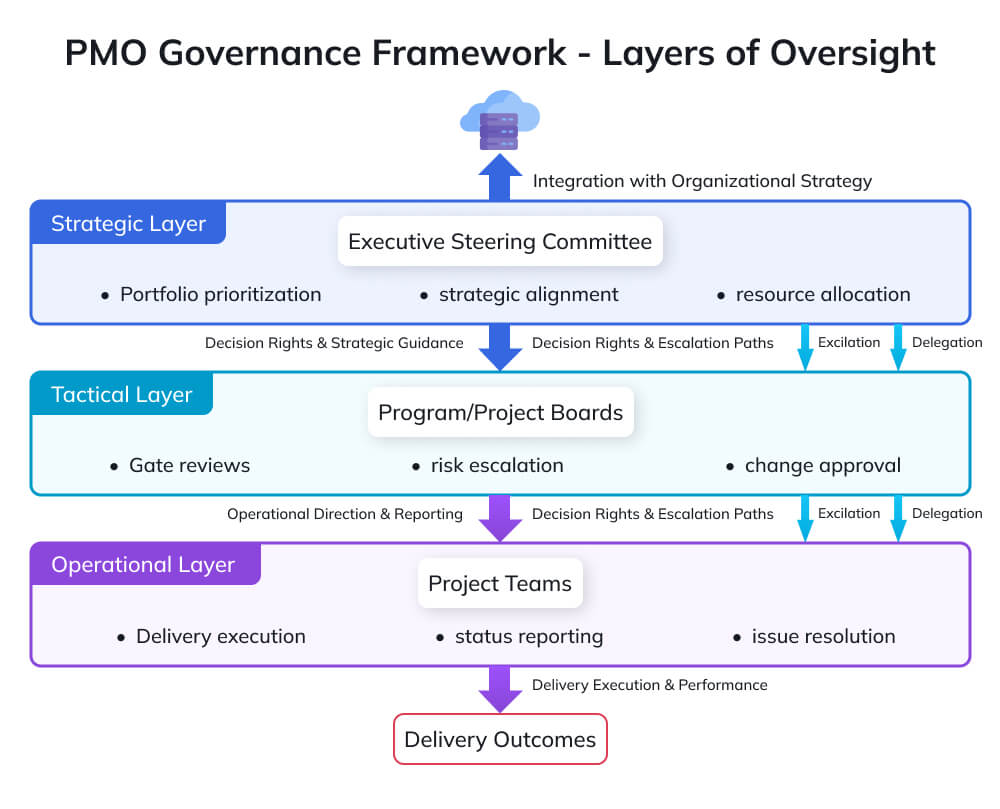
Resource Management and Optimization
In an era where organizations face persistent talent shortages and competing demands, effective resource management separates high-performing PMOs from those struggling to deliver value.
- Cross-Project Resource Allocation: PMO Directors must maintain a holistic view of resource availability and utilization across the entire portfolio. This involves sophisticated resource modeling that considers skills, availability, costs, and strategic priorities. They balance immediate project needs against long-term capability development, making trade-offs that optimize organizational outcomes rather than individual project success.
- Capacity Planning and Forecasting: Proactive PMO Directors look 6-12 months ahead to anticipate resource needs, identify capability gaps, and develop strategies to address shortfalls. This might involve hiring decisions, training investments, contractor engagement, or portfolio adjustments to match available capacity. With 77% of PMOs utilizing temporary resources, effective capacity planning increasingly includes flexible staffing strategies.
- Talent Development and Skill Gap Analysis: Beyond managing current resources, PMO Directors must build organizational capability for the future. They assess current skill inventories, identify emerging capability requirements, and design development programs that prepare the organization for evolving project demands. This includes technical upskilling, methodology training, and leadership development.
- Vendor and Contractor Management: As organizations increasingly leverage external resources, PMO Directors establish vendor management processes, contracting standards, and performance oversight mechanisms. They develop strategic vendor partnerships that provide flexibility while maintaining quality and protecting intellectual property.
- Budget Oversight and Financial Management: Financial stewardship represents a critical PMO Director responsibility. They develop and manage PMO budgets, track portfolio-level financial performance, and ensure appropriate financial controls. This includes capital allocation decisions, operating expense management, and demonstrating return on investment for PMO operations and project portfolios.
| PRO TIP: Implement a Skills Matrix and Resource Heat Map
Create a dynamic skills inventory that tracks not just availability but competency levels across critical capabilities. Pair this with a visual “resource heat map” showing allocation across the portfolio. This enables data-driven resource decisions, identifies burnout risks early, and supports strategic talent acquisition. Update monthly and share with executives to demonstrate resource constraints and justify additional investments. |
Stakeholder Management and Communication
The ability to manage diverse stakeholder groups and communicate effectively across organizational levels often determines PMO Director success more than technical project management expertise.
- Executive-Level Reporting and Dashboards: PMO Directors must distill complex portfolio information into executive-friendly formats that enable strategic decision-making. This involves creating intuitive dashboards highlighting portfolio health, strategic alignment, risk exposure, and value delivery. Effective executive reporting focuses on business outcomes rather than project mechanics, using metrics that resonate with C-suite priorities.
- Managing Stakeholder Expectations: With multiple projects competing for attention and resources, PMO Directors continually manage stakeholder expectations about what’s possible given constraints. This requires diplomatic skill in delivering difficult messages, negotiating scope adjustments, and building consensus around prioritization decisions that inevitably disappoint some stakeholders.
- Building Cross-Functional Relationships: Successful PMO Directors cultivate relationships across departments, breaking down silos that impede project delivery. They position the PMO as a business partner rather than a bureaucratic oversight function, demonstrating how PMO services enable departmental success.
- Communication Strategy Development: Beyond individual communications, PMO Directors design comprehensive communication strategies that ensure appropriate information flows to right audiences at right frequencies. This includes stakeholder analysis, communication channel selection, messaging frameworks, and feedback mechanisms.
- Conflict Resolution at Organizational Level: Resource conflicts, priority disagreements, and strategic misalignments inevitably arise in complex organizations. PMO Directors serve as neutral arbiters, facilitating resolution through established governance processes, data-driven analysis, and consensus-building techniques.
| SUCCESS STORY
Client: Royal Bank of Scotland (RBS) Industry: Banking / Finance & Insurance Challenge: Multiple PPM tools and mixed methodologies across the bank made it hard to get a reliable, enterprise-wide portfolio view, slowing innovation and increasing costs. Solution: Standardized portfolio reporting on a single platform, integrated with finance and HR systems, and shifted to Lean Portfolio Management practices, giving leaders a consistent, near real-time view of portfolio status, issues, dependencies, and outcomes through dashboards. Results:
|
PMO Operations and Continuous Improvement
Operational excellence in PMO management ensures consistent, repeatable success while creating capacity for continuous enhancement.
- PMO Team Leadership and Development: PMO Directors build and lead high-performing teams comprising project managers, analysts, coordinators, and specialists. This involves recruitment, performance management, professional development, and team culture building. Effective PMO Directors create environments where team members feel valued, challenged, and positioned for career growth.
- Tools and Technology Selection: Selecting appropriate project management tools and technologies significantly impacts PMO effectiveness. PMO Directors evaluate options against organizational needs, lead implementation efforts, and drive adoption. However, research shows only 50% of PPM tool features are actively utilized, highlighting the importance of change management and training alongside technology investment.
- Process Optimization and Standardization: While standardization enables consistency, PMO Directors must balance process discipline with flexibility that accommodates different project types and organizational cultures. They regularly review processes to eliminate unnecessary bureaucracy, streamline workflows, and remove barriers to project success.
- Metrics Definition and Performance Tracking: “What gets measured gets managed” applies particularly to PMO operations. PMO Directors establish key performance indicators (KPIs) that track portfolio health, project performance, resource utilization, and business value delivery. Critically, they ensure metrics drive beneficial behaviors rather than gaming or perverse incentives.
- Lessons Learned Management: Mature PMOs capture, analyze, and apply lessons learned across projects, turning individual experiences into organizational knowledge. PMO Directors establish systematic approaches to lessons identification, documentation, and integration into future project planning and execution.
Essential Skills and Competencies
Leadership and Interpersonal Skills
The PMO Director role demands sophisticated leadership capabilities that extend beyond traditional project management skills:
- Strategic Thinking and Vision: Ability to see beyond immediate projects to envision how the PMO and portfolio contribute to long-term organizational success
- Influence and Persuasion: Skill in gaining buy-in without direct authority, convincing stakeholders through logic, data, and relationship capital
- Emotional Intelligence: Understanding and managing emotions—both your own and others’—to navigate complex stakeholder dynamics
- Change Management: Leading organizational transformation as PMO maturity evolves and new processes, tools, or methodologies are introduced
Technical and Methodological Expertise
While leadership is paramount, PMO Directors must maintain credibility through deep technical knowledge:
- Project Management Methodologies: Comprehensive understanding of Agile, Waterfall, Hybrid approaches, and frameworks like SAFe®, PRINCE2®, and PMI standards
- PMO Tools and Software: Proficiency with portfolio management tools, collaboration platforms, and emerging AI-powered project technologies
- Financial Management: Budget development, financial analysis, cost-benefit evaluation, and ROI calculation
- Data Analysis and Reporting: Ability to extract insights from project data, identify trends, and present findings compellingly
Business and Industry Acumen
PMI’s 2025 Pulse of the Profession report emphasizes business acumen as the critical differentiator for project professional success:
- Understanding Business Operations: Knowledge of how different organizational functions interact and contribute to business objectives
- Industry Knowledge: Awareness of industry trends, competitive dynamics, regulatory environment, and technological disruptions
- Organizational Dynamics: Insight into corporate culture, political realities, and informal power structures that influence project outcomes
| PRO TIP: Invest in Business Acumen Development
According to PMI’s 2025 research, business acumen is the #1 differentiator for project success. Dedicate time weekly to understanding your organization’s business model, revenue drivers, and strategic challenges. Read analyst reports about your industry, attend business strategy meetings, and build relationships with finance and operations leaders. This business fluency transforms you from a project administrator to a strategic advisor executives value. |
Challenges Faced by PMO Directors
Common Challenges
Even experienced PMO Directors encounter significant obstacles that can undermine PMO effectiveness:
- Resistance to PMO Initiatives: The statistic that 93% of unsupported PMOs report executives lack understanding of PMO value reflects a fundamental challenge. Project teams may view PMO processes as bureaucratic overhead, while executives question PMO ROI. Overcoming this resistance requires persistent communication of value, quick wins that demonstrate impact, and flexibility in approach.
- Demonstrating PMO Value: With 70% of PMOs lacking formal value assessment processes, many struggle to quantify their contributions. PMO Directors must develop compelling metrics that connect PMO activities to business outcomes—showing not just project completion rates but strategic goal achievement, risk avoidance, and efficiency gains.
- Balancing Control and Flexibility: Too much control stifles innovation and slows delivery; too little creates chaos and inconsistency. Finding the right balance requires understanding organizational culture, project complexity, and risk tolerance while remaining adaptable as these factors evolve.
- Resource Constraints: Perpetual resource shortages force PMO Directors to make difficult allocation decisions, often disappointing stakeholders whose projects are delayed or deprioritized. This challenge intensifies during economic uncertainty when budgets tighten and hiring freezes occur.
- Keeping Pace with Organizational Change: As organizations restructure, pivot strategically, or face market disruptions, PMO Directors must rapidly adapt portfolio priorities, governance approaches, and delivery methodologies while maintaining team morale and stakeholder confidence.
| AVOID THIS MISTAKE
Implementing Comprehensive Governance Before Establishing Value Why it’s problematic: New PMO Directors often start by implementing elaborate governance frameworks, processes, and reporting requirements. This creates perception of bureaucracy before stakeholders experience PMO value, generating resistance that’s difficult to overcome. What to do instead: Begin with targeted “lighthouse projects” where PMO support demonstrably improves outcomes. Build governance incrementally based on lessons learned, involving stakeholders in design. Establish value perception first, then gradually introduce process discipline. This approach builds support that makes subsequent governance adoption much smoother. |
KEY TAKEAWAYS
- PMO Director challenges are primarily organizational and political rather than technical
- 93% of unsupported PMOs cite executive misunderstanding of value as the key barrier
- Demonstrating measurable business value is critical to overcoming resistance
- Balance between control and flexibility must match organizational culture and maturity
- Resource constraints require transparent prioritization frameworks and stakeholder alignment
Best Practices for PMO Directors
Drawing from industry research and practitioner experience, these best practices enhance PMO Director effectiveness:
- Focus on Value Delivery, Not Just Process: Establish PMO services based on organizational needs rather than theoretical frameworks. Regularly survey stakeholders about which PMO activities deliver value and which create friction. Eliminate or streamline low-value activities even if they’re “standard practice.”
- Build Strong Executive Relationships: Invest time developing relationships with C-suite executives and key business leaders. Understand their priorities, speak their language, and position PMO services as enablers of strategic goals. Regular executive briefings keep the PMO visible and valued.
- Embrace Flexibility and Adaptability: Recognize that one size doesn’t fit all. Tailor governance rigor, methodology selection, and reporting requirements to project characteristics. Allow teams autonomy within guardrails rather than mandating rigid processes.
- Invest in PMO Team Development: Your PMO team’s capabilities directly determine PMO effectiveness. Provide professional development opportunities, certifications, mentoring, and challenging assignments. Build a reputation as a place where project professionals develop their careers.
- Leverage Technology Effectively: While only 50% of PPM tool capabilities are typically utilized, the solution isn’t more features—it’s better change management. Ensure tools solve real problems, provide adequate training, and hold users accountable for adoption. Consider consolidating tools to reduce complexity.
- Measure and Communicate Impact: Develop a balanced scorecard of PMO metrics covering strategic alignment, operational efficiency, stakeholder satisfaction, and business value. Share results regularly and transparently, celebrating successes and addressing shortfalls.
Career Path and Professional Development
Path to Becoming a PMO Director
The journey to PMO Director typically follows one of several career trajectories:
- Traditional Project Management Path: Most PMO Directors advance through project management roles—Project Coordinator → Project Manager → Senior Project Manager → Program Manager → PMO Manager → PMO Director. This progression typically requires 10-15 years, building technical expertise and leadership capability.
- Functional Leadership Path: Some PMO Directors transition from functional leadership roles (IT Director, Operations Manager, Business Unit Leader) where they’ve led strategic initiatives and managed cross-functional teams. These professionals bring strong business acumen but may need to develop project management methodology expertise.
- Consulting Path: Management consultants specializing in project delivery often transition into internal PMO Director roles, bringing best practices exposure and change management skills developed across client engagements.

Certifications and Training
Professional certifications significantly enhance PMO Director credibility and effectiveness:
Essential Certifications:
- PMP® (Project Management Professional): The foundational certification demonstrating project management expertise
- PgMP® (Program Management Professional): Particularly relevant for PMO Directors overseeing complex program portfolios
- PMI-RMP® (Risk Management Professional): Valuable for PMO Directors emphasizing enterprise risk management
Advanced Certifications:
- PfMP® (Portfolio Management Professional): The highest PMI certification, ideal for PMO Directors operating at portfolio level
- PMO-CP (PMO Certified Practitioner): Specialized certification focused specifically on PMO operations
- SAFe® Program Consultant (SPC): Relevant for PMO Directors in organizations adopting Scaled Agile
- Leadership Development: Beyond technical certifications, pursue executive leadership programs, business acumen training, and change management certifications to develop the soft skills critical to PMO Director success.
Salary Expectations
PMO Director compensation varies significantly based on organization size, industry, geography, and experience level:
United States Salary Ranges (2024-2025 Data):
- Average: $146,778 per year ($71/hour)
- 25th Percentile: $115,500 per year
- 75th Percentile: $161,500 per year
- Top Earners: $190,000+ per year
- Premium Markets: Major metropolitan areas (San Francisco, New York, Boston) often see salaries $200,000-$245,000+
Factors Affecting Compensation:
- Organization size and industry sector (financial services and technology typically pay highest)
- Portfolio size and budget responsibility
- Years of experience and track record of success
- Educational credentials and professional certifications
- Geographic location and local market conditions
| TAKE THE NEXT STEP
Advance Your PMO Career with PMP® and PgMP® Certification Ready to accelerate your journey to PMO Director? Invensis Learning offers comprehensive certification training that prepares you for leadership roles in project, program, and portfolio management. What you’ll gain:
|
The Future of the PMO Director Role
As we look toward 2025 and beyond, the PMO Director role continues evolving in response to technological advancement, changing work models, and shifting business priorities:
- Digital Transformation and AI Integration: Artificial intelligence and automation are transforming PMO operations. Forward-thinking PMO Directors leverage AI for predictive analytics, automated reporting, resource optimization, and risk identification. Rather than replacing PMO Directors, these technologies augment capabilities, enabling focus on strategic value-adding activities rather than administrative tasks.
- Strategic Business Partnering: The trend toward PMO Directors as strategic business partners rather than project administrators continues accelerating. Future PMO Directors will increasingly participate in strategic planning, business model innovation, and competitive positioning, far beyond traditional project governance.
- Agile and Hybrid PMO Models: With 73% of PMOs reporting remote resources perform as effectively as on-site personnel, location-agnostic, distributed PMO models are becoming standard. Additionally, PMOs are adopting more agile, adaptive governance approaches that balance control with flexibility.
- Focus on Business Outcomes: The evolution from measuring outputs (projects completed) to outcomes (business value delivered) reshapes PMO metrics, processes, and value propositions. Future PMO Directors will be evaluated primarily on strategic goal achievement rather than project execution efficiency.
FINAL KEY TAKEAWAYS
|
Conclusion
The PMO Director role is one of the most challenging and most rewarding career paths in project management. As the strategic leader responsible for portfolio alignment, governance excellence, resource optimization, and stakeholder satisfaction, PMO Directors act as the bridge between executive intent and real delivery outcomes.
PMO Directors who consistently succeed don’t rely on heavier reporting or stricter controls. They build a portfolio that reflects business priorities, establish governance that enables faster decisions (not slower approvals), and communicate progress in a way executives can act on. That requires a blend of strong project fundamentals, program-level governance capability, and business acumen, plus the influence skills to align stakeholders when priorities collide.
If you’re aspiring to become a PMO Director (or want to perform at a higher level in the role), invest in credentials and learning that directly align with the responsibilities outlined in this guide, starting with PMP Certification for strong delivery leadership and progressing to PgMP Training Course for program governance and benefits realization. With the right mix of capability-building and value-focused leadership, you’ll be positioned to translate strategy into execution and build the organizational muscle needed for sustained project success.
Frequently Asked Questions
1. What are the primary responsibilities of a PMO Director?
PMO Directors are responsible for strategic portfolio management, governance framework development, resource optimization across projects, stakeholder management at executive levels, and demonstrating PMO value. They establish standards and methodologies, lead PMO teams, select appropriate tools and technologies, and ensure project delivery aligns with organizational strategy while maximizing return on investment.
2. What qualifications do I need to become a PMO Director?
Most PMO Directors have 10-15 years of progressive project management experience, starting as project coordinators and advancing through project manager, senior project manager, and program manager roles. Professional certifications like PMP® and PgMP® are highly valued. A bachelor’s degree is typically required, with many PMO Directors holding master’s degrees in business administration, project management, or related fields. Strong leadership, business acumen, and stakeholder management skills are essential.
3. How does a PMO Director differ from a Project Manager?
Project Managers focus on delivering individual projects successfully, managing scope, schedule, budget, and team performance. PMO Directors operate at the portfolio level, overseeing multiple projects simultaneously, establishing governance frameworks, making strategic prioritization decisions, and managing enterprise-level resources. PMO Directors set the standards and processes that Project Managers follow, focusing on organizational capability rather than individual project execution.
4. What is the average salary of a PMO Director?
In the United States, PMO Directors earn an average salary of $146,778 per year, with typical ranges from $115,500 (25th percentile) to $161,500 (75th percentile). Top earners in major metropolitan areas or leading large portfolios can earn $190,000-$245,000+ annually. Salary varies significantly based on organization size, industry sector, geographic location, experience level, and professional certifications.
5. What certifications are most valuable for PMO Directors?
The most valuable certifications include PMP® (Project Management Professional) as the foundational credential, PgMP® (Program Management Professional) for program-level expertise, and PfMP® (Portfolio Management Professional) for portfolio management mastery. Additional valuable certifications include PMO-CP (PMO Certified Practitioner), PMI-RMP® (Risk Management Professional), and SAFe® Program Consultant for organizations using Scaled Agile frameworks. Leadership and business acumen certifications also enhance effectiveness.
6. What are the biggest challenges PMO Directors face?
Key challenges include overcoming executive misunderstanding of PMO value (reported by 93% of unsupported PMOs), demonstrating measurable impact when 70% of PMOs lack formal value assessment processes, balancing governance control with flexibility, managing perpetual resource constraints, and keeping pace with organizational change. Additionally, PMO Directors must navigate organizational politics, overcome resistance to standardization, and maintain team morale during difficult prioritization decisions.
7. How do PMO Directors demonstrate value to the organization?
Effective PMO Directors establish comprehensive metrics covering strategic alignment (percentage of projects supporting strategic goals), operational efficiency (on-time, on-budget delivery rates), risk management (issues identified and mitigated), resource utilization optimization, and most importantly, business value delivered. They create executive dashboards, conduct regular value assessments, gather stakeholder feedback, and quantify benefits such as cost avoidance, efficiency gains, and strategic goal achievement enabled by PMO services.