



The cloud computing revolution has fundamentally transformed how organizations operate, innovate, and compete in the digital economy. As businesses accelerate their cloud adoption strategies, one role has emerged as absolutely critical to success: the cloud architect. According to Gartner’s latest forecast, global spending on public cloud services is projected to reach $723 billion by 2025, representing a 21.5% increase from the previous year. This explosive growth has created unprecedented demand for skilled cloud architects who can design, implement, and manage complex cloud infrastructures.
But what exactly does a cloud architect do? How do their responsibilities differ from other cloud professionals? And what does it take to excel in this high-impact, high-reward career?
A cloud architect is the strategic mastermind behind an organization’s cloud computing infrastructure. They design scalable, secure, and cost-effective cloud solutions that align with business objectives while ensuring optimal performance, security, and compliance. Think of them as the architects of the digital world, translating business requirements into technical blueprints that guide cloud transformation initiatives.
In this comprehensive guide, we’ll explore the complete spectrum of cloud architect roles and responsibilities, from strategic planning to day-to-day technical execution. Whether you’re aspiring to become a cloud architect, hiring one for your organization, or simply curious about this pivotal role, you’ll gain deep insights into what makes cloud architects indispensable in today’s technology landscape.
Table of Contents:
- Core Responsibilities of a Cloud Architect
- Key Skills and Competencies Required for a Cloud Architect
- Required Certifications and Professional Development for Cloud Architects
- Day-to-Day Activities and Workflow
- Career Path and Salary Insights
- Cloud Architect Challenges and Best Practices
- Future Trends and Evolution of the Cloud Architect Role
- Conclusion
- Frequently Asked Questions
Core Responsibilities of a Cloud Architect
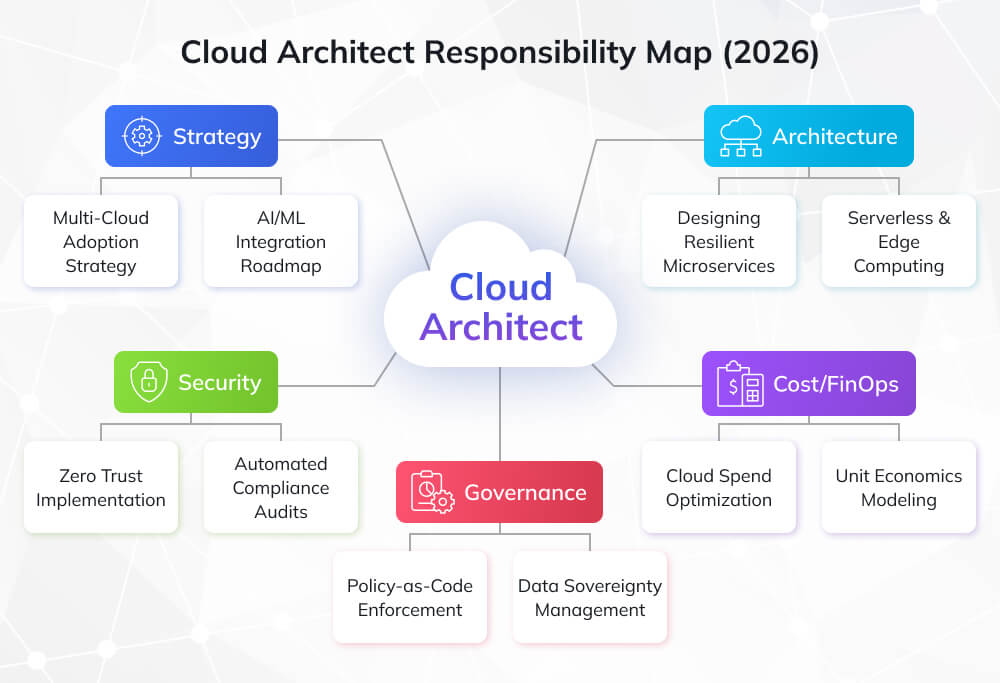
The role of a cloud architect encompasses a broad spectrum of strategic and technical responsibilities that directly impact an organization’s digital transformation success. These professionals serve as the bridge between business objectives and technical implementation, ensuring that cloud solutions deliver maximum value while maintaining security, performance, and cost efficiency. Let’s explore the five primary responsibility areas that define this critical role.
Strategic Cloud Planning and Design
At the heart of a cloud architect’s responsibilities lies strategic planning, the ability to envision and architect cloud solutions that propel business growth while addressing current and future technical requirements. This foundational responsibility requires cloud architects to work closely with C-suite executives, business stakeholders, and IT leadership to understand organizational goals, pain points, and transformation aspirations.
Cloud architects begin by conducting comprehensive assessments of existing IT infrastructure, identifying workloads suitable for cloud migration, and determining which cloud deployment model, public, private, hybrid, or multi-cloud, best serves the organization’s needs. They develop detailed cloud adoption roadmaps that outline migration phases, timelines, resource requirements, and risk mitigation strategies. This isn’t simply a technical exercise; it requires deep business acumen to align technology decisions with financial constraints, regulatory requirements, and competitive pressures.
One of the most complex aspects of strategic planning involves multi-cloud and hybrid cloud strategy development. Today’s organizations rarely commit to a single cloud provider. Instead, they leverage AWS for certain workloads, Azure for enterprise applications, and Google Cloud Platform for data analytics and machine learning. Cloud architects must design strategies that maximize the strengths of each platform while minimizing complexity, ensuring seamless integration, and maintaining consistent security and governance policies across environments.
Real-world strategic planning extends beyond initial cloud adoption. Cloud architects continuously evaluate emerging technologies, assess their potential impact on the organization, and develop strategies for incorporating innovations like edge computing, serverless architectures, and AI-powered cloud services. For example, a retail organization might need a cloud architect to design a strategy that supports both their e-commerce platform on AWS and their in-store IoT devices requiring edge computing capabilities, all while ensuring real-time data synchronization and customer experience consistency.
The strategic planning process also involves vendor evaluation and selection. Cloud architects analyze service level agreements (SLAs), pricing models, geographical coverage, compliance certifications, and technical capabilities across cloud providers. They conduct proof-of-concept projects to validate assumptions, identify potential challenges, and build confidence in recommended solutions before committing to large-scale implementations.
Cloud Infrastructure Architecture and Design
While strategic planning sets the direction, infrastructure architecture and design represent the blueprint that brings cloud strategies to life. This responsibility area demands deep technical expertise across multiple cloud platforms, architectural patterns, and design principles. Cloud architects must create detailed architectural designs that specify how applications, data, networks, and security controls interact within cloud environments.
The architecture design process begins with selecting appropriate cloud service models, Infrastructure as a Service (IaaS), Platform as a Service (PaaS), or Software as a Service (SaaS), based on workload requirements, development team capabilities, and operational preferences. For instance, a cloud architect might recommend IaaS for legacy applications requiring specific operating system configurations, PaaS for modern microservices-based applications to accelerate development, and SaaS for standard business functions like customer relationship management.
Scalability and resilience stand as fundamental design principles in cloud architecture. Cloud architects implement auto-scaling configurations that automatically adjust compute resources based on demand, ensuring applications maintain performance during traffic spikes while minimizing costs during quiet periods. They design multi-region architectures that distribute workloads across geographic locations, protecting against regional outages and reducing latency for global user bases. High availability architectures incorporate redundancy at every layer, multiple availability zones, load balancers, database replicas, and failover mechanisms, to ensure business-critical applications remain operational even when individual components fail.
Network architecture represents another critical design area. Cloud architects design virtual private clouds (VPCs), subnet configurations, routing tables, and connectivity options like VPN tunnels and direct connections to on-premises data centers. They implement content delivery networks (CDNs) to cache static content closer to end users, significantly improving application performance. For organizations with hybrid cloud deployments, architects design secure, high-bandwidth connections between on-premises infrastructure and cloud environments, ensuring seamless workload portability and data synchronization.
Disaster recovery and business continuity planning fall squarely within the architect’s purview. They design backup strategies, recovery time objectives (RTOs), and recovery point objectives (RPOs) that meet business requirements. This might involve implementing automated backup solutions, maintaining hot standby environments in secondary regions, or designing sophisticated failover mechanisms that redirect traffic to backup systems within minutes of detecting primary system failures.
Documentation represents an often-overlooked but essential aspect of infrastructure design. Cloud architects create comprehensive architectural diagrams, decision records, runbooks, and technical specifications that enable development teams to implement designs correctly and operations teams to maintain systems effectively. These documents serve as critical knowledge repositories, especially in dynamic environments where team members change frequently.
| Consider a real-world example: A healthcare organization migrating patient management systems to the cloud requires an architect to design a HIPAA-compliant infrastructure spanning multiple availability zones for high availability, incorporating encrypted data storage, implementing network segmentation to isolate sensitive workloads, designing secure APIs for third-party integrations, and establishing comprehensive audit logging—all while ensuring the system can scale to support millions of patient records and thousands of concurrent users. |
Cloud Architect Responsibility Areas: Time Allocation & Business Impact
| Responsibility Area | Average Time Allocation | Business Impact Level | Technical Complexity | Key Stakeholders |
| Strategic Planning | 20% | Critical | High | C-Suite, Business Leaders |
| Infrastructure Design | 30% | Critical | Very High | Development, Operations |
| Security & Compliance | 20% | Critical | High | Legal, Compliance, CISO |
| Cost Optimization | 15% | High | Medium | Finance, Operations |
| Governance & Standards | 15% | High | Medium | IT Leadership, Teams |
Security and Compliance Management
In an era where data breaches make headlines weekly and regulatory requirements grow increasingly stringent, security and compliance management have become paramount cloud architect responsibilities. These professionals serve as guardians of organizational data, designing security architectures that protect against sophisticated cyber threats while ensuring compliance with industry regulations and data protection laws.
Cloud architects implement comprehensive security frameworks based on industry standards like the NIST Cybersecurity Framework, CIS Controls, or the Cloud Security Alliance’s Cloud Controls Matrix. They adopt defense-in-depth strategies that layer multiple security controls, network security groups, web application firewalls, intrusion detection systems, and endpoint protection, creating multiple barriers attackers must breach. This approach ensures that even if one security control fails, others provide continued protection.
Identity and access management (IAM) design represents a critical security responsibility. Cloud architects implement the principle of least privilege, ensuring users and services receive only the minimum permissions necessary to perform their functions. They design role-based access control (RBAC) systems that streamline permission management, implement multi-factor authentication (MFA) for sensitive access, and establish secure authentication mechanisms for service-to-service communication. Modern cloud architects increasingly leverage zero-trust security models that verify every access request regardless of origin, abandoning the outdated assumption that internal network traffic is inherently trustworthy.
Data protection strategies form another essential component. Cloud architects implement encryption at rest and in transit, design key management systems that secure encryption keys separately from encrypted data, and establish data classification schemes that apply appropriate protection levels based on sensitivity. For organizations operating globally, architects must navigate complex data residency requirements, ensuring that data remains within specific geographic boundaries to comply with regulations like GDPR in Europe or data localization laws in countries like Russia and China.
Regulatory compliance demands significant architectural consideration. Healthcare organizations must design HIPAA-compliant architectures with comprehensive audit logging, encryption, and access controls. Financial services firms require PCI DSS compliance for payment card data processing. Organizations serving European customers must implement GDPR-compliant data handling, including the ability to fulfill data subject access requests and implement the “right to be forgotten.” Cloud architects must understand these regulatory requirements intimately, translating legal language into technical implementation specifications.
Security monitoring and incident response capabilities represent proactive security responsibilities. Cloud architects design centralized logging solutions that aggregate security events from across cloud environments, implement security information and event management (SIEM) systems that detect potential threats, and establish incident response procedures that enable rapid containment and remediation when security incidents occur. They conduct regular security assessments, penetration testing, and vulnerability scanning to identify and remediate security gaps before attackers exploit them.
Cost Optimization and Resource Management
Cloud’s pay-as-you-go model offers tremendous flexibility but can quickly spiral into budget overruns without proper cost management. Cloud architects bear significant responsibility for designing cost-efficient architectures and implementing practices that maximize cloud ROI while maintaining performance and availability standards. This responsibility has become so critical that an entire discipline, FinOps (Financial Operations), has emerged to address cloud financial management.
Effective cost optimization begins during the architecture design phase. Cloud architects make strategic decisions about service selection, instance types, storage tiers, and architectural patterns that profoundly impact costs. For example, choosing serverless architectures for sporadic workloads eliminates costs during idle periods, while containerized applications on Kubernetes enable more efficient resource utilization compared to traditional virtual machines. Architects evaluate trade-offs between performance and cost, determining when premium services justify their expense and when cost-effective alternatives suffice.
Resource right-sizing represents an ongoing optimization responsibility. Cloud architects analyze utilization metrics to identify over-provisioned resources, instances with consistently low CPU utilization, storage volumes with minimal I/O activity, or database instances with excess capacity, and recommend appropriately sized alternatives. They implement automated policies that shut down development and testing environments during non-business hours, reclaim unused elastic IP addresses, and delete orphaned snapshots and volumes left behind by terminated instances.
Reserved instances and savings plans offer significant cost reduction opportunities. Cloud architects analyze workload patterns to identify stable, long-running workloads suitable for one-year or three-year commitments, potentially saving 30-60% compared to on-demand pricing. They balance commitment risks against cost savings, often implementing a portfolio approach that combines reserved instances for baseline capacity with on-demand instances for variable demand.
Cost allocation and showback mechanisms provide visibility into which teams, projects, or applications drive cloud spending. Cloud architects implement tagging strategies that label resources with cost center, project, environment, and owner information, enabling detailed cost reporting and accountability. This transparency empowers teams to make informed decisions about resource usage and creates an organizational culture that values cost efficiency.
Cloud architects also design architectures that leverage cloud-native cost optimization features. They implement lifecycle policies that automatically transition infrequently accessed data to cheaper storage tiers, use spot instances for fault-tolerant workloads at up to 90% discount compared to on-demand pricing, and leverage data transfer optimizations that minimize expensive cross-region and internet egress charges. They establish budget alerts and cost anomaly detection that notify stakeholders when spending exceeds thresholds, preventing budget surprises.
Governance and Standards Implementation
As cloud environments grow in scale and complexity, governance and standards become essential to maintain consistency, security, and operational efficiency. Cloud architects establish governance frameworks that guide how teams provision resources, configure services, and operate workloads. These frameworks balance agility with control, empowering teams to move quickly while preventing configurations that introduce security vulnerabilities, compliance violations, or operational risks.
Infrastructure as Code (IaC) stands as a foundational governance practice. Cloud architects mandate that infrastructure deployments use code-based tools like Terraform, AWS CloudFormation, or Azure Resource Manager templates rather than manual console configurations. This approach provides version control for infrastructure changes, enables peer review processes, ensures consistent deployments across environments, and facilitates disaster recovery through infrastructure reproducibility. IaC transforms infrastructure management from an error-prone manual process into a disciplined software development practice.
Cloud architects develop and enforce architecture standards that specify approved services, configuration baselines, naming conventions, and design patterns. For example, standards might mandate that all production databases must enable encryption, all virtual networks must implement specific firewall rules, or all applications must deploy across multiple availability zones. These standards codify organizational best practices, preventing teams from making common mistakes and ensuring consistent security and operational posture.
Automation represents another critical governance mechanism. Cloud architects implement policy-as-code solutions using tools like AWS Service Control Policies, Azure Policy, or OPA (Open Policy Agent) that automatically enforce governance requirements. These policies might prevent teams from creating resources in unauthorized regions, block configuration changes that would disable logging, or require specific tags on all resources. Automation shifts governance from reactive auditing to proactive prevention, stopping policy violations before they occur.
Documentation and knowledge management fall within the architect’s governance responsibilities. They establish documentation standards, maintain architecture decision records (ADRs) that explain why specific design choices were made, create reusable reference architectures for common use cases, and build internal knowledge bases that capture lessons learned. This documentation accelerates onboarding for new team members, prevents repeated mistakes, and preserves organizational knowledge even as individual contributors change roles.
Cloud architects also establish change management processes that balance agility with stability. They define approval workflows for high-risk changes, establish maintenance windows for production updates, and implement progressive deployment strategies like blue-green deployments or canary releases that minimize blast radius when changes introduce issues. They foster a culture of continuous improvement, regularly reviewing governance frameworks to eliminate unnecessary bureaucracy while strengthening controls that deliver genuine value.
Key Skills and Competencies Required for a Cloud Architect
While understanding the responsibilities of a cloud architect provides the “what,” mastering the required skills addresses the “how.” Cloud architects need a unique blend of technical expertise, business acumen, and interpersonal skills to succeed in this multifaceted role. The complexity and breadth of responsibilities demand continuous learning and skill development across multiple domains.
Technical Skills Required for a Cloud Architect
- Multi-Cloud Platform Expertise: Proficiency across major cloud platforms, AWS, Microsoft Azure, and Google Cloud Platform, has become essential rather than optional. Each platform offers unique services, pricing models, and architectural approaches. Cloud architects must understand the strengths and limitations of each platform to make informed recommendations. This includes deep knowledge of core services: compute (EC2, Azure VMs, Google Compute Engine), storage (S3, Azure Blob Storage, Cloud Storage), networking (VPC, Virtual Networks), databases (RDS, Azure SQL, Cloud SQL), and serverless offerings (Lambda, Azure Functions, Cloud Functions).
- Programming and Scripting: While cloud architects aren’t typically writing application code, scripting proficiency is essential for automation and Infrastructure as Code. Python has emerged as the lingua franca for cloud automation, with boto3 (AWS SDK), Azure SDK, and Google Cloud Client Libraries providing programmatic cloud resource management. Terraform has become the de facto standard for multi-cloud IaC, requiring HCL (HashiCorp Configuration Language) proficiency. Bash scripting remains valuable for Linux-based automation, while PowerShell serves similar purposes in Windows-centric environments.
- Containerization and Orchestration: Modern cloud architectures increasingly leverage containers for application packaging and deployment. Docker expertise enables architects to understand container images, registries, and networking. Kubernetes has become the orchestration standard, requiring architects to understand pods, deployments, services, ingress controllers, and cluster management. Managed Kubernetes services like Amazon EKS, Azure AKS, and Google GKE abstract infrastructure complexity while requiring understanding of their specific implementations and integrations.
- Networking Fundamentals: Despite cloud abstraction, networking knowledge remains critical. Cloud architects must understand TCP/IP, DNS, load balancing, content delivery networks, VPNs, and direct connections. They design network topologies, subnet CIDR blocks, routing tables, and firewall rules. Understanding network security concepts like network segmentation, DDoS protection, and web application firewalls enables architects to design secure network architectures.
- Security and Compliance Knowledge: Beyond implementing security controls, architects must understand security concepts deeply. This includes encryption algorithms and key management, authentication and authorization protocols (OAuth, SAML, OIDC), security frameworks (NIST, CIS), and compliance standards (HIPAA, PCI DSS, GDPR, SOC 2). Understanding threat modeling helps architects anticipate attack vectors and design appropriate defenses.
Business and Leadership Skills Required for a Cloud Architect
- Strategic Thinking and Business Acumen: Technical excellence alone doesn’t make a successful cloud architect. Understanding business objectives, financial considerations, competitive dynamics, and industry trends enables architects to align technical decisions with business outcomes. This means speaking the language of business, discussing ROI, total cost of ownership, time-to-market, and competitive advantage rather than purely technical metrics.
- Communication and Stakeholder Management: Cloud architects serve as translators between technical teams and business stakeholders. They must explain complex technical concepts to non-technical audiences, present architecture proposals to executive leadership, and negotiate trade-offs between competing requirements. Strong written communication skills are equally important for creating clear documentation, architecture decision records, and technical specifications.
- Project Management Capabilities: While not typically serving as dedicated project managers, cloud architects must understand project management principles. They estimate migration timelines, identify dependencies, assess risks, and coordinate across multiple teams. Familiarity with Agile methodologies, DevOps practices, and modern project management tools enhances their effectiveness in collaborative environments.
- Team Leadership and Mentoring: Senior cloud architects often lead technical teams, provide guidance to junior architects and engineers, and establish technical direction for organizations. This requires leadership skills like coaching, conflict resolution, decision-making under uncertainty, and fostering collaborative team cultures. The ability to build consensus among diverse stakeholders with competing priorities proves invaluable.
| PRO TIP: Skill Development Strategies
Build hands-on experience through personal projects and sandboxes. Cloud certifications validate knowledge, but employers value practical experience more highly. Create your own projects, build a multi-tier application, implement CI/CD pipelines, design disaster recovery scenarios, in cloud sandbox environments. Most cloud providers offer free tiers or credits for learning. Document your projects on GitHub and write blog posts explaining your architectural decisions. This demonstrates real capability and creates portfolio evidence that sets you apart in competitive job markets. |
Required Certifications and Professional Development for Cloud Architects
Professional certifications serve as powerful career accelerators for cloud architects, validating expertise, enhancing credibility with employers and clients, and providing structured learning paths through complex cloud technologies. While certifications alone don’t make someone a capable architect, they demonstrate commitment to professional development and mastery of platform-specific knowledge.
Top Cloud Certifications for Cloud Architects in 2026
AWS Certified Solutions Architect: Amazon Web Services offers two levels of architecture certification. The Associate level validates ability to design distributed applications and systems on AWS, covering compute, storage, networking, databases, and security services. The Professional level demonstrates advanced technical skills and extensive experience designing complex cloud solutions, including hybrid architectures, migration strategies, and cost optimization. AWS certifications are widely recognized given AWS’s market leadership position, making them valuable for career advancement.
Microsoft Azure Solutions Architect Expert: This certification validates expertise in designing cloud and hybrid solutions on Microsoft Azure. It requires passing two exams, Azure Administrator Associate and Azure Solutions Architect Expert, covering identity management, storage solutions, compute infrastructure, networking, and security. Azure certifications are particularly valuable for organizations with existing Microsoft enterprise agreements and Windows-centric workloads.
Google Cloud Professional Cloud Architect: This certification demonstrates ability to design, develop, and manage robust, secure, scalable, and dynamic solutions on Google Cloud Platform. It emphasizes infrastructure design, security, compliance, and business requirements analysis. While GCP holds smaller market share than AWS or Azure, it’s growing rapidly, particularly for organizations leveraging its strengths in data analytics, machine learning, and Kubernetes.
Multi-Cloud and Specialized Certifications: As multi-cloud strategies become standard, platform-agnostic certifications add value. HashiCorp Certified Terraform Associate validates Infrastructure as Code expertise across multiple cloud providers. Certified Kubernetes Administrator (CKA) and Certified Kubernetes Application Developer (CKAD) demonstrate container orchestration proficiency. Security specializations like Certified Cloud Security Professional (CCSP) or platform-specific security certifications (AWS Security Specialty, Azure Security Engineer) address the growing importance of cloud security expertise.
Continuous Learning Pathways
Staying Current with Cloud Technologies: Cloud platforms release new services and updates constantly, sometimes hundreds of new features annually. Successful cloud architects commit to continuous learning through multiple channels. Following cloud provider blogs and release notes keeps architects informed about new capabilities. Attending conferences like AWS re:Invent, Microsoft Ignite, or Google Cloud Next provides deep dives into emerging technologies and networking opportunities. Participating in local cloud user groups and online communities facilitates knowledge sharing and peer learning.
Hands-On Practice and Lab Environments: Theoretical knowledge must be reinforced through practical experience. Cloud providers offer extensive free tier access and credits for learning purposes. Platforms like A Cloud Guru, Linux Academy (now part of A Cloud Guru), and CloudAcademy provide hands-on labs and sandbox environments for practicing cloud technologies. Building personal projects, contributing to open-source cloud tools, and experimenting with new services in development environments accelerates learning and builds practical expertise.
Industry Events and Communities: Professional networking accelerates career growth and knowledge development. Cloud-focused communities like the Cloud Native Computing Foundation, local AWS user groups, and online forums provide opportunities to learn from peers, share experiences, and stay connected with industry trends. Speaking at meetups or conferences, writing technical blog posts, and contributing to community projects establishes thought leadership while deepening personal understanding through teaching others.
Day-to-Day Activities and Workflow
Understanding high-level responsibilities provides valuable context, but examining the day-to-day activities of cloud architects reveals how theory translates into practice. While no two days are identical, cloud architects regularly shift focus based on organizational priorities, project phases, and emerging challenges, typical workflows follow recognizable patterns.
Typical Daily Tasks
Morning Routines: Many cloud architects begin their day reviewing monitoring dashboards and overnight alerts. They check system health metrics, cost anomalies, security events, and automated deployment results. This proactive monitoring catches issues before they impact users and provides situational awareness for the day ahead. Morning stand-ups or team check-ins coordinate activities across distributed teams, discuss blockers, and align on priorities.
Architecture Design and Reviews: A significant portion of architect time focuses on design work, creating new architectural blueprints, reviewing proposed designs from engineering teams, and evaluating trade-offs between competing approaches. This might involve sketching infrastructure diagrams, documenting architectural decisions, prototyping proof-of-concept implementations, or collaborating with engineers to refine design details. Architecture review meetings ensure proposed solutions align with standards, identify potential issues early, and provide learning opportunities for team members.
Stakeholder Collaboration: Cloud architects spend considerable time in meetings with various stakeholders. Business leaders seek advice on technical feasibility and cost implications of new initiatives. Security teams collaborate on compliance requirements and security controls. Operations teams discuss deployment strategies and support implications. Vendor meetings evaluate new cloud services or third-party solutions. While meetings can feel like productivity drains, effective architects recognize them as essential for understanding requirements, building relationships, and influencing decisions.
Problem-Solving and Troubleshooting: When production issues arise or projects encounter technical roadblocks, cloud architects often serve as escalation points. They apply deep technical knowledge and broad perspective to diagnose complex problems, identify root causes, and design solutions. This might involve analyzing performance bottlenecks, investigating security incidents, resolving integration challenges, or redesigning components that don’t scale as expected.
Research and Technology Evaluation: The rapid pace of cloud innovation requires continuous research. Architects evaluate new cloud services, assess emerging architectural patterns, research solutions to specific technical challenges, and stay current with industry best practices. This research directly informs recommendations for improving existing systems or adopting new technologies. Many architects dedicate specific time blocks for learning, reading technical documentation, taking online courses, or experimenting with new services in sandbox environments.
Documentation and Knowledge Sharing: Creating and maintaining documentation consumes more time than many expect. Architects document architectural decisions, create runbooks for operational procedures, write technical specifications for development teams, and develop training materials. They also invest time in knowledge sharing, mentoring junior team members, conducting lunch-and-learn sessions, writing internal wiki articles, or presenting at team meetings. This knowledge transfer multiplies the architect’s impact across the organization.
| AVOID THIS MISTAKE: Workflow Pitfalls
Don’t become a meeting-only architect who loses technical edge. It’s easy for senior architects to become consumed by meetings, strategy sessions, and stakeholder management, gradually losing hands-on technical proficiency. This creates dangerous gaps between architectural designs and implementation reality. Successful architects protect time for hands-on technical work, reviewing code, building prototypes, troubleshooting production issues. This maintains technical credibility, ensures designs remain practical rather than theoretical, and keeps skills sharp in rapidly evolving technology landscapes. Why it’s problematic: Architects who lose technical touch design impractical solutions, lose team respect, and become less effective at solving complex technical problems. What to do instead: Block dedicated time for technical work each week. Participate in on-call rotations. Build proof-of-concept implementations. Pair program with engineers. This balance maintains both strategic vision and technical excellence. |
Career Path and Salary Insights
Cloud architect roles represent significant career milestones, typically requiring several years of progressive experience building technical depth and breadth. Understanding typical career progression and compensation helps aspiring architects set realistic goals and current architects benchmark their growth.
Career Progression
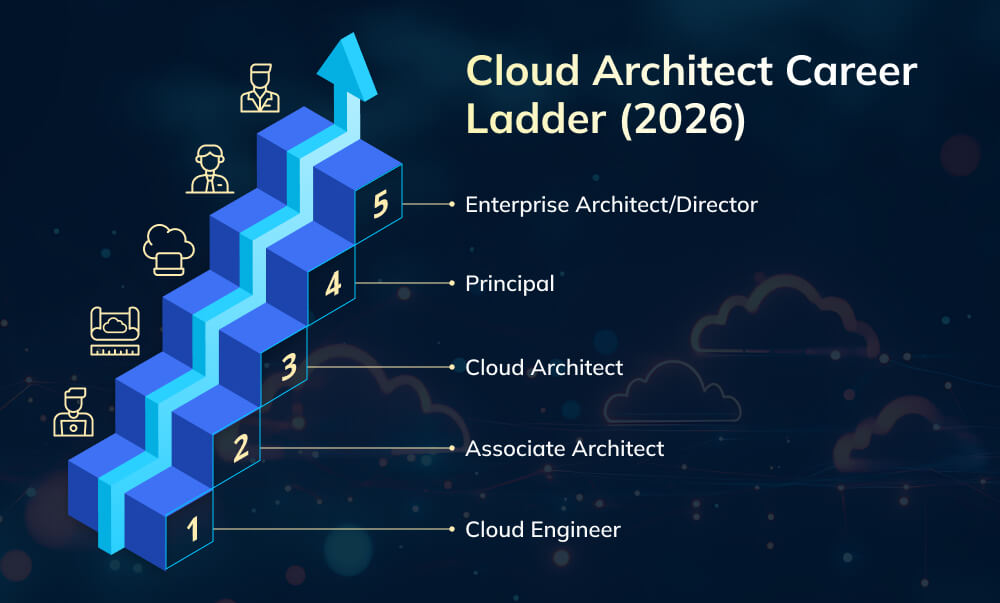
Entry Point – Cloud Engineer/Systems Administrator: Most cloud architects begin their careers in foundational technical roles, cloud engineers, systems administrators, DevOps engineers, or software developers. These positions build essential skills in cloud platforms, infrastructure management, automation, and system design. Duration at this level typically spans 2-5 years, during which professionals deepen technical expertise, earn certifications, and gain exposure to increasingly complex projects.
Mid-Level – Associate or Junior Cloud Architect: With solid foundational skills and initial certifications, professionals transition into associate architect roles. These positions focus on designing solutions within established frameworks, implementing architectures designed by senior architects, and supporting specific workloads or applications rather than enterprise-wide infrastructure. This stage emphasizes developing architectural thinking, understanding design patterns, and building stakeholder communication skills. Professionals typically spend 2-4 years at this level.
Senior Level – Cloud Architect: Full cloud architect positions carry responsibility for designing comprehensive cloud solutions, making significant architectural decisions, and influencing technical direction. These architects work independently, lead complex migration projects, design multi-cloud strategies, and mentor junior team members. This represents the target role for most cloud professionals and can span many years as architects deepen specializations, expand their scope, and deliver increasingly complex solutions.
Advanced Levels – Senior/Lead/Principal Cloud Architect: Senior technical leadership positions involve enterprise-wide architectural responsibility, strategic technology direction, and significant organizational influence. Principal architects often specialize in specific domains, security, data, application architecture, while maintaining broad expertise. These roles require not just technical excellence but also strong business acumen, executive communication skills, and ability to influence without direct authority.
Executive Track – Enterprise Architect/Cloud Director/CTO: Some architects transition into executive leadership positions overseeing entire technology organizations. These roles focus more on strategy, vision, team building, and business outcomes than hands-on technical work. They require strong leadership, business strategy, and organizational management skills beyond pure technical expertise.
2026 Cloud Architect Salary Benchmarks and Trends
Cloud architects command strong compensation reflecting high demand and specialized expertise. According to multiple salary surveys and job market analyses for 2025-2026, compensation varies significantly based on experience, location, industry, and specific cloud expertise.
Entry-Level/Associate Cloud Architects: Typically earn $90,000-$125,000 annually in the United States. These professionals have 2-5 years of cloud experience and one or more associate-level certifications.
Mid-Level Cloud Architects: With 5-8 years of experience and professional-level certifications command $125,000-$160,000 annually. These architects independently design and implement complex cloud solutions and may lead small teams.
Senior Cloud Architects: With 8-12 years of experience earn $160,000-$210,000 annually. They handle enterprise-wide architectural decisions, lead large-scale transformations, and influence organizational cloud strategy.
Principal/Lead Architects: Representing the top 10% of earners make $210,000-$300,000+ annually, particularly in high-cost markets and at large technology companies. Total compensation including bonuses, stock options, and benefits often significantly exceeds base salary.
Geographic location dramatically impacts compensation. Cloud architects in San Francisco, Seattle, New York, and Boston command premiums of 30-50% over national averages. Conversely, remote positions sometimes offer lower compensation while providing lifestyle and cost-of-living benefits.
Industry also affects compensation. Financial services, healthcare technology, and large technology companies typically offer the highest salaries, while non-profit organizations, government positions, and education pay below market averages.
Certification impact on salary proves significant. Professionals holding multiple professional-level certifications across different platforms (AWS, Azure, GCP) command salary premiums of 15-25% compared to non-certified peers with similar experience.
Cloud Architect Challenges and Best Practices
While cloud architect roles offer exciting opportunities and strong compensation, they also present significant challenges. Understanding common obstacles and proven strategies for overcoming them prepares architects for success in this demanding field.
Common Challenges Faced by Cloud Architects
Managing Multi-Cloud Complexity: As organizations adopt multiple cloud providers to avoid vendor lock-in and leverage best-of-breed services, architects face exponentially increasing complexity. Each platform uses different terminology, networking models, security approaches, and management tools. Maintaining expertise across multiple platforms while designing cohesive architectures that span them requires continuous learning and sophisticated integration strategies. Teams must support diverse skill sets, and operations become more complex with multiple monitoring tools, billing systems, and support relationships.
Balancing Security with Agility: Business stakeholders demand rapid innovation and deployment velocity, while security requirements mandate careful controls, reviews, and testing. Cloud architects constantly navigate tension between these competing priorities. Overly restrictive security controls slow development and frustrate teams, while insufficient security creates unacceptable risks. Finding the right balance, implementing security controls that protect without impeding progress, requires deep security understanding combined with pragmatic risk assessment.
Controlling Cloud Costs: Cloud’s consumption-based pricing model offers flexibility but creates cost management challenges. Without proper controls, cloud spending can spiral unexpectedly as developers spin up resources, test environments remain running unnecessarily, and inefficient architectures waste resources. Architects must design cost-effective architectures while educating teams about cost implications and implementing governance controls that prevent waste without stifling innovation.
Keeping Pace with Rapid Technology Change: Cloud platforms introduce hundreds of new services and features annually. Architectural best practices evolve as new patterns emerge. Security threats continuously change requiring new defensive approaches. This relentless pace of change creates constant pressure to learn, adapt, and rearchitect existing systems. Architects risk obsolescence if they don’t continuously update skills, yet the volume of new technologies makes comprehensive mastery impossible.
Proven Best Practices Every Cloud Architect Should Follow
Adopt Automation-First Approaches: Manual processes don’t scale in cloud environments. Successful architects prioritize automation from day one, Infrastructure as Code for resource provisioning, automated security scanning in deployment pipelines, automated backup and disaster recovery procedures, and automated cost optimization recommendations. Automation reduces errors, enables consistency, and frees architects to focus on higher-value strategic work rather than repetitive operational tasks.
Implement Strong Governance Frameworks: Rather than viewing governance as bureaucracy that slows progress, effective architects design governance frameworks that enable safe innovation. Policy-as-code automatically enforces requirements without manual reviews. Self-service platforms let teams provision approved resources independently while preventing risky configurations. Clear standards and reference architectures guide teams toward correct approaches. This approach balances control with agility, preventing security and compliance issues while maintaining development velocity.
Foster Continuous Learning Culture: Organizations that invest in continuous learning adapt more successfully to technology changes. Architects who establish learning cultures, allocating time for training, encouraging certification pursuit, hosting internal knowledge sharing sessions, and celebrating learning achievements, build more capable teams. This multiplies the architect’s impact and creates bench strength as team members develop architectural capabilities.
Build Strong Vendor Relationships: Cloud providers offer extensive resources beyond their platforms, technical account managers, professional services teams, training programs, and architectural review services. Architects who cultivate these relationships gain early access to new features, receive personalized guidance on complex challenges, and influence product roadmaps. Provider communities, user groups, and partner ecosystems offer additional support channels and learning opportunities.
| PRO TIP: Managing Multi-Cloud Environments
Create abstraction layers that provide consistent interfaces across cloud providers. Rather than letting applications directly consume provider-specific services, build internal platform services that abstract cloud differences. For example, create a unified API for object storage that works with S3, Azure Blob Storage, and Google Cloud Storage interchangeably. This approach reduces application complexity, enables workload portability, and isolates provider-specific details to platform teams. While building abstraction layers requires upfront investment, it dramatically simplifies multi-cloud management long-term and prevents applications from becoming tightly coupled to specific providers. |
| AVOID THIS MISTAKE: Over-Architecture
Don’t design overly complex solutions for problems that don’t exist yet. Architects often fall into the trap of designing elaborate, highly sophisticated architectures that anticipate every possible future requirement. They implement complex microservices when a simple monolith would suffice, design for millions of users when handling thousands, or build elaborate multi-region architectures for applications with no business continuity requirements. Why it’s problematic: Over-architecture increases development time, raises costs, creates operational complexity, and makes systems harder to understand and maintain. Teams spend months building infrastructure that delivers no immediate business value. What to do instead: Design for current requirements with clear evolution paths. Start simple and add complexity only when justified by actual needs. Follow the “YAGNI” principle (You Aren’t Gonna Need It). Build systems that are easy to change rather than trying to predict all future changes. This agile approach delivers value faster while maintaining flexibility for future evolution. |
Future Trends and Evolution of the Cloud Architect Role
The cloud architect role continues evolving as technology advances and business needs change. Understanding emerging trends helps architects prepare for future responsibilities and maintain relevance in a rapidly changing field.
Emerging Responsibilities for Cloud Architect in 2026 and Beyond
AI/ML Integration in Cloud Architecture: Artificial intelligence and machine learning are no longer specialized workloads, they’re becoming core components of mainstream applications. Cloud architects must understand ML infrastructure requirements, design architectures that support training and inference workloads, implement MLOps practices, and integrate AI services into application architectures. This includes selecting appropriate compute for GPU-intensive workloads, designing data pipelines that feed ML models, and implementing model serving infrastructures that scale with demand. Generative AI’s explosive growth particularly demands architects understand token-based pricing models, prompt engineering implications for architecture, and integration patterns for large language models.
Edge Computing and IoT Architecture: As organizations deploy Internet of Things devices and require real-time processing near data sources, cloud architects must extend their expertise beyond centralized cloud data centers to edge locations. This involves designing hybrid architectures that distribute workloads between cloud and edge, implementing data synchronization strategies that handle intermittent connectivity, and managing fleet deployments of edge infrastructure. Industries like manufacturing, retail, healthcare, and autonomous vehicles increasingly depend on edge computing, creating new architectural challenges around latency, local processing, and distributed system management.
Green Cloud and Sustainability Focus: Environmental consciousness is becoming a business imperative, not just a PR consideration. Cloud architects increasingly bear responsibility for designing energy-efficient architectures, selecting regions powered by renewable energy, implementing carbon-aware scheduling that shifts workloads to times and locations with cleaner energy, and measuring/reporting carbon footprints of cloud infrastructure. Major cloud providers publish carbon emissions data and provide tools for measuring environmental impact, making sustainability a quantifiable architectural consideration alongside performance, cost, and security.
FinOps and Cloud Economics Specialization: As cloud spending becomes major budget line items, often reaching millions or tens of millions annually, dedicated financial management expertise becomes essential. Some architects specialize in FinOps, focusing deeply on cost optimization, implementing showback/chargeback systems, forecasting cloud spending, and aligning technology decisions with financial objectives. This specialization bridges technology and finance, requiring both technical understanding and business financial acumen.
Platform Engineering and Internal Developer Platforms: Rather than individual teams independently managing cloud infrastructure, organizations increasingly build internal developer platforms that abstract cloud complexity and provide self-service capabilities. Cloud architects evolve into platform engineers, designing and building these internal platforms that enable application teams to focus on business logic while platform teams handle underlying cloud complexity. This shift requires API design skills, developer experience thinking, and ability to build products that internal teams consume.
Conclusion
Cloud architects aren’t just designing infrastructure anymore; they’re shaping how businesses scale, secure, and innovate in the cloud. This guide covered the core responsibilities (strategy, architecture, security, governance, and cost control) as well as the skills and certifications that make architects effective in real organizations.
If you’re building this career, or hiring for it, focus on two things: hands-on architecture work (real deployments, not theory) and continuous learning, as platforms, security standards, and cloud-native patterns keep changing. Want to level up faster? Explore our DevOps training and certification courses, covering cloud fundamentals, cloud security, governance, and advanced architecture, delivered by expert instructors in live virtual or corporate formats.
Frequently Asked Questions
1. What are the main responsibilities of a cloud architect?
Cloud architects are responsible for designing and overseeing an organization’s cloud computing strategy and infrastructure. Their main responsibilities include strategic cloud planning and migration, designing scalable and secure cloud architectures, managing security and compliance, optimizing cloud costs and resources, and implementing governance frameworks. They serve as the bridge between business objectives and technical implementation, ensuring cloud solutions deliver maximum value while maintaining security, performance, and cost efficiency.
2. What skills do you need to become a cloud architect?
Becoming a cloud architect requires a combination of technical and business skills. Technical skills include multi-cloud platform expertise (AWS, Azure, GCP), programming and scripting (Python, Terraform), containerization (Docker, Kubernetes), networking fundamentals, and security knowledge. Business skills include strategic thinking, stakeholder communication, project management, and leadership capabilities. Continuous learning is essential as cloud technologies evolve rapidly with hundreds of new features and services released annually.
3. How much does a cloud architect earn in 2026?
Cloud architects are among the highest-paid technology professionals. In 2026, the average annual salary is approximately $145,771 in the United States. Entry-level cloud architects earn $90,000-$125,000, mid-level architects earn $125,000-$160,000, senior architects earn $160,000-$210,000, and principal/lead architects can earn $210,000-$300,000 or more. Compensation varies significantly based on experience, location, industry, certifications, and multi-cloud expertise. Geographic location can impact salary by 30-50%, with major tech hubs offering the highest compensation.
4. What certifications are required for cloud architects?
While not strictly required, certifications significantly enhance career prospects and earning potential. The most valuable certifications include AWS Certified Solutions Architect (Associate and Professional), Microsoft Azure Solutions Architect Expert, and Google Cloud Professional Cloud Architect. Multi-cloud certifications like HashiCorp Certified Terraform Associate and Certified Kubernetes Administrator add additional value. Security specializations such as Certified Cloud Security Professional (CCSP) are increasingly important. Professionals with multiple professional-level certifications typically command 15-25% salary premiums compared to non-certified peers with similar experience.
5. What is the difference between a cloud architect and cloud engineer?
Cloud architects focus on strategic design, planning, and high-level architecture decisions, while cloud engineers focus on implementation, deployment, and operational management. Architects design the blueprint, defining overall architecture, selecting technologies, and establishing patterns, while engineers build and maintain systems based on those blueprints. Architects typically have broader scope, more experience (usually 5+ years), and stronger business communication skills. Cloud engineer positions often serve as career stepping stones toward architect roles, providing hands-on experience that informs architectural decision-making.
6. How long does it take to become a cloud architect?
The typical path to cloud architect requires 4-8 years of progressive experience in technology roles. Most architects begin as cloud engineers, systems administrators, DevOps engineers, or software developers (2-5 years), transition to associate or junior architect roles (2-4 years), and then advance to full cloud architect positions. The timeline varies based on educational background, learning speed, certification pursuit, and quality of hands-on experience. Accelerated paths exist for highly motivated individuals who aggressively pursue certifications, build personal project portfolios, and seek increasingly responsible roles.
7. What are the career advancement opportunities for cloud architects?
Cloud architects have strong advancement prospects along both technical and management tracks. Technical advancement leads to senior/lead/principal architect positions with enterprise-wide scope, specialized expertise domains, and strategic influence. Some architects specialize in areas like security architecture, data architecture, or FinOps. Management track advancement leads to director-level positions, VP of cloud/infrastructure, or CTO roles overseeing entire technology organizations. The strong job growth (13% through 2033), continuous demand for cloud expertise, and emerging technologies like AI/ML integration and edge computing create sustained advancement opportunities.