



In the fast-paced world of Agile software development, maintaining a healthy product backlog is as critical to project success as watering is to a garden. Yet many teams struggle with backlogs that become overgrown, outdated, and overwhelming. filled with vague user stories, outdated priorities, and items that no longer align with current goals.
Enter backlog grooming (also known as backlog refinement), a crucial but often misunderstood practice that keeps your product backlog clean, prioritized, and ready to drive sprint success.
Whether you’re a Product Owner trying to streamline your backlog management, a Scrum Master facilitating team processes, or a development team member wondering why sprint planning always feels chaotic, understanding backlog grooming is essential.
In this comprehensive guide, we’ll explore:
- What Is Backlog Grooming? A Clear Definition
- Why Backlog Grooming Matters: The Core Purpose
- Key Benefits of Backlog Grooming
- The Backlog Grooming Process: Step-by-Step
- Who Participates in Backlog Grooming?
- How to Structure Backlog Grooming Meetings
- Best Practices for Effective Backlog Grooming
- Common Backlog Grooming Mistakes & Pitfalls
- Backlog Grooming vs. Sprint Planning: What’s the Difference?
- Tools to Support Backlog Grooming
- Conclusion
By the end, you’ll have a complete framework for implementing backlog grooming that transforms your team’s productivity and sprint outcomes.
What Is Backlog Grooming? A Clear Definition
Backlog grooming (now commonly called backlog refinement) is the ongoing collaborative process of reviewing, clarifying, estimating, and prioritizing items in the product backlog to ensure they are ready for upcoming sprints.
According to the Agile Alliance, backlog refinement is when the Product Owner and some (or all) of the development team review items on the backlog to ensure:
- The backlog contains appropriate items.
- Items are prioritized based on current business value.
- Items at the top of the backlog are ready for delivery in upcoming sprints.
- Backlog items are understood by the team executing the work.
The Terminology Shift: From “Grooming” to “Refinement”
You may notice both terms used interchangeably, with backlog refinement increasingly preferred in 2026. Why the change?
The Scrum community moved away from “grooming” due to concerns about the term’s negative connotations in some contexts. “Refinement” more accurately describes the process, it’s about refining and polishing backlog items, not just tidying them up.
Key Point: Both terms refer to the same practice. In this guide, we’ll use both terms interchangeably, as many practitioners still refer to “backlog grooming.”
Why Backlog Grooming Matters: The Core Purpose
Backlog refinement isn’t just another meeting on your calendar, it’s a strategic investment that pays dividends throughout the development process.
The Primary Goals of Backlog Grooming
| Goal | Description |
| Clarity | Ensure all team members understand backlog items before sprint planning |
| Readiness | Prepare items so they’re “sprint-ready” with clear acceptance criteria |
| Prioritization | Keep the backlog ordered by business value and strategic importance |
| Estimation | Size stories appropriately so the team can commit realistically |
| Alignment | Ensure backlog reflects current business priorities and market conditions |
| Efficiency | Make sprint planning faster and more effective |
What Happens Without Regular Backlog Grooming?
Teams that skip or neglect backlog refinement typically experience:
- Chaotic sprint planning sessions that run 2-3 hours (or longer) because items aren’t understood.
- Mid-sprint discoveries that stories are poorly defined or dependencies weren’t.
- Frequent scope changes due to misunderstood requirements.
- Low sprint completion rates because items weren’t properly sized.
- Team frustration from constant interruptions.
- Technical debt accumulation from rushing without proper planning.
According to Adobe Workfront research, teams that conduct regular backlog grooming report 25-40% improvement in sprint predictability and significantly reduced planning time.
Key Benefits of Backlog Grooming
Effective backlog refinement delivers tangible benefits across multiple dimensions:
1. Improved Sprint Planning
Benefit: Sprint planning becomes a focused, efficient meeting (typically 1-2 hours instead of 3-4 hours).
Why: Because backlog items have already been discussed, clarified, and estimated during refinement, sprint planning focuses on commitment and capacity rather than understanding requirements.
Result: Teams can start sprints immediately with confidence rather than spending the first days clarifying scope.
2. Increased Team Productivity
Benefit: Developers spend more time building and less time waiting for clarification.
Why: Clear acceptance criteria, well-defined user stories, and understood dependencies mean fewer mid-sprint interruptions and blockers.
Result: According to Productboard data, teams report a 20-30% reduction in clarification meetings during sprints after implementing regular backlog grooming.
3. Better Prioritization
Benefit: The team always works on the highest-value items aligned with current business goals.
Why: Regular refinement sessions provide a forum to reassess priorities as market conditions, customer feedback, and business strategy evolve.
Result: Reduced waste from building features that lose relevance before completion.
4. Enhanced Quality
Benefit: Fewer defects, rework cycles, and technical debt.
Why: Thorough discussion during refinement surfaces edge cases, technical constraints, and quality considerations before development begins.
Result: Higher first-time quality and reduced post-sprint bug fixes.
5. Improved Team Collaboration
Benefit: Stronger cross-functional communication and shared understanding.
Why: Refinement brings Product Owners, developers, designers, and testers together to discuss upcoming work in a low-pressure setting.
Result: Increased team cohesion and reduced “us vs. them” mentality between product and engineering.
6. Predictable Velocity
Benefit: More consistent sprint outcomes and reliable forecasting.
Why: Better-understood and properly-sized stories lead to more accurate commitments and higher completion rates.
Result: Stakeholders gain confidence in delivery timelines.
The Backlog Grooming Process: Step-by-Step
Effective backlog refinement follows a structured process. Here’s the step-by-step framework used by high-performing Agile teams:
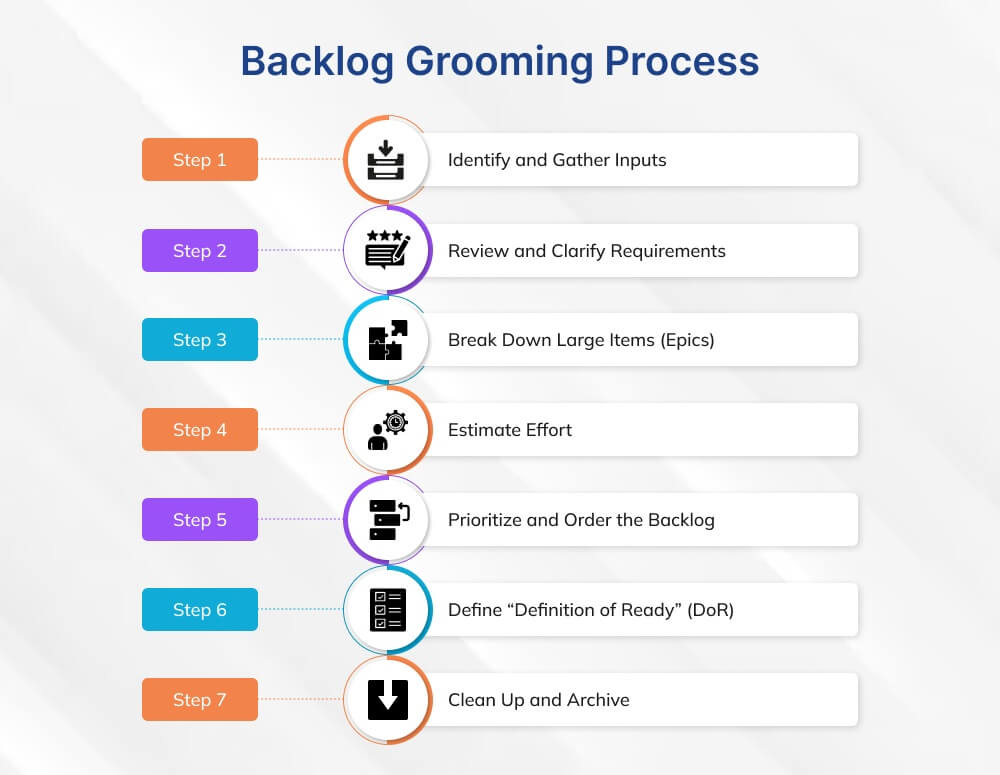
Step 1: Identify and Gather Inputs
Objective: Collect all potential backlog items from various sources.
Sources of Backlog Items:
- Customer feedback and feature requests
- Bug reports and technical debt
- Stakeholder requirements
- Market trends and competitive analysis
- Team improvement ideas
- Security updates and compliance requirements
Action: Product Owner consolidates inputs and adds new items to the backlog before the refinement session.
Step 2: Review and Clarify Requirements
Objective: Ensure everyone understands what each backlog item entails.
Activities:
- Read user stories aloud: Product Owner presents each item
- Ask clarifying questions: Team members seek to understand context, business value, and scope
- Add details: Flesh out acceptance criteria, edge cases, and constraints
- Identify dependencies: Surface technical dependencies, external integrations, or prerequisite work
Example:
Before Refinement:
User Story: “As a user, I want to save payment methods.”
After Refinement:
User Story: “As a returning customer, I want to securely save my credit card information
during checkout so I can complete future purchases faster.”
Acceptance Criteria:
- Customer can opt-in to save payment method during checkout
- Payment data is tokenized (not stored directly)
- Customer can view, edit, and delete saved payment methods in account settings
- PCI DSS compliance requirements are met
- Works on desktop and mobile web
Dependencies:
- Payment gateway API integration complete
- Tokenization service configured
Estimated Effort: 8 story points
Step 3: Break Down Large Items (Epics)
Objective: Decompose large features into sprint-sized user stories.
Why: Large epics or features can’t be completed in a single sprint and are difficult to estimate accurately.
Process:
- Identify items too large for one sprint (typically >13 story points)
- Break into smaller, independently valuable user stories
- Ensure each smaller story delivers value on its own
Example:
Epic: “Multi-factor authentication (MFA) system.”
Broken Down Into:
- User Story: Email-based OTP verification (5 points)
- User Story: SMS-based OTP verification (5 points)
- User Story: Authenticator app support (8 points)
- User Story: MFA enrollment flow (5 points)
- User Story: Remember trusted devices (3 points)
Step 4: Estimate Effort
Objective: Size stories so the team can plan capacity realistically.
Common Estimation Techniques:
- Story Points: Relative sizing using Fibonacci sequence (1, 2, 3, 5, 8, 13, 21)
- T-Shirt Sizes: XS, S, M, L, XL (converted to points later)
- Planning Poker: Team votes simultaneously to avoid anchoring bias
- Affinity Estimation: Group similar-sized stories together
Best Practice: Estimate as a team, not individually. Diverse perspectives surface hidden complexity.
Step 5: Prioritize and Order the Backlog
Objective: Ensure highest-value work is at the top of the backlog.
Prioritization Frameworks:
MoSCoW Method:
- Must Have: Critical for MVP or release
- Should Have: Important but not critical
- Could Have: Nice to have if time permits
- Won’t Have (this time): Deferred to future sprints
WSJF (Weighted Shortest Job First):
WSJF Score = (Business Value + Time Criticality + Risk Reduction) / Effort
Higher scores = higher priority
Value vs. Effort Matrix:
- Quick Wins: High value, low effort → prioritize first
- Major Projects: High value, high effort → plan carefully
- Fill-ins: Low value, low effort → do when capacity allows
- Time Sinks: Low value, high effort → avoid or defer
Outcome: Backlog is ordered with “sprint-ready” items at the top.
Step 6: Define “Definition of Ready” (DoR)
Objective: Establish criteria for when a backlog item is ready for sprint planning.
Example Definition of Ready Checklist:
- User story is written in “As a [user], I want [feature], so that [benefit]” format
- Acceptance criteria are clear and testable
- Dependencies are identified and documented
- Story is estimated by the team
- No blocking questions remain
- Size is appropriate for one sprint (<13 points recommended)
- Business value is understood
Rule: Items that do not meet DoR stay in the backlog for further refinement.
Step 7: Clean Up and Archive
Objective: Keep the backlog manageable and focused.
Activities:
- Remove Duplicates: Consolidate similar items.
- Archive obsolete items: Mark outdated requirements as “Won’t Do”.
- Delete noise: Remove items that no longer align with product strategy.
- Update estimates: Re-estimate older items as understanding improves.
Best Practice: Apply the 20-30-50 Rule for backlog health:
| Status | % of Backlog | Description |
| Ready for Development | 20% | Fully refined, estimated, and meeting DoR |
| In Refinement | 30% | Needs discussion but no external dependencies |
| Ideas/Future | 50% | High-level concepts to be refined later |
Who Participates in Backlog Grooming?
Backlog refinement is a collaborative activity, but not everyone needs to attend every session.
Core Participants (Always Attend)
| Role | Responsibilities in Grooming |
| Product Owner | Leads the session; presents backlog items; clarifies business value and priorities; makes final prioritization decisions |
| Scrum Master | Facilitates the meeting; ensures timeboxes are respected; helps resolve conflicts; coaches the team on refinement techniques |
| Development Team Representatives | Ask clarifying questions; provide technical input; estimate effort; surface dependencies and risks |
Optional Participants (As Needed)
- UX/UI Designers: For stories requiring design input
- QA/Test Engineers: To define testability and quality criteria
- Subject Matter Experts (SMEs): For domain-specific or technical items
- Stakeholders: Occasionally, to provide context on strategic items
Best Practice: Keep core sessions small (5-9 people) to maintain efficiency. Invite specialists for specific agenda items rather than full sessions.
How to Structure Backlog Grooming Meetings
Recommended Frequency
Standard Practice: Hold backlog refinement sessions once per week or mid-sprint for 2-week sprints.
Time Investment Rule: Dedicate approximately 10% of sprint time to refinement activities.
Example for 2-Week Sprint:
- Total sprint time: 80 hours per person
- Refinement time: 8 hours per person per sprint
- Meeting structure: Two 2-hour sessions or four 1-hour sessions spread throughout the sprint
Why Multiple Sessions: Spreading refinement avoids meeting fatigue and allows time for research between sessions.
Meeting Duration
Recommended: 45-60 minutes per session (90 minutes maximum)
Why: Research shows mental effectiveness drops significantly after 60-90 minutes of intensive discussion.
Timebox Structure (60-minute session):
- 5 min: Review agenda and goals
- 40 min: Review and refine 5-8 backlog items
- 10 min: Prioritize and identify items needing further research
- 5 min: Confirm action items and next steps
Sample Agenda TemplateBacklog Refinement Session Date: [Date] Facilitator: [Scrum Master] Participants: [List] Goals: ☐ Refine top 8 backlog items for next sprint ☐ Break down Epic #123 into user stories ☐ Re-prioritize based on stakeholder feedback from yesterday Agenda: 1. Review Action Items from Last Session (5 min) 2. Refine Items for Next Sprint (30 min) – Item #45: Payment method storage – Item #47: Order history pagination – Item #51: Email notification preferences – … 3. Epic Breakdown: Multi-factor Authentication (20 min) 4. Prioritization Review (5 min) Parking Lot (items needing research): – Item #49: Requires security team input – Item #52: Waiting on API documentation Next Session: [Date/Time] |
Best Practices for Effective Backlog Grooming
1. Leverage the DEEP Principle
A well-maintained backlog should be DEEP:
| Letter | Principle | Description |
| D | Detailed Appropriately | Items near the top are detailed; items at the bottom are high-level |
| E | Emergent | Backlog evolves as you learn more about the product and market |
| E | Estimated | Items have relative size estimates to support planning |
| P | Prioritized | Items are ordered by value, with highest priority at the top |
Application: Don’t waste time detailing items that won’t be built for 6+ months. Focus refinement efforts on the next 2-3 sprints.
2. Use the Definition of Ready (DoR)
Create and enforce a Definition of Ready checklist (see Step 6 above). Items not meeting DoR don’t enter sprint planning.
Benefit: Prevents “half-baked” stories from dragging down sprint velocity.
3. Timebox Discussions
Problem: Teams can spend 30 minutes debating a single story’s implementation details.
Solution: Set a 5-7 minute timebox per backlog item. If discussion exceeds the timebox:
- Mark item for deeper research
- Schedule a separate technical spike or design session
- Move to parking lot for follow-up
4. Prepare Before the Meeting
Product Owner Preparation:
- Pre-write user stories with draft acceptance criteria
- Gather supporting documentation (mockups, competitive analysis, customer feedback)
- Identify items requiring specialist input
- Set a clear agenda and share 24 hours in advance
Team Preparation:
- Review agenda items beforehand
- Note questions or concerns to raise
- Research technical feasibility if flagged
Impact: Prepared sessions are 2-3x more efficient than ad-hoc discussions.
5. Focus on the “Near-Term” Backlog
The 80/20 Rule: Spend 80% of refinement time on the top 20% of the backlog (next 2-3 sprints).
Why: Requirements change. Over-refining items that won’t be built for months wastes time and creates rework.
6. Make Refinement Ongoing
Mistake: Treating refinement as a single weekly meeting.
Best Practice: Refinement is continuous. Team members should:
- Add questions to backlog items asynchronously
- Discuss complex items in smaller working groups
- Update estimates as understanding improves
Formal Session Purpose: Synchronize understanding and make decisions, not conduct all refinement work.
7. Rotate Facilitators
Practice: Have different team members facilitate refinement sessions on a rotating basis.
Benefits:
- Develops facilitation skills across the team
- Brings fresh perspectives
- Reduces Product Owner burnout
- Increases team ownership
8. Track Refinement Metrics
Key Metrics to Monitor:
- % of backlog meeting DoR: Target 20% of items “sprint-ready”
- Sprint planning duration: Should decrease with effective grooming
- Sprint completion rate: Should improve as stories are better understood
- Mid-sprint clarification meetings: Should decrease
Review Quarterly: Assess whether refinement practices are working.
Common Backlog Grooming Mistakes & Pitfalls
Even experienced teams fall into these common traps:
1. The Goldilocks Problem: Too Much or Too Little Detail
Mistake: Detailing items too early (far-future items) or too late (items entering sprint unprepared).
Solution: Use the 20-30-50 rule (see Step 7). Only detail items for the next 2-3 sprints.
2. Treating Refinement as “Just Another Meeting”
Mistake: Seeing backlog grooming as overhead rather than value-adding work.
Impact: Teams skip or rush sessions, leading to chaotic sprint planning.
Solution: Educate stakeholders on refinement ROI: Every hour of refinement saves 2-3 hours in sprint planning and mid-sprint thrashing.
3. Creating Horizontal Slices
Mistake: Breaking stories by technical layer (“Build database schema,” “Create API endpoints,” “Build UI”) instead of vertical user value.
Problem: None of these stories delivers value to users independently.
Solution: Create vertical slices that deliver end-to-end value. Each story should provide usable functionality.
| Example:
Horizontal (Bad):
Vertical (Good):
|
4. Allowing Technical Dependencies to Dominate
Mistake: Prioritizing technical convenience over business value.
Example: “We need to refactor the entire authentication system before adding new features.”
Solution: Balance technical needs with business value. Use the Boy Scout Rule, leave code slightly better than you found it, rather than massive refactoring efforts.
5. Treating Acceptance Criteria as Contracts
Mistake: Creating overly rigid acceptance criteria that prevent collaboration during development.
Problem: Developers feel constrained; Product Owners feel items weren’t built “as specified.”
Solution: Acceptance criteria should be guidelines, not legal documents. Encourage conversation as new information emerges.
6. The Product Owner Arrives Unprepared
Mistake: Product Owner hasn’t reviewed or pre-refined backlog items before the session.
Impact: Meeting becomes a brainstorming session rather than refinement, wasting everyone’s time.
Solution: Require Product Owner to pre-write stories and share agenda 24 hours before the session.
7. Inviting Too Many People
Mistake: Inviting the entire development team, all stakeholders, and observers (10-15+ people).
Problem: Large groups slow decision-making and reduce participation.
Solution: Keep the core group to 5-9 people. Invite specialists for specific topics only.
8. Not Removing or Archiving Old Items
Mistake: Backlog grows to 200-300 items, making prioritization overwhelming.
Solution: Quarterly backlog cleanup. Archive items untouched for 6+ months. If they’re still important, they’ll resurface.
Backlog Grooming vs. Sprint Planning: What’s the Difference?
These two events are often confused. Here’s the distinction:
| Aspect | Backlog Grooming (Refinement) | Sprint Planning |
| Purpose | Prepare backlog for future sprints | Commit to work for the upcoming sprint |
| Timing | Ongoing throughout sprint | At the start of each sprint |
| Participants | Product Owner + development team reps | Entire Scrum team |
| Duration | 45-60 minutes per session | 2-4 hours (depends on sprint length) |
| Outcome | Refined, estimated, prioritized backlog | Sprint backlog and sprint goal |
| Decision | “Is this item ready?” | “Can we commit to this?” |
| Focus | Understanding and preparation | Commitment and capacity |
Relationship: Backlog grooming makes sprint planning efficient. Teams that skip grooming often have 3-4 hour sprint planning sessions because they’re doing refinement on the fly.
Tools to Support Backlog Grooming
Leading Backlog Management Tools (2026)
| Tool | Best For | Key Features |
| Jira | Software development teams | User story templates, story points, backlog prioritization, and refinement views |
| Azure DevOps | Microsoft ecosystem teams | Work item hierarchy, capacity planning, backlog refinement views |
| Productboard | Product-led organizations | User feedback integration, prioritization frameworks, and roadmap alignment |
| Linear | Fast-moving startups | Clean UI, keyboard shortcuts, cycle-based planning |
| Monday.com | Cross-functional teams | Visual workflows, customizable fields, and collaboration features |
| Asana | Marketing and creative teams | Portfolio views, custom fields, timeline planning |
Estimation and Prioritization Tools
- Planning Poker: Scrum Poker Online, PlanITpoker
- Affinity Estimation: Miro, Mural, FigJam
- Prioritization: RICE scoring templates, MoSCoW frameworks
Conclusion
Backlog grooming is never the “hero” ceremony, but it’s one of the quiet levers that separates chaotic Agile teams from consistently high-performing ones. When refinement is ad hoc, you get bloated backlogs, painful sprint planning, half-understood stories, and constant mid-sprint clarifications. When it’s treated as a disciplined, recurring practice, with a clear Definition of Ready, structured sessions, and a DEEP, prioritized backlog, you get shorter planning meetings, higher sprint completion rates, fewer surprises, and far more predictable delivery for stakeholders.
If you want your grooming sessions to move from “time sink” to “throughput engine,” start small: define your DoR, run a weekly 60–90 minute refinement, and track metrics like planning time and sprint completion over 2–3 iterations. To go deeper and build team-wide competence in backlog practices, product ownership, and Scrum ceremonies, you can also consider Invensis Learning’s Agile and Scrum certifications, especially Agile Scrum Master and Certified Scrum Product Owner (CSPO)® training, which cover real-world techniques for structuring, prioritizing, and refining product backlogs effectively.