



Software development today moves fast, features change weekly, customer feedback comes daily, and releases can’t wait for long testing cycles. That’s why many teams now rely on Agile testing – a way of testing that happens alongside development, not after it.
Instead of waiting until the end to find what’s broken, Agile testing helps teams catch issues early, adjust quickly, and deliver reliable updates without slowing down. It’s less about following a rigid test plan and more about working closely with developers and users to ensure every sprint delivers something usable and valuable.
An effective Agile test plan provides structure without limiting flexibility, while the Agile testing life cycle ensures quality continues to improve with each iteration. Whether a team uses Scrum, Kanban, or a mix of both, Agile testing keeps everyone aligned, from product owners to QA engineers, on one goal: building better software, faster.
This guide breaks down what Agile testing really is, how it fits into modern development workflows, and the steps to create test plans that keep quality at the core of every sprint.
What is Agile Testing?
Agile testing is a central aspect of Agile Software Development. In Agile development, testing starts before implementation begins. This varies from prior approaches to the program, testing was a step that occurred after development had been completed. Agile testing is a continual process that takes place in conjunction with the development procedure and offers a continuing virtuous cycle.
In traditional models, testers would verify the product only after all coding was done. Agile testing changes that completely. Here, testing and development go hand in hand; every feature, user story, or sprint is tested as it’s built. This constant feedback loop helps teams find bugs early, make fast adjustments, and maintain a working product at every stage.
The goal of testing in Agile isn’t just to check if something works. It’s to ensure every update adds value to users and supports the overall product vision. Since Agile teams work collaboratively, developers, testers, and business stakeholders all share responsibility for quality, not just the QA team.
By following Agile testing practices, teams can adapt quickly to changing requirements, reduce risk, and deliver software that’s both functional and user-centered.
What is an Agile Test Plan?
The Agile test strategy involves test types conducted in the implementation, such as criteria for test data, facilities, test environments, and test outcomes. Unlike the waterfall form, a test program for each release is recorded and revised in an Agile process. Common Agile test plans involve:
A typical Agile testing process plan covers:
- Test objectives – what the team aims to validate within each sprint or release
- Scope and approach – outlining which test types (unit, integration, regression, acceptance) will be used
- Test data and environment – defining where and how the tests will run
- Roles and responsibilities – identifying who owns which part of the testing process
- Sprint schedule and deliverables – setting clear expectations for when and how testing outcomes are shared
A well-crafted Agile test plan ensures the team moves in sync, balancing adaptability with accountability. It also helps product owners, developers, and QA teams maintain transparency on how testing supports every sprint goal.
Agile Testing Methods in Sprint Zero
Before the first line of code is written, Agile teams begin with what’s called Sprint Zero, the foundation sprint that sets everything in motion. It’s where teams prepare, align, and plan how testing will fit into the development cycle.
While no formal testing happens during Sprint Zero, this stage is crucial for defining the Agile test strategy. Teams use it to set up environments, identify tools, outline test data needs, and decide how they’ll collaborate once development begins.
|
During Sprint Zero, Agile testers typically:
|
In Agile testing, Sprint Zero sets the tone for everything that follows. It ensures the team is aligned, the testing infrastructure is ready, and quality is part of the discussion from day one, not something added at the end.
Advantages of Agile Testing
- Save money, and save time. Since they bring the test along with the growth. Around the same time, the mistakes and vulnerabilities are patched and no more time is taken to verify the whole program, identify errors, and solve them.
- In Agile testing, there is very little paperwork needed, as testers utilize reusable spreadsheets.
- Feedback also is part of the life-cycle of Agile development and users provide feedback during each project iteration.
Gain Agile excellence by mastering other Agile certificaiton Courses offered by Invensis Learning!
There are 5 Stages in the Agile Testing Life Cycle
The Agile Testing Life Cycle (ATLC) is an iterative process that integrates testing into every sprint rather than treating it as a final phase. It ensures that defects are caught early, that feedback is continuous, and that software evolves through collaboration rather than silos.
Here’s a breakdown of the five key stages and what makes each unique:
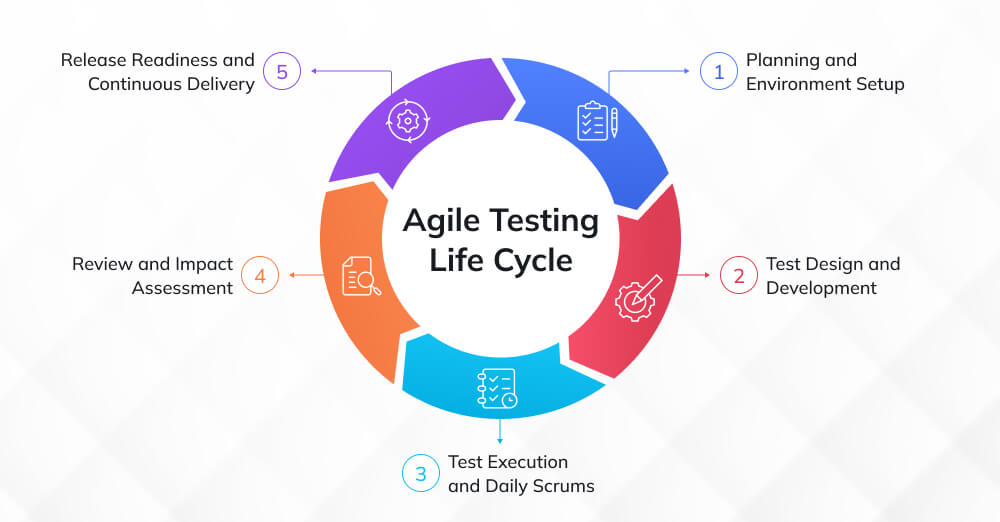
Stage 1: Planning and Environment Setup
This is where quality begins. Before the first line of code is written, testers collaborate with developers, product owners, and business analysts to define what success looks like.
What happens in this stage:
- Identify test objectives, sprint goals, and acceptance criteria.
- Define the testing scope, including automation coverage and manual testing priorities.
- Set up the test environment, data, and required tools (like Jira, Selenium, or Jenkins).
- Decide how testing integrates with CI/CD pipelines for faster releases.
Outcome: A shared understanding of how quality will be measured and delivered across sprints.
Stage 2: Test Design and Development
Once user stories are finalized, this stage converts them into executable test assets. It’s where testers write and optimize test cases, automation scripts, and exploratory scenarios.
Activities include:
- Mapping user stories → test cases for traceability.
- Creating data-driven automation scripts that adapt to iterative changes.
- Conducting peer reviews with developers to ensure accuracy.
- Setting up test repositories for continuous reuse and scalability.
Outcome: A robust, modular test suite that evolves with every iteration.
Stage 3: Test Execution and Daily Scrums
Here, testing becomes an everyday activity, not a checkpoint. Testers run their cases as development progresses, ensuring quick feedback on every build.
Activities include:
- Executing unit, integration, and regression tests during each sprint.
- Participating in daily stand-ups to discuss progress and blockers.
- Reporting and tracking bugs in real-time through Agile boards.
- Validating fixes and retesting continuously.
Outcome: Rapid defect detection, fewer surprises during deployment, and consistent delivery velocity.
Stage 4: Review and Impact Assessment
At the end of each sprint, the focus shifts from execution to evaluation and learning. This stage connects feedback loops and drives continuous improvement.
Activities include:
- Conducting sprint reviews and retrospectives to discuss quality outcomes.
- Performing impact analysis for new changes and potential regressions.
- Tracking defect density, coverage, and test efficiency metrics.
- Collecting user and stakeholder feedback to fine-tune the next iteration.
Outcome: Data-driven insights that strengthen future sprints and ensure quality isn’t just maintained, it’s improved.
Stage 5: Release Readiness and Continuous Delivery
This is the stage where confidence meets execution. The focus is on stability, scalability, and ensuring the product is production-ready.
Activities include:
- Performing final regression testing and acceptance validation.
- Checking performance, security, and compatibility under real conditions.
- Verifying rollback and backup plans.
- Automating post-release monitoring to catch issues early.
Outcome: A reliable release that meets business objectives, user expectations, and technical standards, all without the post-launch chaos.
Conclusion
The true strength of Agile testing lies in its rhythm, a continuous loop of collaboration, validation, and learning. Rather than treating testing as a final hurdle, Agile teams weave it into every sprint, ensuring that quality evolves alongside functionality.
By following a structured Agile testing life cycle, teams can detect defects earlier, adapt faster to change, and deliver software that truly reflects user needs. Each sprint becomes a checkpoint of progress and trust, not just a deadline.
As businesses increasingly rely on speed and flexibility, understanding the Agile testing process isn’t just a technical skill; it’s a competitive advantage. Teams that master this discipline create a culture of continuous improvement, customer focus, and product excellence.
If you’re looking to deepen your Agile expertise, explore certification programs like Agile Scrum Master, each designed to help professionals lead Agile testing and delivery with confidence and precision.