


Have you ever faced a critical project decision where traditional data analysis fell short? When requirements are ambiguous, risks are uncertain, and the path forward isn’t clear, how do you make informed choices? This is where the Delphi Technique, one of project management’s most powerful yet underutilized tools, becomes invaluable.
Developed during the Cold War era to predict future military threats, the Delphi Technique has evolved into a sophisticated forecasting and decision-making method used across industries worldwide. Named after the ancient Greek Oracle of Delphi, renowned for prophetic wisdom, this structured approach harnesses collective intelligence from expert panels to reach consensus on complex issues where data is scarce or conflicting.
In project management, the Delphi Technique helps teams make critical decisions about scope definition, risk assessment, schedule estimation, and resource forecasting with remarkable accuracy. Unlike traditional brainstorming sessions, where dominant personalities can skew outcomes, this method employs anonymity and iterative feedback rounds to extract unbiased expert opinions and build genuine consensus.
According to PMI research, projects that effectively use expert judgment techniques, such as Delphi, achieve significantly higher success rates, particularly in areas requiring forecasting and risk assessment. As project complexity increases, mastering this technique is essential for project managers seeking to improve decision quality and project outcomes.
This comprehensive guide explores everything you need to know about the Delphi Technique in project management: its origins and principles, the step-by-step process, practical applications across project phases, advantages and limitations, and how it compares to other decision-making methods. You’ll discover when to apply this technique, how to implement it effectively, and how to leverage it for PMP certification and career advancement.
Table of Contents:
- Section 1: Understanding the Delphi Technique
- Section 2: The Delphi Process: Step-by-Step Implementation
- Section 3: Applications of the Delphi Technique in Project Management
- Section 4: Advantages and Disadvantages of the Delphi Technique
- Section 5: Delphi Technique vs. Other Decision-Making Methods
- Section 6: Implementing Delphi in Your Projects: Best Practices
- Section 7: The Delphi Technique in PMP and Professional Practice
- Section 8: Future of the Delphi Technique in Project Management
- Conclusion
- Frequently Asked Questions
Section 1: Understanding the Delphi Technique
What Is the Delphi Technique?
The Delphi Technique is a systematic forecasting method that aggregates expert opinions through structured, anonymous questionnaires administered across multiple rounds. This iterative process continues until the expert panel reaches consensus on a particular issue, prediction, or decision.
At its core, the technique relies on four fundamental principles:
Anonymity: Experts provide their opinions without knowing how other panelists have responded, eliminating peer pressure, groupthink, and the influence of dominant personalities. This anonymity encourages honest, unbiased responses grounded in expertise rather than social dynamics.
Iteration: The process involves multiple rounds (typically three) in which experts review aggregated feedback from previous rounds and revise their opinions based on collective insights. This iterative refinement helps converge toward consensus while allowing experts to maintain their positions if they have strong justification.
Controlled Feedback: After each round, a neutral facilitator compiles and summarizes responses, presenting them back to the expert panel without identifying individual contributors. This structured feedback ensures experts can consider diverse perspectives while maintaining anonymity.
Expert Panel: Unlike surveys of general populations, the Delphi Technique specifically targets recognized experts with deep knowledge and experience in the subject area being explored. The quality of results depends heavily on proper expert selection.
Historical Origins and Evolution
The Delphi Technique was developed in the early 1950s by Olaf Helmer and Norman Dalkey at the RAND Corporation during the Cold War. General Henry Arnold commissioned a project called “Project Delphi” to forecast technological developments that could affect military strategy and to identify potential enemy attacks.
Traditional forecasting methods proved inadequate for unprecedented scenarios lacking historical data or established scientific theories. The RAND researchers realized that systematically aggregating expert judgment could produce reliable predictions even in highly uncertain situations. Their breakthrough methodology combined anonymity to reduce bias, iteration to refine thinking, and structured feedback to leverage collective intelligence.
Since its military origins, the Delphi Technique has evolved and found applications across diverse fields, including healthcare policy development, technology forecasting, business strategy, public administration, environmental planning, and, of course, project management. In 2015, BMJ published detailed protocols for using the Delphi method in research, solidifying its academic credibility. More recent adaptations have incorporated digital tools and online platforms, making the technique more accessible and efficient for modern project teams.
The Principle of Collective Intelligence
The Delphi Technique’s effectiveness stems from the principle that collective intelligence from diverse experts often surpasses that of even the most knowledgeable single expert. This phenomenon, observed in nature (e.g., honeybees using swarm intelligence to select optimal nest sites), demonstrates how groups can make better decisions than individuals when properly structured.
As American author Tom Atlee articulated: “To overcome our biological limitations as individuals, we have co-evolved collective systems and capacities.” The Delphi Technique provides the structure necessary to harness this collective wisdom while avoiding the pitfalls of traditional group decision-making, such as dominant personalities, peer pressure, and anchoring bias.
| RESEARCH INSIGHT
“Projects that effectively utilize expert judgment techniques show significantly higher success rates in forecasting and risk assessment. The Delphi approach can predict project timelines and identify potential risks with greater accuracy than individual estimates.” |
Section 2: The Delphi Process: Step-by-Step Implementation
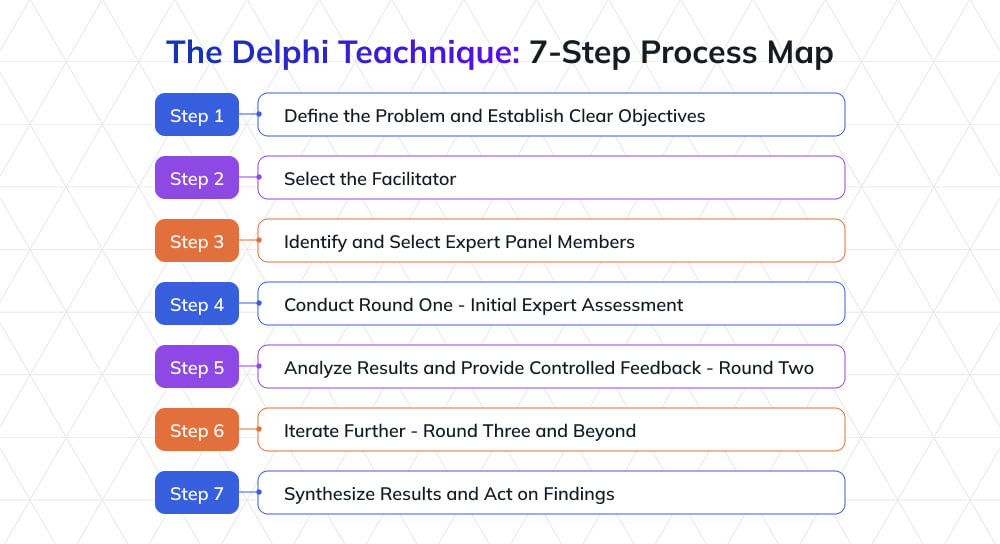
Step 1: Define the Problem and Establish Clear Objectives
The foundation of any successful Delphi study begins with precisely defining the problem or question requiring expert consensus. Vague or overly broad questions lead to unfocused results and expert confusion. Project managers must articulate exactly what decision needs to be made, what forecasts are required, or what risks need to be assessed.
Best Practices For Problem Definition Include:
Specificity: Instead of asking “What risks does this project face?” specify “What are the top five risks that could delay our ERP implementation beyond Q3 2026, and what is the probability of each occurring?” This specificity guides experts toward actionable insights.
Measurability: Frame questions to elicit quantifiable responses when appropriate. For schedule estimation, ask for specific date ranges or duration estimates. For risk probability, use scales (1-5, percentages) that can be aggregated mathematically.
Scope Boundaries: Clearly define what’s in scope and out of scope for the Delphi study. If assessing project risks, specify whether experts should consider only technical risks, or also organizational, financial, and external risks. These boundaries prevent scope creep in the study itself.
Relevance to Decision: Ensure the question directly informs a specific decision or action. If the answer won’t change project approach or stakeholder decisions, reconsider whether a time-intensive Delphi study is warranted.
Step 2: Select the Facilitator
The facilitator plays a critical role in Delphi success, serving as the neutral coordinator who manages the process without influencing content. This individual designs questionnaires, collects and anonymizes responses, analyzes feedback, and communicates results clearly to the expert panel.
Essential Facilitator Qualities Include:
Neutrality and Objectivity: The facilitator must remain impartial, avoiding bias toward any particular outcome. They should not be stakeholders with vested interests in specific results, as this could unconsciously influence how they frame questions or summarize feedback.
Methodological Expertise: Familiarity with the Delphi protocol, statistical analysis, and survey design ensures that the process adheres to best practices. The facilitator should understand when consensus has been achieved and when additional rounds are necessary.
Communication Skills: Clear, precise communication is essential when crafting questionnaires and summarizing complex expert feedback. The facilitator must distill diverse opinions into coherent summaries that experts can easily understand and respond to.
Project Management Knowledge: For project management applications, the facilitator benefits from understanding PM terminology, concepts, and context. This ensures questions are framed appropriately and expert responses are interpreted correctly.
Many organizations assign experienced project managers or PMO members as Delphi facilitators, as they combine methodological knowledge with domain understanding. Alternatively, external facilitators can provide additional neutrality for politically sensitive decisions.
Step 3: Identify and Select Expert Panel Members
The quality of Delphi results depends entirely on expert selection. Panels typically include 5-20 experts, with 10-15 being optimal for most project management applications. Too few experts risk inadequate diversity of perspective; too many create coordination challenges and diminish individual expert motivation.
Expert Selection Criteria:
Relevant Expertise and Experience: Panel members should possess recognized expertise directly relevant to the issue under examination. For IT project risk assessment, include experts in similar technology implementations, security specialists, and change management professionals. Verify expertise through credentials, years of experience, and past project involvement.
Diversity of Perspectives: While all panelists should be experts, seek diversity in backgrounds, organizations, methodologies, and viewpoints. A panel of experts from the same company who think alike won’t produce the collective intelligence benefits the Delphi Technique offers. Include internal and external experts, different functional areas, and various levels of experience.
Availability and Commitment: Delphi studies require sustained participation across multiple rounds spanning weeks or months. Ensure selected experts have time to thoughtfully complete questionnaires and can commit to all rounds. Attrition between rounds undermines result validity.
Willingness to Engage: Look for experts willing to reconsider their positions based on peer feedback. Experts who rigidly maintain initial opinions regardless of new information don’t contribute to the iterative refinement process that makes Delphi effective.
Step 4: Conduct Round One – Initial Expert Assessment
The first round establishes baseline expert opinions before any group feedback influences thinking. This round often uses open-ended questions allowing experts to identify issues, risks, or factors they consider most important.
Round One Characteristics:
Open-Ended Questions: For exploratory Delphi studies, Round One might ask experts to list potential risks, identify critical success factors, or propose solution alternatives. This generates a comprehensive inventory of expert perspectives without constraining thinking.
Individual Estimates: For forecasting applications, experts provide initial estimates (project duration, cost, probability of success) based solely on their experience and judgment. These independent estimates form the baseline for subsequent rounds.
Rationale Documentation: Encourage experts to explain their reasoning, particularly for outlier responses. Understanding why an expert predicts a six-month delay when others predict two months provides valuable context for the panel.
Anonymity Established: Experts submit responses to the facilitator without knowledge of others’ submissions, establishing the anonymity that characterizes the entire process.
Step 5: Analyze Results and Provide Controlled Feedback – Round Two
After Round One, the facilitator analyzes responses, identifies patterns, calculates statistical summaries (mean, median, range for quantitative data), and prepares structured feedback for Round Two.
Feedback Components:
Statistical Summary: For quantitative estimates, provide the group mean, median, quartile ranges, and distribution of responses. This shows each expert where their estimate falls relative to the group without revealing individual opinions.
Qualitative Themes: For open-ended responses, categorize and summarize common themes, unique perspectives, and areas of agreement or disagreement. Present the range of expert opinions in a neutral, organized fashion.
Anonymous Justifications: Include explanations for outlier positions without identifying experts. If one expert predicts significantly higher risk than others, share their reasoning so the panel can consider whether they’ve identified something others missed.
Round Two Questionnaire: Based on Round One results, create a more structured questionnaire. Ask experts to reconsider their positions given the group feedback, either confirming their original stance or revising based on new insights. Request that those maintaining outlier positions provide additional justification.
This round is where collective intelligence emerges. Experts gain perspective on how their judgment compares to peers and can adjust their thinking based on considerations they may have overlooked initially.
Step 6: Iterate Further – Round Three and Beyond
The third round continues the refinement process, with experts reviewing updated statistical summaries and justifications. Typically, consensus emerges by Round Three, defined as reaching stable responses where further iteration produces minimal change.
Consensus Indicators:
Statistical Convergence: The range of quantitative estimates narrows significantly, with most responses clustering around the group median. For example, project duration estimates that ranged from 3-9 months in Round One might converge to 5-7 months by Round Three.
Opinion Stability: Experts’ positions stabilize with little change between rounds, indicating they’ve reached informed conclusions after considering all available perspectives.
Acceptable Disagreement: Perfect unanimity isn’t necessary. If the group reaches a clear majority consensus with well-justified dissenting opinions, this represents successful Delphi completion. The goal is informed consensus, not forced agreement.
Diminishing Returns: When additional rounds produce minimal new insights or position changes, continuing wastes expert time and yields little benefit.
Most Delphi studies complete in three rounds, though complex issues may require four or more. The facilitator decides when sufficient consensus exists to conclude the process and move to implementation.
Step 7: Synthesize Results and Act on Findings
After achieving consensus, the facilitator prepares a comprehensive final report summarizing the expert panel’s conclusions, the convergence process, remaining areas of uncertainty, and actionable recommendations.
Final Deliverables Typically Include:
Consensus Findings: Clear statement of the expert panel’s conclusions, forecasts, or recommendations, including confidence levels and any important caveats.
Decision Support Documentation: Analysis of how findings inform the specific project decisions that motivated the Delphi study. Connect expert consensus directly to actionable next steps.
Minority Perspectives: Document dissenting expert opinions and their justifications. These alternative viewpoints may prove valuable if circumstances change or consensus predictions prove incorrect.
Implementation Guidance: Recommendations for acting on findings, including suggested contingencies if forecasts prove overly optimistic or pessimistic.
The ultimate measure of Delphi success isn’t reaching consensus—it’s whether that consensus improves project decision-making and outcomes. Project managers must translate expert findings into concrete actions that enhance project planning, risk mitigation, or stakeholder alignment.
| PRO TIP
Keep questionnaires concise and focused. Expert participation drops significantly if questionnaires require more than 20-30 minutes to complete. Respect experts’ time by asking only questions that directly serve your decision-making needs. Quality responses from engaged experts outperform comprehensive questionnaires that exhaust panel members. |
Section 3: Applications of the Delphi Technique in Project Management
Risk Identification and Assessment
Risk management represents one of the most valuable applications of the Delphi Technique in project management. When historical data is limited or projects involve novel technologies, regulatory environments, or organizational changes, expert judgment becomes essential for identifying and evaluating risks.
How Delphi Enhances Risk Management:
Comprehensive Risk Identification: In Round One, experts independently identify risks they foresee based on their experience. This broad solicitation typically surfaces 2-3 times more risks than traditional risk workshops, as experts aren’t influenced by groupthink or limited by meeting time constraints.
Probability and Impact Assessment: After compiling a master risk list, subsequent rounds ask experts to estimate each risk’s probability of occurrence and potential impact. The aggregated expert consensus provides more reliable risk prioritization than individual estimates, helping project managers focus mitigation efforts appropriately.
Risk Interdependencies: Expert panels can identify how risks interact and compound. For example, vendor delays might increase the probability of team attrition, which in turn elevates quality risks. These interdependencies are often missed in traditional risk analysis but emerge through structured expert dialogue.
Mitigation Strategy Evaluation: Delphi can assess proposed risk responses, with experts evaluating mitigation strategy effectiveness, feasibility, and cost-benefit trade-offs. This validation helps project managers invest in risk responses most likely to succeed.
Project Schedule and Cost Estimation
Estimating project duration and costs accurately remains one of project management’s most persistent challenges. The Delphi Technique addresses estimation biases and uncertainties inherent in complex projects.
Estimation Applications:
Activity Duration Estimates: For projects lacking historical data on similar activities, Delphi provides reliable duration estimates. Experts with relevant experience provide best-case, most-likely, and worst-case duration estimates, which the facilitator aggregates into probabilistic forecasts.
Three-Point Estimation Enhancement: While three-point estimation (optimistic/most likely/pessimistic) is standard practice, having multiple experts provide three-point estimates for critical activities significantly improves accuracy. The Delphi process identifies unrealistic optimism or excessive conservatism in estimates.
Budget Forecasting: For innovative projects or those in volatile markets, expert panels can forecast costs with greater accuracy than algorithmic models alone. Experts incorporate market trends, resource availability fluctuations, and organizational factors that purely quantitative models miss.
Schedule Risk Analysis: Delphi complements Monte Carlo simulation and other quantitative schedule risk analysis techniques by providing expert-informed probability distributions for activity durations and identifying schedule risks that simulation alone wouldn’t capture.
Scope Definition and Requirements Validation
When project scope is ambiguous or stakeholders have conflicting visions, the Delphi Technique helps establish shared understanding and achieves consensus on project boundaries and requirements.
Scope Applications:
Feature Prioritization: For product development projects with extensive feature wish-lists, expert panels can prioritize requirements based on value delivery, implementation complexity, and strategic alignment. This objective prioritization reduces political maneuvering around scope.
Acceptance Criteria Definition: When success criteria are subjective or unclear, Delphi helps stakeholder experts converge on measurable acceptance criteria that balance ambition with feasibility.
Scope Change Evaluation: For significant scope change requests, expert panels can assess impacts on schedule, cost, quality, and strategic alignment more objectively than individual stakeholders advocating for pet features.
Stakeholder Alignment: The iterative feedback process itself builds stakeholder alignment. As experts see how peers view scope priorities and requirements, they develop shared mental models that reduce downstream conflicts.
Technology Selection and Vendor Evaluation
When projects involve selecting technologies, platforms, or vendors, the Delphi Technique leverages diverse expertise to make informed choices.
Selection Applications:
Technology Evaluation: For organizations choosing between competing technologies (cloud platforms, ERP systems, development frameworks), expert panels assess each option against weighted criteria. The anonymous process prevents vendor relationships or personal technology preferences from unduly influencing decisions.
Vendor Assessment: When selecting implementation partners or outsourcing vendors, Delphi helps evaluate vendor capabilities, cultural fit, and risk profiles. Multiple experts reviewing proposals identify red flags and opportunities single reviewers might miss.
Build vs. Buy Decisions: Expert panels can weigh the trade-offs between building custom solutions versus buying commercial products, considering factors like initial cost, long-term maintenance, customization needs, and organizational capabilities.
Change Management and Organizational Readiness
The Delphi Technique helps assess organizational readiness for change and forecast change management challenges.
Change Management Applications:
Readiness Assessment: Expert panels evaluate whether the organization has sufficient change capacity, leadership support, resources, and cultural preparedness for proposed transformations.
Resistance Prediction: Experts identify likely sources of resistance and forecast its intensity, enabling proactive change management strategies rather than reactive crisis response.
Communication Strategy: Delphi can inform communication plans by identifying what messages resonate with different stakeholder groups and which communication channels prove most effective.
Section 4: Advantages and Disadvantages of the Delphi Technique
Key Advantages
Eliminates Groupthink and Social Pressure: Anonymity removes hierarchical dynamics, dominant personalities, and peer pressure that plague traditional meetings. Junior experts can disagree with senior colleagues without fear of repercussions, ensuring merit-based consensus.
Harnesses Collective Intelligence: The structured process leverages diverse expert perspectives while avoiding pitfalls of face-to-face meetings. Research consistently shows that properly conducted Delphi studies produce more accurate forecasts than individual experts or traditional group meetings.
Geographical Flexibility: Experts can participate from anywhere in the world, enabling organizations to assemble best-available expertise regardless of location. This geographic diversity often enhances result quality by incorporating different regional perspectives and experiences.
Thoughtful Deliberation: Unlike time-pressured meetings, experts can reflect carefully on questions, research unfamiliar topics, and provide well-considered responses. This deliberation improves response quality substantially.
Documented Reasoning: The process creates comprehensive documentation of expert rationale, minority opinions, and consensus evolution. This audit trail proves valuable for defending decisions to stakeholders and learning from outcomes.
Primary Limitations
Time-Intensive Process: Delphi studies typically require 4–8 weeks minimum (sometimes months), making the technique unsuitable for urgent decisions. Each round needs 5–7 days for expert response plus facilitator analysis time.
Expert Availability Challenges: Securing commitment from top experts for multiple rounds proves difficult. Busy experts may decline participation or drop out between rounds, potentially compromising result validity.
Potential for Expert Disagreement: While consensus is the goal, experts sometimes maintain polarized positions despite multiple rounds. When fundamental disagreement persists, results may not provide clear decision guidance.
Facilitator Bias Risk: Though neutrality is essential, facilitators influence results through question framing, feedback summarization, and deciding when consensus is achieved. Poor facilitation undermines result credibility.
No Guarantee of Accuracy: Consensus doesn’t guarantee correctness. Expert panels can collectively err, particularly when facing unprecedented situations where even expert experience provides limited guidance.
| AVOID THIS MISTAKE
Don’t use Delphi for routine, time-sensitive decisions. Many project managers apply this technique inappropriately to everyday choices better suited for quick meetings or individual judgment. Why it’s problematic: The weeks-long process delays decisions unnecessarily, frustrates teams waiting for direction, and wastes valuable expert time on issues that don’t warrant intensive analysis. What to do instead: Reserve Delphi for high-stakes, complex decisions with significant uncertainty where expert consensus adds substantial value. Use faster techniques (brainstorming, nominal group technique, voting) for routine project decisions requiring quick resolution. |
Section 5: Delphi Technique vs. Other Decision-Making Methods
Delphi vs. Brainstorming
Brainstorming involves open, face-to-face discussions where participants freely share ideas. It’s fast (single session) and encourages creative divergence, but suffers from groupthink, dominant personalities, and production blocking (only one person speaks at a time).
Delphi uses anonymous questionnaires administered over multiple rounds, which eliminates social dynamics but requires significantly more time. Brainstorming is better at generating creative alternatives quickly, whereas Delphi excels at evaluating alternatives and forecasting outcomes.
Delphi vs. Nominal Group Technique (NGT)
Nominal Group Technique structures face-to-face meetings where participants silently write ideas, share them round-robin, discuss for clarification, and vote on priorities. NGT provides rapid results (2-3 hour session) while limiting dominant personality influence.
Key differences: NGT requires physical presence or video conferencing, making geographical diversity challenging. Delphi’s anonymity is more complete, as even voting in NGT reveals individual preferences. For quick decisions with co-located teams, NGT often provides better value; for geographically distributed experts or politically sensitive topics requiring deep anonymity, Delphi proves superior.
Delphi vs. Traditional Meetings
Traditional meetings offer real-time interaction, relationship building, and fast decision-making but suffer from numerous cognitive biases, groupthink, and power dynamics.
Research comparing these methods found that Delphi consistently outperforms traditional meetings for forecasting and risk assessment, whereas meetings are better for creative problem-solving and when relationship-building is important. The best approach often combines methods, use Delphi for critical forecasts and assessments, then hold meetings to discuss implementation.
When to Choose Delphi
Select the Delphi Technique when:
- High uncertainty exists with limited historical data
- Expertise is geographically dispersed and assembling physically is impractical
- Politics or power dynamics could bias face-to-face discussions
- Complex forecasting or risk assessment requires deep expert analysis
- Time permits the weeks-long process
- Stakes are high enough to justify the resource investment
Section 6: Implementing Delphi in Your Projects: Best Practices
Design Effective Questionnaires
Keep questions focused, unambiguous, and answerable by your expert panel. Use scales (1-5, 1-10) for quantitative judgments to enable statistical analysis. Limit Round One questionnaires to 15-20 questions; subsequent rounds can be longer as they build on prior responses.
Manage Expert Panel Effectively
Set clear expectations upfront about time commitment, number of rounds, and participation requirements. Send reminders as deadlines approach, but avoid excessive follow-up that feels like harassment. Acknowledge experts’ contributions and share how their insights influenced final decisions.
Leverage Technology
Modern survey platforms (SurveyMonkey, Qualtrics, Google Forms) streamline Delphi administration. These tools automate distribution, collect responses, perform basic statistical analysis, and maintain anonymity. Some project management platforms now include Delphi-specific features.
Know When to Stop
Avoid continuing rounds beyond diminishing returns. If positions stabilize with an acceptable consensus, additional rounds waste expert time. Conversely, if fundamental disagreement persists after three rounds, acknowledge that expert opinion is divided rather than forcing artificial consensus.
Document the Process
Maintain detailed records of all questionnaires, aggregated responses, individual submissions (kept confidential), and facilitation decisions. This documentation supports the credibility of the results and provides valuable lessons learned for future Delphi studies.
Section 7: The Delphi Technique in PMP and Professional Practice
Delphi in the PMBOK® Guide
The Delphi Technique appears throughout the PMBOK® Guide as a tool for several knowledge areas including risk management, schedule management, and procurement management. The PMP exam specifically tests understanding of when and how to apply Delphi in project scenarios.
Key PMBOK® references include:
- Collect Requirements: Using Delphi to build stakeholder consensus on requirements
- Estimate Activity Durations: Leveraging expert panels for schedule estimation
- Identify Risks: Employing Delphi for comprehensive risk identification
- Perform Qualitative Risk Analysis: Using expert consensus to assess risk probability and impact
PMP Exam Considerations
For PMP® candidates, understanding Delphi’s distinguishing characteristics is essential:
- Recognizing when anonymity and iteration are necessary
- Differentiating Delphi from brainstorming, NGT, and other techniques
- Identifying scenarios where Delphi adds most value
- Understanding the facilitator’s role and responsibilities
Scenario questions often present situations with distributed experts, sensitive political dynamics, or high-uncertainty forecasting, all indicators that Delphi might be the appropriate technique.
Career Applications Beyond Certification
Mastering the Delphi Technique enhances project management careers by:
Demonstrating Advanced Expertise: Using sophisticated decision-making techniques signals senior-level capabilities beyond basic PM knowledge.
Building Stakeholder Confidence: Showing that critical decisions rest on structured expert consensus rather than individual opinion increases stakeholder trust.
Improving Decision Quality: The technique significantly improves forecast accuracy and risk assessment, leading to better project outcomes and career advancement.
Facilitating Complex Projects: As projects grow more complex, structured expert judgment becomes increasingly valuable, differentiating skilled PMs from novices.
Section 8: Future of the Delphi Technique in Project Management
Digital Transformation of Delphi
Modern technology is transforming how organizations conduct Delphi studies. Real-time Delphi (e-Delphi) uses online platforms that provide immediate feedback as experts submit responses, accelerating the process while maintaining anonymity. Artificial intelligence assists facilitators by automatically identifying consensus, flagging outliers requiring attention, and summarizing qualitative responses.
Integration with Agile and Hybrid Methodologies
As project management evolves toward Agile and hybrid approaches, the Delphi Technique adapts for use in sprint planning, backlog prioritization, and iterative risk assessment. Lightweight Delphi variations with shorter cycles fit Agile timelines while retaining core benefits.
Growing Importance of Uncertainty
In an increasingly uncertain business environment characterized by rapid technological change, geopolitical instability, and unprecedented challenges, structured expert judgment becomes more valuable, not less. Organizations will continue leveraging Delphi and related techniques to navigate complexity that defies purely data-driven approaches.
Conclusion
The Delphi Technique stands as one of project management’s most powerful yet underutilized decision-making tools. By systematically harnessing collective expert intelligence through anonymous, iterative questionnaires, this method enables project managers to make informed decisions even in the face of high uncertainty and limited data.
From its Cold War origins to modern applications across industries worldwide, the Delphi Technique has proven its value in risk assessment, estimation, scope definition, and strategic decision-making. Projects that effectively apply this method achieve significantly better outcomes in forecasting accuracy, risk management, and stakeholder alignment.
While the technique’s time-intensive nature means it’s not appropriate for every decision, mastering when and how to apply Delphi distinguishes advanced project managers from novices. As project complexity continues increasing and uncertainty remains a persistent challenge, structured expert judgment becomes more critical, not less.
Whether you’re preparing for PMP® certification, managing complex initiatives, or seeking to improve decision quality in your projects, understanding and applying the Delphi Technique equips you with a proven method for navigating uncertainty with confidence. The key is recognizing when this powerful tool adds value and implementing it with discipline, neutrality, and respect for expert time.
Frequently Asked Questions
1. What is the Delphi Technique in project management?
The Delphi Technique is a structured forecasting and decision-making method that uses anonymous questionnaires across multiple rounds to achieve expert consensus. A facilitator compiles responses after each round and provides feedback to panelists, who then revise their opinions. This iterative process continues until consensus emerges, typically by the third round.
2. When should project managers use the Delphi Technique?
Use Delphi for high-stakes decisions involving significant uncertainty, such as risk assessment for unprecedented projects, schedule estimation without historical data, scope definition with conflicting stakeholder views, or technology selection requiring diverse expertise. The technique works best when expertise is geographically dispersed, politics could bias face-to-face discussions, and sufficient time (4-8 weeks minimum) is available.
3. How long does a Delphi study typically take?
Most Delphi studies require 4-8 weeks minimum, with three rounds of questionnaires. Each round needs 5-7 days for expert response plus 2-3 days for facilitator analysis and feedback preparation. Complex issues may require four or more rounds, extending timelines to several months. This time requirement makes Delphi unsuitable for urgent decisions.
4. How many experts should participate in a Delphi panel?
The optimal panel size is typically 10-15 experts, though panels can range from 5-20 members. Fewer than five experts risks insufficient diversity of perspective, while more than 20 creates coordination challenges and diminishes individual expert motivation. The key is to select recognized experts with relevant experience and to ensure diversity of backgrounds and viewpoints.
5. What are the main advantages of the Delphi Technique?
Key advantages include eliminating groupthink and social pressure through anonymity, harnessing collective intelligence from diverse experts, enabling geographical flexibility for dispersed expertise, allowing thoughtful deliberation rather than time-pressured decisions, and creating documented reasoning for future reference. Research shows Delphi consistently outperforms traditional meetings for forecasting and risk assessment.
6. What are the limitations of the Delphi Technique?
Primary limitations include the time-intensive process (weeks or months), challenges securing commitment from busy experts across multiple rounds, potential for persistent expert disagreement despite iteration, risk of facilitator bias in question framing and feedback summarization, and no guarantee that consensus will prove accurate. The technique also doesn’t build personal relationships the way face-to-face meetings do.
7. How does Delphi differ from brainstorming and Nominal Group Technique?
Brainstorming uses face-to-face creative discussions that are fast but susceptible to groupthink and dominant personalities. Nominal Group Technique (NGT) structures face-to-face meetings where participants silently generate ideas, share them, and vote—providing results in a single session. Delphi uses completely anonymous questionnaires over multiple rounds, taking much longer but eliminating social dynamics more thoroughly. Choose based on decision complexity, time available, geographical distribution, and political sensitivity.