Most Agile teams use both epics and user stories, but the difference between them is often misunderstood. This confusion leads to poorly structured backlogs, unclear requirements, and inefficient sprint planning.
In simple terms, an epic is a large body of work that is broken down into smaller user stories. A user story, on the other hand, represents a specific, actionable requirement that delivers value to the end user within a sprint.
Understanding the difference between an epic vs user story is essential for effective Agile planning, prioritization, and execution. This guide explains how they differ, how they relate, and when to use each.
What is an Epic in Agile?
In Agile methodology, an epic is a large and complex body of work that can be deconstructed into smaller tasks, known as user stories. Epics are used to organize and categorize work, providing a high-level view of the project requirements. Typically, epics are too large to be completed in a single iteration and are broken down into smaller, more manageable user stories.
Epics serve as a means to capture and convey the overall scope of a feature or a set of related features. They act as placeholders for the detailed user stories that will be created during the planning and execution phases of an Agile project. Epics play a crucial role in facilitating a structured and iterative delivery of value, providing a strategic framework for achieving project goals.
What is a User Story?
In software development and product management, a user story is an informal narrative describing software features from an end-user perspective. Used in Agile methodology, it outlines user type, needs, and reasons, simplifying requirement descriptions.
|
“Stories are not requirements; they are conversation starters.” |
 |
User stories are recorded on cards, post-it notes, or project management software and may be written by various stakeholders. They embody an agile approach by shifting focus from written to verbal discussions about requirements. Each user story includes a concise written statement and crucial conversations about the desired functionality.
This tool fosters collaboration among clients, users, managers, and development teams, contributing to the iterative nature of Agile development. User stories are integral to capturing detailed software features in a user-centric and adaptable manner.
What is the difference between Epic Vs. User story?
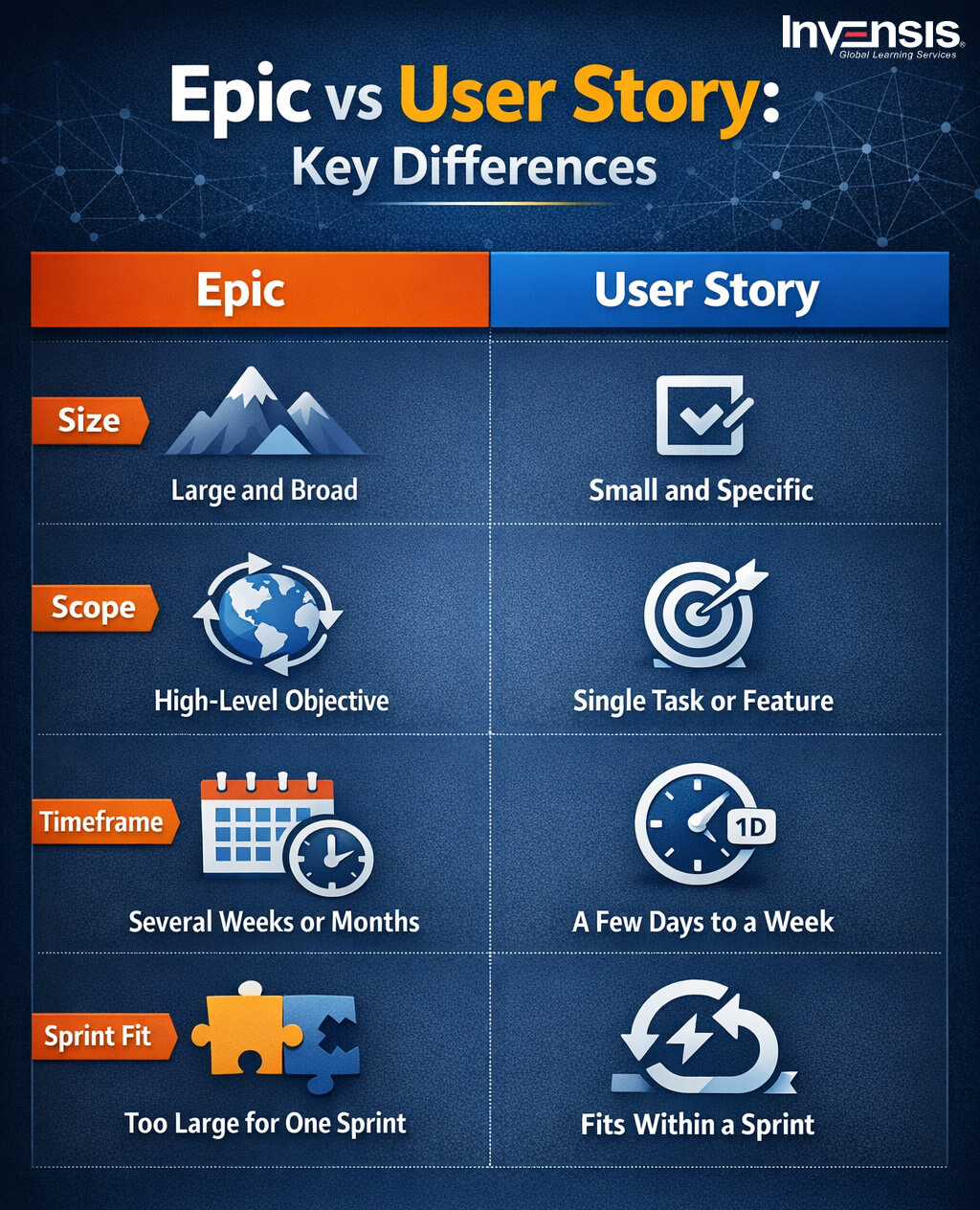
Before diving into the detailed explanation, it is important to understand the difference between epic vs user story at a glance. While both are essential components of Agile development, they serve different purposes in planning and execution. An epic represents a large, high-level objective that spans multiple sprints, whereas a user story focuses on a small, specific requirement that delivers immediate user value.
The key differences lie in their scope, size, level of detail, and role within the product backlog.
The table below provides a clear side-by-side comparison of epics and user stories, helping you quickly identify how they differ and how they work together in Agile projects.
| Aspect | Epic | User Story |
| Definition | A large body of work that can be divided into multiple user stories | A small, specific requirement focused on user value |
| Scope | Broad and high-level | Narrow and detailed |
| Size | Large | Small |
| Timeframe | Spans multiple sprints | Completed within a single sprint |
| Purpose | Represents a major feature or business objective | Describes a specific functionality |
| Sprint Fit | Cannot be completed in one sprint | Designed to be completed in one sprint |
| Backlog Level | High-level backlog item | Derived from epics |
| Example | Build a mobile banking application | As a user, I want to check my account balance |
Definition
An epic is a large body of work that represents a significant feature, goal, or initiative in Agile development. It acts as a container for multiple related requirements. A user story, on the other hand, is a small, specific requirement written from the end user’s perspective, focusing on delivering a single piece of value.
In simple terms:
|
Scope
Epics have a broad scope and cover an entire feature or business objective. They often include multiple functionalities and workflows. User stories have a narrow scope and focus on one specific action or outcome that benefits the user.
| Why this Counts? If your scope is too large, it becomes unmanageable—hence, epics must be broken down. |
Size
Epics are large and cannot be completed in one go. They require decomposition into smaller pieces. User stories are intentionally small so they can be implemented, tested, and delivered quickly.
| Rule of thumb: If it doesn’t fit in a sprint [symbol]rarr[/symbol] it’s likely an epic, not a user story. |
Timeframe
Epics typically span multiple sprints and may evolve as more information becomes available. User stories are short-lived and designed to be completed within a single sprint.
Practical impact:
|
Purpose
The purpose of an epic is to define a major feature or business goal at a high level. It provides direction and context for development. A user story exists to deliver a specific functionality that contributes to that larger goal.
Think of it like this:
- Epic = strategy
- User Story = execution
|
“A user story describes functionality that will be valuable to either a user or purchaser of a system.” This reinforces that user stories are not just technical tasks but value-driven deliverables derived from larger epics.” |
 |
Sprint Fit
Epics cannot be completed within a single sprint due to their size and complexity. User stories are designed specifically to fit within a sprint cycle, making them manageable and trackable.
| This is one of the most critical differences. If teams try to push epics into sprints, delivery breaks down. |
Backlog Level
Epics sit at a higher level in the product backlog and represent major initiatives. User stories are derived from epics and sit at a lower level, where they are prioritized and assigned for development.
| Structure looks like: Epic [symbol]rarr[/symbol] User Stories [symbol]rarr[/symbol] Tasks (optional) |
Example
An epic might be:
Develop a mobile banking application
User stories derived from it could include:
- As a user, I want to log in securely to protect my account.
- As a user, I want to transfer money so that I can manage my finances
- As a user, I want to view transaction history so that I can track spending.
This shows how one epic expands into multiple actionable items.
Epic and User Stories: How They Work Together?
In Agile, epics and user stories are not separate concepts; they are part of the same workflow. An epic represents a large goal or feature, while user stories break that goal into smaller, actionable units that teams can deliver incrementally. 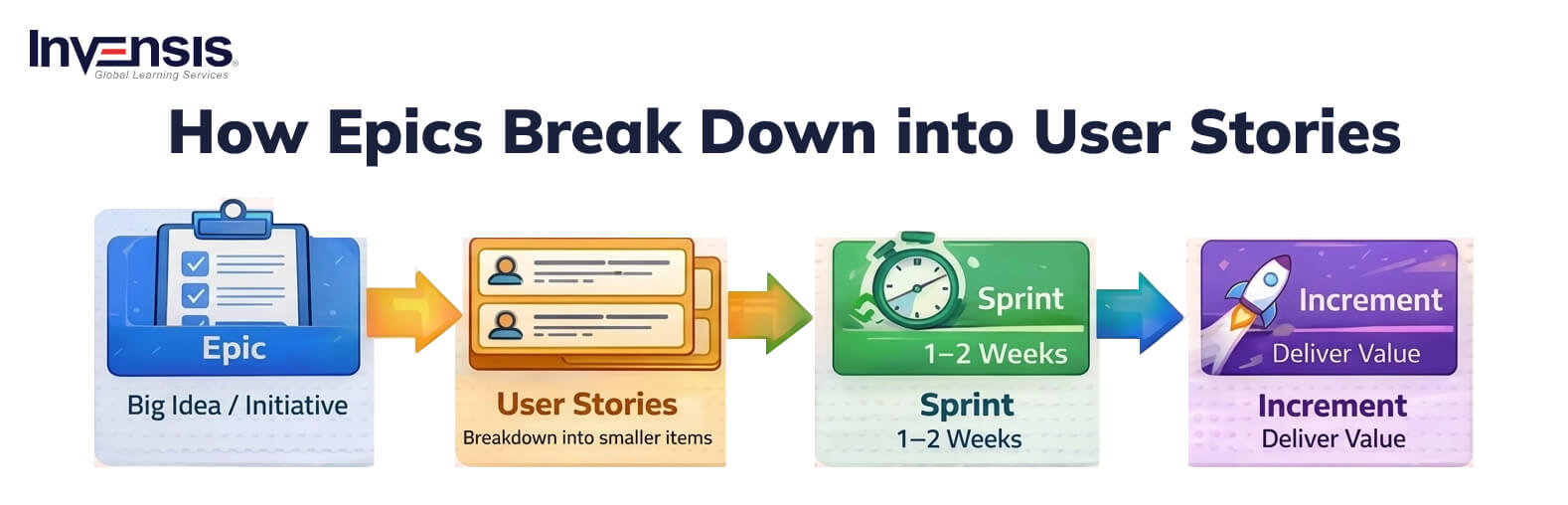
From Idea to Execution
The relationship starts with an idea or business objective. This idea is captured as an epic in the product backlog. Because an epic is too large to implement directly, it is progressively broken down into multiple user stories during backlog refinement.
Each user story represents a specific piece of functionality that contributes to completing the epic. These stories are then prioritized, estimated, and scheduled into sprints for Execution.
Flow:
Epic → User Stories → Sprint Execution → Incremental Delivery
Hierarchy in the Agile Backlog
Epics and user stories form a structured hierarchy within the backlog:
- Epics → Define high-level initiatives or features.
- User Stories → Break epics into actionable deliverables.
- Tasks (optional) → Further break stories into technical steps.
This hierarchy ensures that large goals are systematically converted into manageable work items without losing alignment with business objectives.
Continuous Breakdown and Refinement
Epics are not fully detailed at the beginning. As teams gain clarity, they continuously refine epics into smaller user stories. This process is known as progressive elaboration.
Over time:
- Unclear epics become well-defined.
- Large requirements become actionable stories.
- Priorities shift based on feedback.
This flexibility is a core strength of Agile.
Traceability and Alignment
One of the biggest advantages of linking user stories to epics is the traceability it provides. Every user story can be traced back to a larger business goal, ensuring that development efforts are always aligned with strategic objectives.
This helps teams answer:
- Why are we building this?
- What bigger goal does this support?
Without this linkage, teams risk delivering isolated features with no real impact.
Real-World Example of Epic and User Stories
A practical example of how epics and user stories work together can be seen in Agile guidance provided by Atlassian, widely used by teams working with tools like Jira.
Epic
Build a website for a new product launch.
This epic represents a large initiative encompassing user registration, authentication, and account management. Because of its size and complexity, it cannot be completed within a single sprint.
User Stories
The epic is broken down into smaller, actionable user stories:
- As a user, I want to create an account so that I can access personalized features.
- As a user, I want to log in securely so that my data is protected.
- As a user, I want to reset my password so that I can regain access if I forget it.
This example clearly shows how one epic is divided into multiple user stories, each delivering a specific piece of functionality. While the epic defines the overall objective, user stories enable teams to implement and deliver it incrementally across sprints.
Source: Atlassian
Conclusion
Distinguishing between Agile epics and user stories is vital for effective project management. Epics provide a high-level vision, guiding teams strategically, while user stories offer detailed functionalities for incremental development. This understanding empowers Agile teams to balance comprehensive project goals with manageable granularity, fostering enhanced project success.
The example of “Task Management Upgrade” demonstrates how epics serve as containers for specific user stories, showcasing their collaborative role in Agile methodology. Ultimately, recognizing the importance of epics and user stories is key to achieving success in Agile project management.
For those seeking expertise in Agile project management, Invensis Learning’s Agile Courses are valuable, imparting comprehensive knowledge for managing projects with flexibility and responsiveness in the rapidly changing software development environment.
Frequently Asked Questions
What is the difference between an epic and a user story in Agile?
An epic is a large body of work that represents a major feature or objective, while a user story is a small, specific requirement derived from that epic. Epics are broken down into multiple user stories to enable incremental delivery within sprints.
Is an epic bigger than a user story?
Yes, an epic is significantly larger than a user story. It typically spans multiple sprints and includes several user stories, whereas a user story is designed to be completed within a single sprint.
Can an epic be completed in one sprint?
No, epics are usually too large to complete in a single sprint. If an item can be completed in a single sprint, treat it as a user story rather than an epic.
How many user stories are in an epic?
There is no fixed number of user stories in an epic. The number depends on the epic’s complexity and scope. Larger epics may contain many user stories, while smaller ones may require only a few.
What comes first: the epic or the user story?
An epic comes first. It represents a high-level goal or feature, which is then broken down into user stories for implementation and delivery.
What is the relationship between an epic and a user story?
An epic is a parent item that contains multiple user stories. User stories break down the epic into smaller, actionable tasks that can be completed within sprints.
Is the epic part of Scrum?
Epics are not officially defined in the Scrum Guide, but they are widely used in Agile practices, including Scrum, to manage large bodies of work within the product backlog.
What is an example of an epic and a user story?
An example of an epic is “Build a website for a product launch.”
User stories derived from it could include “As a user, I want to create an account” and “As a user, I want to log in securely.”
Why are epics broken into user stories?
Epics are broken down into user stories to make large, complex work manageable. This allows teams to deliver value incrementally, prioritize effectively, and adapt to changes during development.
What happens if epics are not broken down properly?
If epics are not broken down, teams may struggle with unclear requirements, oversized tasks, delayed delivery, and inefficient sprint planning. Proper decomposition is essential for Agile success.