

Why do 70% of organizational change initiatives fail to achieve their objectives? According to McKinsey’s 2024 research, it’s not due to poor strategy or inadequate resources; it’s because organizations fundamentally misunderstand that successful change is about people, not just processes. Every project, whether implementing new technology, restructuring operations, or transforming business models, requires people to think, behave, and work differently. Without effective change management, even the most brilliantly designed projects crumble under the weight of human resistance.
Change management has evolved from a peripheral project consideration to a critical success factor that can determine whether your multi-million dollar initiative delivers transformational value or becomes another statistic in the failure column. In today’s volatile business environment, where digital transformation, hybrid work models, and market disruptions demand constant adaptation, the ability to manage change effectively isn’t optional; it’s a competitive necessity.
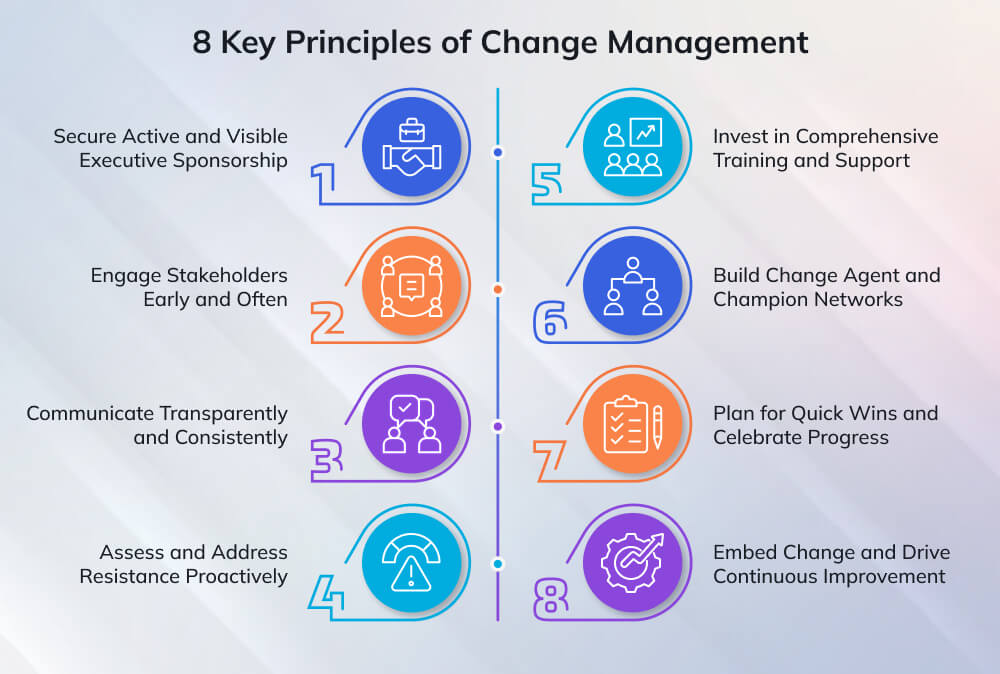
This comprehensive guide explores the eight key principles of change management that separate successful transformations from failed initiatives. You’ll discover proven frameworks used by change leaders at Fortune 500 companies, practical strategies for overcoming resistance, and actionable techniques you can implement immediately.
We’ll examine each principle through both theoretical foundations and real-world applications, showing you not just what to do but how to do it and why it matters. By understanding and applying these principles, you’ll significantly increase your project’s probability of success while building organizational change capability that compounds over time.
Table of Contents:
- Understanding Change Management in a Project Context
- Principle 1: Secure Active and Visible Executive Sponsorship
- Principle 2: Engage Stakeholders Early and Often
- Principle 3: Communicate Transparently and Consistently
- Principle 4: Assess and Address Resistance Proactively
- Principle 5: Invest in Comprehensive Training and Support
- Principle 6: Build Change Agent Networks
- Principle 7: Plan for Quick Wins and Celebrate Progress
- Principle 8: Embed Change and Drive Continuous Improvement
- Conclusion
- Frequently Asked Questions
Understanding Change Management in a Project Context
Before diving into specific principles, it’s essential to understand what change management means in the project context and why it’s fundamentally different from project management. Project management focuses on the technical side of change, tasks, timelines, budgets, and deliverables. Change management focuses on the people side, adoption, proficiency, stakeholder engagement, and cultural alignment.
The Relationship Between Projects and Change Management
Every project creates change, but not every project manages that change effectively. Consider an ERP system implementation: project management ensures the software is configured, tested, and deployed on schedule. Change management ensures users understand why the new system matters, are trained on new processes, overcome resistance to abandoning familiar workflows, and actually adopt the system after go-live to realize business benefits.
The most successful projects integrate change management from inception, not as an afterthought. When change management is embedded throughout the project lifecycle, you create alignment between what’s being delivered technically and what people are ready to embrace behaviourally. This integration reduces resistance, accelerates adoption, and ensures investments deliver intended returns.
Common Change Management Challenges
Project teams consistently encounter predictable challenges when managing organizational change. Resistance from employees comfortable with current processes manifests as scepticism, active opposition, or passive non-compliance. Middle management resistance proves particularly damaging because these leaders directly influence frontline adoption yet often feel threatened by changes they didn’t initiate.
Inadequate communication creates information vacuums that rumour and anxiety fill. When people don’t understand why change is happening, what it means for them, or when it’s occurring, they resist by default. Insufficient training leaves people willing to change but unable to perform new responsibilities effectively, leading to frustration and a return to old methods.
Competing priorities dilute focus when organizations attempt multiple major changes simultaneously without adequate resources or attention. Finally, lack of executive sponsorship undermines change initiatives because, without visible, active leadership support, people question the change’s importance and legitimacy.
Understanding these challenges helps you anticipate obstacles and design interventions addressing root causes rather than just symptoms.
Principle 1: Secure Active and Visible Executive Sponsorship
Executive sponsorship is the single most critical success factor in change management. Research consistently shows that projects with active, visible executive sponsors are 5 times more likely to meet objectives than those with passive or absent sponsorship. Yet many organizations confuse having a senior person’s name on a project charter with genuine sponsorship.
What Effective Sponsorship Looks Like
Active executive sponsors do more than approve budgets and attend steering committee meetings. They build a coalition of support among peer executives, communicating directly and frequently about why the change matters and what it means for the organization. Effective sponsors appear at town halls, departmental meetings, and informal settings to discuss the change, answer questions, and reinforce commitment.
They make tough decisions when conflicts arise between competing priorities, allocating resources to the change initiative and removing organizational barriers that impede progress. When resistance emerges, particularly from influential stakeholders, strong sponsors intervene directly, using their authority and influence to address concerns and maintain momentum.
Visibility is critical. When employees see executives actively engaged, spending time on the initiative, and holding their leadership teams accountable for results, they recognize the change is important and permanent, not a flavour-of-the-month program they can outlast.
Building and Maintaining Sponsorship
If your executive sponsor isn’t naturally active and visible, you must coach them to be effective. Schedule regular sponsor coaching sessions where you provide specific guidance: “At next week’s leadership meeting, we need you to address the concerns from the operations team about timeline,” or “The regional directors need to hear directly from you about why this change is strategic, not optional.”
Create a sponsor roadmap outlining specific activities, communication milestones, and decision points that require their involvement. Prepare talking points, speeches, and responses to anticipated questions, so sponsors can communicate confidently and consistently. The easier you make sponsorship, the more likely executives will fulfil the role effectively.
Monitor sponsor effectiveness through employee feedback and engagement metrics. If people don’t perceive strong leadership support, investigate why and adjust your sponsor engagement strategy accordingly.
| PRO TIP: Create a Sponsor “Report Card” for Accountability
Develop a simple assessment measuring sponsor effectiveness across key dimensions: communication frequency and quality, resource allocation decisions, barrier removal, visible engagement, and coalition building. Share this assessment quarterly with your sponsor, highlighting strengths and specific areas needing more attention. This data-driven approach makes abstract sponsorship concepts concrete and actionable, improving performance without appearing critical. |
Principle 2: Engage Stakeholders Early and Often
Stakeholder engagement determines whether people become champions driving change forward or resistors blocking progress. The principle is simple but often violated: engage stakeholders when you can still incorporate their input, not when decisions are finalized and you’re only seeking buy-in for predetermined outcomes.
Identifying and Analyzing Stakeholders
Effective stakeholder engagement begins with comprehensive identification and analysis. Map all groups affected by the change: end users who will work differently, managers who will lead teams through transition, executives who will sponsor and resource the change, customers who may experience service changes, and support functions like IT, HR, and training who must enable the change.
For each stakeholder group, assess their influence (ability to affect project success), impact (how significantly the change affects them), and current attitude (supportive, neutral, or resistant). This analysis reveals where to focus engagement efforts for maximum return.
Use a stakeholder matrix plotting influence and impact to prioritize engagement. High-influence, high-impact stakeholders require intensive, personalized engagement. High-influence, low-impact stakeholders need enough engagement to maintain support without feeling burdened. Low-influence, high-impact stakeholders need support and information to manage their transition successfully.
Engagement Strategies Across the Change Lifecycle
Engagement needs to vary across project phases. During initiation and planning, engage stakeholders in defining the problem and designing solutions. When people contribute to shaping the change, they develop ownership and commitment. Conduct workshops, focus groups, and interviews to gather input, validate assumptions, and identify concerns early when adjustments are still possible.
During design and development, maintain engagement through progress updates, prototype reviews, and pilot participation. Show how you incorporated earlier feedback and explain decisions where stakeholder input couldn’t be accommodated. This transparency builds trust, even when you can’t give everyone what they want.
During implementation, engage stakeholders as change agents and early adopters. Identify influential individuals within each stakeholder group who can champion the change with their peers. These change agents provide peer-to-peer influence that’s often more credible than official project communications.
Post-implementation, engage stakeholders in optimization and continuous improvement. Demonstrate that the change journey doesn’t end at go-live; their ongoing feedback shapes how the change evolves. This sustained engagement prevents regression to old behaviours and creates momentum for future changes.
The fundamental principle is treating stakeholders as partners in change, not subjects being changed. This mindset shift from “doing change to people” to “enabling people through change” dramatically improves engagement quality and outcomes.
Principle 3: Communicate Transparently and Consistently
Communication is the connective tissue of change management, yet it’s often the most poorly executed element. Effective change communication goes far beyond sending announcements and hosting town halls. It requires a strategic, multichannel approach that addresses both rational and emotional aspects of change while maintaining consistency and transparency throughout the transformation journey.
The ADKAR Communication Framework
One of the most effective communication approaches uses the ADKAR model (Awareness, Desire, Knowledge, Ability, Reinforcement) to ensure messages address what people need at each stage of their change journey. Early communications build awareness of why change is necessary, sharing business drivers, competitive pressures, or strategic imperatives that make the status quo unsustainable.
As awareness builds, communications must create desire by answering, “What’s in it for me?” People need to understand personal benefits, improved efficiency, reduced frustration, career development opportunities, or better customer outcomes. Desire-building communication connects organizational change to individual motivations and values.
Knowledge and ability communications provide practical information: what’s changing, when it’s happening, how new processes work, and where to get help. These tactical messages require clarity, specificity, and accessibility. Finally, reinforcement communications celebrate progress, share success stories, and remind people why they made the journey.
Multi-Channel Communication Strategy
Different stakeholders consume information through different channels and at different frequencies. Executives prefer concise executive summaries and dashboard metrics. Frontline employees need detailed procedural guidance and hands-on support. Middle managers require both strategic context to cascade to teams and tactical details to answer questions.
Your communication plan should leverage multiple channels: face-to-face conversations for complex or sensitive messages, email for detailed information people can reference later, intranet sites for comprehensive documentation, town halls for transparency and two-way dialogue, team meetings for localized discussion and problem-solving, visual displays like posters and infographics for key messages, and videos for storytelling and executive messaging.
The critical principle is consistency across channels. When messages conflict or differ substantially across channels, credibility erodes and confusion increases. Ensure core messages remain consistent while adapting format and detail level to channel and audience.
Addressing the “Knowing-Doing Gap”
A common communication failure is believing that informing people creates change. Communication creates awareness and knowledge, but it doesn’t automatically drive behavior change. This “knowing-doing gap” explains why employees can articulate what they’re supposed to do differently yet continue old behaviors.
Bridge this gap by combining communication with other change interventions: training that builds capability, coaching that provides personalized support, accountability mechanisms that reinforce new behaviors, and systems changes that make new behaviors easier than old ones. Communication amplifies these interventions but cannot replace them.
| “Change initiatives with comprehensive communication strategies, defined as 5+ communication touchpoints across 3+ channels, achieve 47% higher employee engagement scores and 38% faster time-to-adoption compared to initiatives with minimal communication.” |
Principle 4: Assess and Address Resistance Proactively
Resistance to change is normal, predictable, and manageable when approached systematically. The mistake many change leaders make is viewing resistance as a character flaw to overcome through persuasion or authority. Effective change management recognizes resistance as valuable feedback revealing legitimate concerns, unaddressed needs, or flawed change design.
Understanding the Sources of Resistance
Resistance stems from multiple sources, each requiring different intervention strategies. Rational resistance emerges when people have legitimate concerns about the change’s viability, implementation approach, or consequences. These resistors aren’t opposed to change itself; they’re skeptical about this particular change’s execution. Address rational resistance by acknowledging concerns, providing evidence, adjusting approaches based on feedback, and involving skeptics in solution design.
Emotional resistance arises from fear, loss, or uncertainty. Change threatens people’s sense of competence, status, relationships, or identity. Even positive changes create loss, loss of familiar routines, established expertise, or comfortable relationships. Address emotional resistance with empathy and support, and allow people time to process their loss before embracing the new state.
Political resistance occurs when change threatens people’s power, resources, or influence within the organization. These resistors may publicly support the change while privately undermining it. Address political resistance by engaging stakeholders early in decision-making, ensuring changes don’t unnecessarily create winners and losers, and leveraging executive sponsors to address power dynamics.
Resistance Management Strategies
Effective resistance management begins with assessment. Conduct resistance assessments identifying who is resisting, why they’re resisting, how they’re manifesting resistance (active opposition, passive non-compliance, vocal skepticism), and their influence within the organization. This analysis allows targeted interventions rather than broad, ineffective responses.
For influential resistors, engage them in one-on-one conversations. Listen deeply to understand their concerns without immediately defending the change. Ask questions like: “What concerns you most about this change? What would need to be different for you to support it? What risks do you see that we might not have considered?” This dialogue often reveals valuable insights while making resistors feel heard.
Convert resistors into advocates by incorporating their input. When someone raises a legitimate concern, and you adjust the approach accordingly, publicly credit their contribution. This transforms them from adversary to valued advisor, demonstrating that resistance is acceptable when it’s constructive.
For persistent resistance that threatens project success, escalate to executive sponsors. Some resistance requires authority and consequences, particularly when individuals actively undermine change despite good-faith engagement attempts. However, use authority as a last resort after exhausting influence-based approaches.
| AVOID THIS MISTAKE
Labeling All Resistance as “Bad” and Using Only Persuasion to Overcome It Why it’s problematic: Treating resistance as enemy to defeat creates adversarial dynamics and misses valuable feedback. Resistors often see legitimate risks or flaws that change champions, caught in confirmation bias, overlook. Dismissing resistance without understanding its source leads to poor decisions and deeper opposition. What to do instead: Approach resistance with curiosity, not defensiveness. When encountering resistance, first seek to understand: “Help me understand your concerns. What am I missing?” Often, addressing the underlying issue eliminates resistance. When you can’t accommodate concerns, explain why transparently. This respectful engagement transforms many resistors into supporters, even when you can’t give them everything they want. Reserve persuasion and authority for after you’ve genuinely listened and considered the feedback. |
Principle 5: Invest in Comprehensive Training and Support
Even when people understand why change is necessary and want to support it, they cannot succeed without adequate training and ongoing support. The principle here is ensuring people have both knowledge (understanding what to do) and ability (skill to do it effectively) to perform new roles, processes, or systems successfully.
Designing Effective Training Programs
Training design should align with adult learning principles and change management needs. Begin by conducting a skills gap analysis, identifying differences between current capabilities and required capabilities post-change. This analysis reveals what training must address and for whom.
Design training that is role-specific rather than one-size-fits-all. Different roles require different knowledge and skills; generic training wastes time on irrelevant content while missing role-specific needs. A finance user needs different system training than a sales user, even if both use the same platform.
Use multiple training modalities to accommodate different learning styles and constraints: instructor-led sessions for complex topics requiring discussion and practice, e-learning for foundational knowledge people can complete at their own pace, hands-on labs for practicing new skills in safe environments, job aids and quick reference guides for on-the-job support, and peer coaching for personalized guidance and troubleshooting.
Timing matters significantly. Training too early leads to forgotten skills by implementation; training too late leaves people unprepared. The ideal window is 1-2 weeks before people need to apply new skills, close enough that knowledge remains fresh, but with buffer time for additional support if needed.
Building Sustainable Support Structures
Training is necessary but insufficient. People need ongoing support as they encounter real-world situations, edge cases, and challenges not covered in training. Establish multiple support mechanisms: help desks or support hotlines for technical issues; superusers or change champions within each department providing peer support; office hours when experts are available for questions; online communities where users can share tips and solutions; and manager coaching to help leaders support their teams through transitions.
Track support requests to identify common issues, knowledge gaps, or training deficiencies. High volumes of questions on specific topics indicate areas requiring additional training or clarification of processes. Use this data to improve training and support continuously.
Measure training effectiveness through multiple methods: knowledge assessments testing understanding, performance observations, evaluating skill application, productivity metrics comparing performance to baselines, and user confidence surveys gauging readiness and comfort. These measures reveal whether training is achieving intended outcomes or requires refinement.
Principle 6: Build Change Agent Networks
No change management team, regardless of size, can directly support every individual through change. Successful transformations leverage change agent networks, influential individuals distributed throughout the organization who champion change, support peers, provide feedback, and accelerate adoption within their spheres of influence.
Identifying and Recruiting Change Agents
Effective change agents possess specific characteristics: credibility and respect within their peer group, positive attitude toward change balanced with realistic skepticism, strong communication and interpersonal skills, and willingness to invest time in change activities beyond their regular responsibilities. They’re not always formal leaders; often the most effective change agents are influential individual contributors who peers trust.
Identify potential change agents through stakeholder interviews, manager recommendations, and observation of who people naturally turn to for advice. Look for early adopters who embrace new approaches, connectors who bridge different organizational groups, and opinion leaders whose perspectives carry weight.
Recruit change agents by articulating expectations, time commitment, and benefits. Don’t assume people will volunteer; make explicit asks. Frame the opportunity as professional development, leadership visibility, and a chance to shape how change unfolds. Most people are honored to be asked and willing to contribute when expectations are clear.
Empowering and Supporting Change Agents
Change agents need preparation, resources, and ongoing support to succeed. Provide comprehensive training on the change itself plus change management fundamentals: how to have coaching conversations, address resistance, and provide peer support. Equip them with communication materials, talking points, and access to subject-matter experts for questions they cannot answer.
Create a change agent community providing peer support, shared learning, and recognition. Regular meetings allow change agents to share challenges, celebrate successes, and provide feedback to the project team. This community prevents isolation and maintains motivation through difficult periods.
Recognize change agent contributions publicly and meaningfully. Recognition might include executive acknowledgment, performance review documentation, professional development opportunities, or small tangible rewards. The specific recognition matters less than ensuring change agents feel valued for extra effort.
Most importantly, act on change agent feedback. When change agents surface concerns, barriers, or suggestions from the field, respond quickly and transparently. Nothing demotivates change agents faster than feeling their input disappears into a black hole. Even when you cannot implement suggestions, explain why and what alternatives you’re pursuing.
Principle 7: Plan for Quick Wins and Celebrate Progress
Change initiatives often span months or years, creating fatigue, skepticism, and declining momentum. The principle of securing quick wins addresses this challenge by demonstrating tangible progress, building confidence, and maintaining energy throughout the transformation journey.
Identifying and Planning Quick Wins
Quick wins must be genuine achievements, not manufactured celebrations that people see through as superficial. Effective quick wins are visible to many people, unambiguously positive, and clearly related to the change initiative. They demonstrate that the change is real, progressing, and delivering value.
Identify quick win opportunities by analyzing your project plan for milestones achievable in the first 90–180 days that deliver measurable value. Perhaps a pilot implementation with early adopter group, automation of a particularly painful manual process, resolution of a long-standing problem that the change addresses, or successful training completion for the first wave of users.
Structure your implementation approach to enable early wins. Rather than attempting big-bang implementations with no value until everything is complete, use phased rollouts, pilot programs, or modular implementations allowing incremental value delivery. This approach provides multiple opportunities for celebration while reducing risk.
Celebrating and Communicating Wins
When quick wins occur, celebrate them publicly and specifically. Generic celebrations (“Great job, team!”) lack impact. Specific celebrations (“The finance team processed month-end close 30% faster using the new system, two days faster than ever before, which means earlier reporting to executives”) demonstrate concrete value and create credibility.
Use multiple communication channels to share wins: executive communications highlighting strategic progress, team meetings celebrating local successes, visual displays showing progress metrics, and recognition programs honoring individuals who contributed. Make success visible and tangible.
Connect quick wins back to the overall change vision. Help people see how this progress moves the organization toward the desired future state. This connection maintains focus on long-term goals while celebrating near-term achievements.
Balance celebration with realism. Acknowledge remaining challenges while highlighting progress. This balanced tone maintains credibility and prevents cynicism that emerges when leaders seem disconnected from difficulties people are experiencing.
| PRO TIP: Create a “Progress Wall” for Visual Change Journey Tracking
Establish a physical or digital visual display showing the change journey from current state through milestones to future state. Update it regularly with completed milestones, metrics showing improvement, and photos of teams celebrating wins. This visual representation makes abstract change concrete and progress tangible. People can literally see how far they’ve come, which builds momentum and confidence. Update the progress wall weekly and reference it in communications to reinforce forward movement. |
Principle 8: Embed Change and Drive Continuous Improvement
The final principle recognizes that change management doesn’t end at project go-live. Sustaining change requires deliberate effort to embed new behaviors, prevent regression, and create continuous improvement mindsets that build on initial transformation success.
Reinforcement Mechanisms
New behaviors require reinforcement until they become habits. Without deliberate reinforcement, people naturally revert to comfortable old ways, especially when facing stress or time pressure. Implement multiple reinforcement mechanisms: performance metrics that measure adoption of new behaviors, management accountability with leaders responsible for team adoption, recognition programs that celebrate individuals demonstrating new behaviors, and feedback loops that provide performance data showing improvement or gaps.
Update performance management systems, role descriptions, and evaluation criteria to reflect new expectations. When formal systems still measure old metrics and reward old behaviors, people receive conflicting signals about what’s truly important. Alignment between change objectives and performance systems is critical for sustainability.
Address regression immediately when observed. If teams revert to old processes, intervene quickly to understand why and provide the necessary support. Early regression, if unaddressed, spreads rapidly as people see others abandoning new approaches without consequence.
Building Continuous Improvement Culture
The most successful change initiatives create appetite for ongoing improvement rather than viewing change as a one-time event. Build continuous improvement into your approach by establishing feedback mechanisms for users to suggest enhancements, creating cross-functional improvement teams empowered to make changes, celebrating innovation and initiative at all levels, and conducting regular retrospectives examining what’s working and what needs adjustment.
Share lessons learned throughout the change journey and after completion. Document what worked well, what you’d do differently, challenges encountered and how they were overcome, and unexpected benefits realized. This knowledge transfer accelerates future change initiatives and builds organizational change capability.
Measure long-term impact through business outcomes, not just adoption metrics. Did the change deliver promised benefits: productivity improvements, cost reductions, revenue growth, customer satisfaction increases, or employee engagement gains? Compare actual results to projected benefits, investigating gaps and capturing unexpected positive outcomes. This accountability demonstrates change management’s business value and informs future investment decisions.
Conclusion
The eight principles of change management, active executive sponsorship, early and ongoing stakeholder engagement, clear and consistent communication, proactive resistance management, focused training and support, empowered change agents, visible quick wins, and continuous reinforcement, work as a single, integrated system. Organizations that treat these as core disciplines, not “nice-to-have” add-ons, consistently achieve far higher transformation success rates than those that bolt change management on at the end.
At its core, change management is not about pushing people into compliance; it’s about helping them navigate uncertainty with clarity, support, and confidence while still holding the line on business outcomes. The more deliberately you apply these principles, the more your organization builds a repeatable muscle for change instead of relearning the basics in every project.
If you want to move from “knowing the principles” to actually designing and leading change that sticks, consider deepening your skills through Invensis Learning’s Change Management course. It gives you structured frameworks, tools, and real-world practice you can plug directly into your next project, so change management becomes a source of competitive advantage, not an afterthought.
Frequently Asked Questions
1. What’s the difference between change management and project management?
Project management focuses on the technical side of change, delivering specific outputs (new system, reorganized structure, updated process) on time, within budget, and meeting specifications. Change management focuses on the people side, ensuring individuals understand, accept, and adopt the changes those outputs create. Project management asks “Did we build it correctly?” while change management asks “Are people using it effectively?” Both are essential; projects without change management often deliver technically successful solutions that people don’t adopt, failing to realize business benefits. The most successful initiatives integrate both disciplines from project inception.
2. When should change management start in a project?
Change management should begin during project initiation, not months before go-live as commonly practiced. Early change management activities include engaging stakeholders in problem definition and solution design, building sponsor coalition and preparing executives for their roles, conducting change impact assessments identifying who will be affected and how, developing change management strategy and resource plans, and establishing communication frameworks and messaging platforms. Starting early allows you to design changes with adoption in mind, engage stakeholders when their input can still shape outcomes, and build momentum gradually rather than expecting rapid acceptance of fully formed changes.
3. How do I calculate ROI for change management investments?
Calculating change management ROI requires comparing project outcomes with and without change management interventions. Measure adoption rate and speed (percentage of target users actively using new processes/systems and time to full adoption), productivity impact (efficiency gains from new processes realized versus theoretical maximum), benefit realization (percentage of projected business benefits actually achieved), and avoidance of failure costs (reduced resistance, lower support costs, avoided rework, prevented project failure). Research shows projects with excellent change management achieve benefits 143% of objectives, while those with poor change management realize only 35% of objectives, a 108% differential. Even modest change management investment (typically 5-15% of project budget) yields substantial returns through improved adoption and benefit realization.
4. What certifications are valuable for change management professionals?
Several certifications provide credibility and structured knowledge for change management practitioners. Prosci® Change Management Certification is the most widely recognized, teaching the ADKAR methodology and providing practitioner designation. The Change Management Institute (CMI) offers Certified Change Management Professional (CCMP®) for experienced practitioners. The Association of Change Management Professionals (ACMP®) provides Certified Change Management Professional (CCMP™) certification. Project Management Institute offers Change Management Professional specialization. These certifications typically require training, examinations, and, in some cases, verification of experience. Choose based on your industry, geography, and which methodology aligns with your organizational context. Certifications demonstrate commitment to the discipline and provide frameworks applicable across diverse change scenarios.
5. How do I manage change when I don’t have dedicated change management resources?
Many project managers must manage change without dedicated change management teams or budgets. Start by integrating change management principles into existing project activities: use stakeholder engagement sessions (already scheduled) also to build ownership and address concerns, leverage project status meetings also to communicate change impact and progress, incorporate change readiness assessment questions into requirements gathering, include adoption metrics alongside technical delivery metrics, and train project team members on basic change management approaches. Focus on highest-impact activities: securing active sponsorship, identifying and engaging key stakeholders, developing clear communication about why change matters and what it means for people, and planning training and support. Even part-time focus on these fundamentals significantly improves outcomes compared to ignoring change management entirely.
6. How long does organizational change take?
Change timelines vary dramatically based on change complexity, scope, organizational culture, and change management approach. Individual change through the ADKAR model (Awareness → Desire → Knowledge → Ability → Reinforcement) typically takes 60–90 days for simple changes, 6–12 months for moderate changes, and 12-24+ months for transformational changes. Organizational change requires the aggregation of individual transitions and the organization as a whole. Expect simple process changes to stabilize in 3–6 months; technology implementations to require 6–12 months for full adoption; organizational restructuring to take 12–18 months for new structures to function effectively; and cultural transformations to take 2–5 years for significant, sustained change. Attempts to accelerate beyond these realistic timeframes typically result in superficial compliance without genuine adoption or, worse, failure of the change initiative.
7. What do I do when middle managers resist change?
Middle manager resistance is particularly challenging because these leaders directly influence frontline adoption while often feeling most threatened by changes imposed from above. Address middle manager resistance through specific strategies: engage them early in planning and decision-making so they have ownership, not just implementation responsibilities; articulate their new role and how they’ll be supported, reducing fear of incompetence; provide additional training and coaching since they must lead others through change while transitioning themselves; create middle manager forums for peer support and shared problem-solving; recognize and reward managers who effectively lead their teams through change; and escalate persistent resistance to executive sponsors when managers actively undermine change despite good-faith engagement. Often, resistance stems from unclear expectations, inadequate support, or fear of looking incompetent. Address these root causes before resorting to consequences.