In manufacturing, a single unnoticed defect can have consequences far beyond the production floor. A faulty component in an automotive assembly line can lead to costly recalls. A contamination issue in pharmaceutical production can halt distribution and trigger regulatory investigations. Even minor inconsistencies in electronics manufacturing may result in product failures after shipment.
This is where quality control inspectors play a crucial role. They act as the final safeguard between production and the customer. Their work ensures that materials, processes, and finished goods meet defined quality standards before products move further down the supply chain.
While automation and advanced testing technologies have changed how manufacturing operates, the need for skilled professionals who can evaluate quality, interpret inspection data, and identify defects remains essential across industries.
What Does a Quality Control Inspector Actually Do?
A quality control inspector is responsible for examining products, materials, and production processes to ensure they meet predefined specifications. This involves much more than simply identifying defects.
Inspectors review measurements, compare outputs against engineering specifications, and confirm that production processes are operating within acceptable tolerance levels. Their observations help prevent defective products from reaching customers and provide valuable feedback to production teams.
In many organizations, quality control inspectors work closely with engineers, production supervisors, and compliance teams. Their findings often influence adjustments in manufacturing procedures, tooling configurations, or material selection.
In practical terms, they serve as both investigators and communicators, identifying problems and ensuring the right teams address them.
Case Study: Quality Failures and Product RecallsEven industry leaders can face major consequences when quality issues go unnoticed. In the late 2000s, Toyota Motor Corporation recalled tens of thousands of vehicles due to component defects affecting driver safety. The incident forced the company to strengthen inspection procedures across manufacturing stages, from incoming material checks to final vehicle testing. The case demonstrates how early defect detection and rigorous inspection processes are essential for protecting both customer safety and brand reputation. Source: AllAboutLean |
Key Roles and Responsibilities of a Quality Control Inspector
The day-to-day work of a quality control (QC) inspector changes depending on the product and the industry, but the core job is always the same: confirm that what’s being produced matches what was promised, on paper, in regulations, and to the customer. That means checking the product, checking the process, and documenting everything in a way that stands up to scrutiny.
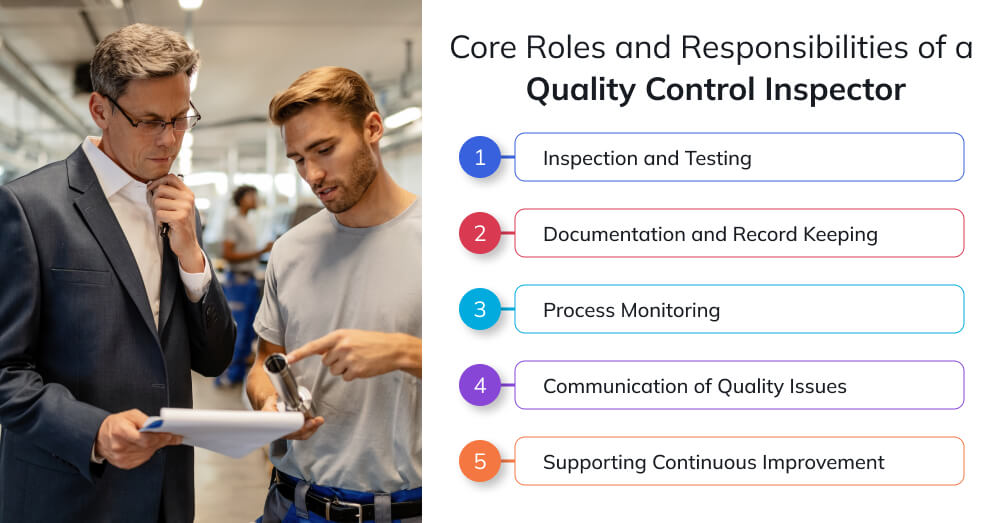
1) Inspection and Testing
Inspection isn’t just “looking for defects.” It’s a controlled check against specs, tolerances, and acceptance criteria, done in a way that another inspector could repeat and reach the same conclusion.
A QC inspector typically:
- Interprets drawings/specs: understands tolerances, critical-to-quality dimensions (CTQs), surface finish requirements, material grades, and fit/function requirements.
- Measures and verifies: uses tools such as calipers, micrometers, gauges, plug gauges, or CMM readings to confirm dimensional accuracy.
- Tests were required: runs functional checks (fit tests, torque checks, leak tests, pressure checks, continuity tests) based on the product and risk level.
- Follows sampling rules: applies batch sampling plans and acceptance limits so pass/fail decisions are consistent and defensible, especially when 100% inspection isn’t practical.
- Checks visual and finish standards: verifies surface defects, labeling, assembly correctness, weld/solder appearance (where applicable), and packaging integrity based on defined defect criteria.
- Flag patterns, not just defects: when the same issue repeats, inspectors don’t stop at pass/fail, they document what’s recurring and support root-cause investigations using structured tools such as an Ishikawa (fishbone) diagram to map likely causes across people, process, material, and equipment.
- Triggers containment when needed: holds suspect lots, isolates nonconforming items, and prevents mixing good stock with questionable stock to avoid downstream contamination.
What separates a strong inspector from an average one is consistency: same method, same standards, repeatable results, and the discipline to escalate when something looks “within limits” but clearly trending in the wrong direction.
| When quality issues occur repeatedly, inspectors and engineers often analyze the root causes using structured problem-solving frameworks. One widely used method is the Ishikawa diagram, developed by quality expert Kaoru Ishikawa, which visually maps possible causes of defects across categories such as materials, machinery, methods, and manpower. |
2) Documentation and Record Keeping
In quality, if it isn’t documented, it didn’t happen. Documentation is how quality becomes traceable and how companies survive audits and disputes.
A QC inspector usually:
- Records results clearly: measurements, test outcomes, and pass/fail decisions with time stamps and batch/serial identifiers.
- Maintains traceability: links inspection results to the exact lot number, supplier batch, machine line, and operator shift when applicable.
- Logs deviations properly: documents what failed, how it failed, and what was done next, without vague language.
- Handles controlled documents: uses the correct versions of checklists, SOPs, test methods, and inspection plans (old versions can create compliance risk).
- Supports audits: maintains records that can be presented to internal auditors, customers, or regulators.
In regulated industries (pharma, medical devices, aerospace), this documentation often matters as much as the inspection itself.
3) Process Monitoring
QC inspectors don’t only inspect outputs; they also monitor the processes that produce them. The earlier you catch process drift, the less scrap, rework, and customer risk you carry downstream.
Typical responsibilities include:
- In-process checks: verifying dimensions or parameters at defined intervals during production (not just at the end).
- Monitoring process variation: spotting patterns, measurements drifting high/low across a shift is a warning sign, even if parts still “pass.”
- Checking calibration and tool condition: ensuring measuring tools, gauges, and equipment are calibrated and fit for use; confirming calibration stickers and dates.
- Verifying compliance with SOPs: confirming that operators follow required steps (setup, torque values, temperature ranges, mixing times, etc.).
- Identifying recurring fault triggers: material change, machine wear, operator technique differences, environmental conditions (humidity/temperature), or shift handover issues.
- Validating mistake-proofing controls: where the process uses Poka-Yoke mechanisms (simple controls designed to prevent errors before they become defects), inspectors verify they’re actually working as intended, sensors trigger correctly, fixtures prevent wrong placement, interlocks aren’t bypassed, and alarms are responded to instead of ignored.
This is where QC becomes proactive: not just catching defects, but helping ensure the line can’t easily create them in the first place.
| Many modern manufacturing systems rely on mistake-proofing techniques known as Poka-Yoke, a concept developed by industrial engineer Shigeo Shingo as part of the Toyota Production System. These mechanisms are designed to prevent human errors before they create defects. Quality control inspectors often verify whether such controls are functioning correctly and ensure that production processes remain within defined tolerance levels. |
This is where QC becomes proactive rather than reactive.
4) Communication of Quality Issues
Finding a defect is useless if it’s not communicated in a way that drives action. Inspectors need to speak in facts, impact, and next steps.
They typically:
- Raise nonconformance reports: documenting the defect type, severity, location, and evidence (measurements/photos).
- Trigger containment actions: flagging parts for hold, labeling rejected lots, stopping a line when required, and preventing shipment of questionable material.
- Escalate correctly: knowing when to inform a supervisor immediately vs. when to route through quality engineering.
- Explain the “why it counts”: translating quality issues into business risk, returns, warranty claims, audit failures, and safety risks.
- Coordinate with teams: production, maintenance, engineering, and supply chain, because quality failures are often process- or supplier-related, not just “inspection problems.”
Good inspectors remain calm and clear under pressure, especially when production pushes output.
5) Supporting Continuous Improvement
Inspectors are often the first to see repeat failures. When their observations are used properly, they help prevent the same defect from showing up again next week.
They contribute by:
- Spotting patterns and trends: same defect recurring in the same machine, shift, supplier batch, or product variant.
- Providing input for corrective actions: what changed recently, what failed before, and what “fixes” didn’t hold.
- Helping validate fixes: confirming whether a change actually improved outcomes through follow-up inspections.
- Supporting RCA efforts: participating in root cause analysis discussions by bringing real evidence from the floor.
- Suggesting practical controls: tighter inspection frequency on a known weak point, better checklists, clearer defect definitions, or improved measurement methods
Case Study: Detecting a Defect Before Mass ProductionA well-known example of the importance of inspection and process monitoring comes from the automotive industry. During routine quality checks in one of Toyota’s production facilities, inspectors identified abnormal variations in the torque applied to engine fasteners during assembly. Although the components remained within acceptable tolerances, inspectors observed a pattern suggesting that the tightening equipment was gradually drifting out of calibration. Rather than allowing production to continue, the issue was escalated to the engineering and maintenance teams. A detailed investigation revealed that a calibration issue in the torque tools could eventually lead to inconsistent fastening strength in engines. By identifying the issue early, the inspection team prevented thousands of vehicles from leaving the production line with potentially unreliable engine components. The incident led to improvements in the plant’s preventive maintenance schedule and additional monitoring systems for torque tools. This example illustrates how quality control inspectors contribute not only to defect detection but also to process improvement and risk prevention across manufacturing operations. Source: Toyota |
This is where inspectors help shift quality from “catching defects” to “reducing defects.”
Essential Skills Every Quality Control Inspector Needs
Successful inspectors combine technical expertise with analytical thinking and attention to detail.
Technical Knowledge
Inspectors must understand measurement techniques, inspection tools, and manufacturing processes. Familiarity with engineering drawings and specifications is also essential.
Analytical Thinking
Quality control involves interpreting inspection data and identifying patterns that may indicate process issues.
Attention to Detail
Even small deviations can signal larger problems within production systems. Inspectors must remain vigilant when examining products and measurements.
Communication Skills
Inspection findings must be reported clearly so production teams can address quality concerns quickly.
Problem-Solving Ability
When quality issues arise, inspectors often participate in identifying corrective actions and improving manufacturing processes.
Industries That Employ Quality Control Inspectors
Quality inspection roles appear across many industries where product consistency and safety are critical.
- Automotive Manufacturing: Inspectors verify components such as engine parts, braking systems, and structural assemblies.
- Pharmaceutical Production: Quality inspection focuses heavily on regulatory compliance, documentation accuracy, and contamination control.
- Electronics Manufacturing: Inspectors evaluate circuit boards, solder joints, and component alignment using specialized equipment.
- Aerospace and Defense: Quality control plays an essential role in verifying structural integrity and safety compliance.
- Food and Beverage Production: Inspectors monitor hygiene standards, packaging integrity, and product labeling accuracy.
Each industry places different emphasis on inspection methods and regulatory requirements.
Case Study: Aerospace QC and Safety-Critical Inspection (Boeing 787)Aerospace quality inspection focuses on risks that don’t show up as “simple defects.” For example, reporting on Boeing’s 787 program describes how a quality leader (John Barnett) raised concerns in safety-critical areas, such as oxygen system reliability and debris/metal shavings near wiring, illustrating why aerospace QC requires rigorous documentation, traceability, and escalation protocols. This is the practical reality of aerospace inspection: The inspector’s job is not only to detect issues, but also to ensure they’re recorded correctly, escalated through the right channels, and handled in accordance with regulatory-grade discipline. Source: Business Insider |
Where Quality Control Inspectors Fit in the Production Process
Quality inspection occurs at several stages within a production environment. Understanding these stages helps explain how inspectors contribute to consistent product quality.
Incoming Material Inspection
Before manufacturing begins, inspectors verify that raw materials or components meet supplier specifications. This prevents defective inputs from affecting the production process.
In-Process Inspection
During manufacturing, inspectors monitor production lines to confirm that operations remain within tolerance limits. This stage helps identify issues before large volumes of defective products are produced.
Final Product Inspection
Once production is complete, inspectors examine finished goods to ensure they meet functional and aesthetic standards.
Pre-Shipment Verification
In some industries, especially export manufacturing, inspectors perform final checks before products leave the facility to ensure compliance with customer or regulatory requirements. By performing checks at multiple stages, inspectors help organizations catch issues early and minimize costly rework.
Salary Expectations and Job Outlook
The job outlook for Quality Control Inspectors in the United States is stable but not fast-growing. According to the U.S. Bureau of Labor Statistics (BLS), employment for this role is projected to grow little or not at all through 2034, meaning the number of jobs will remain relatively steady. However, there will still be many openings, averaging about 69,900 per year, mainly due to workers retiring or leaving the profession.
Even with automation and technological changes in manufacturing, human inspectors remain essential for tasks that require judgment, nuanced measurements, and specialized inspections that are not fully automated. Industries such as aerospace, medical devices, automotive, and pharmaceuticals continue to rely on quality control professionals to meet safety standards and regulatory compliance.
Employment by Industry (U.S.)
Here are the sectors that traditionally employ quality control inspectors:
- Manufacturing – the largest employer
- Professional, scientific, and technical services
- Administrative and support services
- Wholesale trade
Salary Outlook (U.S.)
Salary levels for Quality Control Inspectors vary widely based on job level (I/II/III), industry, location, certifications, and years of experience.
Typical Pay (Recent Benchmarks)
- Median pay (BLS benchmark): The BLS reports a median annual wage of $47,460 (May 2024) for quality control inspectors nationwide.
- Role-level benchmark (closer to “QC Inspector” jobs): Salary.com’s benchmark for Quality Control Inspector I shows an average salary of $48,559 (as of February 1, 2026), with a typical majority range of $44,708 to $53,237 (25th–75th percentile).
- Broader Salary.com “QC Inspector” page (mixed titles): Salary.com also lists an average of $168,217 (as of March 1, 2026) for “Quality Control Inspector,” with ranges that can stretch widely depending on the position variants included on the page. Treat this as an aggregate across multiple QC Inspector role variations, not the typical pay for entry- or mid-level inspector roles.
Source: Salary.com
Certifications and Training That Support Career Growth
Invensis highlights IASSC-aligned Lean Six Sigma belt certifications (Yellow/Green/Black) as a way to demonstrate competence. A practical take:
- If your role is mostly inspection execution, certification helps you stand out.
- If you want to move into quality engineering, supplier quality, or process improvement, certification can help you advance.
Relevant training links already embedded in the original article:
- Lean Fundamentals Training
- Lean Six Sigma Yellow Belt
- Lean Six Sigma Green Belt
- Lean Six Sigma Black Belt
Conclusion
Strong inspection practices help organizations maintain consistent product quality. As industrial pioneer Henry Ford once said, “Quality means doing it right when no one is looking.”
Quality Control Inspectors are the last line of defense against costly defects, recalls, and compliance failures. They verify that products and processes meet defined standards by inspecting materials and finished goods, using measurement and testing tools, reviewing SPC/quality data, and working with production, engineering, and suppliers to identify root causes and prevent repeat issues. When done well, quality control protects customer trust, reduces rework and scrap, supports audits, and helps organizations deliver consistent output at scale.
If you want to grow beyond routine inspection and move into higher-impact quality roles, build capabilities in core quality methods, control charts, CAPA, root cause analysis, Lean tools, and Six Sigma problem-solving. Explore our Quality Management Certification Courses to strengthen these skills and become more effective in quality assurance. Enroll today to accelerate your career path in quality.