


Have you ever experienced the frustration of a project where nobody knows who’s responsible for what, decisions stall because it’s unclear who has authority to approve them, multiple team members duplicate the same work while critical tasks fall through the cracks, and finger-pointing replaces accountability when things go wrong? These symptoms point to a common project management ailment: unclear roles and responsibilities. The cure? A well-designed RACI matrix.
The RACI matrix, standing for Responsible, Accountable, Consulted, and Informed, is a powerful yet simple tool that brings clarity to complex projects by explicitly mapping who does what for every task, decision, and deliverable. According to the Project Management Institute’s research, projects using formal responsibility assignment matrices like RACI are 40% more likely to meet their objectives and experience 35% fewer conflicts over roles and authority compared to projects with ambiguous responsibility definitions.
Despite its proven effectiveness, many project managers either don’t use RACI matrices or implement them poorly, creating documents that sit unused in project folders rather than serving as living tools that guide daily work. The difference between RACI matrices that transform project clarity and those that become bureaucratic paperwork lies in understanding when to use them, how to create them effectively, and strategies for maintaining their relevance throughout the project lifecycle.
This comprehensive guide equips you with everything you need to leverage RACI matrices for project success. You’ll discover what each RACI designation means and when to use it, step-by-step instructions for creating effective RACI matrices, common pitfalls that undermine RACI effectiveness and how to avoid them, advanced variations like RASCI and DACI for specialized needs, real-world examples demonstrating RACI application across different project types, and best practices for implementing and maintaining RACI matrices with your teams.
Table of Contents:
- Understanding the RACI Matrix Framework
- How to Create a RACI Matrix Step-by-Step
- Common RACI Matrix Mistakes and How to Avoid Them
- RACI Variations and Alternatives
- Implementing RACI Matrices in Your Projects
- Real-World RACI Matrix Examples
- Conclusion
- Frequently Asked Questions
Understanding the RACI Matrix Framework
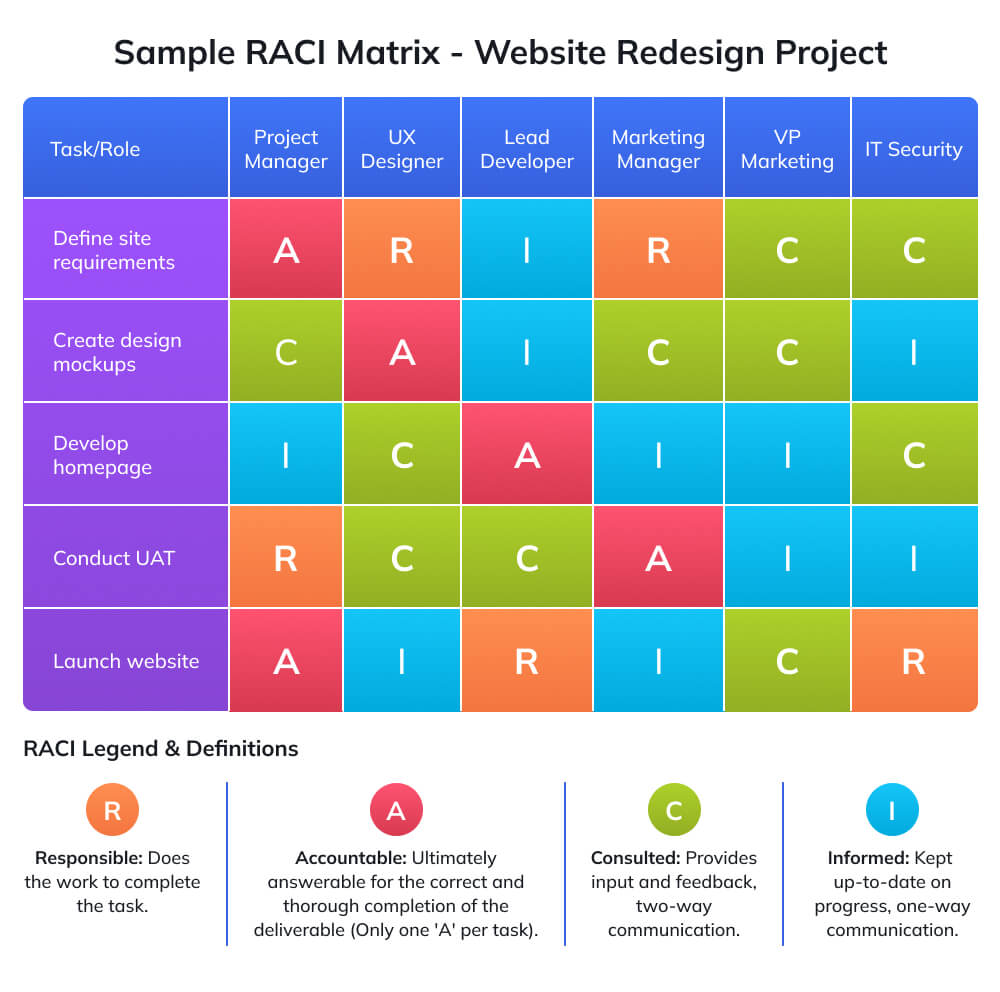
The RACI matrix is a responsibility assignment matrix that maps tasks, deliverables, or decisions (rows) to stakeholders or roles (columns), with each intersection assigned a letter designation indicating that stakeholder’s relationship to that activity. Before building your first RACI matrix, you must thoroughly understand what each designation means, its implications, and when to assign it.
The Four RACI Designations Explained
R – Responsible (The Doer): The Responsible party is the person or people who actually perform the work to complete the task or create the deliverable. They’re the “doers” who execute the activity, conducting research, creating documents, writing code, designing interfaces, or whatever work the task entails. Multiple people can share Responsible designation for a single task when work is genuinely collaborative or when different individuals handle different aspects of the same deliverable.
For example, in a website redesign project, multiple developers might all be Responsible for “Build responsive website pages,”one handling the homepage, another the product pages, another the checkout flow. They’re all doing the work, so they’re all Responsible. However, having too many Responsible parties can create diffusion of responsibility where everyone assumes someone else is handling it. When assigning multiple R’s, ensure clear sub-task division so each person knows their specific contribution.
A – Accountable (The Owner): The Accountable party is the single individual who ultimately owns the task’s success or failure. They have decision-making authority and must sign off on the work before it’s considered complete. The Accountable person doesn’t necessarily do the work themselves, they ensure it gets done properly and on time. Critically, there can only be one A per task. Multiple accountable parties create confusion about who has final authority and decision-making power.
The Accountable person delegates work to Responsible parties, reviews their output, approves final deliverables, makes trade-off decisions when needed, and bears consequences for success or failure. In our website example, the Digital Project Manager might be Accountable for “Build responsive website pages.” They don’t write the code. Still, they ensure developers complete it properly, review the work, approve it for launch, and report to leadership if any problems arise.
C – Consulted (The Advisors): Consulted parties are subject matter experts whose input is sought before decisions are made or work is finalized. This is two-way communication. you ask for their opinion, they provide input, and you incorporate relevant feedback. Consulted stakeholders have specialized knowledge, experience, or perspectives that improve decision quality but don’t have approval authority.
In the website project, you might consult the SEO specialist on page structure decisions, the legal team on terms and conditions content, or the customer service team on FAQ organization. Their expertise informs decisions, but they don’t make final calls; that’s the Accountable person’s role. Over-consulting creates bottlenecks and slows progress. Only designate people as Consulted if their input genuinely adds value and you’re willing to adjust plans based on their feedback potentially.
I – Informed (The Observers): Informed parties need to know about decisions or progress but don’t contribute to the work. This is one-way communication, you tell them what’s happening, but they don’t provide input or approval. Informed stakeholders typically have downstream dependencies on the work, need awareness for coordination purposes, or have organizational interest in the outcomes.
For the website project, you might keep the sales team informed about launch timing so they can plan promotional activities, or inform the IT security team about new web forms being added for their monitoring awareness. Over-informing wastes stakeholders’ time with unnecessary updates. Only designate people as Informed if they genuinely need awareness and will use that information for something, not just to be nice or inclusive.
RACI Rules and Best Practices
Effective RACI matrices follow specific rules ensuring clarity and usability. The most critical rule is exactly one Accountable (A) per task, never multiple A’s or no A. If you’re tempted to assign multiple Accountable parties, you haven’t broken down the task sufficiently. Split it into sub-tasks, each with a single owner.
At least one Responsible ® per task is required; someone must do the work. If no one is Responsible, the task won’t happen. You can have multiple R’s when work is genuinely collaborative, but ensure they coordinate to avoid duplication or gaps.
Minimize the use of “Consulted ©” designations to avoid decision-making bottlenecks. Every C you add creates another person whose input you must solicit and potentially incorporate, slowing progress. Consult only people whose expertise is genuinely necessary for sound decisions.
Limit Informed (I) stakeholders to those with real need-to-know. Information overload is real, bombarding people with updates they don’t need damages their trust in your communication. Be selective about who needs awareness.
Avoid assigning the same person both R and A for most tasks. While not strictly wrong, when one person is both the doer and the owner, it often indicates the task should be assigned to someone else so that person can focus on higher-level coordination. Exceptions include small teams or individual contributor tasks.
How to Create a RACI Matrix Step-by-Step
Creating an effective RACI matrix requires systematic thinking about your project structure, stakeholders, and decision-making processes. Follow this step-by-step approach to build RACI matrices that actually guide your projects rather than collecting digital dust.
Step 1: Identify All Project Tasks and Deliverables
Begin by listing every significant task, deliverable, milestone, or decision point in your project. The right level of detail balances completeness with usability, too granular and your matrix becomes unwieldy; too high-level and it doesn’t provide sufficient clarity.
For most projects, organize tasks by major project phases or workstreams. A software development project might include categories like Requirements Gathering, Design, Development, Testing, and Deployment, with 3-8 key tasks under each phase. A marketing campaign might organize by Planning, Content Creation, Campaign Execution, and Performance Analysis.
Focus on items where role clarity matters, tasks involving multiple people, deliverables requiring approval, decisions affecting multiple stakeholders, or activities where responsibility has been unclear in past projects. You don’t need to RACI every tiny action; focus on the 20% of activities that drive 80% of confusion and conflict.
Use your project plan or work breakdown structure as the foundation. If you’ve already decomposed your project into tasks for scheduling, those tasks become your RACI matrix rows. Ensure your task descriptions are specific and action-oriented: “Develop project requirements document,” not just “Requirements”; “Approve final design mockups,” not “Design review.”
Step 2: Identify All Relevant Stakeholders and Roles
List every person or role who will participate in or be affected by the project. For smaller projects (under 10 people), you can use individual names. For larger projects or recurring project types, use roles or positions rather than names, “Marketing Manager,” “Lead Developer,” “Product Owner” which makes the matrix reusable and adaptable when specific people change.
Include all potential stakeholders: project team members who do the work, managers who provide oversight and approvals, subject matter experts who provide specialized input, executive sponsors who make strategic decisions, and adjacent teams with dependencies or information needs. It’s better to include someone who ends up with few or no assignments than to overlook a stakeholder who should be involved.
Organize stakeholders logically in your matrix columns, perhaps by department, hierarchy level, or functional area. This organization helps identify patterns and ensures balanced workload distribution. In digital projects, you might organize columns as: Project Management, Design Team, Development Team, Marketing, Executive Stakeholders, External Partners.
Step 3: Assign RACI Designations
Now comes the critical work, assigning appropriate RACI designations for each task-stakeholder intersection. Work systematically through your matrix, considering each task and asking:
Who will actually do this work?
These are your Responsible ® parties. Be specific; “development team” is too vague if you have front-end, back-end, and mobile developers. Identify which specific role or person is responsible for each work item.
Who ultimately owns this deliverable?
This is your single Accountable (A) person. If you’re struggling to identify one owner, the task may need to be split. Remember, the Accountable person approves the work and is accountable for its success or failure, but they don’t necessarily do the work themselves.
Whose expertise or input do we need?
These are your Consulted © parties. Be ruthless about limiting these, only include stakeholders whose input genuinely improves decisions and whom you’re willing to wait for. If you’re just being polite or political, consider making them Informed instead.
Who needs to know this is happening?
These are your informed (I) stakeholders. Include people with downstream dependencies, coordination needs, or legitimate organizational interest. Exclude people who don’t need awareness, your matrix shouldn’t be an invitation list to every update.
Start with the most critical or complex tasks where role clarity is essential. As patterns emerge, your Product Owner may be accountable for most requirements tasks, and your Dev Lead for most technical tasks; subsequent assignments become easier.
Step 4: Review and Validate
Once you’ve completed initial assignments, review your matrix systematically for common problems:
Every row must have exactly one A. If you find multiple A’s, determine who has final authority and mark the others as Consulted or Informed. If you find no A, assign clear ownership.
Every row must have at least one R. If no one is Responsible, who’s doing the work? Assign it or eliminate the task.
Look for overloaded stakeholders. If someone is Accountable for 80% of tasks, they’re a bottleneck. Redistribute ownership or reconsider your task breakdown.
Identify excessive consultation. Tasks with 5+ Consulted parties will experience decision paralysis. Reduce Cs to only essential experts.
Check for under-utilized stakeholders. If someone on your project has few or no assignments, why are they included? Either give them meaningful responsibilities or remove them from the matrix.
Validate your matrix with key stakeholders before finalizing. Schedule a review meeting with project leadership and team leads; walk through responsibilities for their areas; confirm they agree with Accountable assignments; and adjust based on feedback on workload distribution or expertise availability. This validation process builds buy-in and catches errors before they cause problems.
Step 5: Communicate and Implement
A RACI matrix only provides value if people know it exists, understand it, and reference it regularly. Implementation requires deliberate communication and reinforcement.
Present the finalized matrix to all stakeholders in a kickoff meeting or dedicated review session. Walk through how to read the matrix, explain each person’s key responsibilities, clarify what each RACI designation means operationally, and establish how the matrix will be used throughout the project. Answer questions and address concerns about workload or authority.
Make the matrix easily accessible, share it in your project management tool, post it to your team collaboration space, include it in project documentation, and reference it in regular status meetings. The matrix should be a living document people consult when questions arise, not a file buried in project archives.
Establish update protocols for when roles change, new tasks emerge, or people join or leave the project. Assign someone (typically the project manager) responsibility for maintaining the matrix and communicating updates.
| PRO TIP: Use Your RACI Matrix as a Conflict Resolution Tool
When conflicts arise about authority or responsibility, and they will, reference the RACI matrix to resolve them objectively. Make it a team norm: when someone questions who should decide something or who’s responsible for a task, respond with “Let’s check the RACI.” This practice transforms the matrix from static documentation into a practical tool that shapes daily interactions. Over time, team members will proactively reference it, reducing conflicts before they escalate and building a culture of clarity and accountability. |
Common RACI Matrix Mistakes and How to Avoid Them
Even experienced project managers make predictable mistakes when creating and using RACI matrices. Understanding these pitfalls helps you design more effective matrices and implementation strategies.
Mistake 1: Too Many “Consulted” Designations
The most frequent RACI mistake is over-consulting, assigning C to anyone who might have an opinion or could potentially add value. Every Consulted party you add creates an obligation to solicit their input and consider their feedback, which slows decision-making and creates bottlenecks.
- Why it happens: Project managers want to be inclusive, fear leaving someone out who might later feel excluded, or don’t want to make stakeholders feel unimportant. Political considerations often drive excessive consultation, consulting senior executives even when their input isn’t necessary because it seems respectful.
- The consequence: Tasks with 6, 8, or 10 Consulted parties experience decision paralysis. Gathering everyone’s input takes weeks, feedback often conflicts, and the Accountable person struggles to synthesize diverse opinions into coherent decisions. Projects slow to a crawl.
- How to avoid it: Be ruthless about limiting Consulted designations. Ask for each potential C: “Do we genuinely need this person’s expertise to make a good decision? Are we willing to potentially adjust our approach based on their input? Can they provide unique perspective not available from others?” If the answer to any question is no, make them Informed instead. Reserve Consulted for true subject matter experts whose knowledge is essential.
For senior stakeholders, you’re tempted to consult for political reasons, consider making them aware of clear escalation paths so, they receive updates. Still, they aren’t consulted on every decision unless issues arise requiring their involvement.
Mistake 2: Multiple Accountable Parties
Assigning multiple A’s to a single task, or worse, no A at all, creates ambiguity about ultimate ownership and decision authority. When everyone is accountable, no one truly is. Shared accountability dilutes responsibility.
- Why it happens: Project managers struggle to identify single owners for cross-functional tasks, want to distribute workload evenly, or avoid interpersonal conflict by not clearly designating one person as the final decision-maker. Sometimes organizational politics make it difficult to assign accountability to one person without offending others.
- The consequence: Decisions stall because it’s unclear who has the authority to make final calls. When problems arise, finger-pointing replaces accountability as multiple “accountable” parties blame each other. Work quality suffers when no single person owns the outcome.
- How to avoid it: Enforce the “exactly one A per task” rule religiously. If you can’t identify a single Accountable party, you haven’t broken down the task sufficiently and split it into sub-tasks where clear ownership emerges. For genuinely cross-functional tasks, assign Accountability to whoever has the most at stake or whose approval is required for the task to be “done.” Make others Responsible (for doing parts of the work) or consulted (for providing expertise).
If organizational dynamics make it impossible to assign single accountability, escalate to your sponsor or the steering committee to clarify authority; this ambiguity will cause problems over time, so address it early.
Mistake 3: Too Granular or Too High-Level
RACI matrices fail when they operate at the wrong level of detail. Too granular, listing every tiny task, creates unwieldy matrices that overwhelm stakeholders and require constant maintenance. Too high-level, listing only major phases, fails to provide the clarity needed to prevent confusion.
- Why it happens: Project managers don’t think carefully about appropriate detail level for their specific project and stakeholders. They either copy task lists directly from detailed project plans (too granular) or create RACI matrices from superficial phase descriptions (too high-level).
- The consequence: Granular matrices become administrative burdens nobody references because they’re too complex to navigate. High-level matrices fail to clarify the specific handoffs, approvals, and responsibilities where confusion actually occurs.
- How to avoid it: Target the detail level where role ambiguity actually exists, tasks involving multiple people, key deliverables requiring approval, decision points affecting multiple stakeholders, and handoffs between teams or phases. A general guideline: aim for 15-40 tasks for most projects. Fewer than 15 suggests you’re too high-level; more than 40 and you’re probably too granular unless it’s a very complex, long-duration program.
Test your detail level by asking: “Does this level of detail clarify who does what for activities where confusion could occur?” If yes, you’ve found the right level. If stakeholders still don’t know who handles specific responsibilities, go more granular. If they’re overwhelmed by detail, consolidate tasks.
Mistake 4: Creating the Matrix and Never Using It
The most wasteful mistake is investing time to create a thoughtful RACI matrix, then filing it away and never referencing it again. The matrix becomes compliance documentation rather than a practical tool guiding daily work.
- Why it happens: After initial creation, project managers don’t establish practices for regular reference. Team members don’t understand how to use the matrix or forget it exists. Without reinforcement, people default to informal role definitions and tribal knowledge.
- The consequence: Role confusion emerges despite having created a RACI matrix to prevent it. The time invested in creation is wasted. Skepticism develops about project management tools and documentation.
- How to avoid it: Build RACI matrix usage into team practices. Reference it explicitly in every status meeting when discussing who’s working on what. When role questions arise, say “Let’s check the RACI” and pull it up. When onboarding new team members, walk through their responsibilities using the matrix. Update it visibly when changes occur. Make it a living tool people consult regularly, not a dusty artifact.
RACI Variations and Alternatives
While the standard RACI framework works well for most projects, certain situations benefit from variations that add nuance or modify designations to fit organizational needs and decision-making structures better.
RASCI Matrix: Adding the “S” for Support
RASCI adds a fifth designation, Support (S), to distinguish between people who do the work (Responsible) and those who provide assistance or resources to the doers. The Support designation clarifies helper roles without making them fully Responsible for deliverables.
When to use RASCI: Projects with clear distinctions between primary workers and supporting resources, such as development teams (Responsible for code) supported by DevOps engineers (Support with infrastructure). Organizations where resource allocation clarity is critical. Teams where people feel their support contributions aren’t recognized in standard RACI.
Example: For “Develop mobile app” task, mobile developers are Responsible (doing the coding), the Product Manager is Accountable (owns the outcome), UX designers are Consulted (input on user experience), and DevOps engineers are Support (provide build pipelines and testing infrastructure). Marketing team is Informed (aware of progress).
RASCI adds complexity, so only use it when the distinction between Responsible and Support genuinely clarifies roles. For many projects, Support parties can simply be marked as Responsible with clear sub-task division.
RACI-VS: Adding Verify and Sign-off
Some organizations add Verify (V) for those who check work quality and Sign-off (S) for final approval authority, creating more granular accountability for quality assurance and approval processes.
When to use RACI-VS: Regulated industries where separation between verification and approval is required (pharmaceuticals, finance, aerospace). Projects with complex quality assurance requirements. Organizations with strict compliance and audit trails.
Example: For “Finalize financial report” task, the Financial Analyst is Responsible (creates report), Senior Accountant Verifies (checks accuracy and compliance), CFO Signs-off (final approval for distribution), and Board of Directors is Informed (receives the report).
This variation works when you need to explicitly separate quality checking from final approval authority, but adds complexity requiring clear definitions of what Verify and Sign-off mean in your context.
DACI: Driver, Approver, Contributors, Informed
DACI offers an alternative framework particularly popular in technology companies. Driver (D) is the single person driving the decision or task to completion, similar to RACI’s Accountable. Approver (A) is the person with authority to make the final decision, they may or may not be the Driver. Contributors © provide input and do work. Informed (I) need awareness.
When to use DACI: Decision-making processes more than task execution. Projects where decision authority is more important than work responsibility. Organizations like Intuit, Atlassian, and other tech companies using DACI as their standard framework.
Example: For “Decide pricing strategy” decision, Product Marketing Manager is the Driver (gathers input, drives the process), CEO is the Approver (makes final decision), Sales Leadership, Finance, and Product Management are Contributors (provide input and analysis), and Sales Team is Informed (needs to know the outcome).
DACI emphasizes decision-making while RACI emphasizes task execution. Choose based on whether your primary need is clarifying decisions or clarifying work allocation.
Choosing the Right Framework
For most projects, standard RACI provides sufficient clarity without unnecessary complexity. Consider variations only when you have specific needs they address: RASCI when support roles need explicit recognition, RACI-VS when verification must be separate from approval for compliance, or DACI when decision authority is more important than task responsibility.
Introducing variations requires clear communication about what each designation means in your context and why you’re using the variation instead of standard RACI. Complexity is justified only when it adds genuine value.
Implementing RACI Matrices in Your Projects
Creating the matrix is only half the battle, successful implementation requires deliberate strategies to gain buy-in, sustain the matrix, and integrate it into team workflows.
Gaining Team Buy-In
RACI matrices only work when team members embrace them as helpful tools rather than bureaucratic overhead. Build buy-in through involving key stakeholders in RACI creation, people support what they help create, explaining the “why” clearly, show how RACI prevents specific problems they’ve experienced, addressing concerns transparently, some team members may fear RACI creates rigidity or extra work, and demonstrating value quickly, use the RACI to resolve an early role conflict, proving its utility.
During initial rollout, emphasize that RACI clarifies expectations to help people succeed, not to micromanage or create paperwork. Frame it as a communication tool that prevents the frustrations everyone experiences when roles are ambiguous.
Maintaining the RACI Matrix
RACI matrices require active maintenance as projects evolve. Establish update processes including scheduling regular reviews (monthly for long projects), updating when people join or leave the project, adjusting when scope changes introduce new tasks, and revising when role clarity issues emerge despite the matrix.
Assign RACI matrix ownership to a specific person, typically the project manager, responsible for updates and communication. Version control your matrix and communicate changes clearly: “Updated RACI v2.1: Added tasks for Phase 3, reassigned accountability for testing to new QA Lead.”
Integrating RACI into Project Workflows
Make the RACI matrix a natural part of project operations by referencing it in weekly status meetings when assigning new work, pulling it up during planning sessions when defining upcoming tasks, using it to resolve conflicts about authority or responsibility, and including it in project onboarding for new team members.
Create habits around RACI usage. When someone asks “Who’s responsible for X?” or “Who approves Y?”, respond by opening the RACI matrix. This behavioral reinforcement makes referencing the matrix automatic rather than exceptional.
RACI Matrix Tools and Templates
While RACI matrices can be created in any tool supporting tables, some tools work better than others. Options include:
Spreadsheet Software (Excel, Google Sheets): Most common approach. Advantages include familiar interface, easy to share and collaborate, simple to maintain and update, and flexible formatting. Works well for most projects. Use color coding (R=blue, A=green, C=yellow, I=gray) to improve visual scanning.
Project Management Software (Monday.com, Asana, Smartsheet): Many PM tools include RACI matrix templates or functionality. Advantages include integration with task management, automatic updates when people or tasks change, and centralized access within project workspace. Best for teams already using these platforms heavily.
For most teams, a well-formatted spreadsheet provides the right balance of simplicity and functionality. Focus more on how you use the matrix than which tool you use to create it.
Real-World RACI Matrix Examples
Understanding RACI theory is important, but seeing how it applies to actual projects makes the framework practical and actionable. These examples demonstrate the application of RACI across different project types and organizational contexts.
Example 1: Website Redesign Project
A mid-sized company is redesigning its corporate website. Key stakeholders include the Digital Marketing Manager, Web Development Team Lead, UX Designer, Content Manager, IT Security Specialist, and Vice President of Marketing.
Sample RACI Assignments:
- Define website requirements: Content Manager (R – gathers needs), Digital Marketing Manager (A – owns final requirements), UX Designer (C – consults on user needs), Development Lead (C – consults on technical feasibility), VP Marketing (I – informed of scope).
- Create design mockups: UX Designer (R – creates designs), Digital Marketing Manager (A – approves designs), Content Manager (C – consulted on layout), VP Marketing (C – consulted on brand alignment), Development Lead (I – informed of designs).
- Develop website code: Development Team (R – writes code), Development Lead (A – owns technical delivery), UX Designer (C – consulted during implementation), Digital Marketing Manager (I – informed of progress).
- Write website content: Content Manager (R – writes copy), Digital Marketing Manager (A – approves content), UX Designer (C – consulted on content structure), VP Marketing (I – informed of messaging).
- Conduct security review: IT Security Specialist (R – performs assessment), Development Lead (A – owns remediation), Digital Marketing Manager (I – informed of findings).
- Launch website: Development Lead (R – executes deployment), Digital Marketing Manager (A – approves go-live), IT Security (C – final security confirmation), VP Marketing (I – informed of launch)
This RACI clarifies that the Digital Marketing Manager owns most business decisions while the Development Lead owns technical execution, preventing confusion about authority. Notice the VP Marketing is primarily Informed, kept aware but not bottlenecking day-to-day decisions.
Example 2: Software Feature Development
An agile development team is building a new analytics dashboard feature. Stakeholders include the Product Owner, Scrum Master, Development Team (3 developers), UX Designer, QA Engineer, and stakeholders from Sales and Customer Success.
Sample RACI Assignments:
- Define user stories: Product Owner (A/R – writes and owns stories), Development Team (C – consulted on technical approach), UX Designer (C – consulted on user interaction), Sales/Customer Success (I – informed of scope).
- Design user interface: UX Designer (R – creates designs), Product Owner (A – approves design direction), Development Team (C – consulted on implementation feasibility).
- Develop dashboard functionality: Development Team (R – codes features), Scrum Master (A – ensures delivery according to definition of done), Product Owner (C – clarifies requirements as needed).
- Conduct quality assurance testing: QA Engineer (R – tests functionality), Development Team (A – owns quality and fixes defects), Product Owner (C – validates against acceptance criteria).
- Document feature for users: Product Owner (R – writes documentation), Development Team (C – technical accuracy review), Sales/Customer Success (I – informed for customer communication).
This example shows how RACI works in agile environments. The Product Owner is Accountable for most business decisions, while the Development Team (or specific developers) is Accountable for technical delivery quality. The Scrum Master facilitates but typically isn’t Accountable for specific deliverables; they ensure the process works.
Example 3: Marketing Campaign Launch
A company is launching an integrated digital marketing campaign. Stakeholders include the Campaign Manager, Content Writer, Graphic Designer, Social Media Specialist, Email Marketing Specialist, Paid Ads Specialist, and Marketing Director.
Sample RACI Assignments:
- Develop campaign strategy: Campaign Manager (A/R – creates strategy), Marketing Director (C – provides strategic input and approves budget), all specialists (C – consulted on channel-specific tactics).
- Create campaign content: Content Writer (R – writes copy), Campaign Manager (A – approves content), Graphic Designer (C – consulted on visual integration).
- Design campaign graphics: Graphic Designer (R – creates visuals), Campaign Manager (A – approves designs), Content Writer (C – consulted on message alignment).
- Set up email campaign: Email Marketing Specialist (R – builds emails and automation), Campaign Manager (A – approves before send), Content Writer (C – final copy review).
- Launch social media ads: Social Media Specialist (R – creates and launches ads), Campaign Manager (A – approves messaging and budget), Paid Ads Specialist (C – consulted on targeting).
- Monitor campaign performance: Campaign Manager (A/R – monitors metrics and reports), all specialists (R – track channel-specific metrics), Marketing Director (I – informed of results).
This matrix clarifies that the Campaign Manager orchestrates the campaign and approves all major elements while specialists execute channel-specific work. The Marketing Director provides strategic input but doesn’t bottleneck execution-level decisions.
These examples demonstrate how RACI adapts to different project types while maintaining core principles: single accountability, clear work assignment, limited consultation, and selective information sharing.
Conclusion
The RACI matrix is a simple framework that solves a very expensive problem: role ambiguity. When used properly, it clarifies who does what, who decides, and who needs to be in the loop, reducing conflicts, speeding up decisions, and preventing work from slipping through the cracks.
The real value doesn’t come from creating a beautiful chart once; it comes from treating RACI as a living tool. Refer to it in meetings, use it to resolve ownership disputes, update it when reality changes, and enforce the “one Accountable per task” discipline. Even on small projects, that level of clarity compounds into faster execution and fewer escalations.
If you want to move beyond understanding RACI “in theory” to applying it confidently across complex projects, consider strengthening your skills through Invensis Learning’s project management courses. They give you practical frameworks, templates, and real-world case work so tools like RACI become part of how you run projects, not just something you’ve read about.
Frequently Asked Questions
1. When should I use a RACI matrix in my project?
RACI matrices provide most value for projects with multiple stakeholders where role clarity matters: cross-functional projects involving diverse teams with overlapping responsibilities, complex projects with many decision points and approvals, projects where previous role confusion caused problems, matrix organizations where people report to different managers, and larger teams (typically 8+ people) where informal coordination breaks down.
For very small projects with 2-3 people in the same department with clear hierarchy, RACI might be overkill. For anything more complex, RACI prevents confusion that inevitably emerges when roles remain implicit. Start using RACI during project planning, ideally before work begins, so everyone has clarity on responsibilities and authority.
2. Can one person have multiple RACI designations for the same task?
Yes, someone can be both Responsible and Consulted (doing work while also being consulted on other aspects), both Responsible and Informed (doing work while also needing awareness of other elements), or theoretically other combinations. However, avoid making someone both Responsible and Accountable for most tasks. While not strictly wrong, when the same person is both doer and owner, it often indicates the task should be delegated to someone else while that person focuses on oversight and coordination.
The exception is individual contributor tasks where one person genuinely does and owns the work. The problematic combination is multiple people being Accountable, this should never happen, as it creates confusion about ultimate authority and decision-making power.
3. How detailed should my RACI matrix be?
Target the level where role ambiguity actually exists, tasks involving multiple people, key deliverables requiring approval, decision points affecting multiple stakeholders, and handoffs between teams or phases. A practical guideline: aim for 15-40 tasks for most projects. Fewer than 15 suggests you’re too high-level and not providing sufficient clarity. More than 40 becomes unwieldy unless you’re managing a very complex, long-duration program.
Test your detail level by asking: “Does this clarify who does what for activities where confusion could occur?” If stakeholders still don’t know specific responsibilities, go more granular. If they’re overwhelmed by excessive detail, consolidate tasks. Different projects need different detail levels, a two-week marketing campaign needs less granularity than a year-long ERP implementation.
4. What’s the difference between RACI and RASCI?
RASCI adds a fifth designation, Support (S), to distinguish between people who do the work (Responsible) and those who provide assistance or resources to the doers. In RASCI, Responsible parties are primary workers accountable for delivering output, while Support parties provide resources, tools, or assistance but don’t own deliverables. For example, developers might be Responsible for building a feature while DevOps engineers are Support by providing infrastructure and deployment pipelines.
Use RASCI when you need to explicitly recognize support roles that might otherwise feel unacknowledged or when distinguishing primary workers from helpers is important for resource allocation. For most projects, standard RACI suffices, you can mark support parties as Responsible with clear task division or simply make them Informed if they’re not actively doing work. RASCI adds complexity, so only use it when the distinction genuinely clarifies roles beyond what standard RACI provides.
5. How do I handle disagreements about RACI assignments?
Disagreements about RACI assignments, particularly about who should be Accountable or whether someone should be Consulted, are common and usually reveal important underlying issues about authority, workload, or expertise. Address disagreements by first understanding the concern: Why does someone disagree with an assignment? Are they worried about workload, unclear about expectations, concerned about authority, or feeling excluded? Often disagreements stem from misunderstanding what RACI designations mean operationally.
Clarify expectations: explain that being Accountable means owning outcomes and having approval authority but not necessarily doing all the work. Remind that Consulted means their input is valued but they don’t have veto power. For genuine conflicts over authority, escalate to your project sponsor or steering committee, these authority questions need executive resolution. Document the final RACI with rationale for contentious assignments so the reasoning is clear if questions resurface later.
6. Should I use individual names or roles in my RACI matrix?
Use individual names for small, one-time projects with stable team composition (under 10 people, short duration, minimal personnel changes expected). Names provide specificity and accountability. Use roles or positions for larger projects, projects with potential personnel changes, recurring project types where the matrix serves as a reusable template, or organizational contexts where documenting individual names creates politics or privacy concerns.
For example, use “Marketing Manager,” “Lead Developer,” “Product Owner” rather than specific names. Many projects benefit from a hybrid approach: use roles in the master RACI matrix, then create a separate stakeholder roster mapping roles to current individuals. This provides reusability while maintaining personal accountability. Update the roster when people change without reformatting the entire matrix. The key is clarity, whether using names or roles, ensure everyone knows who specifically is responsible for what.
7. How often should I update my RACI matrix during a project?
Update your RACI matrix whenever project circumstances change the validity of role assignments: when people join or leave the project team, when scope changes introduce new tasks or eliminate planned tasks, when organizational changes shift reporting relationships or authority, or when you discover RACI assignments aren’t working as intended and need revision. For long-duration projects (6+ months), schedule regular RACI reviews, monthly or quarterly, even if no obvious changes have occurred.
These reviews catch drift where informal role changes have happened but the documented RACI hasn’t been updated. Treat the RACI as a living document reflecting current reality, not historical planning. When you update the matrix, version control it (RACI v2.0, v2.1, etc.) and communicate changes clearly to all stakeholders: “RACI updated: Phase 3 tasks added, testing accountability transferred to new QA Lead Sarah Chen.” Make updates visible so people don’t reference outdated versions.