
Six Sigma uses mathematical formulas and process metrics to eliminate defects and reduce variation. These Six Sigma calculations help organizations measure process quality and determine how close a process is to achieving the Six Sigma benchmark of fewer than 3.4 defects per million opportunities.
Understanding the Six Sigma calculation formula is essential because it allows teams to measure performance using standardized metrics such as DPU, DPO, DPMO, and Yield. These Six Sigma formulas are widely used in quality management to analyze defects and improve process efficiency.
The goal: fewer than 3.4 defects per million opportunities. Six Sigma’s aim is to enhance and increase productivity in the processes (such as how to correct variation) and products. Be sure to keep these Six Sigma measurements and formulas handy when you have gathered your data and begin making your calculations.
There are some important priorities for any company, such as minimizing expenses, meeting deadlines, improving connectivity, streamlining processes, and cutting waste. All these tasks lead to the successful completion of the project when performed correctly. On a trial basis, Motorola was one of the first major corporations to use Six Sigma to streamline product quality and demonstrate the real business value of Six Sigma in improving operational performance and reducing defects. The results were very positive and boosted the company’s overall performance.
Key Terminologies
Before performing any Six Sigma calculation, it is important to understand the key metrics used in Six Sigma formulas. These metrics help organizations measure process defects and determine a system's overall sigma performance.
- Defect: In Six Sigma, a defect refers to any outcome that does not meet customer requirements or defined quality standards.
- Defect vs. Defective: A defect is a single instance of non-conformance within a product or process. A defective unit is a product or service that contains one or more defects.
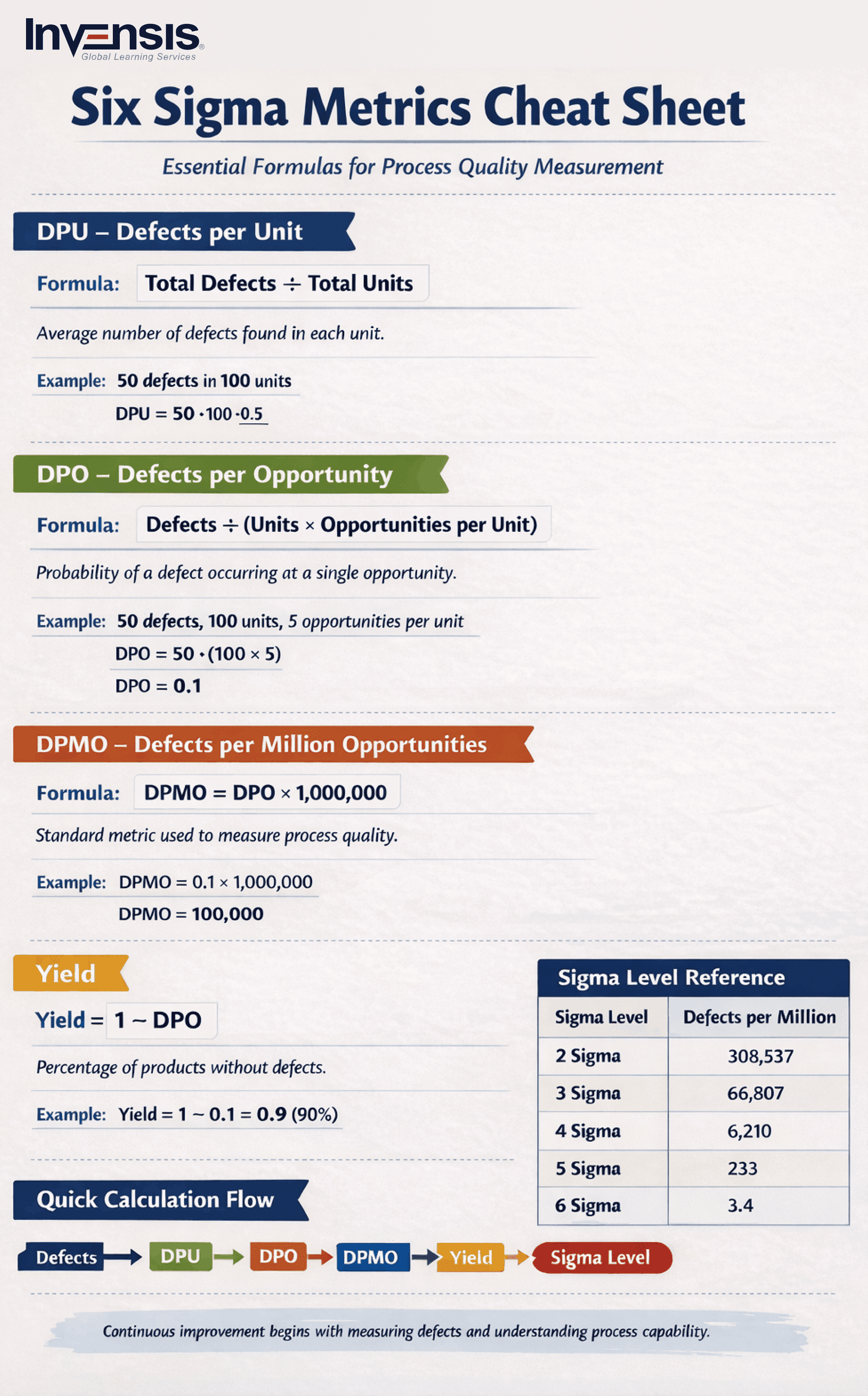
- DPU: The average number of defects found while sampling a population is DPU or Defects Per Unit.
DPU
DPU is one of the most commonly used metrics in Six Sigma calculations because it helps measure the average number of defects per unit in a process.
DPU = Defects ÷ Total Number of Units
Example:
| Input | Value |
| Defects | 15 |
| Units | 500 |
| DPU |
15 ÷ 500 = 0.03 |
DPO
DPO is Defects Per Opportunity. It is a metric indicating the number of defects per opportunity in a process. In Six Sigma calculations, the DPO formula is used as a key Six Sigma calculation formula to determine the probability of defects in a process.
DPO = Defects / (Total Number of Units × Opportunities Per Unit)
Example:
| Input | Value |
| Defects | 15 |
| Opportunity Per Unit |
5 |
| Units |
500 |
| Total Opportunities |
500 × 5 = 2,500 |
| DPO |
15 ÷ 2,500 = 0.006 |
DPMO
Many professionals also use a Six Sigma calculator to quickly compute DPMO values and determine a process's sigma level from defect data.
DPMO = DPO × 106
(or)
DPMO = (Defects ÷ (Total Units × Opportunities per Unit)) × 106
Example:
| Input | Value |
| Defects | 15 |
| Opportunity Per Unit |
5 |
| Units |
500 |
| Total Opportunities |
500 × 5 = 2,500 |
| DPMO | (15 ÷ 2,500) ×106 = 6000 |
Yield: Yield is specified as a percentage of net commitments over the total number of opportunities
Yield = 1-DPO
Example:
| Input | Value |
| Defects | 15 |
| Opportunity Per Unit |
5 |
| Units |
500 |
| Total Opportunities |
500 × 5 = 2,500 |
| DPO | 15 ÷ 2,500 = 0.006 |
| Yield | 1-0.006 = 0.994 |
|
Expert Insight “We can't improve what we don't measure.” Six Sigma practitioners emphasize that process improvement begins with measurement. By using statistical metrics such as DPMO and sigma levels, organizations can identify defects objectively and make data-driven decisions rather than relying on assumptions. — Dr. Mikel J. Harry, Co-creator of Six Sigma — Source |
Six Sigma Calculations
In Six Sigma calculations, a production process must produce fewer than 3.4 defects per million opportunities to achieve a Six Sigma level. This performance corresponds to a 6 sigma percentage of approximately 99.99966% process accuracy. A true Six Sigma process operates at an extremely high level of quality, producing no more than 3.4 defects per million opportunities. At this level of performance, process variation is tightly controlled and the likelihood of defects occurring becomes extremely low. Most processes don’t run on Six Sigma. They’re working at 5 Sigma, 4 Sigma, or worse. To get an appreciation of the numbers involved, here’s the full scale:
|
Sigma Level |
Defect Rate |
Yield |
|
2σ |
308,770 DPMO |
69.10% |
|
3σ |
66,811 DPMO |
93.33% |
|
4σ |
6,210 DPMO |
99.38% |
|
5σ |
233 DPMO |
99.97% |
|
6σ |
3.4 DPMO |
99.99% |
|
Expert Insight Six Sigma focuses on reducing variation in processes because variation creates opportunities for defects. By controlling variation and measuring process performance statistically, organizations can achieve predictable quality and improve customer satisfaction. |
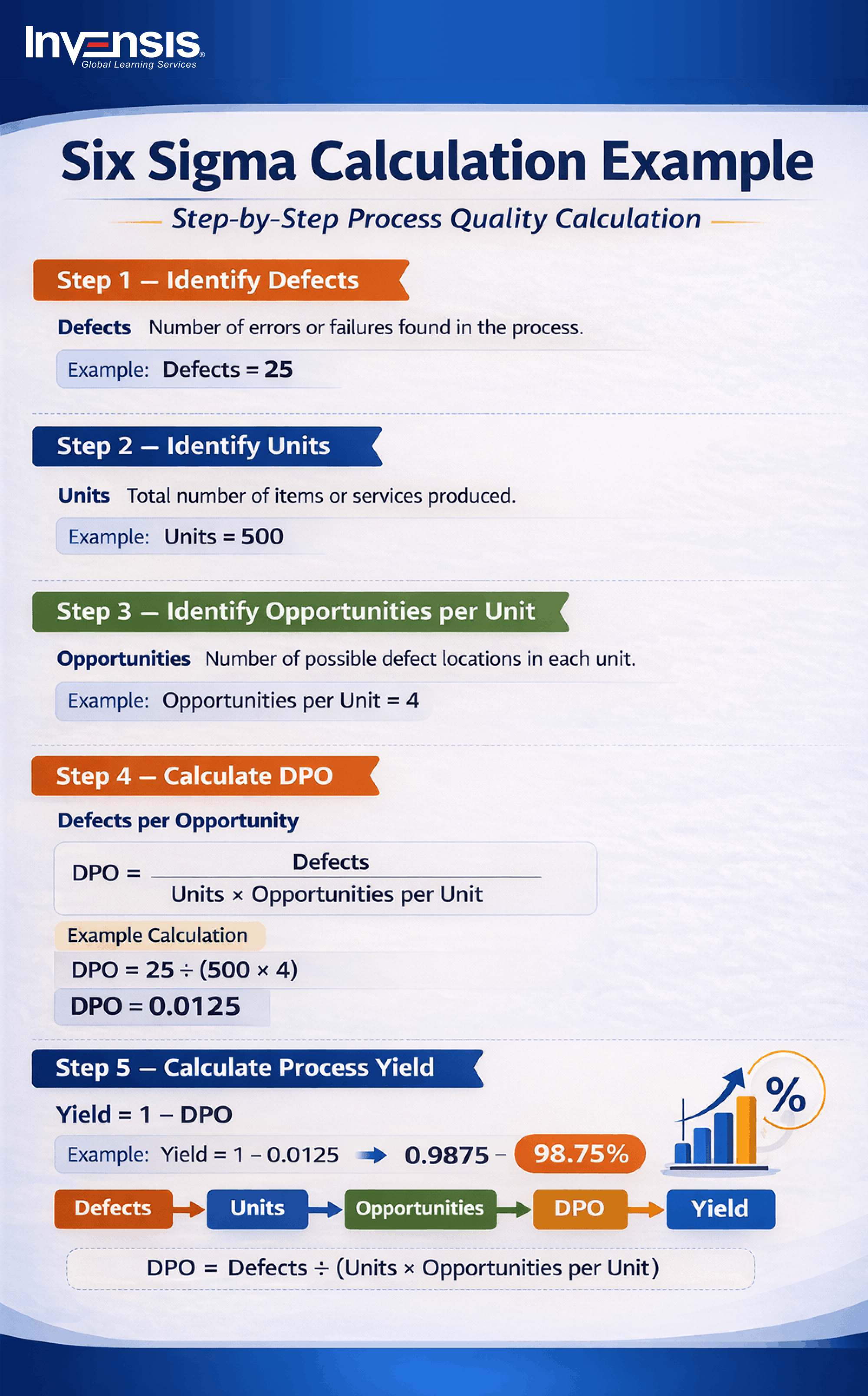
To assess whether the process capability is relative to the process specifications, the Sigma Process rating should be determined. We must compute the total number of defects, the total number of opportunities, and the defect rate to calculate the process sigma rating.
A defect is something beyond the requirements of the customer. The opportunity, on the other hand, is the total number of probabilities for failure. Based on the Sigma Process Table, the Six Sigma Rating is predicted to yield 99.99966 percent. The percentage of products or services without defects is the yield.
Example of Six Sigma Calculation
A project is based on a billing mechanism. The team needs the customer to have the right bills sent. For this process, they have described one opportunity-either the bill is correct or not. In terms of complexity, all of the bills generated are the same. The team took a sample of 250 bills and identified 60 defects.
The following example demonstrates how a Six Sigma calculation is performed using real process data.
| Parameter | Value |
| Total Number of Defects |
60 |
| Total Number of Units | 250 |
| Defect Opportunities per Unit | 1 |
| Metric | Formula | Calculation | Result |
| DPU | Defects ÷ Total Units | 60 ÷ 250 | 0.24 |
| DPO | Defects ÷ (Total Units × Opportunities Per Unit) | 60 ÷ (250 × 1) | 0.24 |
| DPMO | DPO × 106 | 0.24 × 10⁶ | 240,000 |
| Yield | 1 - DPO | 1 - 0.24 | 0.76 |
Based on the Process Sigma table, the process being implemented by the team only has a sigma rating between 2 to 3. The higher the degree of sigma, the lower the number of defects.
Why is Six Sigma Important?
Process failures often begin as small errors that gradually increase operational costs and reduce efficiency. Six Sigma helps organizations detect these issues early by using structured quality metrics and statistical analysis to eliminate defects before they grow into larger operational problems.
Without quality control and error control, business cancer will begin to consume your business. Six Sigma methodologies are looking for perfection or as close as possible to 3.4 defects per million opportunities (DPMO). Methodologies rely on many aspects, from the skillful decision to the quality of the product and the processes that produce it. Most of the businesses run at Three or Four Sigma. That means that the losses they incur as a consequence of poor quality cost them 10 to 15% of their profits. However, a Six Sigma business will produce considerable savings. These improvements highlight the true Six Sigma value for organizations seeking to reduce operational costs and improve product or service quality.
Start Your Six Sigma Certification Journey
Six Sigma-certified professionals command a measurable salary premium. ASQ's 2026 salary survey puts the average Lean Six Sigma Green Belt at $97,000 in the US. Invensis Learning's Green Belt and Black Belt programmes are built to prepare you for that exam in 16 hours of instructor-led trainin Organizations typically develop Six Sigma expertise through structured certification levels such as Lean Six Sigma Yellow Belt certification, Lean Six Sigma Green Belt certification, Lean Six Sigma Black Belt certification, and Master Black Belt. These roles help teams apply statistical tools, analyze process data, and lead continuous improvement initiatives across the organization.Learning how to apply Six Sigma formulas, interpret sigma levels, and use Six Sigma calculators is an essential skill for quality management professionals.
To get a better understanding of which Lean Six Sigma course benefits the most for you or the team, check out some of the popular courses below to get a comprehensive understanding of the same.