


A sprint retrospective gives a development team a dedicated space to pause, observe recent work, and identify improvements in a constructive and supportive way.
Instead of viewing it as another routine meeting, it works best when the team treats it as an opportunity to strengthen skills, processes, and teamwork. Every sprint creates learning, and the retrospective makes sure that learning does not go unnoticed or unused.
When guided with clarity, the session can highlight what worked well, where small adjustments can improve flow, and how collaboration can feel easier and more productive.
The real value comes from turning reflections into actions that everyone understands and agrees to follow. This creates steady progress and shared ownership that continues from one sprint to the next.
Table Of Contents
- What is a Sprint Retrospective?
- 5 Core Principles Behind an Effective Sprint Retrospective
- How to Hold an Effective Sprint Retrospective Meeting
- Checklist for Teams to Hold an Effective Retrospective Meeting
- Conclusion
What is a Sprint Retrospective?
A sprint retrospective is a structured discussion held at the end of each sprint where the team reflects on how the work was completed and agrees on specific improvements for future sprints.
The focus is on collaboration, workflow, tools, and team practices rather than on individual performance or delivered features. A well-run retrospective is not a review meeting and not a forum for blame. It is a deliberate improvement session that helps the team understand what supported progress, what created friction, and how they can work more effectively in the next sprint.
In Scrum, the sprint retrospective is a mandatory event defined in the Scrum Guide, reinforcing its role as a core mechanism for continuous improvement. Teams that use retrospectives consistently are better positioned to adapt their processes, strengthen collaboration, and improve delivery predictability over time.
5 Core Principles Behind an Effective Sprint Retrospective
An effective sprint retrospective is shaped by a few guiding principles that keep the session purposeful, constructive, and focused on real improvement rather than casual reflection.
- Focus on team learning rather than individual performance: The goal is to understand what helped and what slowed the team as a whole, so improvement actions support collective progress.
- Keep discussions evidence-based instead of opinion-driven: Insights should come from actual events, data, behaviour patterns, or sprint outcomes, not assumptions or personal preferences.
- Create a safe and respectful environment for honest input: Every participant should feel comfortable sharing observations without fear of judgment or defensive reactions.
- Aim for small and meaningful improvements rather than large transformations: Incremental actions are easier to apply, monitor, and sustain across multiple sprints.
- Convert insights into clear and owned actions: A retrospective is only valuable when learnings are linked to who will do what and by when, in a way that the team can later verify.
How to Hold an Effective Sprint Retrospective Meeting
An effective sprint retrospective does not depend on a clever format or a fun activity. It depends on clear preparation, confident facilitation, and disciplined follow-through.
The goal is simple. The team should leave the meeting with a shared understanding of how they worked in the sprint and with a small set of concrete actions that will improve the next one.
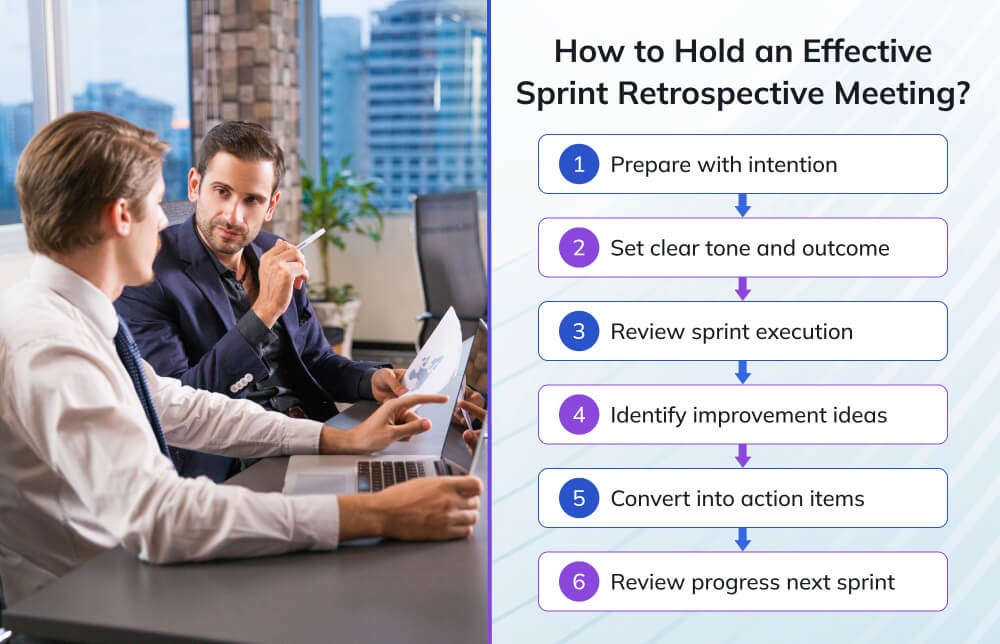
1. Prepare with Intention Before the Meeting
The work of a good retrospective starts before people enter the room or join the call. The facilitator reviews the sprint board, delivery flow, blockers, scope changes and any important events that affected progress.
This preparation helps surface patterns and specific examples so the conversation stays grounded in reality. It is useful to set a clear purpose for the session in advance.
For example, the focus might be smoother handoffs, more predictable planning or fewer unplanned interruptions. Sharing this focus with the team in the invite helps people arrive with relevant observations instead of trying to think on the spot.
2. Start with Clarity and a Calm Tone
The opening minutes set the tone for the entire meeting. The facilitator briefly reminds everyone why they are meeting and what outcome they want. For example, the result might be two or three improvement actions that are small, realistic and ready to apply in the next sprint.
It is also important to reassure the team that the conversation is about the way of working rather than judging individuals. Simple language works best.
For instance, the aim is to understand what helped and what made the work harder so the group can adjust together. This keeps the energy constructive and encourages people to speak honestly.
3. Look Back at the Sprint in a Structured Way
Once the frame is clear, the team reviews what actually happened in the sprint. This is not a product demo. It is a look at how work moved through the system.
The facilitator guides the group through the flow of the sprint from planning through execution to completion. People can highlight moments where things went smoothly as well as points where work stalled or confusion appeared.
To keep this step productive, the facilitator asks specific and neutral questions. For example;
- What helped us progress quickly
- Where did we wait or rework more than expected
- Which agreements from the previous retrospective did we follow and which ones drifted
The aim is to collect observations rather than jump straight into solutions. This creates a shared picture of reality before debate begins.
4. Turn Observations into Focused Improvement Ideas
After the team has surfaced enough observations, the conversation shifts to improvement. At this point, it is easy to generate a long wish list that will never be applied. A strong facilitator keeps the group disciplined and guides them to a small number of truly important changes. The team can group related points and look for patterns.
For example, several issues may indicate unclear priorities or an excessive number of work items initiated simultaneously. The focus then becomes one underlying cause rather than many scattered symptoms.
From there, the group suggests specific changes in behaviour or process. Good improvement ideas are described in plain and practical language. They should describe what will be done differently in the next sprint, not vague hopes about attitude or motivation.
5. Define Actions with Owners and Realistic Timing
An idea is not yet an action. Before the meeting ends each chosen improvement must be turned into a clear commitment.
For every action, the team agrees on three elements.
- What exactly will be done?
- Who is responsible for driving it?
- When will it start, or when should it be visible?
This information is written in a place the team already uses. That might be the sprint board, a dedicated improvement column or a shared document. The key is that actions do not remain in private notes or in memory. They must be visible and easy to revisit.
6. Close the Loop in the Next Retrospective
The true test of an effective retrospective is not how good the conversation felt. It is whether the agreed actions were actually applied. At the start of the next retrospective, the facilitator briefly reviews the previous actions.
The team checks whether each action was completed, partly completed or dropped. They also discuss whether the change had any noticeable effect on the way they work.
This simple review builds accountability and gradually improves the quality of the actions the team chooses. People see that improvement items are real commitments rather than suggestions that will be forgotten.
When these steps are followed consistently, the sprint retrospective turns into a reliable mechanism for small, steady improvements. The meeting no longer feels like an obligation at the end of a sprint. It becomes a practical habit that supports better delivery and stronger teamwork over time.
Example Output Format of Sprint Retrospective
The outcome of a sprint retrospective should be written in a short and precise format that focuses on what will be done differently, who is responsible, and when the change will be visible. The team can use a simple improvement record that captures only the information required to act and follow up. The example below demonstrates a clear and workable output structure that promotes accountability and results.
Improvement Record Example |
||||
| Improvement Area | Specific Action to Apply | Owner | Starting Point | Expected Visible Change |
| Planning clarity | Limit active work items to maintain smoother flow | Team Lead | Start of next sprint | Reduced task switching and fewer blocked items |
| Definition quality | Introduce a short checklist before starting any item | QA and Developer Pair | First development day of next sprint | Fewer rework cycles and clearer acceptance expectations |
| Communication rhythm | Add a short daily handoff update in team chat | Whole Team | Continue immediately | Faster clarification and reduced waiting time |
A retrospective output that looks like this becomes a working reference for the team rather than a summary. It can be reviewed at the start of the next retrospective to confirm progress without debate or confusion.
Checklist for Teams to Hold an Effective Retrospective Meeting
Use this quick check before closing the retrospective. The meeting is considered effective only if every point receives a clear yes.
- The discussion focused on how the team worked rather than product features or individual performance.
- Observations were based on real events, data, or visible behaviour rather than opinions or assumptions.
- The team selected only a small number of improvement items that can realistically be applied in the next sprint.
- Every improvement item was turned into a clear action with an owner and a visible starting point.
- The actions were added to a shared workspace that the team already uses instead of being stored in private notes.
- The team confirmed that these actions will be reviewed in the next retrospective.
When this checklist consistently returns full Yes, the retrospective is functioning as a continuous improvement mechanism rather than a routine discussion.
Conclusion
A well-executed retrospective becomes the engine of a team’s continuous improvement rather than just another calendar event. When every session results in clear, owned action and measurable follow-through, the meeting becomes a tool for performance, not a ritual. If you’re ready to deepen your capability in facilitating meaningful retrospectives and leading Agile teams, consider the Agile Scrum Foundation Certification, the Agile Scrum Master (ASM) Certification, or the Agile PM Foundation & Practitioner Certification offered by Invensis Learning. Each of these courses builds skills in structured reflection, facilitation, and improvement delivery.