Introduction
Project management is no longer confined to a single department or industry. Today, project managers lead software launches, hospital transformation programs, construction builds, marketing campaigns, and enterprise change initiatives. In the U.S., employment for project management specialists is projected to grow 6% from 2024 to 2034, with about 78,200 openings per year on average. At the same time, PMI projects that global demand could require up to 30 million additional project professionals by 2035. That makes this a smart time to understand not just what project managers do, but also how their roles differ.
If you are exploring project management as a career, the first thing to know is that there is no single “project manager” mold. Some roles are defined by industry, others by delivery model, and others by the level of business responsibility they entail. This guide breaks down the different types of project managers so you can see where each role fits, what skills it demands, and how to choose a path that matches your strengths and goals.
| Research Snapshot PMI also forecasts a possible global talent gap of up to 30 million project professionals by 2035. |
What are the different types of Project Managers?
At the core, every project manager is responsible for moving a defined piece of work from idea to outcome. That usually means aligning scope, schedule, budget, resources, risks, and stakeholder communication. According to PMI, project managers identify goals, plan tasks, manage resources, communicate with stakeholders, remove blockers, and guide delivery toward successful results. The U.S. Bureau of Labor Statistics similarly describes the role as coordinating budgets, schedules, staffing, vendors, milestones, and documentation.
|
“The project manager’s role is evolving from task manager to strategic leader who drives business outcomes.” — Harold Kerzner, Project Management Expert |
 |
What changes from one project manager type to another is the context. In some roles, the biggest challenge is technical complexity. In others, it is regulation, field coordination, rapid iteration, or executive alignment. That is why “types of project managers” are best understood through three lenses: industry specialization, delivery methodology, and organizational scope.
| Criteria | What changes | Common examples |
| Industry specialization | Domain knowledge, regulations, stakeholders, deliverables | IT, software, construction, healthcare, marketing |
| Methodology and delivery style | How work is planned and executed | Agile, traditional, hybrid |
| Scope and seniority | Level of ownership and business impact | Project coordinator, project manager, senior PM, program manager, portfolio leader |
Which Types of Project Managers are Defined by Industry Specialization?
One of the most practical ways to classify project managers is by the kind of work they oversee. The title may stay the same, but the day-to-day reality changes significantly depending on the industry.
|
“Project-based work is becoming the norm across sectors. Whether you're in tech, healthcare, government, nonprofits, or building your own business, knowing how projects work is essential.” |
 |
IT and Software Project Managers
IT and software project managers focus on digital systems, software releases, infrastructure upgrades, integrations, cybersecurity rollouts, or cloud migrations. Their work often includes coordinating developers, analysts, testers, vendors, and business stakeholders while balancing deadlines with technical dependencies. In software environments, they also need enough delivery fluency to translate between technical teams and business decision-makers.
This type of project manager tends to succeed when they are comfortable with evolving requirements, cross-functional collaboration, and structured communication. In many organizations, the IT or software PM becomes the person who keeps product, engineering, operations, and leadership aligned while ensuring delivery remains realistic and transparent.
Construction Project Managers
Construction project managers work in one of the most coordination-heavy project environments. They deal with schedules, procurement, contractors, subcontractors, safety considerations, permits, budgets, and on-site execution. PMI’s construction talent research highlights how infrastructure growth, clean-energy investment, and housing demand are intensifying the need for construction project professionals, with the industry projected to need nearly 2.5 million additional construction project professionals by 2035.
Unlike many office-based projects, construction projects carry strong physical, financial, and sequencing constraints. A delay in one phase can ripple through procurement, labor allocation, and completion dates. That makes construction PMs especially strong in planning discipline, risk anticipation, field coordination, and schedule control.
Healthcare Project Managers
Healthcare project managers operate in a setting where complexity is high, and the cost of poor execution can directly affect patient care, compliance, and business performance. PMI notes that healthcare organizations face increasing pressure to reinvent operations and improve execution, while nearly half of healthcare projects fail to deliver value. That reality makes strong healthcare project leadership particularly important.
These professionals may lead clinical technology deployments, hospital process improvement initiatives, care-delivery transformation, digital health programs, or compliance-driven projects. Compared with other project roles, healthcare PMs often need sharper sensitivity to regulation, governance, risk management, and stakeholder environments that include both administrative and clinical leaders.
Marketing Project Managers
Marketing project managers bring structure to creative and commercial work. They often oversee campaign launches, brand rollouts, market entry programs, research initiatives, content production calendars, product launch coordination, and cross-channel execution. PMI describes project management in marketing as the discipline that turns creative thinking into timely, cost-effective implementation.
What makes marketing Ps distinct is their ability to create order without stifling creativity. They must coordinate writers, designers, media teams, sales stakeholders, agencies, and leadership while keeping scope, deadlines, and quality intact. In fast-moving organizations, a strong marketing project manager improves speed-to-market and helps teams execute consistently under shifting business priorities.
| Key Takeaway Industry-specific project managers all perform the same core leadership function, but the most effective ones add domain fluency. The deeper the operational complexity, the more valuable that specialization becomes. |
If you want to build a stronger foundation for any of these paths, exploring structured project management certification courses or a focused PMP certification training program can help you strengthen both delivery knowledge and career credibility.
Different Types of Project Managers Defined by Methodology
Not every project manager is differentiated by industry. Many are differentiated by how they lead delivery.
Agile Project Managers
Agile project managers lead work in environments where adaptability, iteration, and rapid feedback matter more than rigid long-range planning. PMI describes agile as a mindset and practice set that helps teams adapt quickly, deliver faster, reduce risk, and drive continuous innovation. PMI’s agile learning portfolio spans Scrum, Kanban, Lean, and related approaches, emphasizing flexibility rather than one fixed framework.
An Agile project manager typically spends less time enforcing a static plan and more time facilitating flow, removing blockers, improving collaboration, and keeping teams aligned to value delivery. This role is especially common in software, digital transformation, and product-led environments where priorities evolve quickly, and learning happens throughout execution.
Traditional or Waterfall Project Managers
Traditional project managers work best where requirements are clear, dependencies are predictable, and sequence matters. Coursera describes traditional delivery as more linear and planning-heavy, with work completed in stages and a major deliverable at the end. This style remains common in infrastructure, procurement-heavy programs, regulated work, and projects where rework is expensive.
A traditional PM is usually strongest in baseline planning, documentation, governance, milestone control, and change management. Their value lies in reducing ambiguity early, locking decisions where needed, and maintaining discipline as the project moves through defined phases.
Hybrid Project Managers
Hybrid project managers combine structure and flexibility. They may use stage gates, formal governance, and executive reporting while allowing iterative delivery within specific workstreams. Hybrid leadership is increasingly valuable because many organizations now face both compliance and innovation needs simultaneously. PMI’s agile guidance reinforces this broader view by emphasizing adaptable ways of working rather than a rigid allegiance to a single method.
In practice, hybrid PMs often serve as the bridge between traditional business expectations and modern team execution. They are valuable in enterprise technology, healthcare transformation, and large cross-functional initiatives where some elements can evolve while others must remain tightly controlled.
| Pro Tip If you enjoy process discipline, construction, compliance, or capital projects may suit you well. If you thrive in fast feedback loops and change-rich environments, Agile or hybrid roles may be a better match. |
You can also build that foundation through a broader project management fundamentals training course before moving into advanced certifications.
Which Project Managers are based on Scope, Seniority, and Business Impact?
A third way to understand project manager types is by the scale of accountability they carry. 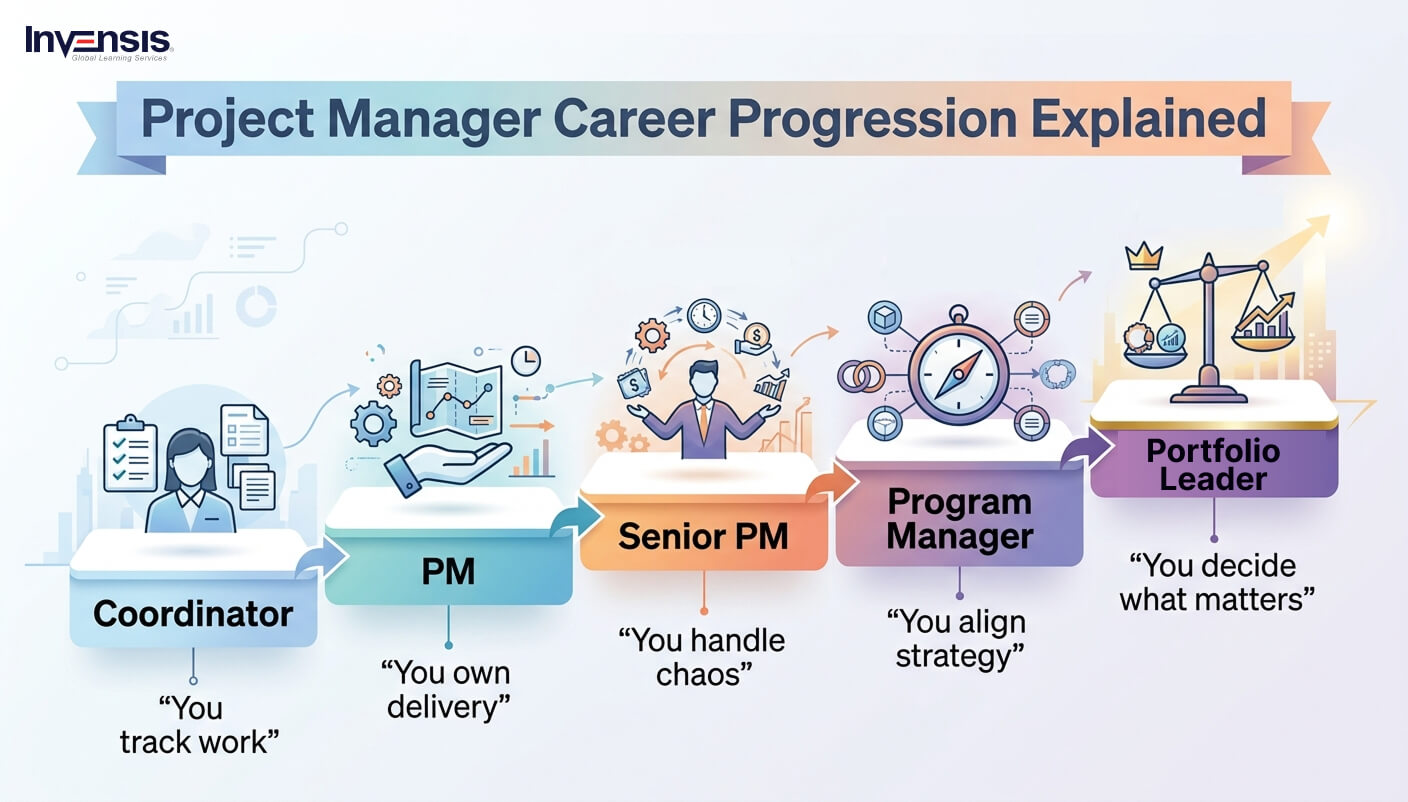
At the entry level, roles such as project coordinator or project support specialist focus on documentation, reporting, scheduling support, meeting follow-ups, and workflow administration. These roles are ideal for learning the mechanics of learning delivery, stakeholder communication, and project governance from the ground up.
A mid-level project manager owns an end-to-end initiative. That includes planning, stakeholder management, risk tracking, resource coordination, cost monitoring, and delivery communication. This is the role most people picture when they hear “project manager,” and it remains the foundation of most project careers.
Senior project managers usually lead larger, riskier, or more strategically visible programs. They may oversee multiple workstreams, manage complex stakeholder landscapes, guide less experienced PMs, or stabilize troubled projects. What separates them from mid-level PMs is not just experience, but judgment: they are expected to make stronger trade-off decisions under pressure.
Beyond that, organizations often distinguish program managers and portfolio or PMO leaders. Program managers coordinate related projects to achieve a broader business outcome, while portfolio leaders make prioritization and investment decisions across groups of projects. These roles are less about task control and more about strategic alignment, benefits realization, and enterprise decision-making.
| Role Level | Main focus | Typical success measure |
| Project Coordinator | Support and administration | Process consistency and reporting accuracy |
| Project Manager | Delivery of one project | Scope, time, cost, quality, stakeholder alignment |
| Senior Project Manager | Complexity and leadership | Business-critical delivery and risk control |
| Program Manager | Coordination across related projects | Strategic outcomes and cross-project value |
| Portfolio/PMO Leader | Prioritization and governance | Investment alignment and organizational impact |
What Skills Make Each Type of Project Manager Successful?
Although the context changes, several skills matter across every project manager type: communication, organization, leadership, problem-solving, and time management. PMI lists leadership, adaptability, organization, creative problem-solving, effective communication, and team motivation among the core capabilities of strong project managers.
What changes is the emphasis. Construction PMs need stronger schedule control and field coordination. Healthcare PMs need more governance and risk sensitivity. Agile PMs need facilitation and adaptability. Marketing PMs need to orchestrate stakeholders and move quickly. Senior and portfolio leaders need sharper business judgment, prioritization, and executive communication.
That is why career growth in project management is not just about accumulating years of experience. It is about deliberately developing the mix of technical, leadership, and business skills that fit your target role.
How can you choose the Right Project Manager Career Path?
The right project management path usually sits at the intersection of three things: the problems you enjoy solving, the environment you work best in, and the level of specialization you want over time.
If you like tangible outcomes, visible progress, and structured planning, construction or traditional delivery roles may suit you. If you enjoy ambiguity, digital tools, collaboration, and iterative work, Agile or software project roles may feel more natural. If you are motivated by mission-driven impact, healthcare projects can offer a meaningful path. If you enjoy pace, creativity, and campaign execution, marketing project management can be a strong fit.
A practical next step is to choose one domain to deepen in while keeping your core project management capabilities broad. That combination of strong fundamentals and relevant specialization is what often makes a project manager stand out in the market.
| Career Action Start broad, then specialize. Learn universal project disciplines first, then build domain depth in the industry or delivery style that best matches your strengths. |
Conclusion
Project management is no longer a one-size-fits-all career. As this guide shows, the different types of project managers are shaped by industry demands, delivery approaches, and the level of business responsibility they carry. Whether it is managing complex construction timelines, driving agile software releases, coordinating healthcare transformation, or leading enterprise-wide programs, the core role remains the same: turning strategy into execution. The real differentiator is how well a project manager adapts their skills to the context they operate in.
If you are serious about building a long-term career in project management, the smartest move is to first master the fundamentals and then specialize. Structured learning paths such as PMP certification training, Agile certifications, or project management fundamentals courses can help you build both credibility and capability. Over time, combining strong delivery skills with domain expertise positions you for higher-impact roles such as senior project manager, program manager, or portfolio leader.
Frequently Asked Questions
1. What Are The Main Types Of Project Managers?
The main types of project managers are usually grouped by industry, methodology, and seniority. Common examples include IT project managers, construction project managers, healthcare project managers, marketing project managers, Agile project managers, and senior or program-level project leaders.
2. Is An Agile Project Manager Different From A Traditional Project Manager?
Yes. An Agile project manager typically works in iterative, fast-changing environments and focuses on team flow, adaptability, and continuous improvement. A traditional project manager usually works with more fixed requirements, linear planning, and tightly controlled delivery stages.
3. Which Type Of Project Manager Is Best For Beginners?
Entry-level professionals often begin in project coordinator or project support roles. These positions help you learn scheduling, reporting, stakeholder communication, and delivery governance before moving into full project ownership.
4. Do Project Managers Need Industry Specialization?
Not always at the start, but specialization becomes more valuable as projects become more complex. Industries such as healthcare and construction especially reward project managers who understand domain-specific rules, risks, and stakeholder expectations.
5. Are Project Manager Jobs In Demand?
Yes. The U.S. Bureau of Labor Statistics projects 6% growth for project management specialists from 2024 to 2034, and PMI projects global demand could require up to 30 million additional project professionals by 2035.
6. What Skills Matter Most For Project Managers In The Future?
Analytical thinking, resilience, adaptability, leadership, communication, and digital fluency are becoming even more important. As AI and technology reshape work, project managers who can lead change and coordinate cross-functional execution will stand out.