


Table of Contents:
- Introduction
- What Is a Feature in Agile?
- Where Do Features Fit in the Agile Hierarchy?
- What Are the Key Characteristics of a Feature in Agile?
- What Are Agile Feature Examples?
- What Is the Difference Between Features, Epics, and User Stories in Agile?
- How Are Agile Features Prioritized?
- How Are Agile Features Written?
- How Do Features Work in Different Agile Frameworks?
- What Are Common Mistakes Teams Make with Agile Features?
- Conclusion
Introduction
Agile teams break large product goals into progressively smaller, more actionable pieces. At the heart of that breakdown sits a unit that is often misunderstood: the feature.
Features in Agile are neither the high-level strategic vision nor the granular day-to-day tasks. They occupy the middle ground, specific, deliverable capabilities that carry real business value and can be planned, built, and demonstrated within a defined timeframe. Getting features right is foundational to how agile teams plan programs, manage backlogs, and deliver value continuously.
This guide covers what a feature is, how it fits into the Agile backlog hierarchy, the key characteristics of a well-formed feature, agile feature examples from real scenarios, how features are prioritized, and how features differ from epics, capabilities, and user stories.
What Is a Feature in Agile?
A feature in Agile is a service or function of the product that delivers business value and fulfills the customer’s need. More specifically, from the Scaled Agile Framework (SAFe), the most widely adopted framework for scaling Agile across enterprises, a feature represents solution functionality that delivers business value, fulfills a stakeholder need, and is sized to be delivered by an Agile Release Train within a Program Increment.
In practical terms, a feature is:
- Large enough to represent a meaningful product capability with clear user or business value
- Small enough to be planned, built, tested, and demonstrated within a set delivery cycle
- Concrete enough to be broken down into individual user stories that teams can act on
Features in Agile are typically too large to work on directly, so they are broken down into smaller user stories. Each feature is broken down into several user stories because it is usually too big to work on directly. A user story is an informal, short description of a part of a software feature, written from the user’s perspective, that explains how this piece of the feature offers something of value.
The agile feature definition is consistent across frameworks in its core intent: a feature is a distinct, valuable capability of the product, not a task, not a requirement specification, and not a vague aspiration. It is a named, sized, and hypothesized piece of functionality with a clear owner and measurable acceptance criteria.
Where Do Features Fit in the Agile Hierarchy?
Understanding agile features requires understanding where they sit relative to other Agile work items. The typical hierarchy from largest to smallest is:
|
“Scrum is built on the idea of transparency, inspection, and adaptation, which is only possible when work is decomposed into small, manageable pieces.” |
 |
Initiatives (or Themes)
They are the broadest strategic objectives that set direction across the organization. Initiatives are composed of multiple epics.
Epic
Large, overarching bodies of work representing broad business objectives or goals. They are typically high-level and abstract, providing strategic direction for a project. Epics span multiple sprints or quarters and are broken down into features and user stories. Epics are a helpful way to organize your work and to create a hierarchy. The idea is to break work down into deliverable pieces so that large projects can actually get done.
Features
The bridge between strategic intent (epics) and delivery execution (user stories). Features represent concrete evolutions or significant additions to the product, serving as a bridge between the strategic ambitions encapsulated in the epics and the detailed actions described by the user stories. They are essential for translating user needs and expectations into tangible elements that enrich the product experience.
User Stories
The most granular component in the hierarchy. User stories are the smallest unit of work in Agile, written from the end user’s perspective, typically completable within a single sprint. As a [role], I want [goal] so that [benefit] is the standard format.
Tasks
The lowest level: specific, technical activities that developers pick up to complete a user story.
The relationship is hierarchical: epics contain features, features contain user stories, and user stories break down into tasks. Understanding the distinctions and relationships between epics, features, and user stories is essential for successful agile project management. Epics provide the strategic vision, features represent actionable components of that vision, and user stories detail the specific tasks needed to deliver value to the user.
A practical illustration: for a fictional e-commerce website, the epic might be “Order Management.” Features within that epic could include order tracking, returns and exchanges, and refund processing. User stories within the “returns and exchanges” feature would then include: selecting orders for return, entering return information, creating mailing labels, and refunding payments.
What Are the Key Characteristics of a Feature in Agile?
Not every named product capability qualifies as a well-formed agile feature. There are specific characteristics that define and distinguish a proper agile feature from a vague requirement or an oversized epic.
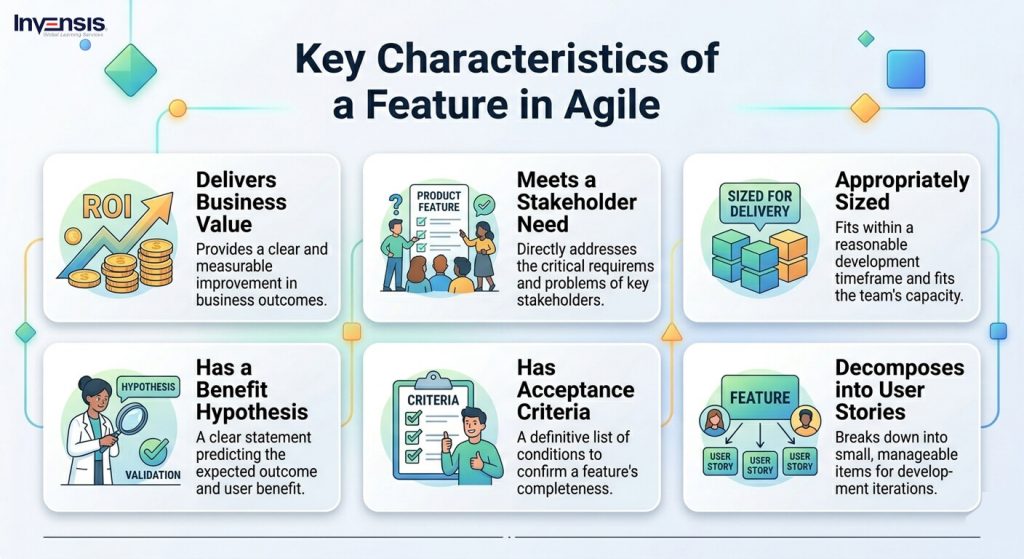
Delivers Business Value
A feature must deliver clear, measurable value to the business or to the end user. Features are distinct components of functionality that meet specific user needs and, in that way, provide tangible business value. This distinguishes features from technical tasks (which may be necessary but do not themselves deliver user-facing value) and from vague descriptions (which cannot be measured or prioritized).
Meets a Stakeholder Need
In SAFe, a feature represents a service that fulfills a stakeholder’s need and delivers business value. The feature must have an identifiable beneficiary, a customer, an internal user, or a business function whose need the feature addresses. Without a clear stakeholder, there is no way to write a meaningful benefit hypothesis or acceptance criteria.
Appropriately Sized
A feature in Agile must be sized to be completed within a defined delivery window. In SAFe, this means a feature must be deliverable by an Agile Release Train (ART) within a Program Increment (PI), generally under two months of total effort. Features are maintained in the ART Backlog and sized to fit in a PI so that each delivers new value.
If a feature is too large to fit within a PI, it is either a capability (which spans multiple ARTs) or an epic that needs to be further decomposed. If it is too small, it is more accurately a user story.
Has a Benefit Hypothesis
A well-formed agile feature requires a benefit hypothesis. The benefit hypothesis is the business value that the feature is expected to deliver. Similar to a scientific hypothesis, this is a statement that will ultimately be tested to see if it is correct. A common formula: “We believe [feature proposition] will deliver [expected benefit] as measured by [metric].”
This hypothesis-driven approach is what allows teams to validate whether a feature delivered its intended value, and to pivot or optimize if it did not.
Has Acceptance Criteria
In SAFe, a feature’s acceptance criteria are usually written by the stakeholder or the product owner. The acceptance criteria should provide a framework to measure whether the benefit is being delivered. They are used to: determine if the feature has been implemented correctly, establish whether the business benefits are being delivered, mitigate implementation risks, and facilitate early validation testing to prevent unnecessary costs and effort.
Decomposes into User Stories
Every feature must be decomposable into a set of user stories that teams can pick up and complete in sprints. Only when all of the user stories have been completed can you consider a feature deliverable. This decomposability is what makes features actionable at the team level.
What Are Agile Feature Examples?
Grounding the agile feature definition in concrete examples makes the concept clearer for teams who are building or refining their backlogs.
Example 1: Project Management Software, Task Prioritization
In project management software, “Task Prioritization” is a feature that enables users to assign priority levels to tasks. The benefit hypothesis: “We believe enabling users to set and view task priority levels will reduce time spent on low-impact work and increase on-time delivery rates, as measured by task completion rate and user satisfaction scores.”
User stories within this feature could include: as a project manager, I want to assign a priority level (High, Medium, Low) to each task so that my team knows what to work on first; as a team member, I want to see a sorted task list by priority so that I can focus on the most important work without manual searching.
Example 2: E-commerce Platform, Checkout Process
A checkout process is a feature within the broader “Order Placement” epic. It delivers direct business value (completed purchases) and fulfills the core stakeholder need (a frictionless buying experience). User stories within this feature might include: adding items to cart, entering shipping information, selecting payment method, applying discount codes, and receiving an order confirmation.
Example 3: Banking Application, Two-Factor Authentication
Two-Factor Authentication (2FA) is both a business feature (reduces fraud and liability) and a user feature (increases account security). The benefit hypothesis would establish the expected reduction in unauthorized access incidents as the measurable benefit. User stories include: as a user, I want to receive a one-time code by SMS so that I can verify my identity when logging in from a new device.
Example 4: Healthcare Platform, Appointment Scheduling
An online appointment scheduling feature in a healthcare platform delivers value to patients (convenient booking) and to the organization (reduced call center volume). User stories include: searching for available appointment slots by specialty, selecting a preferred doctor, confirming appointment details, and receiving automated reminders.
Example 5: Enabler Feature, API Integration for Reporting
Not all agile features are user-facing. Enabler features are technical capabilities that support the development of business features. An enabler feature might be: “Integrate reporting API to support real-time dashboard data.” This is an enabler feature because it does not directly deliver customer-facing value on its own, but it enables the team to build reporting features that do. Enabler features include a short phrase along with a benefit hypothesis and acceptance criteria, just like business features.
What Is the Difference Between Features, Epics, and User Stories in Agile?
The terms feature, epic, and user story are often used interchangeably in informal Agile practice. That creates real problems, blurred responsibilities, planning confusion, and unclear accountability. Here is how each is precisely distinguished.
Feature vs. Epic
An epic is a large, strategic body of work that may take multiple sprints, quarters, or even longer to complete. It represents a broad business objective. A feature is a specific, deliverable component of an epic that can be completed by one or more teams within a defined timeframe. In SAFe, an epic is a high-level strategic initiative at the portfolio level, a feature is a deliverable capability at the program level, and a user story defines customer-centric tasks completed within a sprint.
Epics are broken down into multiple features. A single epic might contain anywhere from three to a dozen or more features, depending on its scope. Mixing epics and features in the backlog or using them interchangeably leads to blurred responsibilities and planning confusion.
Feature vs. User Story
Features are distinct elements of functionality that offer value to the business and user. Stories are small parts of a feature that allow teams to put context to their actions. Each completed user story iteratively builds the feature. Only when all of the user stories have been completed can you consider a feature deliverable.
User stories are written from the user’s perspective and describe a specific task or interaction. Features describe a product’s capability. A user story is: “As a customer, I want to track my order in real time so I can know when it will arrive.” The feature it belongs to is: “Order Tracking.”
Feature vs. Capability (SAFe-specific)
In SAFe, there is a distinction between features and capabilities. A feature is defined at the ART (Agile Release Train) level and delivered within a single PI. A capability represents large solution functionality whose implementation often spans multiple ARTs and is sized to be delivered within a PI. Capabilities behave the same way as features but have a higher level of abstraction and support the definition and development of large solutions. Capabilities are split into features for implementation.
How Are Agile Features Prioritized?
Feature prioritization is one of the most critical and contested activities in Agile program planning. Deciding which features get built first determines what value the organization delivers and when. Several approaches exist, but in scaled Agile, the leading method is Weighted Shortest Job First (WSJF).
Weighted Shortest Job First (WSJF)
Weighted Shortest Job First (WSJF) is a prioritization model used to sequence work for maximum economic benefit. In SAFe, WSJF is estimated as the relative cost of delay divided by the relative job duration. Using WSJF, features are reviewed and prioritized at PI boundaries.
The WSJF formula divides the Cost of Delay by the Job Size (effort or duration). A feature with a high Cost of Delay and a small Job Size earns the highest WSJF score and moves to the top of the backlog.
The Cost of Delay is composed of three factors:
User/Business Value: The direct benefit the feature delivers to users and the business. What is the relative value to the user? What is the impact on revenue?
Time Criticality: The urgency of delivering the feature. How does value decay over time? Will delaying this feature cost market share, customer trust, or a regulatory window?
Risk Reduction and/or Opportunity Enablement, whether delivering this feature reduces future risk (technical debt, security vulnerability, compliance exposure) or opens new strategic opportunities.
WSJF ensures that teams prioritize features that deliver the highest value in the shortest time, not just features that seem important in isolation. Product Management uses WSJF to prioritize features; System Architects use it to prioritize enabler features.
MoSCoW and Value vs. Effort
For teams not operating within SAFe, simpler prioritization frameworks are common. The MoSCoW method (Must Have, Should Have, Could Have, Won’t Have) provides a qualitative ranking framework. A Value vs. Effort matrix plots features on two axes to identify quick wins (high value, low effort) versus strategic bets (high value, high effort) versus features to deprioritize (low value, any effort).
Story Point Estimation for Features
Feature points represent the amount of work complexity, effort, and knowledge required to complete one feature. They are the same as story points, but in the context of a feature rather than a user story. Feature points help teams gauge how complex a task is, make planning easier, and allow comparison of task sizes to support prioritization and resource allocation.
How Are Agile Features Written?
Well-written features follow a consistent format that communicates who benefits, what is being delivered, and what success looks like.
The Feature Name
A feature name should be a short, clear phrase that communicates the capability being built. “Two-Factor Authentication,” “Real-Time Order Tracking,” “In-App Notifications for Task Due Dates.” The name must be meaningful to both technical and non-technical stakeholders.
The Benefit Hypothesis
The benefit hypothesis is the testable statement of expected value. A good structure: “We believe [feature] will deliver [benefit] as measured by [metric].” Example: “We believe enabling customers to track orders in real time will reduce inbound support calls about order status by 30%, as measured by monthly call center volume.”
Acceptance Criteria
Acceptance criteria define the conditions that must be true for the feature to be considered complete and for the benefit hypothesis to be valid. They are written collaboratively by product management, stakeholders, and development teams. Good acceptance criteria are specific, testable, and tied to the benefit hypothesis.
Example acceptance criteria for “Real-Time Order Tracking”:
- Users can view the current status of their order (Confirmed, Processing, Shipped, Out for Delivery, Delivered) from their account dashboard
- Status updates reflect within 30 minutes of the actual shipment event
- Users receive an in-app and email notification at each status change
- The tracking interface is accessible on mobile and desktop browsers
Decomposition into User Stories
Once a feature is defined and approved, the teams split features into stories to be implemented, integrated, tested, and demonstrated as the functionality becomes available. Each user story addresses one specific interaction or behavior within the feature. The collection of completed user stories constitutes the delivered feature.
How Do Features Work in Different Agile Frameworks?
While the concept of an agile feature is broadly consistent, different frameworks handle features in slightly different ways.
Scrum
In standard Scrum, the concept of a feature exists informally rather than as a defined artifact. Work is organized around the product backlog, which contains user stories and epics. Teams and product owners may use features to group related user stories, but there is no prescribed feature layer in the Scrum framework itself. Epics and features are higher-level containers used to organize work. Typically, user stories or backlog items roll up into features.
SAFe (Scaled Agile Framework)
SAFe provides the most structured definition of a feature in Agile. Features live in the ART Backlog and are owned by Product Management. They must fit within a single Program Increment. They have defined components (benefit hypothesis, acceptance criteria, WSJF score, Feature and Benefit matrix). Product Management and the System Architect define features and enablers, respectively. SAFe also distinguishes between business features and enabler features.
Kanban
Kanban teams may use features as higher-level work items on their boards, but the framework does not prescribe a specific hierarchy. The focus is on visualizing flow and limiting work-in-progress. Features often appear as swimlanes or card groupings in Kanban implementations.
What Are Common Mistakes Teams Make with Agile Features?
Even experienced Agile teams make predictable mistakes when defining and managing features.
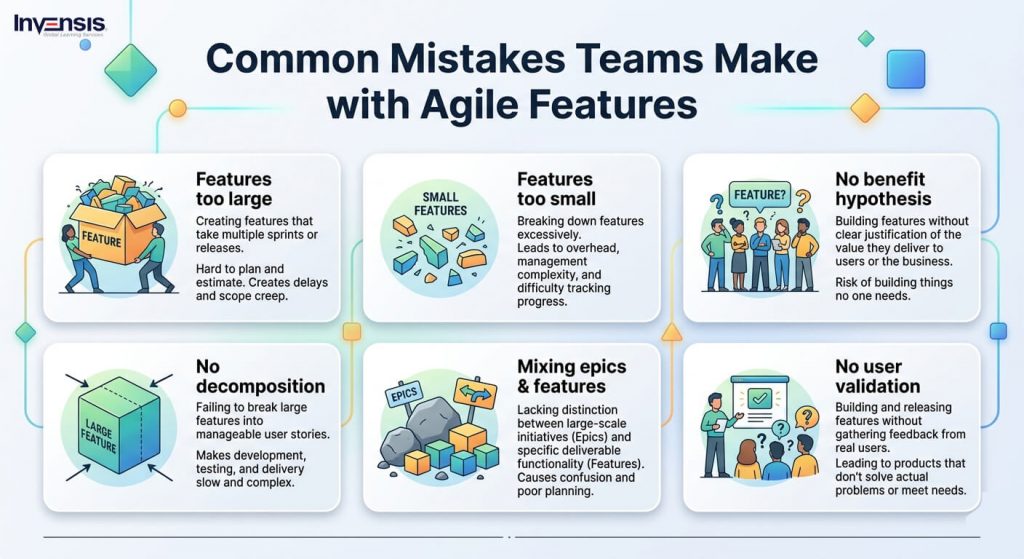
Making features too large. A feature that spans multiple Program Increments is actually a capability or an epic. Oversized features create planning problems, obscure dependency management, and make it impossible to demonstrate incremental value. Size features to fit within your delivery cycle.
Making features too small. A feature that is the size of a user story adds unnecessary hierarchy without a meaningful benefit. If a feature contains only one user story, reconsider whether it is actually a feature or simply a story.
Skipping the benefit hypothesis. Features defined without a benefit hypothesis cannot be validated. Teams end up building to specification rather than building to value. Writing a measurable hypothesis before development begins disciplines teams to think about outcomes, not just outputs.
Not breaking features into user stories before a PI. Features are not directly executable. Teams need user stories to plan sprints. Failing to decompose features in time for planning creates blockers and reduces sprint predictability.
Mixing features and epics in the same backlog. When epics and features are treated interchangeably in the backlog, prioritization becomes arbitrary and stakeholder communication breaks down. Maintain clear definitions and consistent use of each level across the team and organization.
Neglecting user validation. Skipping user validation or neglecting to gather feedback results in features that do not solve real user problems or meet business goals. Features should be shaped by user research and validated against real user behavior after delivery.
Conclusion
Features are the critical bridge between strategy and execution in Agile. They translate high-level business goals into deliverable capabilities that teams can plan, build, and validate within a defined timeframe. When features are clearly defined, properly sized, and backed by a strong benefit hypothesis, they enable teams to deliver continuous value while maintaining alignment with stakeholder expectations and organizational priorities.
For Agile teams, mastering features is not optional; it is essential for effective backlog management, prioritization, and delivery predictability. By structuring work correctly across epics, features, and user stories, teams avoid confusion, reduce rework, and ensure that every increment contributes to meaningful outcomes. The real advantage comes when teams consistently focus on value-driven features rather than just task completion, enabling faster feedback, better decision-making, and sustained product success.
If you want to strengthen your understanding of Agile practices and apply feature-driven delivery effectively in real projects, enrolling in a structured Agile Certification Training courses can give you a clear advantage. A well-designed program helps you master backlog structuring, feature prioritization techniques like WSJF, and real-world Agile frameworks such as Scrum and SAFe, enabling you to deliver consistent business value and advance confidently in Agile roles.