



In 2026, organizations face unprecedented complexity. Digital transformation accelerates at breakneck speed, artificial intelligence reshapes workflows, and customer expectations evolve faster than ever. According to recent industry research, companies implementing AI-enabled Agile practices achieve 30% faster time-to-market and 25% improvement in stakeholder satisfaction. At the heart of this transformation stands a critical role: the Agile Coach.
But the Agile Coach of 2026 looks vastly different from their predecessors. No longer confined to facilitating Scrum ceremonies or teaching frameworks, today’s Agile Coaches serve as strategic partners, change agents, and AI integration specialists. They bridge the gap between human collaboration and machine intelligence, guide enterprise-wide transformations, and cultivate cultures of continuous adaptation.
This comprehensive guide explores the complete landscape of Agile coaching responsibilities in 2026. You’ll discover the core duties that define the role, the cutting-edge skills required for success, how AI integration has revolutionized coaching practices, and the career pathways available in this high-demand profession.
Table Of Contents
- Understanding the Agile Coach Role in 2026
- Core Roles and Responsibilities of an Agile Coach
- Essential Skills and Qualities for Success
- AI Integration and Human-AI Collaboration
- Challenges Facing Agile Coaches
- Conclusion
Understanding the Agile Coach Role in 2026
What is an Agile Coach?
An Agile Coach is a professional who guides organizations, teams, and individuals in adopting and optimizing Agile methodologies. Unlike a Scrum Master who typically focuses on a single team, or a Project Manager who concentrates on delivery timelines, an Agile Coach operates at multiple organizational levels, from coaching individual contributors to mentoring executives on business agility.
In 2026’s AI-enabled workplace, Agile Coaches serve as facilitators of human-AI collaboration. They help teams leverage predictive analytics for backlog prioritization, use AI-powered tools for risk identification, and maintain human-centered decision-making despite increasing automation. The modern Agile Coach understands that agility isn’t about speed alone; it’s about intelligent responsiveness in complex environments.
The Evolution of Agile Coaching
The journey from team-level facilitation to enterprise-level strategic partnership reflects Agile coaching’s maturation. Early Agile coaches (2010s) primarily taught Scrum mechanics and facilitated ceremonies. By the late 2010s, scaling frameworks like SAFe expanded coaching to program and portfolio levels. Today, in 2026, Agile Coaches integrate AI-driven insights, data analytics, and predictive modeling into their practice.
This evolution reflects broader business needs. Organizations no longer seek Agile adoption for its own sake, they pursue business agility to survive disruption. Agile Coaches have responded by developing competencies in organizational design, change management, leadership development, and now, AI integration.
Core Roles and Responsibilities of an Agile Coach
Facilitating Agile Transformation and Adoption
Leading an organization from traditional methodologies to Agile ways of working represents one of the most complex responsibilities. This isn’t simply about introducing new processes; it’s about catalyzing fundamental shifts in organizational culture, decision-making structures, and value delivery approaches.
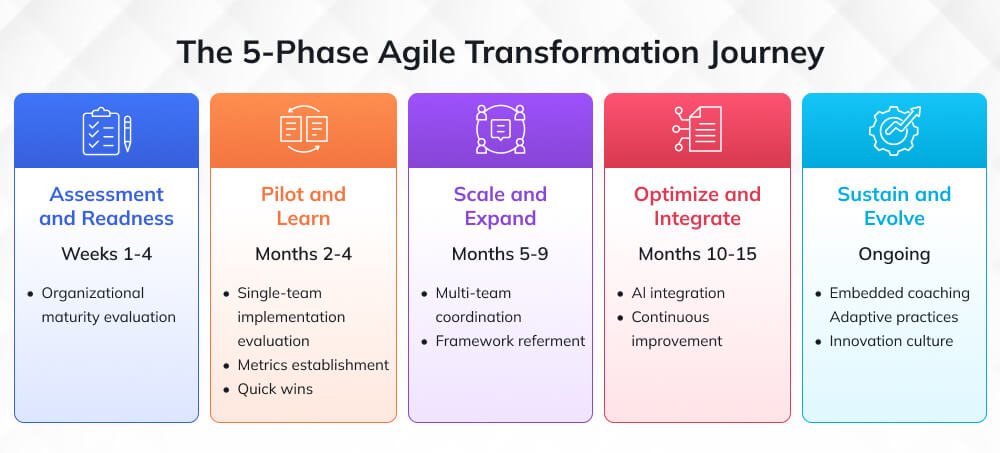
The transformation journey begins with assessment. Agile Coaches evaluate organizational readiness by examining current processes, cultural norms, leadership mindsets, and technical capabilities. They identify pockets of resistance, locate early adopters who can champion change, and map the political landscape.
Once the assessment complete, Agile Coaches design transformation roadmaps that balance ambition with pragmatism. Rather than attempting organization-wide change overnight, effective coaches implement phased approaches with clear milestones and quick wins. They might start with a pilot team, demonstrate value through measurable outcomes, then expand to additional teams.
Cultural change management represents perhaps the most challenging aspect. Agile Coaches must help organizations shift from command-and-control hierarchies to empowered, self-organizing teams. This requires patient work: facilitating difficult conversations, addressing fears about role changes, celebrating experiments (even failed ones), and modeling the behaviors they wish to see.
Coaching and Mentoring Teams and Individuals
While transformation operates at the organizational level, profound change happens through individual growth. Agile Coaches dedicate significant time to one-on-one and small-group coaching, helping people develop new capabilities and navigate the challenges of adaptive work.
Coaching Product Owners requires helping them transition from requirements gatherers to value maximizers. Many Product Owners initially struggle with prioritization, saying “everything is important.” Agile Coaches teach techniques like weighted shortest job first (WSJF) and cost of delay analysis. More importantly, they coach Product Owners to have difficult conversations with stakeholders about trade-offs.
Scrum Masters receive coaching on facilitation mastery and servant leadership. An Agile Coach might shadow a Scrum Master’s retrospective, then provide feedback on questioning techniques and conflict handling. They help Scrum Masters understand when to step in versus when to let the team struggle productively.
Team coaching focuses on building collective capabilities. Agile Coaches facilitate team chartering sessions where members define their working agreements and communication norms. They teach collaborative practices like pair programming and specification by example. When teams experience conflict, coaches create safe spaces for difficult conversations.
Leadership coaching for executives represents an increasingly important dimension. C-suite leaders often intellectually support Agile transformation but struggle to change their own behaviors. An Agile Coach might help a VP understand how their insistence on detailed upfront plans creates fear that stifles experimentation.
Facilitating Agile Ceremonies and Practices
While ceremony facilitation might seem tactical, it provides crucial opportunities for coaches to demonstrate effective practices and observe team dynamics. In 2026, ceremony facilitation increasingly involves AI-assisted tools that surface insights, but the human coach remains essential for creating psychological safety.
Sprint planning exemplifies this blend of AI augmentation and human facilitation. Modern Agile Coaches leverage AI tools that analyze historical velocity, identify dependencies, and suggest effort estimates. However, the coach’s role extends beyond data presentation. They facilitate conversations that ensure the team understands the “why” behind selected work.
Daily stand-ups, when facilitated effectively, become powerful coordination sessions rather than rote status updates. Agile Coaches teach teams to focus on progress toward sprint goals, surface impediments quickly, and offer help to teammates.
Retrospectives represent perhaps the most powerful ceremony for continuous improvement. Skilled Agile Coaches employ diverse facilitation techniques, from classic start/stop/continue to timeline retrospectives and sailboat exercises. They ensure retrospectives produce actionable improvements that teams commit to implementing.
Removing Organizational Impediments
While teams can solve many obstacles, systemic impediments require organizational-level intervention. Agile Coaches serve as impediment escalation specialists, identifying patterns and working with leadership to eliminate structural blockers.
Process-related impediments often emerge from legacy policies that made sense in traditional environments but hinder agility. An Agile Coach might discover that teams wait weeks for environment provisioning. Rather than simply documenting this impediment, the coach works with operations leadership to explore solutions, perhaps implementing infrastructure-as-code approaches.
Interpersonal conflicts require delicate coaching interventions. When tension exists between a Product Owner who constantly changes priorities and a development team frustrated by whiplash, the Agile Coach facilitates conversations to uncover root causes.
Organizational politics represent particularly challenging impediments. When competing departments resist collaboration, coaches must navigate power dynamics carefully. They build coalitions of support, demonstrate value through metrics, and sometimes engage in strategic patience.
Driving Continuous Improvement Culture
Continuous improvement transforms from abstract principle to lived reality through consistent practices and genuine commitment to learning. Agile Coaches serve as architects and stewards of improvement cultures.
Beyond just running retrospectives, Agile Coaches ensure these ceremonies produce genuine insights and actionable changes. They teach teams to look beyond surface symptoms to underlying systemic issues. When a team complains about “too many meetings,” a skilled coach helps them examine which meetings provide value.
Metrics and KPIs, when used wisely, accelerate improvement by making progress visible. Agile Coaches help teams select meaningful metrics, cycle time, lead time, deployment frequency, defect rates, and customer satisfaction scores. Critically, they establish metrics as learning tools rather than punishment mechanisms.
AI-powered analytics provide unprecedented improvement insights in 2026. Coaches leverage tools that identify patterns invisible to humans. However, the coach ensures teams interpret data through human judgment, understanding that numbers provide input for discussion, not automatic answers.
Guiding AI Integration in Agile Workflows
The emergence of AI as a transformative force makes AI integration guidance a defining responsibility for Agile Coaches in 2026. This represents new territory, requiring coaches to develop AI literacy while maintaining focus on human-centered collaboration.
Helping teams adopt AI-powered tools begins with education and experimentation. Agile Coaches introduce tools for backlog prioritization, risk prediction, and test automation. Rather than mandating tools, coaches facilitate safe-to-fail experiments where teams try technologies and evaluate results.
Balancing automation with human collaboration proves essential. While AI can automate repetitive tasks and analyze vast datasets, Agile Coaches ensure teams maintain ownership of strategic choices. They teach teams to use AI as an advisor providing recommendations, not an oracle dictating actions.
Ensuring ethical AI usage represents an emerging coaching responsibility. Agile Coaches help teams examine potential biases in AI recommendations, question data sources and algorithms, and maintain transparency about how AI influences decisions.
KEY TAKEAWAYS: Core Agile Coach Responsibilities
|
Essential Skills and Qualities for Success
Technical and Methodological Expertise
Deep understanding of Agile frameworks provides the foundation for effective coaching. Agile Coaches must master Scrum, Kanban, XP (Extreme Programming), and understand when each framework fits different contexts.
Knowledge of scaling frameworks, SAFe (Scaled Agile Framework), LeSS (Large-Scale Scrum), and Nexus, enables coaches to guide enterprise-level transformations. AI and data literacy have become a baseline expectation. While coaches needn’t become data scientists, they must interpret analytics, understand basic machine learning concepts, and evaluate AI tool capabilities.
DevOps and modern development practices round out technical competencies. Agile Coaches work most effectively when they understand continuous integration/continuous deployment (CI/CD), infrastructure-as-code, and technical practices like test-driven development.
Interpersonal and Leadership Skills
Exceptional communication abilities distinguish great coaches. This includes speaking clearly to diverse audiences, writing effectively, and presenting compellingly to build support for Agile initiatives.
Active listening and powerful questioning form the core of coaching methodology. Rather than telling teams what to do, effective coaches ask questions that spark insight: “What options have you considered?” “What concerns do you have?” “How will you know if this experiment succeeded?”
Emotional intelligence proves essential for navigating the human dimensions of organizational change. Agile Coaches read room dynamics, sense when someone feels uncomfortable, and adjust their approach based on emotional undertones.
Influencing without authority represents perhaps the most critical leadership capability. Agile Coaches rarely have formal positional power. Instead, they influence through expertise, relationship-building, demonstrated value, and strategic coalition-building.
Adaptability and Continuous Learning
Growth mindset and curiosity distinguish Agile Coaches who thrive long-term. The field evolves constantly, new frameworks emerge, technologies shift, research updates best practices. Coaches committed to continuous learning read voraciously, attend conferences, and participate in communities of practice.
Embracing change and uncertainty models the adaptability coaches advocate. When organizational priorities shift unexpectedly, or when a carefully designed intervention fails, resilient coaches adapt their approach.
AI Integration and Human-AI Collaboration
AI as a Collaborative Partner
The most successful organizations in 2026 view AI not as a replacement for human intelligence but as a collaborative partner that augments human capabilities. Agile Coaches facilitate this perspective shift, helping teams move beyond fear toward productive collaboration.
AI-powered backlog prioritization exemplifies this partnership. Modern tools analyze customer behavior data, market trends, and business metrics to recommend feature sequencing. Rather than simply accepting these recommendations, effective teams use them as sophisticated input for prioritization conversations.
Predictive analytics for sprint planning transforms how teams forecast their work. AI examines historical velocity patterns, team composition changes, and story characteristics to predict capacity more accurately. Agile Coaches help teams interpret these predictions while maintaining healthy skepticism.
Real-time risk identification provides early warning of potential problems. AI tools monitor sprint progress and code complexity metrics to flag stories at risk. When the system highlights risks, Agile Coaches facilitate team conversations: “What’s driving this prediction? Do we agree? What could we do differently?”
Coaching Teams Through AI Adoption
AI adoption rarely happens smoothly. Agile Coaches navigate these human dimensions with empathy and strategic communication.
Addressing AI adoption resistance begins with understanding its sources. When developers express concerns about AI-generated code, coaches explore the underlying fears: Does the team worry about deskilling? About accountability when AI code contains bugs?
Training teams on AI tools requires balancing technical instruction with philosophical framing. Coaches don’t just teach which buttons to click, they facilitate conversations about how AI fits into team workflows and which decisions remain human-owned.
Ensuring transparency in AI-driven decisions protects team autonomy and trust. Agile Coaches establish practices where teams document significant AI-influenced decisions and explain the reasoning behind accepting or rejecting AI recommendations.
Ethical Considerations in AI-Enabled Agility
As AI influences more decisions, ethical considerations become paramount. Agile Coaches serve as ethical guardians, raising questions teams might overlook.
Ensuring responsible AI usage begins with examining training data and algorithmic approaches. When an AI tool recommends prioritizing certain features, coaches ask: “What data trained this model? Might it reflect biases from our historical decisions?”
Guarding against algorithmic bias requires vigilance. AI models can perpetuate or amplify existing biases. Agile Coaches help teams audit AI systems for fairness and representation.
Balancing efficiency with human judgment prevents over-reliance on AI optimization. While AI excels at finding efficient solutions, it may miss important considerations: team morale, skill development opportunities, or strategic positioning.
Challenges Facing Agile Coaches
Common Obstacles
Organizational resistance to change manifests in passive acceptance without genuine commitment. Leadership might approve Agile adoption intellectually while maintaining behaviors that undermine it.
Lack of leadership buy-in represents perhaps the most significant impediment. When executives view Agile as “something the teams do” rather than requiring their own adaptation, transformation stalls.
Siloed departments resist the cross-functional collaboration Agile requires. Teams depend on shared services controlled by separate organizations with different priorities.
Skill gaps in teams slow adoption when people lack foundational capabilities. Developers without automated testing skills struggle with continuous integration. Product Owners without business analysis capabilities make poor prioritization decisions.
Strategies for Overcoming Challenges
Building executive sponsorship starts with speaking the language of business outcomes. Rather than advocating for Agile based on framework benefits, effective coaches demonstrate how Agile practices accelerate time-to-market and improve customer satisfaction.
Starting with pilot programs reduces organizational resistance by proving concepts before demanding large-scale commitment. Coaches select pilot teams carefully, choosing groups with supportive leadership and meaningful work.
Demonstrating ROI through metrics provides evidence that influences skeptics. Coaches establish baseline measurements before transformation, then track improvements over time.
Continuous upskilling and education addresses capability gaps systematically. Agile Coaches design learning journeys, perhaps starting with foundational Agile training through Invensis Learning’s Certified Scrum Master program.
KEY TAKEAWAYS: Overcoming Agile Coaching Challenges
|
Conclusion
The Agile Coach role in 2026 is among the most dynamic and impactful careers in modern business. Far beyond facilitating ceremonies, today’s Agile Coaches serve as strategic partners in organizational transformation, architects of continuous improvement cultures, and guides through the complex integration of AI into human workflows.
The responsibilities explored, from facilitating enterprise-wide transformations to coaching individuals and removing impediments to AI adoption, demonstrate the breadth of this profession. Success requires technical expertise in Agile methodologies, exceptional interpersonal skills, and genuine commitment to continuous learning.
As AI reshapes work, Agile Coaches stand at a critical intersection. They help organizations harness AI’s power while preserving the human elements, creativity, empathy, and ethical judgment that make Agile teams effective.
The financial rewards reflect this value, with salaries ranging from $110,000 for entry-level to $160,000+ for senior practitioners. But beyond compensation, Agile Coaches find deep satisfaction in developing people, transforming organizations, and enabling teams to deliver meaningful value.
Ready to begin or advance your Agile coaching journey? Explore Invensis Learning’s comprehensive Agile certification programs, from foundational CSM training to advanced coaching credentials, designed to develop the skills that position you for success in this transformative profession.