



Project cost management looks like “numbers work” from the outside, but it’s one of the few disciplines that can quietly decide whether a project creates value or quietly burns cash. The projects that stay profitable and predictable aren’t just the ones with “good estimates”; they’re the ones built on clear cost baselines, explicit assumptions, disciplined change control, and real-time visibility into how spend is tracking against plan.
Most “sudden” budget blowups aren’t bad luck. They’re the result of vague estimating, optimistic approvals, unmanaged scope creep, and cost reporting that lags reality by weeks. Project cost management is the set of practices you use to plan, estimate, budget, monitor, forecast, and control project spending so you can deliver the agreed scope within approved financial limits, without quietly sacrificing quality, schedule, or stakeholder trust.
In this guide, you’ll get a practical view of cost management end-to-end: how to move from rough estimates to a defensible cost baseline, how to use variance analysis and Earned Value Management (EVM) for early warning, how to forecast where you’ll actually land, and which tools and habits consistently prevent overruns. The goal isn’t just “tracking expenses,” it’s making cost performance predictable, explainable, and a strength of your project, not a liability.
Table of Contents:
- What Is Project Cost Management?
- The Core Processes of Project Cost Management
- Earned Value Management (EVM): The Backbone of Modern Cost Control
- Cost Baselines, Contingency, and Reserves
- Best Practices for Effective Project Cost Management
- Essential Tools for Project Cost Management (What to Use and When)
- Conclusion
- Frequently Asked Questions (FAQ)
What Is Project Cost Management?
Project cost management is often mistaken for “keeping expenses low.” In reality, it’s about making costs predictable, explainable, and controllable, so stakeholders can fund the right scope at the right time and make informed trade-offs before overruns become irreversible.
A widely used definition frames cost management as the function that maintains effective financial control through evaluating, estimating, budgeting, monitoring, analyzing, forecasting, and reporting cost information. That phrasing matters: it highlights that cost management is not only tracking actuals, it also includes forecasting and decision support.
What Cost Management Includes (In Real Projects)
Cost Management Typically Covers:
- Estimating: predicting costs based on scope, delivery approach, and assumptions
- Budgeting: allocating funds over time and across work packages
- Cost control: monitoring actual vs. baseline, analyzing variances, and taking corrective action
- Forecasting: projecting final cost outcomes using performance trends and known changes
- Reporting: communicating cost status in a way that supports timely decisions
These activities are repeatedly emphasized as mechanisms for maintaining financial control.
Why is it Difficult?
Cost estimating and management are challenging because projects contain uncertainty: evolving scope, technical risks, market pricing shifts, staffing constraints, and schedule volatility. GAO’s guidance for large programs stresses that reliable cost forecasting and updates are essential because public and organizational decision-makers need to know whether outcomes are achievable and what they will cost.
In other words, cost management is not paperwork; it’s decision infrastructure.
The Core Processes of Project Cost Management
You can think of project cost management as a system with four practical layers:
- Estimate the cost of work
- Build an approved budget baseline
- Track and control spending against baseline
- Forecast outcomes and drive corrective action
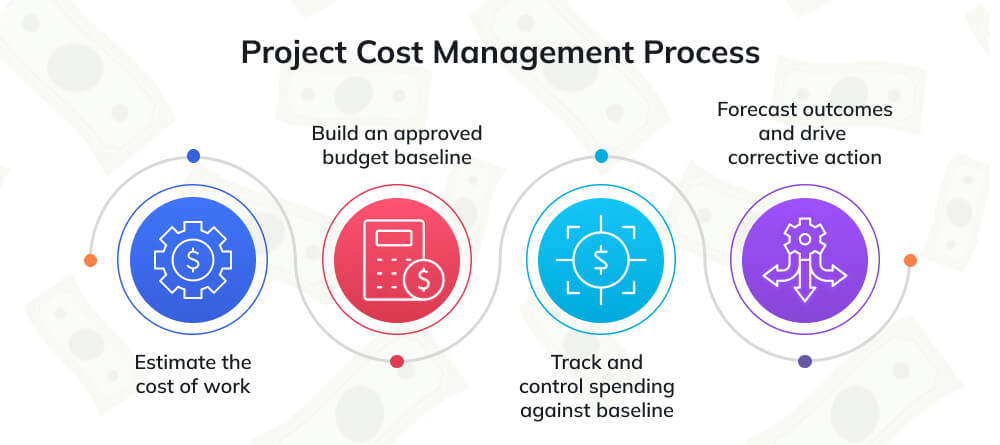
PMI’s cost management function describes these layers as cost estimating, cost budgeting, cost control, and cost applications (e.g., historical databases, reporting, life cycle costing).
Below is the workflow you can follow on most projects regardless of methodology (predictive, hybrid, agile), with increasing depth where projects are complex or high-stakes.
1) Cost Estimating: From “idea” to Defensible Numbers
Cost estimating is the process of estimating and forecasting costs throughout a project’s lifecycle. In practical terms, that means:
- Defining what “cost” includes (labor, vendor, tools, overhead allocation, compliance, etc.)
- Estimating at the right level (activity, work package, feature, deliverable)
- Documenting assumptions, constraints, and exclusions
A strong estimate answers two questions:
- What Will it Cost if Everything Goes as Planned? (base estimate)
- What Might it Cost if Risks Materialize? (risk-adjusted / contingency-informed view)
The “cone of uncertainty” reality
Early estimates are inherently less precise because scope is less mature. That’s why professional estimating frameworks classify estimate types by maturity of definition and expected accuracy range.
For example, AACE’s classification system maps estimate classes to scope maturity and shows that early “Class 5” conceptual estimates can carry broad ranges, while later “Class 1” estimates are more detailed and narrower, because inputs are more defined.
Implication for you: Don’t over-promise precision early. Instead, commit to a process that improves accuracy as definition matures.
2) Cost Budgeting: Creating the Cost Baseline and Funding View
Budgeting isn’t simply “the total number.” It’s the process of establishing budgets, standards, and monitoring systems to measure and manage costs.
Key outputs include:
Cost Baseline (The Reference Line)
The cost baseline becomes the official point of comparison for:
- Actual cost tracking
- Variance analysis
- Earned value reporting
- Change control decisions
Without a baseline, you can’t reliably say you’re over/under budget, only that you spent money.
Work Breakdown Structure (WBS) Alignment
Budgeting depends on a clear breakdown of work. PMI describes the WBS as a task-oriented framework that organizes total work and supports scope/cost/schedule communication and control.
A disciplined WBS enables:
- Consistent roll-ups (work package → control account → project total)
- Traceability between scope and cost
- Stronger cost control and reporting
Time-Phased Budgets and Cash Flow
Budgeting should reflect timing, when money will be spent, not just totals. PMI’s guidance highlights cash flow analysis and the importance of comparing budgeted and actual costs over time.
This is where many projects fail: they approve a total budget but don’t structure spending expectations by month/phase, making early warning signs harder to detect.
3) Cost Control: Monitor, Analyze, Report, Correct
Cost control is the ongoing process of gathering, accumulating, analyzing, monitoring, reporting, and managing costs.
This is not a single monthly task; it’s a rhythm.
What Cost Control Requires
At minimum:
- A baseline to compare against
- Real, timely actuals (from timesheets, invoices, procurement systems)
- Variance analysis to identify deviations
- Decision-making mechanisms (corrective actions, scope trade-offs, change control)
PMI explicitly calls out monitoring actual vs. budget and taking corrective action when variances arise.
4) Forecasting: Predicting Where You Will Land
Forecasting is where cost management becomes strategic.
A project can be “fine today” and still be on track to exceed budget due to:
- Productivity decline
- Compounding rework
- Schedule slippage increases labor burn
- Late risk discovery
- Scope creep not captured as formal change
GAO emphasizes that reliable cost estimates must be updated with actual costs and revised to reflect program changes, then differences between estimated and actual costs must be analyzed, often using EVM data.
Earned Value Management (EVM): The Backbone of Modern Cost Control
If you want one method that converts “budget vs. spend” into a performance narrative, EVM is it.
GAO describes EVM as a tool that integrates technical scope with schedule and cost, comparing:
- Value of work accomplished
- Actual cost spent
- Value of work planned
And then measuring differences as cost and schedule variances.
PMI also includes EVM-aligned concepts like BCWS/BCWP/ACWP, variance analysis, and performance indices in cost reporting guidance.
The Three Core EVM Values
- PV (Planned Value): Budgeted value of work planned
- EV (Earned Value): Budgeted value of work actually completed
- AC (Actual Cost): Money actually spent for completed work
Essential Variance and Performance Metrics
PMI’s cost management content includes formulas/structures for variance analysis and indices (e.g., cost variance and performance indices).
Common metrics:
- Cost Variance (CV) = EV − AC
- Schedule Variance (SV) = EV − PV
- Cost Performance Index (CPI) = EV ÷ AC
- Schedule Performance Index (SPI) = EV ÷ PV
How to Interpret CPI and CV (Quick Intuition)
- CPI < 1.0: You’re getting less value per dollar than planned (inefficient spending trend)
- CV < 0: You’re over budget for the work completed
EVM matters because it helps you diagnose whether a budget issue is caused by:
- Inefficient execution
- Underestimated work
- Scope creep
- Delays (that can later translate into higher costs)
Cost Baselines, Contingency, and Reserves
Many cost overruns aren’t caused by bad execution; they’re caused by unclear financial structure. Teams confuse “baseline,” “contingency,” and “reserves,” and then make poor decisions when uncertainty arises.
Cost Baseline
The cost baseline is your approved plan, your “line in the sand.” PMI describes it as a cost performance measurement baseline used for comparisons, analyzing, and forecasting future costs.
Contingency vs. Management Reserve (Conceptual Separation)
GAO distinguishes between contingency funding for “unknown unknowns” at the program level and management reserve for “known unknowns” tied to contract scope and managed at the contractor level.
The takeaway is not the exact label, it’s the discipline:
- Some budget is planned and baselined (for defined work)
- Some budget exists to manage uncertainty and risk
- You should know who controls which portion and when it can be used
Best Practices for Effective Project Cost Management
The best cost managers do the basics extremely well, and they do them early.
1. Define Cost Scope Early
Cost surprises often come from “hidden” categories:
- Support labor
- Onboarding and training
- Environments, tools, and licenses
- Procurement lead times
- Compliance/security work
Write these into your cost management approach from the start.
2. Use a WBS-Driven Structure for Estimates and Budgets
PMI explicitly positions WBS as the common framework for scope/cost/schedule communication and control. When your budget mirrors your WBS:
- Reporting becomes easier
- Ownership is clearer
- Variance analysis is more actionable
3. Document Assumptions and Ground Rules
GAO highlights ground rules and assumptions as key steps in reliable cost estimating. Without this:
- Estimates can’t be audited
- Stakeholder alignment is weak
- Scope debates become political instead of factual
4. Make Forecasting a Continuous Habit, not a Milestone Activity
Update estimates using actuals and reflect changes in scope or conditions, GAO stresses both updating with actual costs and revising to reflect program changes. Forecasting should be done whenever:
- Productivity changes
- Staffing changes
- Key risks trigger
- Scope changes are proposed
5. Build “Early Warning” Reporting
PMI describes integrated cost/schedule reporting (including S-curves and baseline vs actual). The best dashboards don’t just show totals, they show:
- Trend direction (getting better/worse)
- Variance drivers
- Expected landing cost (forecast)
- Required corrective actions
| PRO TIP Treat Estimating as a Lifecycle, Not a One-Time Event. Use early estimates for decision-making, then deliberately “re-estimate” at stage gates as scope maturity increases, similar to how estimate classes tighten with definition maturity in AACE’s classification approach. |
Essential Tools for Project Cost Management (What to Use and When)
Tools don’t fix weak cost discipline, but the right toolset dramatically improves speed, accuracy, and visibility.
Below is a practical tool view (organized by what cost managers actually need to do).
1. Estimating and Budgeting Tools
Use these when building the estimate and cost baseline:
- Spreadsheet-based models (common for early-stage or smaller projects)
- Estimating frameworks that support maturity-based accuracy thinking (AACE classification is an example of maturity-to-accuracy mapping)
2. Scheduling + Cost Integration Tools
EVM and integrated reporting depend on schedule + cost alignment.
Tools that support time-phased budgets and progress measurement are especially useful because they help you compute EV/PV-style views (conceptually aligned to GAO and PMI’s emphasis on baseline and integrated reporting)
3. Reporting and Analytics Tools
You need:
- Dashboards for variance trends
- Drill-down views by WBS / control accounts
- Clean monthly reporting (for governance cadence)
4. Historical Cost Databases (Often Overlooked)
PMI highlights historical data banks for storing and referencing cost information and trends for future estimates. If your organization lacks this, your estimates will repeatedly restart from scratch.
Conclusion
Project cost management isn’t about squeezing every line item; it’s about building a system where money, schedule, and scope move in sync, and problems surface early, not at the end. When you define cost scope clearly, build a solid, time-phased baseline, track performance with EVM-style indicators, and forecast continuously, budget conversations shift from defensive (“why are we over?”) to proactive (“here’s where we’ll land, and here are the options to stay on track”).
Done well, cost management becomes a core strategic capability: it protects margins, de-risks portfolios, and builds executive confidence that approved budgets will deliver the promised outcomes. The difference between projects that “just spend” and projects that create predictable value is exactly this level of discipline around estimating, baselining, variance analysis, and change control.
If you want to go beyond theory and actually master these practices, Invensis Learning’s PMP® Certification Training is a natural next step. It dives deep into project cost management processes, cost baselines, reserves, Earned Value Management (EVM), and forecasting as defined in PMI’s latest standards, while sharpening your overall project leadership skills. For organizations operating in more structured environments, PRINCE2® Foundation and Practitioner training can further strengthen your governance and stage-based cost control. Investing in these certifications doesn’t just help you pass an exam; it gives you the tools and language to run financially predictable projects in the real world.
Frequently Asked Questions (FAQ)
1. What is project cost management in simple terms?
Project cost management is the process of planning, estimating, budgeting, tracking, and controlling project spending to ensure the project finishes within approved financial limits. It includes monitoring actuals, analyzing variances, forecasting final costs, and reporting financial status for decision-making.
2. What’s the difference between cost estimating and cost budgeting?
Cost estimating predicts how much work will cost based on scope and assumptions. Cost budgeting allocates those estimates into an approved, structured plan (often time-phased) that becomes the baseline for monitoring and control.
3. Why do projects go over budget even with a good estimate?
Because budgets fail due to unmanaged change, schedule slippage, hidden risks, and delayed visibility, not just poor estimation. Reliable cost management requires updating estimates with actuals and revising for program changes.
4. What is Earned Value Management (EVM)?
EVM is a method that integrates scope, schedule, and cost to assess performance. It compares the value of completed work and planned work against actual cost, producing cost and schedule variances that help forecast final outcomes.
5. What is a cost baseline?
A cost baseline is the approved budget plan used to measure project performance. It enables variance analysis, forecasting, and corrective action decisions by providing a consistent reference point against actual costs.
6. How accurate are early-stage project estimates?
Early estimates can be highly variable because scope definition is limited. AACE’s estimate classification shows that early conceptual estimates typically have broader accuracy ranges, while later detailed estimates narrow as definition maturity increases.
7. Does cost management apply to agile projects?
Yes. ISO notes project management guidance applies across predictive and adaptive approaches (including agile). The methods shift (e.g., burn rates, capacity costing), but you still need baseline expectations, actuals, variance insight, and forecasting.