



Table of Contents:
- Introduction
- How Should You Answer Release Manager Interview Questions?
- What Are the Top Release Manager Interview Questions and Answers?
- Conclusioon
Introduction
A Release Manager sits at the center of delivery, coordination, risk control, and communication. In modern software environments, the role is not limited to pushing code into production. It involves planning releases, aligning teams, managing dependencies, securing approvals, monitoring risk, and ensuring the business is ready for deployment. PMI describes the Release Manager as much more than a schedule owner: this person is a coordinator, negotiator, communicator, and leader of a cross-functional team focused on delivering a quality product on time and within budget.
That is why Release Manager interviews are broad in scope. Hiring managers want proof that you understand release processes, stakeholder management, environment readiness, deployment controls, incident response, and continuous improvement. They may also test your familiarity with structured release stages, such as planning, building, testing, final review, and deployment, as well as governance mechanisms, such as approvals, gates, and deployment logs, found in platforms like Azure DevOps.
This guide explains the most common Release Manager interview questions and gives you strong sample answers you can adapt to your own experience.
How Should You Answer Release Manager Interview Questions?
The best answers are specific, structured, and outcome-focused. Instead of giving textbook definitions only, explain how you have applied release management in real situations. A good formula is:
Situation → Approach → Tools/Controls → Outcome → Improvement
For example, instead of saying, “I manage release risk carefully,” say, “For a quarterly enterprise release, I used a readiness checklist, dependency tracking, CAB approvals, and a rollback plan. That helped us deploy on schedule with no Sev-1 incidents, and we later improved handoff communication based on post-release feedback.”
That structure shows leadership, process maturity, and business awareness.
What Are the Top Release Manager Interview Questions and Answers?
1) What Is Release Management?
Sample Answer:
Release management is the structured process of planning, coordinating, testing, approving, and deploying software or service changes into production in a controlled way. I see it as the bridge between development and business value. It is not only about deployment; it is about ensuring readiness across people, process, technology, support, and communication. A good release process reduces risk, improves predictability, and helps teams deliver changes consistently.
Why This Answer Works:
It shows you understand release management as an end-to-end discipline rather than a deployment-only activity. That aligns well with how ServiceNow describes release management and how PMI frames the Release Manager’s role.
2) How Do You Plan a Release?
Sample Answer:
I start by defining the release scope, target date, environments, dependencies, and business objective. Then I build a release plan that includes milestones, owners, testing windows, approval checkpoints, deployment steps, communication plans, and rollback criteria. I also identify risks early, especially around cross-team dependencies, environment availability, and production support readiness. Once the plan is reviewed with stakeholders, I track it through a release calendar and readiness checkpoints.
Why This Answer Works:
It reflects the planning discipline described in release management guidance, where milestones, timelines, responsibilities, and repeatable workflows are central to a successful release.
3) How Do You Manage a Release Calendar with Multiple Teams?
Sample Answer:
I treat the release calendar as a shared source of truth. I usually map releases by application, environment, business criticality, and blackout windows. I hold regular cross-functional syncs with development, QA, operations, security, and business stakeholders to identify conflicts early. When there are overlapping changes, I assess dependency risk, infrastructure contention, support coverage, and customer impact before deciding whether to combine, resequence, or defer releases.
Why this Answer Works:
It demonstrates coordination, conflict resolution, and prioritization, which are essential in environments where many teams introduce changes into shared systems.
4) How Do You Decide Whether a Release Is Ready for Production?
Sample Answer:
I use a formal readiness review rather than relying on intuition. My checklist typically includes test completion, defect status, business signoff, rollback validation, support readiness, monitoring setup, deployment scripts, approval completion, and communication readiness. If any critical item is unresolved, I do not recommend a go-live. I believe a go/no-go decision should be evidence-based and documented.
Why this Answer Works:
It shows governance maturity and a low-drama, high-discipline approach to production releases. Microsoft’s release pipeline model also highlights the importance of approvals, staged execution, and logging.
5) How Do You Handle Release Risks?
Sample Answer:
I categorize release risks into technical, operational, business, compliance, and dependency-related risks. Then I assign mitigation actions, owners, and trigger points. For example, if a release has database schema changes, I make sure rollback compatibility is tested early. If a release depends on multiple vendors or teams, I add earlier checkpoints and fallback paths. I prefer to make risk visible well before deployment day so escalation is proactive, not reactive.
Why this Answer Works:
It shows that you think beyond testing and understand risk as a broader release-management responsibility.
6) What Would You Do If a Production Release Failed?
Sample Answer:
My first priority would be service stability and customer impact reduction. I would quickly assess the severity, activate the rollback or remediation plan, and make sure technical leads, support teams, and key stakeholders are informed. If rollback is the safest option, I would execute it based on predefined criteria rather than debating too long in the moment. After recovery, I would run a post-release review to identify root cause, update controls, and prevent repeat failures.
|
“Reliability is one of the key things that I believe the software industry must stay focused on. A craftsman must be able to count on his tools.” |
 |
Why this Answer Works:
It shows calm decision-making, incident discipline, and commitment to learning. DORA’s delivery metrics also emphasize failed deployment recovery time as a meaningful performance measure, so recovery speed matters.
7) How Do You Balance Speed and Stability in Release Management?
Sample Answer:
I do not see speed and stability as opposites. The goal is to make releases smaller, safer, and more repeatable. I usually encourage automation, standardized deployment patterns, stronger pre-production testing, and clear rollback paths. Smaller batch sizes reduce complexity and make failures easier to isolate. I track metrics like deployment frequency, change fail rate, and recovery time to make sure we improve both delivery pace and reliability.
Why this Answer Works:
It aligns closely with DORA’s research, which states that speed and stability are not long-term tradeoffs and that teams should improve both throughput and instability measures.
8) Which Metrics Do You Track as a Release Manager?
Sample Answer:
I usually track a mix of operational and outcome metrics. On the delivery side, I monitor deployment frequency, change lead time, change failure rate, failed-deployment recovery time, and deployment rework rate. On the release execution side, I may also track release success rate, rollback rate, approval lead time, defect leakage, and incident volume after release. The point is not to chase metrics for their own sake, but to identify bottlenecks and improve the release process over time.
|
“Continuous delivery means that your software is production-ready from day one of your project … and that you can release to users on demand at the push of a button.” For release managers, that means building processes that improve both speed and control rather than treating them as trade-offs.” — Jez Humble, |
 |
Why this Answer Works:
It shows you are data-driven and familiar with current software delivery performance frameworks.
9) How Do You Work with DevOps, CI/CD, and Automation?
Sample Answer:
I see release management and DevOps as complementary. CI/CD improves flow and automation, while release management adds coordination, control, and visibility. In mature environments, I work closely with engineering teams to automate build promotion, testing, deployment, approvals, and logging wherever possible. I also make sure automation still supports auditability, rollback readiness, and stakeholder communication. The goal is not manual control for its own sake; it is controlled, repeatable delivery at scale.
Why this Answer Works:
It shows you are not threatened by automation and understand how governance and automation can work together. Microsoft’s documentation highlights approvals, artifact flow, multistage deployments, and logs as core release pipeline capabilities.
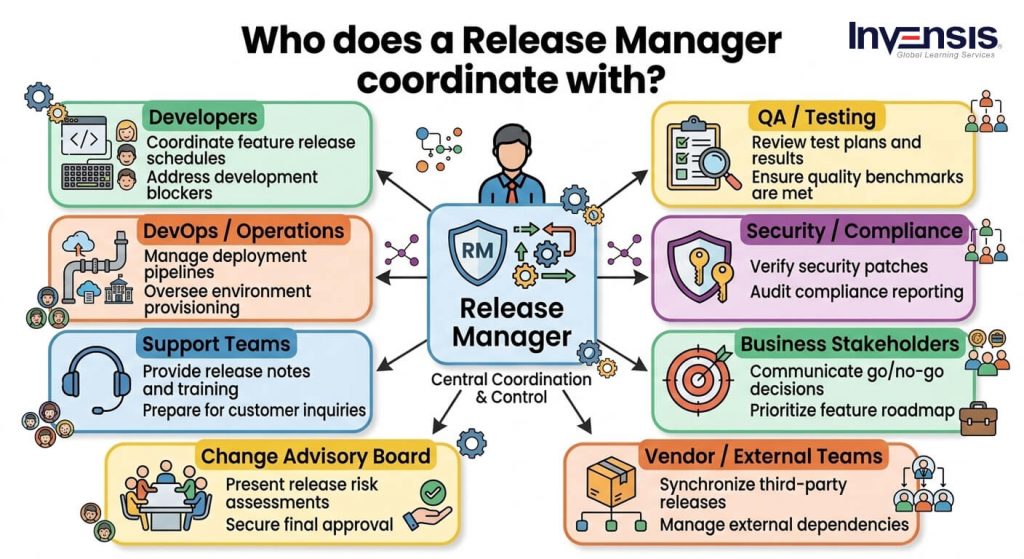
10) How Do You Coordinate Developers, Testers, Operations, and Business Stakeholders?
Sample Answer:
I rely on shared visibility and predictable communication rhythms. I make sure everyone knows the release scope, dependencies, critical path, and decision points. For complex releases, I use readiness meetings, written status updates, deployment runbooks, and issue escalation channels. I also tailor communication to the audience: engineers need execution details, while business stakeholders usually need impact, timing, and risk summaries. Good coordination means translating across groups, not just sending updates.
Why This Answer Works:
PMI explicitly describes the Release Manager as a coordinator, communicator, negotiator, and mediator across stakeholders.
11) How Do You Handle Scope Changes Close to a Release Date?
Sample Answer:
I evaluate late scope requests based on business value, risk, testing readiness, and release stability. If the change is urgent and justified, I assess whether it can be safely included without compromising deployment quality. If not, I recommend deferring it to the next release or handling it through an emergency path with explicit approvals. I believe protecting release integrity is part of the Release Manager’s job, even under pressure to add “just one more change.”
Why this Answer Works:
It demonstrates discipline, stakeholder management, and respect for controlled change.
12) How Do You Prepare for a Go/No-Go Meeting?
Sample Answer:
I prepare a concise readiness summary that covers scope, completed testing, outstanding defects, approvals, rollback readiness, support readiness, known risks, and recommendations. I make sure critical leads are present or represented, and I document the decision and any conditions attached to it. If the release proceeds, everyone leaves the meeting knowing roles, escalation paths, and timing. If it does not proceed, the blockers and next steps are equally clear.
Why this Answer Works:
This answer shows leadership under pressure and strong governance habits.
13) What Tools Have You Used for Release Management?
Sample Answer:
I have worked with release processes supported by tools for ticketing, CI/CD, and deployment governance, such as Jira, Azure DevOps, ServiceNow, and collaboration platforms like Confluence or Teams. My focus is less on the tool brand and more on how the tool supports traceability, approvals, environment tracking, artifact visibility, communication, and post-release reporting. A tool should make the process clearer, not more bureaucratic.
Why this Answer Works:
It shows practical experience without sounding tool-dependent. It also reflects common platform capabilities described by Microsoft and ServiceNow.
14) Can You Describe a Challenging Release You Managed?
Sample Answer:
Yes. In one complex release, we had multiple application teams, a shared production window, and a dependency on a vendor-delivered component that arrived late. I immediately moved the team to daily readiness tracking, separated critical-path items from optional scope, and requested earlier business sign-off on unaffected components. I also had the operations team validate monitoring and rollback scenarios in advance. We successfully deployed the critical scope while deferring lower-priority items to the next release. The key lesson was that transparency and fast decision-making matter more than pretending everything is on track.
Why this Answer Works:
It uses a real-world story structure and shows prioritization, communication, and controlled decision-making.
15) Why Do You Want to Work as a Release Manager?
Sample Answer:
I enjoy roles that combine planning, coordination, and operational impact. Release management sits at the point where strategy becomes customer-facing reality, and I find that responsibility meaningful. I like helping teams deliver with confidence, reducing friction between functions, and building repeatable processes that improve over time. For me, the role is rewarding because it blends structure, collaboration, and measurable business value.
Why this Answer Works:
It sounds thoughtful, role-specific, and aligned with what the job actually demands.
16) How Do You Manage Release Dependencies Across Teams?
Sample Answer:
I start by identifying dependencies early in the planning stage and documenting them clearly by team, system, environment, and timeline. Then I track them through regular release readiness reviews so blockers are visible before deployment week. If one dependency becomes a risk to the critical path, I assess whether we should resequence work, create a fallback, or remove non-essential scope. My goal is to prevent hidden dependencies from becoming release-day surprises.
Why this Answer Works:
It shows that you understand release management as a coordination discipline, not just a deployment task. PMI describes the Release Manager as a proactive cross-functional leader who stays aware of stakeholder activities and their impact on delivery.
17) How Do You Handle Emergency Releases or Hotfixes?
Sample Answer:
For emergency releases, I follow a lighter but still controlled process. I quickly confirm business impact, define the minimum viable fix, identify the approval path, and ensure the deployment and rollback steps are clear. Even when speed matters, I do not skip communication, traceability, or post-release validation. After the hotfix, I make sure we review the root cause and decide whether any process gap allowed the issue to reach production.
Why this Answer Works:
It shows balance. You are willing to move fast, but not recklessly. That reflects strong release judgment, especially in environments where change must still follow a defined and auditable path.
18) How Do You Approach Change Advisory Board or Approval Governance?
Sample Answer:
I treat governance as a decision-support mechanism, not a formality. Before any approval meeting, I make sure stakeholders have the release scope, impact summary, risk level, implementation plan, rollback plan, testing evidence, and support readiness information. That allows the CAB or approvers to make an informed decision quickly. I have found that approval works best when the release manager reduces ambiguity before the meeting rather than trying to explain everything live under pressure.
Why this Answer Works:
It shows you understand structured approvals and readiness evidence. Microsoft’s release pipeline guidance highlights both pre-deployment and post-deployment approvals as important control points in the release process.
19) How Do You Communicate a Release to Business Stakeholders?
Sample Answer:
I focus on business impact, timing, risk, and user readiness. Business stakeholders usually do not need every technical detail, so I summarize what is changing, when it will happen, whether there is expected downtime, what the risks are, and what support is available if anything goes wrong. I also tailor the communication based on the audience. Executives want a concise risk and readiness view, while support teams may need more detailed operational guidance.
Why this Answer Works:
It demonstrates stakeholder awareness and communication maturity. PMI emphasizes that a Release Manager is a communicator and mediator, not just a scheduler.
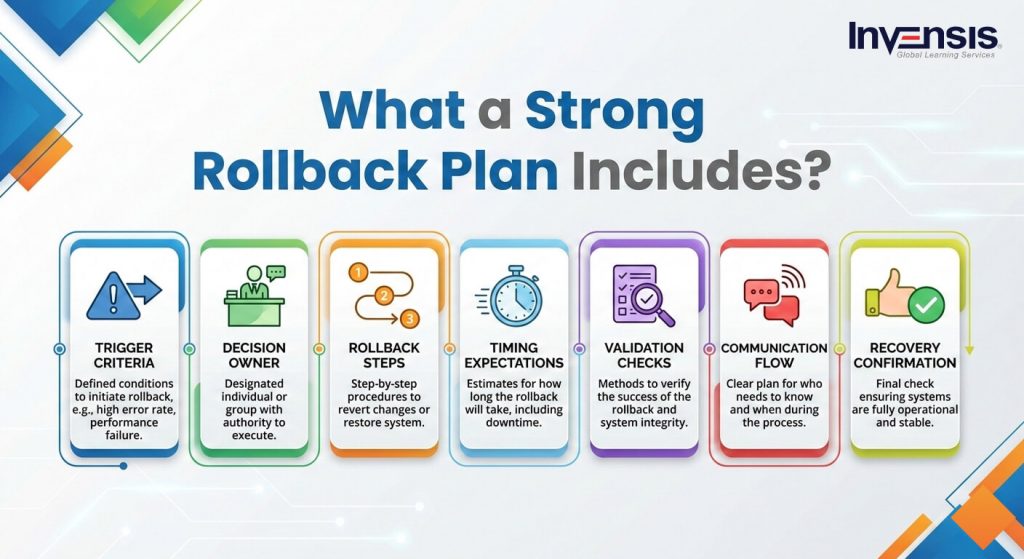
20) What Do You Include in a Rollback Plan?
Sample Answer:
A rollback plan should define the trigger criteria, ownership, execution steps, timing expectations, validation checks, and communication steps. I also make sure the rollback is technically feasible and tested when possible, especially if the release includes database or infrastructure changes. A rollback plan is only useful if it is realistic under pressure, so I keep it clear, actionable, and aligned with the deployment design.
Why this Answer Works:
It shows operational realism. In release management, recovery readiness is as important as deployment readiness, especially when production incidents require immediate intervention. DORA also highlights failed deployment recovery time as an important measure of delivery performance.
21) How Do You Ensure Environments Are Ready for a Release?
Sample Answer:
I verify environment readiness through a checklist that covers infrastructure availability, configuration alignment, access permissions, deployment tooling, test data, monitoring setup, and integration points. I also make sure environment ownership is clear so there is no confusion during the release window. If an environment is unstable or inconsistent with production, I raise that risk early because environment issues often create false confidence or late surprises.
Why this Answer Works:
It reflects disciplined preparation and an understanding that environmental readiness directly affects release quality and predictability.
22) How Do You Work with QA and User Acceptance Testing Teams?
Sample Answer:
I work closely with QA and UAT teams to align timelines, entry criteria, defect thresholds, and sign-off expectations. I want testing teams to know the business objective behind the release, not just the list of features, because that helps them prioritize what matters most. I also track defect trends and unresolved issues before recommending production readiness. My role is to make sure testing outcomes are clearly understood and factored into release decisions.
Why this Answer Works:
It shows you value testing as part of release governance rather than as a box-ticking exercise. ServiceNow’s release management process explicitly includes testing, revision, final review, and deployment as core stages.
23) How Do You Handle a Situation Where One Team Misses a Critical Delivery Milestone?
Sample Answer:
First, I assess the impact on the release critical path and determine whether the missed milestone affects core scope, compliance, or production readiness. Then I bring the relevant stakeholders together quickly to review options such as recovery planning, resequencing, partial release, or deferral. I try to keep the conversation focused on facts and impact rather than blame. The sooner the release team has clarity, the faster we can make a responsible decision.
Why this Answer Works:
It demonstrates calm leadership, issue triage, and cross-functional problem-solving. Those are essential skills in a role that sits between delivery pressure and operational accountability.
24) How Do You Conduct a Post-Release Review?
Sample Answer:
I run the post-release review shortly after deployment while the details are still fresh. I typically examine whether the release met its objectives, whether there were incidents or near misses, how accurate the planning assumptions were, and what slowed the team down. I like to separate process issues from one-time anomalies so improvements are practical. The goal is not to assign blame but to make the next release safer, faster, and easier to manage.
Why this Answer Works:
It shows continuous improvement thinking. ServiceNow notes that release management does not end at launch and that teams should assess the release afterward to identify bottlenecks and improve future releases.
25) How Do You Support Continuous Improvement in Release Management?
Sample Answer:
I use a mix of retrospectives, operational feedback, and performance metrics to improve the release process. I look for recurring friction points such as approval delays, unstable environments, unclear ownership, or repeated rollback triggers. Then I work with the cross-functional team to improve the biggest bottleneck first. I prefer measurable improvement, so I track trends such as deployment frequency, change failure rate, and recovery time over time rather than relying solely on anecdotal feedback.
Why this Answer Works:
It shows you are data-driven and improvement-focused. DORA recommends using delivery metrics to understand performance and identify constraints, while also warning against treating metrics as goals without context.
Conclusioon
Release Manager interviews are designed to test far more than your knowledge of deployment steps. Employers want to see whether you can think clearly under pressure, coordinate across teams, control risk, communicate with stakeholders, and keep releases moving without compromising stability. The strongest answers are practical, structured, and backed by real examples that show how you plan, assess readiness, manage dependencies, respond to failures, and improve the process over time.
As you prepare, focus on building answers that reflect both operational discipline and business awareness. That is what makes a strong Release Manager credible in modern delivery environments. To further strengthen your capabilities, you can also explore our related DevOps certification courses, which can help you build the planning, governance, collaboration, and delivery skills needed for release-focused roles.