

Table of Contents:
- Introduction
- What Are Risk Management Tools in Project Management?
- Top Risk Management Tools for Project Managers
- How to Choose the Right Risk Management Tool
- Conclusion
- Frequently Asked Questions
Introduction
Every project carries uncertainty. The difference between successful and failed projects often comes down to how well risks are identified, analyzed, and managed. This is where risk management tools in project management play a critical role. Instead of reacting to problems after they occur, these tools help project managers anticipate risks, assess their impact, and plan mitigation strategies in advance.
Whether you are managing a small team or leading large, complex programs, using the right project risk management tools can significantly improve decision-making, reduce delays, and control costs. In this guide, we break down the most effective risk management tools and techniques, including both traditional methods and modern software solutions, so you can choose the right approach for your projects.
What Are Risk Management Tools in Project Management?
Risk management tools in project management are structured methods, frameworks, and software solutions used to identify, analyze, prioritize, and control risks throughout the project lifecycle. Instead of relying on intuition or reactive decisions, these tools provide a systematic approach to handling uncertainty.
|
“One of the world’s most well-known security consultants noted that “Risk comes from not knowing what you’re doing.” |
 |
In practical terms, a risk management tool helps answer three critical questions:
- What could go wrong (or right)?
- How likely is it to happen?
- What will be the impact on the project?
By using the right project risk management tools, project managers can move from guesswork to data-driven decision-making.
Types of Risk Management Tools
Risk management is not limited to a single method. It typically involves a combination of:
- Identification Tools
Used to uncover potential risks
(e.g., brainstorming, checklists, Risk Breakdown Structure) - Analysis Tools
Used to evaluate probability and impact
(e.g., Probability-Impact Matrix, Sensitivity Analysis) - Mitigation Tools
Used to plan responses
(e.g., risk response strategies, contingency planning) - Monitoring Tools
Used to track risks over time
(e.g., risk registers, dashboards, software tools)
Top Risk Management Tools for Project Managers
Using risk management tools in project management is not about filling documents for the sake of process. It is about making uncertainty visible, measurable, and manageable. A good project manager does not wait for risks to turn into issues. They use the right project risk management tools early enough to identify threats, evaluate exposure, and take action before the project starts slipping on cost, schedule, scope, or quality.
Below are the most important risk management tools and techniques every project manager should understand, with a practical explanation of what each one does, when to use it, and where it adds value.
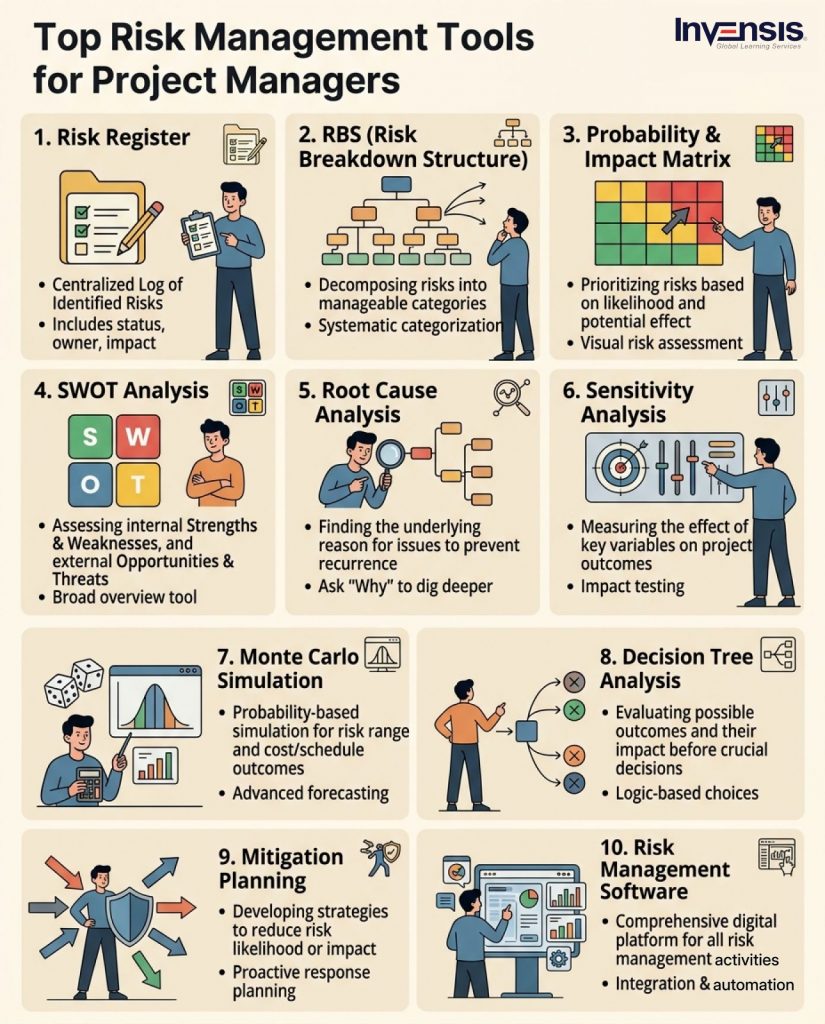
1. Risk Register
The risk register is the most basic and essential project risk management tool. It is a structured document or system where all identified risks are recorded, evaluated, assigned, and monitored throughout the project lifecycle.
A standard risk register usually includes:
- Risk ID
- Risk description
- Category
- Probability
- Impact
- Risk score or priority
- Risk owner
- Response strategy
- Mitigation actions
- Current status
The reason the risk register matters is simple: if risks are not documented, they are not being managed properly. Teams often discuss risks informally in meetings, but unless those risks are recorded, assigned, and tracked, they disappear into conversation and come back later as avoidable problems.
In practice, the risk register acts as the project’s central risk record. It gives stakeholders visibility into what could affect the project and what is being done about it. It also supports accountability, because every major risk should have an owner responsible for monitoring and responding to it.
The register is especially useful because it evolves over time. New risks are added, old ones are closed, probability and impact scores are updated, and mitigation actions are tracked. This makes it one of the most practical tools for risk management in both small and large projects.
2. Risk Breakdown Structure (RBS)
The Risk Breakdown Structure, or RBS, is a hierarchical classification tool that organizes risks into categories. Instead of listing risks randomly, it groups them into structured buckets such as:
- Technical risks
- Financial risks
- Operational risks
- Resource risks
- Legal or compliance risks
- External risks
This tool is valuable because one of the biggest failures in risk management is incomplete identification. Teams tend to focus on obvious risks, usually schedule delays or budget overruns, and ignore less visible categories such as vendor dependency, regulatory exposure, communication breakdowns, or stakeholder conflict. The RBS forces a broader view.
Think of it as the risk equivalent of a work breakdown structure. It does not analyze risk by itself, but it improves the quality of risk identification by making sure the team looks across all potential sources of uncertainty.
The RBS is particularly useful during project initiation, risk workshops, and planning sessions. It helps teams ask better questions. Instead of asking only “what risks do we see,” it pushes them to ask “what technical, financial, operational, or external risks could affect this project?” That small shift improves coverage significantly.
3. Probability and Impact Matrix
The Probability and Impact Matrix is one of the most commonly used risk management techniques because it helps teams quickly prioritize risks based on two core dimensions:
- How likely the risk is to occur
- How severe would the impact be if it occurs
Each identified risk is scored for probability and impact, usually on a low-medium-high scale or a numeric scale such as 1 to 5. Those two values are then plotted in a grid. Risks that fall into the high-probability, high-impact zone become top priority. Risks with low likelihood and low impact are monitored but may not require immediate action.
This tool is effective because not all risks deserve the same level of attention. One of the easiest ways to waste time in project risk management is to treat minor risks like major ones. The matrix gives structure to prioritization.
It is especially helpful in stakeholder discussions because it simplifies complex risk conversations into a visual and practical format. Senior stakeholders do not need pages of theory. They need to know which risks matter most and why. The matrix provides that clarity.
The limitation is that it is still a qualitative tool. It helps rank risks, but it does not quantify financial or schedule exposure in detail. That is why it is often used alongside more advanced project management risk tools when needed.
4. SWOT Analysis
SWOT Analysis stands for:
- Strengths
- Weaknesses
- Opportunities
- Threats
Although it is broader than pure project risk analysis, it remains a useful risk management tool because it helps teams assess both internal and external factors that could influence project performance.
The “weaknesses” and “threats” elements are where the risk value becomes strongest. Weaknesses reveal internal limitations such as lack of expertise, dependency on key resources, or poor technical readiness. Threats reveal external pressures such as competitor activity, regulation changes, supply chain disruption, or market volatility.
The advantage of SWOT is that it forces strategic thinking early in the project. It is especially useful in feasibility analysis, project initiation, business case development, and high-level planning. It gives a broader context before the project moves into detailed risk analysis.
Its weakness is that it is not detailed enough on its own. It identifies exposure areas, but it does not replace tools like risk registers or probability-impact analysis. So it works best as a starting-point tool, not the full risk management system.
5. Root Cause Analysis
Root Cause Analysis is a technique used to understand the underlying source of a problem or recurring risk. Instead of only responding to visible symptoms, it asks what is actually causing the issue in the first place.
Common root cause analysis methods include:
- The 5 Whys
- Fishbone Diagram (Ishikawa)
- Cause-and-effect mapping
This tool matters because many teams struggle to distinguish symptoms from causes. For example, if a project keeps missing deadlines, the visible issue is delay. But the real cause may be unrealistic estimates, unclear requirements, weak vendor coordination, or overloaded resources. If you only react to the delay itself, the problem repeats.
Root cause analysis is useful both reactively and proactively. Reactively, it helps investigate why a risk event happened. Proactively, it helps identify structural weaknesses that may generate future risks. It is especially valuable in project reviews, lessons-learned sessions, recurring issue analysis, and high-impact risk investigations.
This is one of the most useful risk mitigation tools because better mitigation depends on understanding the source of the exposure. Bad diagnosis leads to bad response.
6. Sensitivity Analysis
Sensitivity Analysis assesses how changes in one variable affect overall project outcomes. In simple terms, it answers the question: if this input changes, how much does the project change?
For example, a project manager may test:
- What happens to total cost if labor rates increase by 10%
- What happens to schedule if a critical activity takes 20% longer
- What happens to profitability if material prices fluctuate
This makes sensitivity analysis one of the most practical project risk management tools for understanding which assumptions matter most.
The reason it is powerful is that not every variable has equal influence. Some assumptions barely affect the project. Others can significantly damage budget or timeline. Sensitivity analysis helps identify those high-impact drivers, so teams can focus mitigation where it actually matters.
This technique is often visualized through tornado diagrams, which rank variables by how much they affect the output. It is especially useful in cost planning, financial forecasting, schedule analysis, and decision-making under uncertainty.
Sensitivity analysis is not about predicting the future perfectly. It is about showing where the project is most vulnerable if assumptions prove wrong.
7. Monte Carlo Simulation
Monte Carlo Simulation is one of the more advanced risk management tools and techniques used in project planning. It models uncertainty by running a large number of simulations using different combinations of input values.
Instead of producing a single forecast, it generates a range of possible outcomes and the probability of each. For example, instead of saying “the project will finish in 12 months,” Monte Carlo simulation might show:
- 50% chance of finishing in 12 months
- 80% chance of finishing in 14 months
- 95% chance of finishing in 15 months
This is far more realistic than single-point estimates, especially in large or complex projects.
Monte Carlo is valuable because real projects do not behave in fixed, predictable ways. Durations vary. Costs fluctuate. Resource productivity changes. Dependencies create ripple effects. Monte Carlo captures that variability better than simple estimation methods.
It is most useful in:
- Large infrastructure projects
- Capital-intensive programs
- Schedule risk analysis
- Cost risk analysis
- Portfolio forecasting
The limitation is that it requires decent input data and analytical maturity. Used badly, it produces fake precision. Used well, it becomes one of the most powerful project management risk tools available.
8. Decision Tree Analysis
Decision Tree Analysis helps evaluate choices under uncertainty by mapping decision paths, possible outcomes, and associated probabilities. It is especially useful when a project team must choose among multiple alternatives, each with different levels of risk and return.
A decision tree typically includes:
- Decision points
- Possible branches or scenarios
- Probabilities for each branch
- Costs, benefits, or payoffs for each outcome
This makes it a strong risk management technique for comparing options in procurement, make-or-buy decisions, vendor selection, scope alternatives, or strategic project choices.
Its value lies in forcing explicit thinking. Instead of choosing based on instinct or internal politics, the team examines possible outcomes and quantifies the trade-offs. It turns vague uncertainty into a structured comparison.
Decision tree analysis is especially useful when paired with Expected Monetary Value calculations, because it shows not just what could happen but also the likely value of each choice over time.
9. Risk Mitigation Planning Tools
Risk identification and analysis mean nothing if the team does not turn them into response actions. That is where risk mitigation tools come in. These are the methods and planning frameworks used to decide how the project will respond to each significant risk.
The standard response options usually include:
- Avoid the risk
- Reduce or mitigate the risk
- Transfer the risk
- Accept the risk
For positive risks or opportunities, teams may also:
- Exploit
- Enhance
- Share
- Accept
A mitigation planning tool may take the form of a response matrix, action tracker, contingency plan, issue escalation template, or integrated risk response plan. The specific format matters less than the logic behind it: every major risk should have a deliberate response.
This is where many risk processes fail. Teams identify risks, score them, and then stop. That is not management. That is documentation. Real risk management starts when someone decides what will actually be done, by whom, by when, and with what backup plan.
Mitigation planning is one of the most important tools for risk management because it connects analysis to execution.
10. Risk Management Software Tools
As projects become more complex, manual spreadsheets are no longer enough. This is where digital risk management tools and software platforms become important. These tools help teams identify, document, analyze, monitor, and report risks at scale.
Examples often used in projects include:
- Microsoft Project
- Primavera P6
- Jira, in Agile and delivery contexts
- Enterprise risk tools such as Active Risk Manager
- Dashboard and analytics platforms for reporting risk trends
The benefit of software is not just storage. Good tools support:
- Real-time updates
- Risk ownership tracking
- Automated alerts
- Integration with schedules and tasks
- Centralized reporting
- Better audit trails
- Cross-team visibility
Software becomes especially useful when projects involve multiple teams, multiple vendors, distributed stakeholders, or large numbers of risks. In such environments, static files quickly become outdated and disconnected from the project’s real activity.
That said, software does not solve a poor risk culture. A bad process inside a sophisticated tool is still a bad process. The value comes from using software to improve consistency, visibility, and decision-making, not from the platform alone.
How to Choose the Right Risk Management Tool
Having access to multiple risk management tools does not automatically improve your project outcomes. The real challenge is selecting the right tool for the right situation. Many project managers either overcomplicate risk management by using advanced tools unnecessarily or oversimplify it and miss critical risks.
Choosing the right project risk management tool depends on a few key factors.
1. Consider Project Size and Complexity
Not every project requires advanced analysis.
- Small Projects
Use simple tools like:- Risk register
- Basic checklists
- Probability-impact matrix
- Medium Projects
Add:- Risk Breakdown Structure
- Root cause analysis
- Structured mitigation planning
- Large or Complex Projects
Use advanced tools such as:- Monte Carlo simulation
- Sensitivity analysis
- Risk management software
The mistake is using Monte Carlo for a simple project or using only a checklist for a high-risk program.
2. Understand the Level of Uncertainty
The higher the uncertainty, the more analytical your tools need to be.
- Low Uncertainty
Basic qualitative tools are enough - Moderate uncertainty
Combine qualitative and structured analysis - High uncertainty
Use quantitative tools like:- Monte Carlo simulation
- Decision tree analysis
If outcomes are unpredictable, simple tools won’t give reliable insights.
3. Align Tools with Decision Needs
Ask a simple question:
What Decision Am I Trying to Make?
- If you need prioritization ? Probability-impact matrix
- If you need root cause ? Root cause analysis
- If you need forecasting ? Monte Carlo simulation
- If you need documentation ? Risk register
Tools should support decisions, not just process.
4. Evaluate Team Capability
A tool is only useful if your team can actually use it.
- If the team lacks analytical skills:
- Avoid complex simulations
- Use structured but simple tools
- If the team is experienced:
- Introduce advanced modeling tools
Overcomplicating tools leads to poor adoption and inaccurate outputs.
5. Consider Time and Resource Constraints
Some risk management techniques require:
- Data
- Time
- Expertise
For tight deadlines:
- Use quick, high-impact tools (matrix, register)
For long-term or high-value projects:
- Invest time in deeper analysis
Not every project has the luxury of detailed modeling.
6. Use a Combination, Not a Single Tool
No single risk management tool is sufficient.
Effective risk management typically includes:
- Identification tool (RBS, brainstorming)
- Analysis tool (matrix, sensitivity analysis)
- Planning tool (mitigation strategies)
- Monitoring tool (risk register, software)
The goal is integration, not isolation.
Conclusion
Effective risk management is not about eliminating uncertainty; it’s about understanding it, prioritizing it, and responding to it with clarity. The right combination of risk management tools in project management enables project managers to move from reactive firefighting to proactive control. Whether it’s a simple risk register for visibility or advanced techniques like Monte Carlo simulation for forecasting, each tool plays a specific role in improving decision-making and project outcomes.
The key is not using more tools, but using the right tools consistently and intelligently. When applied correctly, these project risk management tools help reduce cost overruns, avoid schedule delays, and build stakeholder confidence, ultimately increasing the chances of project success.
Ready to master these risk management tools and apply them effectively in real projects?
Enroll in Invensis Learning’s Project Management Professional (PMP) Certification Training to gain hands-on expertise in risk management techniques, tools, and real-world project scenarios, and take your project management skills to the next level.
Frequently Asked Questions
1. What are risk management tools in project management?
Risk management tools are structured methods and systems used to identify, analyze, prioritize, and control risks throughout the project lifecycle. These include tools like risk registers, probability-impact matrices, and analytical techniques such as Monte Carlo simulation.
2. What is the most commonly used risk management tool?
The risk register is the most commonly used tool. It serves as a central repository for documenting, tracking, and managing all project risks.
3. What is the difference between risk management tools and techniques?
- Tools refer to frameworks or systems (e.g., risk register, software platforms)
- Techniques refer to methods used within those tools (e.g., SWOT analysis, sensitivity analysis)
Both are used together to manage risks effectively.
4. Which risk management tools are best for beginners?
For beginners, the most effective tools include:
- Risk register
- Risk Breakdown Structure (RBS)
- Probability and impact matrix
These are simple, practical, and widely used in projects.
5. What are advanced risk management tools?
Advanced tools include:
- Monte Carlo simulation
- Sensitivity analysis
- Decision tree analysis
These are typically used in large or complex projects that require detailed risk analysis.
6. What are risk mitigation tools?
Risk mitigation tools are methods used to reduce the probability or impact of risks. These include planning techniques, contingency strategies, and structured response frameworks.
7. How do project managers choose the right risk management tools?
The choice depends on:
- Project size and complexity
- Level of uncertainty
- Available data
- Team expertise
Using the right tool for the context is more important than using multiple tools.
8. Are risk management tools necessary for small projects?
Yes, but simpler tools are usually sufficient. Even small projects benefit from basic tools like risk registers and prioritization matrices.
9. Can software replace traditional risk management tools?
Software enhances risk management by automating tracking and reporting, but it does not replace the need for structured thinking and analysis. Tools are only as effective as their use.
10. What are common mistakes when using risk management tools?
Common mistakes include:
- Using tools without understanding them
- Overcomplicating simple projects
- Not updating risk data regularly
- Treating risk management as a one-time activity
11. How often should risk management tools be updated?
Risk tools should be updated regularly throughout the project lifecycle, especially during key milestones or when project conditions change.
12. Do Agile projects use risk management tools?
Yes, but in a more integrated and continuous way. Risks are managed through:
- Iterative planning
- Frequent reviews
- Team collaboration
13. What is the role of risk management tools in decision-making?
These tools help project managers:
- Prioritize risks
- Evaluate potential outcomes
- Make informed decisions
They convert uncertainty into structured insights.
14. Are risk management tools applicable across industries?
Yes, risk management tools are used across industries such as construction, IT, finance, and healthcare. However, the types of risks and tools may vary by industry.
15. What is the biggest benefit of using risk management tools?
The biggest benefit is proactive control. These tools help prevent problems before they occur, improving project success rates and reducing uncertainty.