

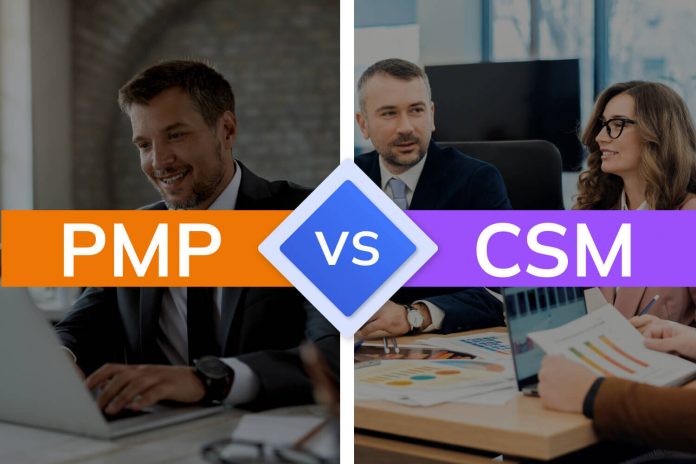
Standing at the crossroads of your project management career, you face a critical decision: Should you pursue the globally recognized Project Management Professional (PMP) certification or the Agile-focused Certified ScrumMaster (CSM) credential? This choice isn’t merely about adding letters after your name, it fundamentally shapes your career trajectory, earning potential, and professional identity in the project management landscape.
In 2025, the demand for certified project management professionals reached unprecedented levels, with 70% of organizations now requiring formal certification for senior PM roles. Yet the question persists: which certification delivers maximum career value? According to PMI’s latest salary survey, PMP-certified professionals earn a median salary of $120,000 in the United States, representing a 33% premium over non-certified peers. Meanwhile, Certified ScrumMasters earn an average salary of $109,000, with particularly strong demand in thetechnology and software development sectors.
The answer isn’t universally applicable, it depends on your career goals, industry focus, preferred work methodology, and geographic location. This comprehensive comparison guide examines every critical dimension of the PMP certification versus CSM debate, providing data-driven insights to help you make the most strategic decision for your professional future. Whether you’re an aspiring project manager just starting your journey or an experienced professional looking to formalize your expertise, understanding these differences will save you time, money, and career missteps.
Understanding PMP: The Global Standard for Project Management
The Project Management Professional (PMP) certification, administered by the Project Management Institute (PMI), represents the gold standard in project management credentials worldwide. Established in 1984, PMP has become synonymous with comprehensive project management expertise across industries and methodologies.
What is PMP Certification?
PMP certification validates your competency in leading and directing projects using globally recognized best practices outlined in the Project Management Body of Knowledge (PMBOK Guide). The credential demonstrates mastery across three domains (People, Process, Business Environment) and ten knowledge areas, including scope, schedule, cost, quality, resources, communications, risk, procurement, stakeholder management, and integration.
Core PMP Characteristics:
- Methodology: Broad framework applicable to any project management approach (traditional, Agile, hybrid)
- Global Recognition: Over 1.2 million PMP holders across 200+ countries
- Industry Versatility: Valued across construction, healthcare, IT, pharmaceutical, government, finance, and manufacturing sectors
- Strategic Focus: Emphasizes leadership, business acumen, and strategic alignment
PMP Eligibility Requirements
PMP certification eligibility requires substantial documented project management experience, making it a mid-career credential rather than entry-level:
Option 1:
- Four-Year College / University Degree
- 36 months of experience leading projects within the past eight years
- 35 hours of project management education/training or CAPM certification
Option 2:
- High School or Secondary School Diploma
- 60 months of experience leading projects within the past eight years
- 35 hours of project management education/training or CAPM certification
These requirements ensure PMP candidates possess real-world experience before attempting certification, creating a credential that signals proven capability rather than theoretical knowledge alone.
PMP Exam Structure and Difficulty
The PMP examination represents one of the most challenging professional certifications available:
Exam Specifications:
- Duration: 230 minutes (3 hours 50 minutes)
- Questions: 180 questions (175 scored, 5 pretest)
- Format: Multiple choice, multiple response, matching, hotspot, fill-in-the-blank
- Passing Score: Not publicly disclosed (adaptive algorithm)
- Domains: People (42%), Process (50%), Business Environment (8%)
- Pass Rate: Approximately 61% (first attempt, global average)
The PMP exam’s difficulty stems from its emphasis on situational judgment and application rather than pure memorization. Questions present complex project scenarios that require candidates to select the “best” or “most appropriate” response from multiple viable options.
| PRO TIP
The PMP exam underwent significant updates in 2021, shifting from predictive (waterfall) methodology emphasis to a balanced approach: 50% hybrid/Agile and 50% predictive methodologies. This transformation reflects real-world project environments where flexibility matters. Modern PMP-certified professionals demonstrate versatility across methodologies—a key differentiator from CSM’s Agile-exclusive focus. |
Understanding CSM: The Agile Team Leadership Specialist
The Certified ScrumMaster (CSM) certification, offered by Scrum Alliance, represents specialized expertise in facilitating Scrum teams within Agile environments. Launched in 2002, CSM has become the go-to credential for professionals working in iterative, collaborative, and adaptive project delivery contexts.
What is CSM Certification?
CSM certification validates your ability to facilitate Scrum processes, remove impediments for development teams, and serve as a servant-leader who enables team self-organization and continuous improvement. The credential focuses exclusively on the Scrum framework, one specific Agile methodology characterized by fixed-length Sprints, defined roles (Product Owner, Scrum Master, Development Team), and specific ceremonies (Sprint Planning, Daily Scrum, Sprint Review, Sprint Retrospective).
Core CSM Characteristics:
- Methodology: Exclusive focus on Scrum framework within Agile methodology
- Team-Level Focus: Emphasizes facilitation, coaching, and impediment removal
- Industry Concentration: Strongest demand in software development, IT, and technology sectors
- Tactical Orientation: Day-to-day team dynamics and Sprint execution
CSM Eligibility Requirements
Unlike PMP’s stringent experience requirements, CSM maintains an accessible entry threshold:
Prerequisites:
- No formal experience required: Entry-level professionals are eligible
- Mandatory training: Must complete 16-hour CSM course from Certified Scrum Trainer (CST)
- Active participation: Course attendance and engagement required
- No pre-exam education hours: Training course fulfills all requirements
This accessibility makes CSM an attractive option for professionals transitioning into Agile environments, recent graduates, or those seeking quick certification without extensive documented experience.
CSM Exam Structure and Difficulty
The CSM examination emphasizes foundational Scrum knowledge assessment rather than advanced situational judgment:
Exam Specifications:
- Duration: 60 minutes (1 hour)
- Questions: 50 multiple-choice questions
- Format: Multiple choice with single correct answers
- Passing Score: 74% (37 out of 50 questions correct)
- Attempts Included: Two exam attempts within 90 days (included with training fee)
- Pass Rate: Approximately 85-90% (first attempt after training)
The examination’s relative accessibility reflects its purpose as a foundational credential validating basic Scrum understanding rather than comprehensive project management expertise. Most candidates who complete the required training pass on their first or second attempt.
| AVOID THIS MISTAKE
Assuming CSM’s easier exam means lower professional value Why it’s problematic: While CSM requires less preparation than PMP, dismissing its value overlooks critical market dynamics. In Agile-mature organizations (particularly tech companies), CSM combined with practical Scrum Master experience commands significant respect and compensation. The exam difficulty doesn’t correlate directly with certification ROI. What to do instead: Evaluate certification choice based on your target industry, methodology preferences, and career stage rather than exam difficulty alone. CSM’s accessibility makes it ideal for early-career professionals building Agile credentials before pursuing advanced certifications. |
Head-to-Head Comparison: 8 Critical Dimensions
Understanding individual certifications provides foundation, but direct comparison across key decision factors reveals which credential aligns with your specific circumstances and goals.
1. Cost Comparison: Total Investment Analysis
Financial investment extends beyond exam fees to include training, membership, study materials, and renewal costs:
Complete Cost Breakdown: PMP vs CSM (2025)
| Cost Component | PMP | CSM |
| Professional Membership | $139/year (PMI) | $100/2 years (Scrum Alliance) |
| Mandatory Training | $1,000-$2,000 (35 hours) | $1,000-$1,450 (16 hours) |
| Exam Fee (Member) | $405 | Included in training |
| Exam Fee (Non-Member) | $655 | Included in training |
| Study Materials | $100-$300 | $0-$100 (minimal needed) |
| Exam Retake Fee | $405 (member) / $655 (non-member) | $25 per attempt (after initial 2) |
| Certification Renewal | $60 (member) / $150 (non-member) every 3 years | $100 every 2 years |
| Total Initial Investment | $1,644-$3,094 | $1,100-$1,550 |
Source: PMI and Scrum Alliance
2. Time Investment: Speed to Certification
Time represents another critical resource in certification decisions:
PMP Timeline:
- Training completion: 4 Days (35 hours)
- Self-study preparation: 60-120 hours over 6-12 weeks
- Application processing: 5-7 business days (up to 30 days if audited)
- Total time to certification: 2-4 months
CSM Timeline:
- Mandatory training: 2 days (16 hours)
- Exam preparation: Minimal (covered in training)
- Exam availability: Immediate after training
- Total time to certification: 2-3 days
| CSM – A dramatically faster path enables quick credentialing to meet immediate job-market needs or organizational requirements. |
3. Salary Potential: Earning Power Comparison
Compensation analysis reveals nuanced differences based on experience level and industry:
PMP Salary Data (United States):
- Median salary: $120,000
- Entry-level (< 3 years): $80,000-$97,500
- Mid-career (5-10 years): $112,500-$132,500
- Senior (10+ years): $140,000-$150,000+
- Premium vs. non-certified: 33%
CSM Salary Data (United States):
- Median salary: $109,000
- Entry-level (< 3 years): $85,000-$95,000
- Mid-career (5-10 years): $105,000-$125,000
- Senior (10+ years): $130,000-$145,000
- Premium vs. non-certified: 18-22%
Source: PayScale
4. Geographic Recognition: Where Each Credential Thrives
Regional preferences significantly impact certification value:
PMP Geographic Strength:
- Dominant regions: United States, Canada, India, Middle East, Asia-Pacific
- Industry concentration: Government, construction, healthcare, pharmaceutical, and manufacturing
- Global presence: 215 countries with PMI chapters
- Job posting requirements: 70% of U.S. project management roles prefer/require PMP
CSM Geographic Strength:
- Dominant regions: Europe, Australia, South America, technology hubs globally
- Industry concentration: Software development, IT, digital agencies, startups
- Agile adoption correlation: Strongest in regions with high Agile methodology penetration
- Tech sector dominance: 82% of tech PM/Scrum Master roles prefer CSM or PSM credentials
| PMP – Broader global recognition across all regions, though CSM excels in Agile-mature markets. |
5. Methodology Applicability: Scope of Practice
Project methodology alignment determines credential relevance:
PMP Methodology Coverage:
- Predictive/Waterfall: Full coverage
- Agile/Scrum: 50% of exam content (post-2021)
- Hybrid approaches: Extensive coverage
- Lean/Kanban: Included
- Versatility score: 10/10
CSM Methodology Coverage:
- Predictive/Waterfall: Not covered
- Agile/Scrum: Exclusive deep focus
- Hybrid approaches: Limited (only Scrum component)
- Lean/Kanban: Not covered
- Versatility score: 6/10
| PMP – Comprehensive methodology coverage enables working across diverse project environments. |
6. Career Trajectory: Advancement Potential
Long-term career implications differ substantially:
PMP Career Path:
- Entry roles: Project Coordinator → Project Manager
- Mid-level: Senior Project Manager → Program Manager
- Senior level: PMO Director → VP of Project Management
- Executive potential: High (Strategic leadership focus)
- Cross-industry mobility: Excellent
CSM Career Path:
- Entry roles: Scrum Master → Agile Coach
- Mid-level: Senior Scrum Master → Agile Delivery Lead
- Senior level: Director of Agile Transformation → Agile Practice Lead
- Executive potential: Moderate (Specialist trajectory)
- Cross-industry mobility: Limited to Agile-mature organizations
| PMP – Broader executive pathway and cross-industry mobility, though CSM offers specialized Agile leadership track. |
7. Exam Difficulty and Preparation
Certification difficulty impacts confidence and success probability:
PMP Difficulty Factors:
- Extensive experience required before eligibility.
- 230-minute marathon exam requiring stamina.
- Situational judgment questions with multiple “correct” answers.
- Adaptive algorithm adjusts difficulty based on performance.
- 61% first-attempt pass rate.
- Structured study plans widely available.
CSM Difficulty Factors:
- No experience prerequisite.
- 60-minute accessible exam.
- Straightforward multiple-choice format.
- Training directly prepares for exam content.
- 85-90% first-attempt pass rate.
- Limited study materials needed (less preparation depth).
| CSM – Significantly more accessible, though lower difficulty correlates with foundational rather than advanced expertise validation. |
8. Renewal and Maintenance Requirements
Ongoing professional development obligations vary:
PMP Renewal (CCR Cycle):
- Cycle duration: 3 years
- PDU requirement: 60 Professional Development Units
- PDU categories: Education (35+ PDUs), Giving Back (up to 25 PDUs)
- Renewal fee: $60 (member) / $150 (non-member)
- Continuing education: Mandatory, ensures currency
CSM Renewal:
- Cycle duration: 2 years
- SEU requirement: 20 Scrum Education Units
- SEU categories: Various learning activities validated by Scrum Alliance
- Renewal fee: $100
- Continuing education: Mandatory, maintains active status
| PMP – Longer cycle (3 vs 2 years) provides more time to accumulate requirements, though more total units needed. |
Which Certification Should You Choose? Decision Framework
With eight dimensions analyzed, how do you decide which certification aligns with your circumstances? This strategic framework guides your decision:
Choose PMP If You:
- Have 3+ years of documented project management experience meeting eligibility requirements.
- Work across multiple project methodologies (traditional, Agile, hybrid environments).
- Target traditional industries like construction, healthcare, pharmaceuticals, government, or manufacturing.
- Seek executive leadership positions (PMO Director, VP of Project Management).
- Value global recognition for an international career.
- Manage large, complex projects with significant budgets and stakeholder complexity.
- Prioritize maximum salary premium (33% vs 18-22% for CSM.
- Prefer a comprehensive methodology foundation applicable to any project type.
Choose CSM If You:
- Are you early in your project management career with limited documented experience
- Work exclusively in Agile/Scrum environments or plan to specialize in
- Target technology, software development, or IT sectors with Agile
- Need quick certification for immediate job requirements (2-3 days vs months
- Prefer team-level facilitation over strategic program/portfolio
- Value lower initial investment ($500-$1,500 less than PMP
- Want an accessible entry point before pursuing advanced
- Work in a startup or tech company where Scrum is the primary methodology
The “Both” Strategy: Credential Stacking
Many successful project management professionals pursue both certifications strategically:
Recommended Sequence:
- CSM First (if early career): Build an Agile foundation quickly, gain practical experience.
- PMP Second (after 3-5 years): Add comprehensive methodology expertise and global recognition.
- Advanced certifications: PMI-ACP, A-CSM, CSP, based on specialization interests.
Benefits of Holding Both:
- Demonstrates methodology versatility valued by employers
- Combines PMP’s strategic breadth with CSM’s Agile depth
- Average salary premium for dual certification: 38-42% (vs 33% for PMP alone)
- Maximum job market flexibility across industries and project types
Conclusion
The PMP vs CSM decision isn’t about identifying a universally “better” certification, both credentials offer substantial career value in appropriate contexts. PMP delivers comprehensive methodology expertise, global recognition, and the highest salary premiums for professionals managing complex projects across diverse industries. CSM provides specialized Agile/Scrum mastery, rapid credentialing, and strong demand in technology-driven organizations embracing iterative development.
Your optimal choice emerges from an honest assessment of your career stage, industry focus, methodology preferences, and professional aspirations. If you’re an experienced project manager seeking executive leadership and cross-industry mobility, PMP represents your best strategic investment. If you’re early in your career, specializing in Agile environments within technology sectors, CSM offers the fastest path to credibility and career acceleration.
Perhaps most importantly, these certifications aren’t mutually exclusive. Many successful project management professionals pursue both credentials strategically, CSM for immediate Agile credibility, followed by PMP for comprehensive methodology mastery and maximum career flexibility. This dual-certification approach delivers the highest salary premiums and positions you for leadership roles requiring both strategic breadth and Agile depth.
The question isn’t which certification to pursue, it’s when to start. Every month of delay represents missed earning potential, fewer opportunities, and slower career progression. Whether you choose PMP training, Agile and Scrum certification, or a strategic path to both, begin your certification journey today and transform your project management career trajectory.
Frequently Asked Questions
1. Can I take the CSM exam without attending the mandatory training course?
No. Unlike PMP, CSM requires mandatory completion of a 16-hour course taught by a Certified Scrum Trainer (CST) before exam eligibility. This training cannot be bypassed or substituted with self-study. The course fee ($1,000-$1,450) includes two exam attempts and a two-year Scrum Alliance membership, so you receive comprehensive value beyond just exam access.
2. Is PMP harder than CSM, and does difficulty correlate with value?
Yes, PMP is significantly more challenging with a 61% first-attempt pass rate compared to CSM’s 85-90%. However, difficulty doesn’t directly determine career value. PMP’s rigor validates comprehensive expertise across methodologies, while CSM’s accessibility provides quick credentialing for Agile specialists. In Agile-mature tech companies, experienced Scrum Masters with CSM credentials often match or exceed PMP salaries despite the easier exam.
3. Which certification has better job market demand in 2026?
Job demand varies by industry and region. In the United States, PMP appears in 70% of project management job postings across all industries, while CSM dominates 82% of technology sector PM and Scrum Master roles. If you’re targeting traditional industries (construction, healthcare, government), PMP offers better opportunities. For software development, IT, and tech startups, CSM provides stronger market alignment.
4. Should I get PMP if I already have CSM, or is that redundant?
Not redundant, complementary. Dual certification demonstrates the versatility of the methodology that employers value highly. The combination signals that you can facilitate Agile teams (CSM) while also strategically managing traditional and hybrid projects (PMP). Professionals holding both credentials report salary premiums of 38-42%, compared to 33% for PMP alone. If you’ve gained the required 3-5 years of experience since earning CSM, adding PMP significantly expands your career options.
5. How do PMP and CSM compare to PSM (Professional Scrum Master)?
PSM, offered by Scrum.org, represents a third Agile credential option. Key differences: PSM requires no mandatory training (exam-only pathway available), costs less ($200 per attempt), but has a higher passing score requirement (85% vs CSM’s 74%). PSM is considered slightly more rigorous than CSM but doesn’t require Scrum Alliance membership or ongoing renewal fees. Both CSM and PSM validate Scrum expertise; CSM emphasizes facilitation through required training, while PSM emphasizes knowledge through a more challenging examination.
6. Can I use PMP training hours toward CSM, or vice versa?
Training hours don’t transfer directly between certifications. PMP’s 35 contact hours fulfill PMI requirements but don’t substitute for CSM’s mandatory 16-hour Scrum-specific training. However, if you hold CSM and pursue PMP, your CSM training hours can count toward PMP’s 35-hour requirement, reducing additional training needed. Conversely, completing PMP first provides foundational knowledge helpful for CSM training, but doesn’t replace the mandatory CSM course.
7. Which certification should I pursue first if I plan to get both eventually?
For most professionals, CSM first makes strategic sense: it requires no experience prerequisite, costs less, and provides quick Agile credibility while you accumulate the 3-5 years of experience needed for PMP eligibility. This sequence also allows you to apply Scrum knowledge in real projects, strengthening your PMP preparation when the time comes. Exception: If you already meet PMP experience requirements and work in non-Agile environments, PMP first establishes a comprehensive foundation before adding Agile specialization via CSM.