


Table of Contents:
- Introduction
- Why do Teams Confuse RACI and DACI?
- What is RACI, and How Does it Work?
- What is DACI, and How Does it Work?
- How do RACI and DACI Differ Side by Side?
- Which Framework Should You Choose for Different Situations?
- What Common Mistakes Make Both RACI and DACI Fail?
- How Can You Implement RACI or DACI Successfully?
- What Should You Remember Before Choosing Between RACI and DACI?
- Conclusion
- Frequently Asked Questions
Introducation
Choosing between RACI and DACI sounds simple until a team hits delays, duplicate work, or endless approval loops. That is when leaders realize they do not just need “clarity”; they need the right kind of clarity. RACI helps teams define who owns execution for tasks and deliverables, while DACI helps define who drives and approves key decisions. When organizations use the wrong model for the wrong problem, meetings multiply, ownership blurs, and momentum drops. PMI describes RACI as a responsibility assignment tool that clarifies stakeholder roles and even supports the communication plan, while Atlassian positions DACI as a framework for making high-impact group decisions with clear decision rights.
This guide explains what each model means, where each one works best, how they differ in practice, and how to choose the right one without overengineering your process. If you lead projects, programs, product launches, governance forums, or cross-functional change, this comparison will help you pick a model your team will actually use.
Why do Teams Confuse RACI and DACI?
Teams confuse these frameworks because both are designed to reduce ambiguity, both use role labels, and both are often introduced during planning workshops. But they solve different operating problems. RACI answers, “Who is doing the work, approving the work, advising on the work, and staying updated?” DACI answers, “Who is driving the decision, who has the final say, who contributes expertise, and who needs to know the outcome?”
|
“In the absence of clearly defined roles, people either duplicate effort or avoid responsibility.” |
 |
The confusion worsens in complex organizations, where execution and decision-making occur simultaneously. For example, a transformation program may need a RACI matrix for implementation tasks, but a DACI structure for high-stakes choices such as vendor selection, platform migration, or release go/no-go decisions. If leaders try to use RACI for a decision-heavy situation, they often end up debating whether “Responsible” or “Accountable” is the real decision-maker. If they use DACI for day-to-day execution, they may clarify authority but still leave task ownership vague.
What is RACI, and How Does it Work?
A RACI chart, also known as a responsibility assignment matrix, maps work items against stakeholders so everyone understands their role in each task, milestone, or deliverable. Asana defines RACI as a model that clarifies who completes the work, who approves it, who gives input, and who must be kept updated. PMI similarly describes the Responsibility Assignment Matrix as a way to spell out stakeholder roles across participating departments and use that structure as a baseline for communications.
What Does Each RACI Role Mean?
- Responsible means the person doing the work. This is the role that executes the task from start to finish. In a healthy RACI setup, the responsible owner is not just a name on a spreadsheet; they are the operational lead who keeps the task moving.
- Accountable means the person who signs off on the work and owns the final result. Asana recommends only one accountable role per task to avoid approval confusion. This person is often the project manager, department head, product owner, or functional leader, depending on the project’s structure.
- Consulted includes the subject-matter experts whose input improves the quality of the work before it moves forward. They provide perspective, but they do not own delivery.
- Informed includes stakeholders who need visibility into progress or outcomes but are not expected to contribute directly.
When Does RACI Work Best?
RACI works best when the challenge is coordination. If multiple teams are contributing to a project and handoffs are creating confusion, RACI helps expose gaps, overlaps, and approval bottlenecks. It is especially useful for implementation-heavy initiatives such as software releases, process redesign, compliance rollouts, onboarding programs, and cross-functional service delivery.
What are The Limits of RACI?
RACI can become too detailed if teams try to assign roles for every micro-task. It also becomes unhelpful when people interpret it as a decision-rights framework instead of an execution framework. That is why RACI is excellent for delivery ownership, but less precise for major business decisions.
What is DACI, and How Does it Work?
DACI is a decision-making framework that defines who drives a decision, who approves it, who contributes expertise, and who needs to be informed afterward. Atlassian describes DACI as a way to simplify decision-making by defining stakeholder roles up front, especially when the decision is complex, cross-functional, or high-stakes.
What Does Each DACI Role Mean?
- Driver is the person responsible for moving the decision process forward. According to Atlassian, this person gathers information, aligns stakeholders, defines the scope of the decision, and makes sure the decision is reached by the agreed date. The Driver is not necessarily the final authority; they are the coordinator and momentum owner.
- Approver is the one person with the final say. Atlassian is explicit here: it should be one person, not several. That clarity is what makes DACI strong in situations where decisions stall because too many people believe they have veto power.
- Contributors are the subject-matter experts who bring analysis, constraints, and recommendations into the discussion. Their input matters, but they do not make the final decision.
- Informed includes the people and teams affected by the outcome who need visibility once the choice is made.
When Does DACI Work Best?
DACI works best when the challenge is decision quality and decision speed. It is ideal for situations such as selecting a new platform, deciding on market-entry timing, resolving a product roadblock, approving a major architectural shift, or choosing among competing implementation options. Atlassian specifically recommends DACI for complex decisions, high-stakes decisions, cross-functional projects, resource allocation choices, and process improvements.
| Industry Insight
DACI also encourages better documentation. Atlassian recommends capturing background and relevant data, options considered, action items, and the final outcome to preserve the rationale behind the decision. That makes DACI particularly useful in distributed teams where people need transparency after the meeting ends. |
How do RACI and DACI Differ Side by Side?
Which Model Focuses on Execution, and Which Focuses on Decisions?
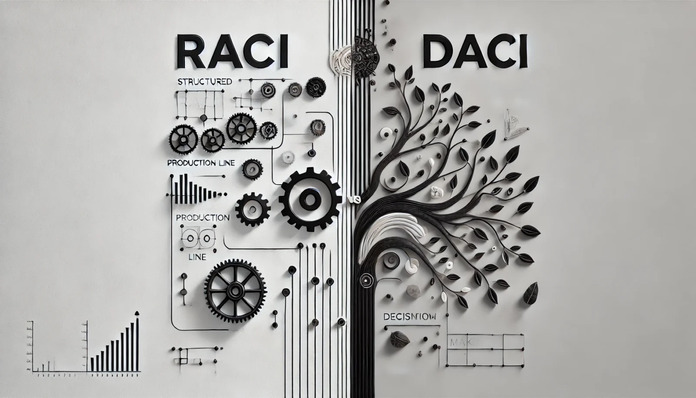
The biggest difference is their center of gravity. RACI is execution-centric. It organizes tasks, deliverables, sign-offs, and communication. DACI is decision-centric. It organizes the process of reaching a decision, especially when many people are involved.
Which Model Answers “Who Does the Work,” and Which Answers “Who Makes the Call”?
RACI answers, “Who performs the task and who approves the completed work?” DACI answers, “Who drives the decision process and who has final approval authority?” This is the difference between task ownership and decision ownership.
Which Model is Better for Recurring Delivery Work?
RACI is better for work that repeats across phases or teams, build, test, review, release, train, monitor, support. It is practical in project plans, implementation boards, service operations, and PMO governance.
Which Model is Better for High-Stakes One-off Choices?
DACI is better when a team faces a turning-point decision, choose vendor A or B, delay launch or proceed, centralize or decentralize ownership, migrate now or phase later.
Side-by-Side Comparison Table
| Dimension | RACI | DACI |
| Primary purpose | Clarifies task and deliverable ownership | Clarifies decision-making ownership |
| Best used for | Execution, coordination, approvals, communications | Cross-functional, high-impact decisions |
| Core roles | Responsible, Accountable, Consulted, Informed | Driver, Approver, Contributors, Informed |
| Final authority | Accountable approves completed work | Approver makes the final decision |
| Momentum owner | Usually the Responsible role or PM | Driver explicitly moves the decision forward |
| Typical artifact | Responsibility matrix by task/deliverable | Decision document with options, data, and outcome |
| Best timing | During planning and execution | Before and during major decision points |
| Main risk if misused | Becomes bureaucratic or too detailed | Overused for routine work and slows daily execution |
| Ideal outcome | Clear execution and fewer handoff issues | Faster, cleaner, better-documented decisions |
Why Is RACI More Execution-Focused While DACI Is More Decision-Focused?
The biggest difference lies in purpose. RACI is designed to organize project execution. It tells teams who is responsible for doing the work, who is accountable for approving it, who should be consulted before moving ahead, and who only needs updates. That makes it highly effective for structured projects with multiple tasks, milestones, dependencies, and approvals.
DACI, on the other hand, is designed to organize decision-making. It does not primarily ask who will complete the work; instead, it asks who will drive the decision process, who will approve the final choice, who will contribute expertise, and who should be informed of the outcome. This is especially useful when a team is stuck between options and needs a structured path to resolution.
A simple way to explain this to readers is: RACI manages work, while DACI manages choices. That makes RACI more natural in delivery environments and DACI more natural in governance or strategic forums.
How Do the Roles in RACI and DACI Differ in Meaning?
Although the acronyms look alike, the roles are not interchangeable.
In RACI, the central operational roles are Responsible and Accountable. The responsible person performs the task, while the accountable person signs off and owns the result. This makes RACI ideal when the work itself must be tracked clearly from start to finish. PMI also notes that a RACI chart helps define stakeholder roles across departments and supports communication planning by clarifying who receives information and at what level of detail.
In DACI, the central roles are Driver and Approver. The driver is not necessarily doing the work; instead, this person pushes the decision process forward, gathers inputs, organizes the discussion, and ensures a decision is made on time. The approver is the one final authority. Atlassian explicitly emphasizes that the approver should be a single person, which is one reason DACI helps avoid stalled or political decision cycles.
So, while RACI asks, “Who will do and approve the work?” DACI asks, “Who will move this decision along and who will make the final call?” That distinction is highly relevant in cross-functional teams, where execution and decision-making authority do not always reside with the same person.
When Should Teams Use RACI Instead of DACI?
Teams should use RACI when the main challenge is coordination across recurring or multi-step work. For example, RACI works well for implementation projects, release activities, compliance rollouts, service transition plans, and training programs where the work is already defined but ownership may be fuzzy. In such environments, the biggest risk is often that people assume someone else is handling a task, approval, or communication step. RACI solves that problem by mapping responsibility directly to work items.
In short, if the project is moving forward but people are unclear about who owns which part of the delivery, RACI is usually the better fit.
When Should Teams Use DACI Instead of RACI?
Teams should use DACI when the main challenge is not execution but decision clarity. It is especially helpful when a team is evaluating options, balancing inputs from multiple functions, or facing a high-impact choice that affects budget, timelines, customers, or cross-functional priorities. Atlassian recommends DACI for complex decisions, high-stakes decisions, cross-functional initiatives, resource allocation decisions, and process improvements.
DACI is also more suitable when teams are stuck in long discussions because too many people believe they have a vote. By defining one driver and one approver, the framework narrows ownership while still allowing expert input. Contributors still shape the decision, but they do not own it. That is one of DACI’s biggest advantages in product, transformation, and executive decision environments.
Another useful feature is that DACI encourages teams to document the background, relevant data, options considered, action items, and final outcome. That makes it stronger than a casual verbal decision because it preserves the rationale behind the choice. In distributed or fast-moving organizations, that documentation becomes very valuable later.
So if the team knows what work needs to be done but cannot agree on which path to take, DACI is the better framework.
How Do RACI and DACI Affect Speed and Agility Differently?
RACI improves speed by reducing confusion during execution. It helps teams move faster because fewer tasks fall through the cracks, fewer approvals are missed, and fewer stakeholders are left wondering whether they should act. But RACI can also become slow if teams overbuild it and try to assign roles to every tiny activity. When the matrix becomes too detailed, it turns into bureaucracy instead of clarity.
DACI improves speed in a different way. It accelerates decision-making by reducing ambiguity about authority. Rather than letting many stakeholders act informally as co-approvers, DACI ensures that one person owns the final decision while others contribute in defined ways. That is why it often works well in moments of uncertainty or conflict. However, if teams use DACI for routine daily tasks, it can feel too heavy and unnecessary.
How Do RACI and DACI Handle Stakeholder Involvement Differently?
RACI typically involves stakeholders from a delivery perspective. The consulted role exists to provide input that improves work, and the informed role ensures the right people stay up to date. This is helpful in environments where handoffs, compliance, communication, and status visibility are critical.
DACI, however, involves stakeholders from the perspective of decision influence. Contributors are chosen because they bring expertise that shapes the quality of the decision, while informed stakeholders are those affected by the result. The emphasis is less on workflow communication and more on structured participation in decision-making.
This leads to a unique practical point: RACI is stronger for stakeholder communication throughout project execution, while DACI is stronger for stakeholder participation in critical decisions. That makes DACI especially useful when teams need broad expertise but do not want broad voting rights.
What Are the Unique Risks of Using RACI in the Wrong Situation?
RACI becomes risky when teams use it to address a decision-rights problem rather than a delivery problem. In those cases, people debate whether “Responsible” or “Accountable” holds the true authority, and the framework loses clarity. McKinsey warns that traditional RACI setups can create confusion when too many stakeholders end up with a vote or veto, when input timing is poorly orchestrated, and when delegated decisions still escalate upward because no one feels truly empowered.
|
“If everyone is accountable, then no one is accountable.” |
 |
Another issue is that RACI can be overextended. If every task gets a full RACI treatment, teams may spend more time maintaining the chart than doing the work. That is why RACI should be applied at a practical level, usually at a task, deliverable, milestone, or workstream level—not as a microscopic tracker for every action.
So the unique risk of RACI is not that it is flawed, but that it is often used too broadly or interpreted too loosely.
What Are the Unique Risks of Using DACI in the Wrong Situation?
DACI becomes risky when teams apply it to routine delivery work that does not require formal decision governance. If every small operational issue gets a driver, an approver, a contributor group, and a decision document, the team may create unnecessary process overhead. DACI works best when the decision has enough impact to justify structure. Atlassian itself notes that not every decision requires this level of rigor.
Another risk is misunderstanding the driver’s role. Some teams assume the driver is automatically the final authority, but in DACI, that is not the case. The driver moves the process forward; the approver makes the final call. If that difference is not understood, teams may still run into conflict or silent power struggles.
The unique risk of DACI, then, is overformalizing simple work or blurring the distinction between facilitation and decision authority.
Which Framework Works Better in Matrix and Cross-Functional Organizations?
In matrix organizations, both frameworks are useful, but in different layers of governance. Cross-functional structures often create dual pressures: the need to deliver work across departments and the need to make decisions amid competing priorities. RACI clarifies how teams collaborate operationally across those boundaries, while DACI clarifies who has decision authority when multiple leaders or functions are involved.
This is where a unique blog point can be added: RACI is often better below the steering level, while DACI is often better at the steering level. In other words, RACI works well for workstream management, while DACI works well for escalations, trade-off decisions, and executive-level choices. That distinction makes the article more practical for enterprise readers.
Can RACI and DACI Work Better Together Than Alone?
Yes, and for many organizations, this is actually the smartest approach. A team can use DACI to decide on a major issue, such as tool selection, release timing, or scope trade-offs, and then use RACI to implement the chosen path. This combination prevents a common governance mistake: trying to force one model to handle both decision rights and delivery ownership.
For example, a digital transformation team could use DACI to decide whether to adopt a phased rollout or a big-bang deployment. Once that decision is approved, the implementation team could switch to RACI to clarify who owns planning, testing, training, cutover, communication, and post-go-live support. In that sense, DACI gets the team to the right choice, and RACI gets the chosen work done well.
Which Final Takeaway Should Readers Remember About RACI vs DACI?
If the team’s biggest problem is, “Nobody knows who owns this task,” use RACI. If the biggest problem is, “Everyone has an opinion, but nobody knows who decides,” use DACI. That one distinction makes the framework choice much easier and more practical.
The most mature organizations do not treat RACI and DACI as competing models. They treat them as complementary tools: one for clarity in execution, the other for clarity in decision-making. Used correctly, both can reduce friction, improve accountability, and help teams move faster with less confusion.
| RESEARCH INSIGHT Atlassian’s State of Teams found that 56% of knowledge workers say teams at their company plan and track work in different ways, 50% discovered another team was working on the same thing later, and 55% find it hard to track down information. Teams with clear goals were 18% more likely to be effective and 20% more likely to be productive. The report surveyed 5,000 knowledge workers and 100 Fortune 500 executives. |
This research matters because RACI and DACI are both, at their core, tools for reducing ambiguity. If your problem is duplicated effort and unclear delivery ownership, RACI is usually the better fit. If your problem is slow or contested decisions, DACI is usually stronger.
Which Framework Should You Choose for Different Situations?
If your team is managing a structured implementation with many dependencies, choose RACI. It works well for PMO-led projects, release plans, audit programs, service transitions, and transformation delivery streams where clarity about handoffs matters most.
If your team is stuck on a major choice with many opinions, choose DACI. It is better for pricing decisions, tool selection, organizational redesign, feature prioritization conflicts, or enterprise platform approvals because it clearly separates contributors from the final approver.
If you are running a large initiative, use both. For example, a cloud migration, ERP rollout, or enterprise launch may use DACI for major decision gates and RACI for implementation workstreams. This hybrid approach is often the most mature because it recognizes that decisions and execution are related but not identical.
When Should You Use RACI Only?
Use RACI only when:
- The workflow is already agreed
- The team mainly needs operational clarity
- Approvals are straightforward
- Tasks and communication flows are the main challenge
When Should You Use DACI Only?
DACI is most useful when:
- A major decision is holding up execution
- Multiple teams or functions need to provide input
- Leadership wants one clearly defined decision-maker
- Ambiguity is likely to cause delays, misalignment, or conflict.
When Should You Combine RACI and DACI?
Combine them when:
- Your initiative has both execution complexity and decision complexity.
- Different teams own delivery, but executives own turning-point decisions.
- You need governance without slowing the work down.
| PRO TIP Start with DACI at the decision level and then convert the approved path into an RACI for implementation. This prevents teams from arguing about who decides and who delivers in the same document. |
Which Skill Areas Help Teams Apply These Frameworks Better?
Teams that struggle with role clarity often also need stronger project governance, stakeholder communication, and planning discipline. For deeper capability building, explore Invensis Learning’s Project Management Fundamentals Training, PMP Certification Training, PgMP Certification Training, and the broader Project Management Certification Courses.
What Common Mistakes Make Both RACI and DACI Fail?
The first mistake is trying to please everyone. Teams often assign too many consulted roles, too many de facto approvers, or too many hidden influencers. That creates the illusion of inclusion but slows things down.
The second mistake is confusing visibility with ownership. Someone can be informed without being consulted, and someone can contribute expertise without owning the outcome. When those lines blur, stakeholders either overstep or disengage.
The third mistake is treating the framework as static. Roles change as projects move from discovery to design to rollout. If your matrix or decision document is never updated, it becomes an artifact rather than a management tool.
The fourth mistake is skipping timing. Atlassian recommends that DACI decisions include a due date; otherwise, review and input get deprioritized, and momentum slows. That principle applies to RACI as well: role clarity without timing clarity still produces drift.
How Can You Implement RACI or DACI Successfully?
Start by identifying the real source of friction. Ask whether your delays come from unclear task ownership or unclear decision authority. That diagnosis should determine your model.
Next, keep the design simple. In RACI, define roles at the deliverable level rather than every micro-task. In DACI, document the decision question, the options considered, the contributors, the due date, and the final approver.
Then, socialize the framework early. Review it with the people involved, not after the confusion has already started. Asana recommends reviewing and adjusting the RACI chart with the team to catch missing contributors or redundant assignments before work begins.
Finally, connect the framework to real operating rhythms. A RACI matrix should link to project plans, governance reviews, and communications. A DACI should link to decision logs, steering forums, and implementation follow-through. If the framework lives outside the actual workflow, people will ignore it.
| INDUSTRY PULSE In Atlassian’s State of Teams, 70% of knowledge workers said it would be easier to make progress with fewer, more specific goals, and 64% said their team is constantly being pulled in too many directions. That is a strong reminder that role clarity works best when paired with goal clarity. |
What Should You Remember Before Choosing Between RACI and DACI?
- RACI is your best tool when work is moving, but ownership is fuzzy.
- DACI is your best tool when decisions are stuck because authority is fuzzy.
- RACI supports execution discipline, handoff clarity, and communications planning.
- DACI supports faster, cleaner, well-documented decisions.
- For complex programs, the strongest model is often DACI for key decisions + RACI for delivery.
In short, RACI and DACI are not rivals so much as they are tools for different layers of project governance. If your team needs to know who does what, start with RACI. If your team needs to know who decides what, start with DACI. If your initiative includes both governance challenges, use both deliberately and keep each one focused on its actual purpose.
Conclusion
Choosing between RACI and DACI ultimately comes down to diagnosing the real bottleneck in your team. If execution is slowing down due to unclear ownership, RACI provides the structure to align responsibilities, streamline handoffs, and improve communication among stakeholders. If progress is blocked by indecision, competing opinions, or unclear authority, DACI offers a cleaner path by defining who drives the decision and who makes the final call. The mistake most teams make is not selecting the wrong framework, but applying a single model to address both execution and decision challenges simultaneously.
In practice, the most effective teams do not treat RACI and DACI as alternatives; they use them together with intent. DACI helps teams reach the right decision faster, while RACI ensures that the decision is executed without confusion. For leaders managing complex projects, programs, or transformations, the real advantage lies in knowing when to switch between the two. When applied correctly, both frameworks reduce friction, strengthen accountability, and create a more disciplined, outcome-focused way of working.
Frequently Asked Questions
What is the Main Difference Between RACI and DACI?
The main difference is scope. RACI is designed to clarify task and deliverable ownership, while DACI is designed to clarify decision ownership. Use RACI for execution and DACI for high-impact decisions.
Can RACI and DACI be used together?
Yes. In large projects, DACI governs major decisions, while RACI governs delivery activities after the decision is made. This is often the most practical approach for enterprise initiatives.
Is DACI Better Than RACI?
Not universally. DACI is better for decision-heavy situations. RACI is better for execution-heavy situations. “Better” depends on the problem you are solving.
Who Should be the Accountable Person in RACI?
The accountable person should be the single role that owns the final approval of the work. Asana recommends only one accountable role per task to avoid confusion.
Who Should be The Approver in DACI?
The approver should be the single person with enough authority and context to make the final call. Atlassian emphasizes that this should be one person, not a group.