


The real estate industry is experiencing unprecedented complexity. With global construction spending projected to reach $14 trillion, the stakes for successful project delivery have never been higher. Yet, industry data reveals a sobering reality: nearly 70% of real estate projects exceed their original budgets, and over 60% face significant schedule delays. Whether you’re overseeing a luxury residential tower, a mixed-use commercial complex, or an affordable housing initiative, the ability to navigate multifaceted challenges, from regulatory compliance and stakeholder management to budget control and risk mitigation, defines the difference between project success and costly failure.
Real estate project management stands at the intersection of construction expertise, financial acumen, stakeholder diplomacy, and strategic planning. It demands professionals who can orchestrate diverse teams, manage complex timelines, and deliver exceptional results under pressure. This comprehensive guide explores the essential phases, critical challenges, and proven strategies that empower real estate project managers to consistently deliver projects on time, within budget, and to specification. Whether you’re an experienced professional seeking to refine your approach or a newcomer aiming to understand this dynamic field, the insights ahead will equip you with actionable knowledge for real-world success.
Table of Contents:
- What is Real Estate Project Management?
- Core Phases of Real Estate Project Management
- Essential Skills for Real Estate Project Managers
- Key Challenges in Real Estate Project Management
- Best Practices for Successful Real Estate Project Management
- The Future of Real Estate Project Management
- Conclusion
- Frequently Asked Questions
What is Real Estate Project Management?
Real estate project management is the specialized discipline of planning, coordinating, and controlling all activities required to transform a property concept into a completed, operational asset. Unlike general project management, it uniquely integrates construction management, property development expertise, financial analysis, regulatory navigation, and long-term asset strategy within a single comprehensive framework.
Defining Real Estate Project Management
At its core, real estate project management encompasses the entire lifecycle of property development, from initial site identification and feasibility assessment through design, construction, and final handover. It requires professionals to balance competing demands: investor expectations for returns, community requirements for responsible development, regulatory mandates for compliance, and operational needs for functional, sustainable buildings. The real estate project manager serves as the central orchestrator, ensuring alignment across architects, engineers, contractors, financial institutions, regulatory agencies, and end users.
Key Characteristics of Real Estate Projects
Real estate projects possess distinctive attributes that differentiate them from other project types:
- Capital Intensity: Projects typically require significant upfront investment, often ranging from millions to billions of dollars, demanding rigorous financial controls and cash flow management
- Extended Timelines: Development cycles frequently span 2-5 years or longer, requiring sustained focus and adaptive management across changing market conditions
- Regulatory Complexity: Multiple layers of zoning laws, building codes, environmental regulations, and permit requirements create intricate compliance landscapes
- Stakeholder Diversity: Projects involve numerous parties with varying interests, investors, lenders, government agencies, contractors, neighbors, and future occupants
- Site-Specific Constraints: Each project location presents unique challenges related to geography, existing infrastructure, environmental conditions, and community context
- Market Sensitivity: Property values and project viability fluctuate with economic cycles, interest rates, and local market dynamics
Understanding these characteristics is fundamental to developing effective management strategies tailored to real estate’s unique demands.
Core Phases of Real Estate Project Management
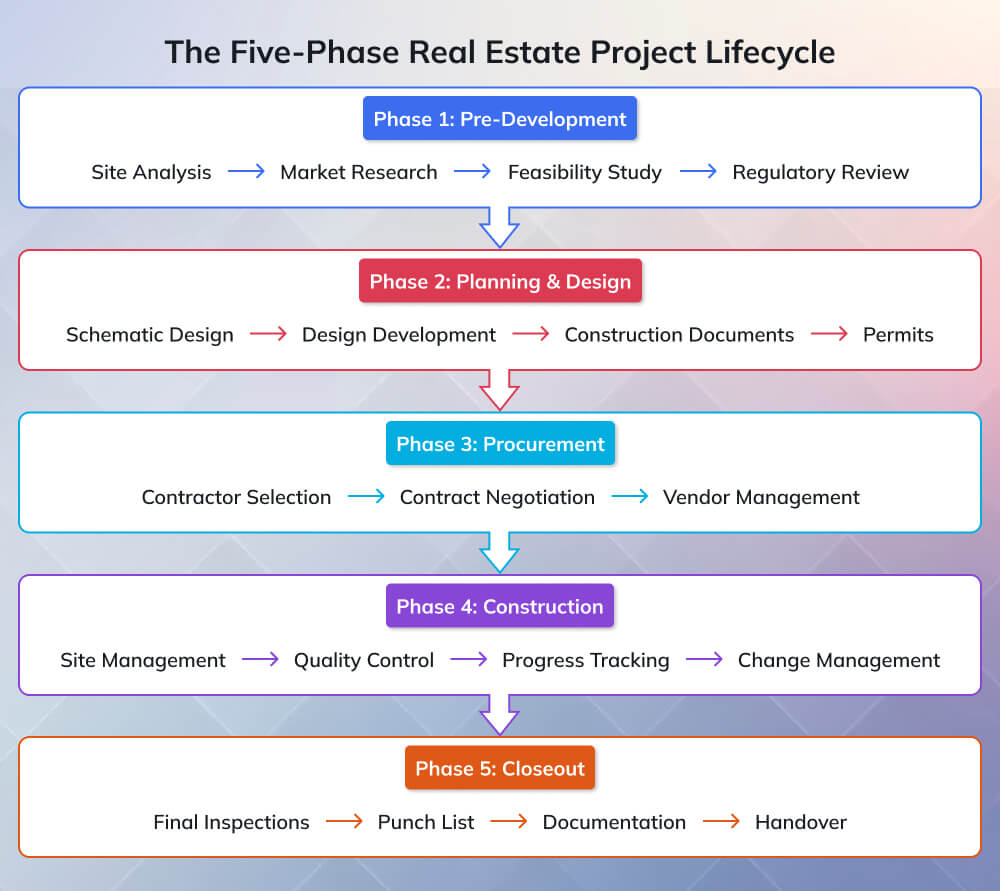
Successful real estate development follows a structured progression through distinct phases, each with specific objectives, deliverables, and decision gates. Mastering these phases enables project managers to maintain control, anticipate challenges, and guide projects toward successful completion.
Pre-Development and Feasibility Phase
The pre-development phase establishes the foundation for all subsequent work. During this critical stage, project managers conduct comprehensive site analysis to evaluate location suitability, considering factors such as accessibility, proximity to amenities, demographic trends, and competitive positioning. Market research provides essential intelligence about demand drivers, absorption rates, pricing benchmarks, and target audience preferences.
Financial feasibility modeling sits at the heart of this phase. Project managers develop detailed pro formas that project revenues, costs, financing structures, and return metrics. These models incorporate acquisition costs, hard and soft construction costs, financing expenses, marketing budgets, and projected income streams. Sensitivity analysis tests assumptions against various scenarios, construction cost escalation, market softening, interest rate changes, to identify risk thresholds and establish contingency requirements.
Regulatory due diligence examines zoning classifications, allowable uses, density limitations, height restrictions, and required approvals. Early engagement with planning departments, community groups, and relevant agencies helps identify potential obstacles and builds relationships essential for navigating the approval process. Environmental assessments evaluate site contamination, wetlands, endangered species, and other factors that could constrain development or trigger remediation requirements.
The phase concludes with a go/no-go decision based on comprehensive analysis. Successful projects demonstrate market demand, financial viability, regulatory feasibility, and alignment with investor objectives before advancing to detailed planning.
| PRO TIP
Engage planning authorities early and often during pre-development Establishing collaborative relationships with municipal planning departments before formal submissions can save months of delay. Schedule pre-application meetings to discuss project concepts, identify concerns, and understand approval timelines. Many jurisdictions offer expedited review for projects that align with community priorities like affordable housing or sustainable design. |
Planning and Design Phase
With project feasibility confirmed, the planning and design phase translates vision into detailed specifications. Project managers coordinate multidisciplinary design teams—architects, structural engineers, MEP (mechanical, electrical, plumbing) engineers, landscape architects, and specialized consultants, to develop comprehensive construction documents.
The architectural design process typically progresses through schematic design, design development, and construction documents. Each stage refines details while maintaining focus on functionality, aesthetics, constructability, and budget alignment. Project managers facilitate regular design reviews with stakeholders to ensure the evolving design meets expectations and maintains commercial viability.
Engineering specifications address structural systems, foundation design, building envelope performance, HVAC systems, electrical distribution, plumbing infrastructure, fire protection, and life safety systems. Coordination between disciplines prevents conflicts and ensures integrated building systems. Building Information Modeling (BIM) technology enables virtual construction, clash detection, and coordination before physical work begins.
The permit acquisition process often represents a critical path activity. Project managers shepherd applications through multiple agencies, building departments, fire marshals, environmental regulators, transportation authorities, tracking requirements, responding to comments, and maintaining momentum toward approval. Strategic sequencing of permits can enable early site work or foundation construction while superstructure permits progress through review.
Stakeholder alignment during this phase is crucial. Regular communication with investors ensures design decisions align with pro forma assumptions. Engagement with contractors provides constructability feedback and preliminary pricing validation. Community outreach addresses neighbor concerns and builds support for project approvals.
Procurement and Contracting Phase
Procurement strategy significantly impacts project outcomes. Project managers evaluate delivery methods, design-bid-build, design-build, construction management at-risk, integrated project delivery, selecting the approach best suited to project characteristics, market conditions, and owner preferences. Each method allocates risk differently and creates distinct team dynamics.
Contractor selection balances multiple criteria: pricing competitiveness, technical capability, financial stability, safety record, schedule reliability, and cultural fit. Rigorous prequalification screens candidates, while competitive bidding or negotiated selection processes identify the optimal partner. Reference checks, financial analysis, and bonding capacity verification protect against contractor default risk.
Contract negotiations establish the legal and commercial framework governing project delivery. Key provisions address scope definition, pricing structures (lump sum, guaranteed maximum price, cost-plus), schedule commitments, quality standards, change order procedures, payment terms, warranty requirements, and dispute resolution mechanisms. Project Management Professional (PMP®) certification equips professionals with contract management competencies essential for navigating these complex negotiations.
Vendor management extends beyond the general contractor to specialized subcontractors, material suppliers, equipment providers, and professional consultants. Project managers establish procurement schedules that sequence purchases to support construction workflows while managing cash flow and avoiding premature commitments that lock in pricing before final design resolution.
Construction Execution Phase
Construction execution transforms plans into physical reality, demanding intensive coordination, quality vigilance, and adaptive problem-solving. Project managers establish site presence through owner’s representatives or dedicated project teams who monitor daily progress, verify work quality, and maintain communication channels across all project participants.
Quality control protocols ensure work meets specifications and industry standards. Regular inspections at critical milestones, foundation completion, structural framing, building envelope installation, MEP rough-in, finish work, identify deficiencies early when corrections are most cost-effective. Testing and commissioning procedures verify that building systems operate as designed. Documentation through photos, daily reports, and inspection records creates accountability and supports future warranty claims if needed.
Progress monitoring tracks actual performance against baseline schedules and budgets. Weekly progress meetings review completed work, identify emerging issues, and adjust short-term plans. Monthly reporting to stakeholders provides transparency on schedule adherence, budget consumption, quality metrics, and risk status. Earned value management techniques quantify performance trends and forecast final outcomes based on current productivity.
Change management represents one of the most critical execution phase responsibilities. Requested changes, whether driven by owner preferences, design refinements, unforeseen conditions, or regulatory requirements, must be evaluated for cost, schedule, and quality impacts. Rigorous change order procedures document proposals, secure approvals, and update project baselines. Uncontrolled scope creep destroys budgets and schedules; disciplined change management maintains project integrity while accommodating necessary adjustments.
Safety management protects workers and limits liability exposure. Project managers ensure contractors implement comprehensive safety programs including site-specific safety plans, daily toolbox talks, personal protective equipment requirements, fall protection systems, and incident response protocols. Active safety monitoring and regular audits reinforce the expectation that safety is non-negotiable.
Closeout and Handover Phase
The closeout phase transitions projects from construction to occupancy, requiring meticulous attention to detail and systematic completion of remaining obligations. Final inspections by building departments, fire marshals, and other authorities verify code compliance and authorize occupancy certificates. Project managers coordinate these inspections, addressing any deficiencies identified before final approval.
Punch list development captures remaining minor work items requiring completion or correction. Systematic walkthroughs with contractors, design teams, and owner representatives create comprehensive lists organized by location and trade. Tracking punch list progress and verifying completion ensures projects achieve substantial completion status, triggering milestone payments and warranty commencements.
Documentation compilation assembles the information necessary for building operation and future maintenance. As-built drawings reflecting field changes, equipment manuals, warranty certificates, maintenance schedules, commissioning reports, and operational training materials transfer to owner facility management teams. Complete documentation preserves institutional knowledge and supports efficient building operation over its lifecycle.
Financial closeout reconciles final costs, processes remaining payments, releases retainage, and closes out contracts. Final lien waivers from contractors and suppliers protect owners from future payment claims. Project managers prepare final budget reports showing actual costs versus original budgets, analyzing variances and capturing lessons learned for future projects.
The handover process transitions responsibility from project teams to operational teams. Training sessions familiarize building operators with mechanical systems, life safety equipment, and building automation. Warranty management systems track warranty periods for various building components, ensuring defects discovered during warranty periods receive prompt contractor attention.
Essential Skills for Real Estate Project Managers
Real estate project management demands a diverse skill set spanning technical knowledge, leadership capabilities, and business acumen. Successful professionals continuously develop competencies across multiple domains.
Technical Competencies
Technical mastery provides the foundation for credible project leadership. Understanding construction methods, building systems, and engineering principles enables intelligent evaluation of contractor proposals, constructability reviews, and quality assessments. Familiarity with PRINCE2® methodology and other structured project management frameworks provides systematic approaches to planning, monitoring, and controlling complex initiatives.
Proficiency with project management software, scheduling tools like Microsoft Project or Primavera P6, cost management systems, and BIM platforms enhances planning precision and communication effectiveness. Data literacy enables interpretation of project metrics, financial reports, and performance trends to support evidence-based decision-making.
Regulatory knowledge spanning zoning codes, building regulations, environmental laws, and safety standards helps navigate compliance requirements. While specialized consultants provide detailed expertise, project managers must understand regulatory frameworks sufficiently to identify issues, assess implications, and coordinate compliance efforts.
Leadership and Communication Skills
Real estate projects bring together diverse professionals with different priorities, vocabularies, and perspectives. Effective leadership aligns these stakeholders toward common objectives despite competing interests. Emotional intelligence, the ability to understand and influence emotions in oneself and others, proves essential for managing conflicts, motivating teams, and building collaborative relationships.
Communication skills adapt messages to diverse audiences. Technical discussions with engineers require precision and detail; executive updates emphasize financial performance and strategic implications; community presentations focus on benefits and address concerns. Written communication through reports, meeting minutes, and contract documents demands clarity and accuracy. Verbal communication in meetings, presentations, and negotiations requires persuasiveness and active listening.
Negotiation skills balance assertiveness with collaboration. Whether negotiating change orders with contractors, resolving design conflicts, or mediating stakeholder disagreements, skilled negotiators find mutually acceptable solutions that advance project objectives while preserving relationships.
Financial and Business Acumen
Real estate projects fundamentally represent financial investments seeking returns. Understanding financial statements, return metrics (IRR, equity multiple, cash-on-cash return), and capital structures enables intelligent dialogue with investors and lenders. Budget development, cost estimating, and financial forecasting skills support realistic planning and variance analysis throughout execution.
Market awareness informs decisions about project positioning, pricing strategies, and absorption assumptions. Understanding economic cycles, interest rate trends, demographic shifts, and competitive dynamics helps project managers anticipate external factors affecting project success.
Risk management capabilities identify potential threats, from construction defects and cost overruns to market deterioration and regulatory challenges, and develop mitigation strategies. Professional certifications like PMI-RMP® (Risk Management Professional) provide structured frameworks for systematic risk identification, assessment, response planning, and monitoring.
Business strategy skills connect individual projects to broader organizational objectives, ensuring project decisions support long-term portfolio performance and company reputation.
Key Challenges in Real Estate Project Management
Despite careful planning and skilled execution, real estate projects encounter predictable challenges that test project managers’ capabilities. Understanding these challenges and implementing proven countermeasures distinguishes successful professionals from those who struggle with chronic difficulties.
Budget Overruns and Cost Control
Budget overruns plague the real estate industry, with research showing construction projects exceeding initial budgets by an average of 27%. Multiple factors drive cost escalation: inaccurate initial estimates that understate complexity, unforeseen site conditions requiring additional work, scope changes requested by owners or mandated by regulations, material price escalation in inflationary environments, labor shortages driving wage increases, and productivity issues from weather delays or coordination problems.
Effective cost control begins with realistic budgeting grounded in detailed quantity takeoffs, market-validated unit prices, and appropriate contingency reserves. Contingencies should reflect project risk profiles, renovation projects in occupied buildings merit higher contingencies than ground-up construction on well-characterized sites. Typically, 10-20% contingencies are appropriate depending on project complexity and market conditions.
Case Study: Storrs Center – Turning a Strip Mall into a DowntownThe challenge Mansfield had no real “college town” core, just an aging strip mall and underused land near campus. UConn was losing appeal with prospective students and faculty because there was “nothing to do” around the university. The site also had environmental constraints and a long history of community resistance to development. Project management approach Real estate project management focused on:
Results & lessons
|
Cost tracking systems provide real-time visibility into budget consumption. Monthly cost reports compare committed costs (contracted amounts plus approved change orders) and actual expenditures against budgets, calculating cost variance and forecasting final project costs. Early identification of negative trends enables corrective action before variances become unrecoverable.
Value engineering exercises identify opportunities to reduce costs without compromising functional performance or quality. These structured reviews challenge specifications, explore alternative materials or systems, and optimize designs for cost efficiency. Most effective when conducted during design development, value engineering can also generate savings during construction when budget pressures emerge.
Change order management discipline prevents the incremental scope additions that collectively destroy budgets. Each requested change undergoes rigorous evaluation: Is it necessary or nice-to-have? Can it be deferred to post-occupancy? What are the full cost and schedule implications? Only changes passing this scrutiny should proceed, with full transparency to stakeholders about cumulative change order impacts.
Timeline Delays and Schedule Management
Schedule delays frustrate stakeholders and increase costs through extended financing carry, delayed revenue generation, and prolonged general conditions. According to Harvard Business Review research on megaprojects, the average construction project experiences schedule delays of 31%, with one in five projects delayed by more than 50%.
Common delay drivers include permitting delays from incomplete applications or regulatory backlog, design changes requiring document revisions and resubmissions, unforeseen site conditions necessitating redesign, material delivery delays from supply chain disruptions, weather impacts during critical outdoor work, labor shortages limiting crew sizes, coordination failures between trades creating rework, and scope changes adding work to critical paths.
Proactive schedule management begins with realistic baseline schedules reflecting actual productivity rates, appropriate activity sequencing, realistic material lead times, and weather allowances based on historical data. Overly aggressive schedules set projects up for failure and undermine credibility when inevitable adjustments occur.
Critical path management focuses attention on the specific activity sequences that determine overall project duration. Float (schedule flexibility) on non-critical activities provides buffering capacity, while critical path activities merit intensive monitoring and resource prioritization. Critical path compression techniques, fast-tracking (overlapping sequential activities) and crashing (adding resources to accelerate work), recover schedules when delays occur, though both introduce additional costs and risks.
Look-ahead scheduling establishes short-term work plans (typically 2-6 weeks) detailing upcoming activities, resource requirements, material deliveries, and constraint resolution. Weekly coordination meetings with trade contractors identify conflicts, resolve constraints, and commit to near-term work plans. This collaborative planning prevents the finger-pointing and blame-shifting that wastes time and damages relationships.
Recovery schedules, developed when projects fall behind baseline, establish revised completion dates and the specific actions necessary to achieve them. Recovery may require extended work hours, increased crew sizes, alternate sequencing, or scope prioritization. Transparent communication about recovery strategies and their cost implications maintains stakeholder confidence even when original schedules prove unachievable.
Stakeholder Alignment and Communication
Real estate projects inherently involve numerous stakeholders with divergent interests. Investors prioritize financial returns and risk management. Lenders focus on loan security and covenant compliance. Contractors seek profitability and workload stability. Architects champion design integrity. Regulators enforce code compliance and community welfare. Neighbors resist disruption and density. Future tenants demand functionality and amenities. Balancing these competing interests requires sophisticated stakeholder management.
Stakeholder analysis maps each party’s influence, interests, concerns, and communication preferences. This understanding informs tailored engagement strategies, detailed financial reporting for investors, regular payment schedules for contractors, proactive outreach addressing neighbor concerns, collaborative design sessions with end users.
Communication plans establish reporting cadences, meeting rhythms, escalation protocols, and information distribution appropriate to each stakeholder group. Regular status reports provide transparency about progress, issues, and forecasts. Executive dashboards distill complex project data into key metrics, schedule status (on time/delayed), budget status (under/over), quality metrics, and risk indicators.
Conflict resolution skills prove essential when stakeholder interests collide. Effective approaches begin with understanding underlying interests behind stated positions, identifying common ground, generating creative options that address multiple parties’ core needs, and facilitating agreements that all parties can support. Escalation to senior leadership or formal dispute resolution processes should be reserved for conflicts that direct negotiation cannot resolve.
Transparency builds trust even when delivering difficult messages. When problems arise, budget overruns, schedule delays, quality defects, early disclosure with proposed solutions maintains credibility. Surprises destroy stakeholder confidence; proactive communication about emerging issues, while uncomfortable, demonstrates professional integrity and provides opportunity for collaborative problem-solving.
Regulatory Compliance and Risk Management
Navigating the complex regulatory landscape governing real estate development challenges even experienced professionals. Zoning regulations control land use, density, height, setbacks, parking requirements, and architectural standards. Building codes specify structural, mechanical, electrical, plumbing, and fire protection requirements. Environmental regulations address stormwater management, wetland protection, contamination remediation, and endangered species protection. Historic preservation ordinances constrain modifications to designated structures or districts.
Compliance strategy begins during pre-development with comprehensive regulatory due diligence identifying all applicable requirements and the approval pathways for meeting them. Early engagement with regulatory agencies clarifies expectations, identifies concerns, and builds working relationships that facilitate efficient approval processes.
Permit coordination plans sequence applications strategically, recognizing that certain permits serve as prerequisites for others. Site plan approvals typically precede building permits. Environmental clearances may be required before grading permits issue. Understanding these interdependencies and maintaining realistic timeline expectations prevents schedule surprises.
Risk management extends beyond regulatory compliance to encompass the full spectrum of project threats. Market risk from economic downturns, credit risk from counterparty default, operational risk from construction defects, reputational risk from community opposition, and natural hazard risk from earthquakes or hurricanes all merit systematic assessment and response planning.
Risk registers catalog identified risks, assess their probability and potential impact, assign risk ownership, and document response strategies, avoidance (eliminating the threat), mitigation (reducing likelihood or impact), transfer (shifting risk to insurance or contractors), or acceptance (acknowledging and monitoring). Regular risk reviews update assessments as projects progress and new threats emerge.
Insurance programs transfer financial consequences of certain risks. Builder’s risk insurance protects against construction damage. General liability coverage protects against third-party injury or property damage claims. Professional liability insurance covers design errors. OCIP (owner-controlled insurance programs) or CCIP (contractor-controlled insurance programs) consolidate coverage for large projects. Adequate coverage limits and appropriate policy structures protect against catastrophic losses.
Best Practices for Successful Real Estate Project Management
While challenges are inevitable, proven best practices significantly improve project outcomes. Leading professionals consistently implement these strategies to enhance performance.
Leverage Technology and Project Management Tools
Modern technology platforms dramatically enhance project visibility, coordination, and efficiency. Cloud-based project management systems provide centralized repositories for documents, schedules, budgets, and communications accessible to all authorized team members regardless of location. This eliminates version control problems and ensures everyone works from current information.
Building Information Modeling (BIM) creates digital representations of physical and functional building characteristics. BIM enables virtual construction, clash detection, identifying conflicts before field installation, quantity extraction for precise estimating, and facilities management data for post-construction operations. Owners increasingly mandate BIM workflows for their coordination and documentation benefits.
Construction management software streamlines field operations through mobile applications for daily reporting, photo documentation, time tracking, and issue management. Real-time data capture improves accuracy and enables faster decision-making compared to traditional paper-based processes.
Drone technology provides aerial photography tracking site progress, volumetric surveys measuring earthwork quantities, and infrastructure inspection identifying defects. Virtual reality enables immersive design reviews and marketing presentations before construction begins. Professional project management training increasingly incorporates these emerging technologies, recognizing their growing importance in modern practice.
Implement Robust Risk Management
Systematic risk management prevents surprises and prepares appropriate responses when anticipated threats materialize. Risk identification workshops bringing together project teams, contractors, and subject matter experts generate comprehensive risk inventories through structured brainstorming. Common categories include financial risks, schedule risks, quality risks, safety risks, regulatory risks, and external risks from weather, market conditions, or supply chain disruptions.
Quantitative risk analysis uses Monte Carlo simulation to model probability distributions for costs and schedules, producing probabilistic forecasts, for example, “80% confidence the project will complete within $50M and 24 months.” This analytical rigor supports contingency determination and provides realistic expectations to stakeholders.
Contingency management establishes financial and schedule reserves to absorb materialized risks. Contingencies should be held centrally by project managers rather than distributed across individual budget line items where they inevitably get consumed by creeping scope. Formal approval processes for contingency drawdown maintain discipline and preserve reserves for genuine needs.
Regular risk reviews, typically monthly, update risk assessments as projects progress. New risks emerge, identified risks may increase or decrease in criticality, and consumed risks are closed. This dynamic risk management maintains relevance throughout project lifecycles.
Foster Collaborative Stakeholder Relationships
Project success flows from strong relationships built on trust, transparency, and mutual benefit. Collaborative contracting models like integrated project delivery create shared risk-reward structures aligning all parties’ financial interests with project success. Even within traditional delivery methods, project managers can foster collaboration through fair dealing, prompt decision-making, and recognition of partners’ legitimate business interests.
Partnering workshops at project commencement establish working relationships, clarify expectations, develop communication protocols, and create shared commitment to project goals. These team-building investments pay dividends throughout projects when inevitable challenges arise.
Regular appreciation and recognition of strong performance motivates excellence. Public acknowledgment of safety achievements, quality workmanship, or problem-solving contributions reinforces desired behaviors and builds positive project culture. Conversely, addressing performance deficiencies promptly and privately preserves relationships while correcting issues.
Long-term relationships with high-performing contractors, consultants, and suppliers create competitive advantages. Trusted partners familiar with your standards, processes, and expectations perform more efficiently and reliably than constantly rotating new participants who must learn your requirements from scratch.
The Future of Real Estate Project Management
The real estate industry stands at an inflection point as technological innovation, sustainability imperatives, and changing work patterns reshape development practices. Forward-thinking project managers position themselves and their organizations to capitalize on emerging trends.
Digital Transformation and PropTech
Property technology (PropTech) investments reached $32 billion globally in 2024 according to Deloitte, reflecting accelerating digital transformation across the real estate value chain. Artificial intelligence analyzes market data to optimize site selection, pricing strategies, and design decisions. Machine learning algorithms predict construction costs with increasing accuracy by analyzing historical project data and current market conditions.
Internet of Things (IoT) sensors embedded in buildings collect operational data on energy consumption, space utilization, environmental conditions, and equipment performance. This real-time intelligence enables predictive maintenance, operational optimization, and data-driven decisions about building management. Project managers increasingly specify smart building infrastructure as standard requirements.
Blockchain technology promises to streamline transaction processes, enable fractional ownership structures, and create transparent audit trails for property records and contracts. While adoption remains nascent, early applications demonstrate potential for reducing transaction costs and increasing transparency in property transactions.
Sustainability and Green Building
Environmental, Social, and Governance (ESG) considerations increasingly drive investment decisions, with institutional investors demanding proof of sustainability performance. Net-zero carbon commitments require projects to minimize operational carbon emissions through energy efficiency, renewable energy, and electrification while addressing embodied carbon in construction materials through low-carbon concrete, recycled steel, and mass timber alternatives.
Green building certifications, LEED, WELL, BREEAM, Passive House, provide frameworks for designing and documenting high-performance buildings. These certifications increasingly serve as minimum requirements for institutional investors and corporate tenants prioritizing sustainability. Agile project management methodologies complement sustainability goals by enabling iterative refinement of building performance during design and construction.
Resilience design addresses climate adaptation, preparing buildings for increased extreme weather, flooding risks, heat stress, and other climate impacts. Building codes increasingly mandate resilience features, and insurance considerations incentivize proactive climate risk mitigation.
Modular Construction and Innovation
Prefabrication and modular construction shift work from field to factory, improving quality control, reducing schedule duration, minimizing weather impacts, and enhancing worker safety. Bathroom pods, mechanical equipment rooms, and even complete residential units can be factory-fabricated, transported to sites, and rapidly installed. While not appropriate for all project types, modular approaches merit evaluation for repetitive building components or schedule-sensitive projects.
Advanced materials including self-healing concrete, transparent solar panels, and ultra-high-performance fiber-reinforced composites expand design possibilities and improve building performance. Project managers must stay current with material innovation to evaluate emerging options against traditional alternatives.
Robotics and automation increasingly appear on construction sites. Autonomous equipment, robotic bricklayers, and exoskeleton-assisted workers enhance productivity and reduce injury risk. While human expertise remains irreplaceable, technology augmentation improves construction efficiency and safety outcomes.
| TAKE THE NEXT STEP
Master Project Management for Real Estate Success: PMP® Certification Training Whether you’re managing residential developments, commercial properties, or mixed-use projects, PMP® certification provides the globally recognized framework for consistent project success. Our expert-led training covers the methodologies, risk management strategies, and stakeholder management techniques specifically applicable to real estate development. What you’ll gain:
|
Conclusion
Real estate project management represents one of the most challenging and rewarding career paths in the built environment. The discipline demands technical knowledge spanning construction, engineering, and design; financial acumen encompassing budgeting, forecasting, and investment analysis; leadership capabilities including stakeholder management, negotiation, and conflict resolution; and strategic thinking connecting individual projects to organizational objectives and market dynamics.
The core phases, pre-development feasibility, planning and design, procurement and contracting, construction execution, and closeout and handover. provide a structured framework for navigating complexity. Yet successful project managers recognize that methodology alone is insufficient. The human dimensions of leadership, communication, relationship building, and problem-solving ultimately determine whether projects succeed or struggle.
Persistent challenges including budget overruns, schedule delays, stakeholder conflicts, and regulatory obstacles test every project manager’s capabilities. Those who master proactive risk management, disciplined cost and schedule control, transparent stakeholder communication, and systematic compliance strategies consistently deliver superior outcomes even when facing inevitable adversity.
Frequently Asked Questions
1. What is real estate project management?
Real estate project management is the specialized discipline of planning, coordinating, and controlling all activities required to transform a property concept into a completed, operational asset. It integrates construction management, financial analysis, regulatory navigation, and stakeholder coordination throughout the development lifecycle from initial feasibility through design, construction, and final handover.
2. What are the key phases of a real estate project?
Real estate projects progress through five core phases: (1) Pre-Development and Feasibility, site analysis, market research, and financial modeling; (2) Planning and Design, architectural design, engineering, and permit acquisition; (3) Procurement and Contracting, contractor selection and contract negotiation; (4) Construction Execution, site management, quality control, and progress monitoring; (5) Closeout and Handover, final inspections, documentation, and transition to operations.
3. What skills do real estate project managers need?
Successful real estate project managers require technical competencies including construction knowledge, project management methodologies, and software proficiency; leadership and communication skills encompassing stakeholder management, negotiation, and conflict resolution; and financial and business acumen including budgeting, financial analysis, market awareness, and risk management. Professional certifications like PMP® or PRINCE2® validate these competencies.
4. How do you manage budget overruns in real estate projects?
Managing budget overruns requires realistic initial estimates with appropriate contingencies, rigorous change order management requiring formal approval for scope additions, continuous cost tracking comparing committed and actual costs against budgets, value engineering to identify cost reduction opportunities, and transparent communication with stakeholders about cost trends and corrective actions. Early identification of negative variances enables timely intervention before overruns become unrecoverable.
5. What are the biggest challenges in real estate project management?
The most persistent challenges include budget overruns averaging 27% due to unforeseen conditions and scope changes; schedule delays averaging 31% from permitting issues and coordination failures; stakeholder alignment difficulties managing diverse interests across investors, contractors, regulators, and communities; and regulatory compliance navigating complex zoning, building codes, and environmental requirements. Systematic risk management and proactive communication help mitigate these challenges.
6. Which project management certification is best for real estate professionals?
The Project Management Professional (PMP®) certification from PMI is the most widely recognized credential, providing comprehensive project management frameworks applicable across industries including real estate. PRINCE2® offers a structured methodology popular internationally. PMI-RMP® specializes in risk management, particularly valuable given construction’s inherent uncertainties. Many successful real estate project managers hold multiple certifications demonstrating broad competencies.
7. How is technology changing real estate project management?
Technology is transforming real estate project management through Building Information Modeling (BIM) enabling virtual construction and clash detection; cloud-based project management platforms providing real-time collaboration; artificial intelligence optimizing design and cost decisions; IoT sensors enabling smart buildings and predictive maintenance; drones for site monitoring; and mobile applications streamlining field reporting. PropTech investment reached $32 billion in 2024, accelerating digital transformation across the industry.