


In project management, the difference between success and failure often comes down to one critical factor: resource management. You can have a brilliant project plan, an engaged team, and executive support, but without the right people, equipment, materials, and budget allocated at the right time, your project is destined to struggle.
This is where a Resource Breakdown Structure (RBS) becomes indispensable. Far more than just a list of team members or a budget spreadsheet, an RBS provides a comprehensive, hierarchical framework that organizes every resource your project needs for success. It’s your roadmap for understanding who and what will deliver your project, when they’re available, and how much they’ll cost.
In this comprehensive guide, we’ll explore everything you need to know about Resource Breakdown Structures, from fundamental definitions to practical implementation steps, industry examples, best practices, and the tools that make RBS management seamless in 2026.
Table of Contents:
- What is a Resource Breakdown Structure (RBS)?
- Why Resource Breakdown Structures?
- RBS vs. WBS vs. OBS: Understanding the Differences
- Essential Components of an Effective RBS
- How to Create a Resource Breakdown Structure: A Step-by-Step Guide
- Industry-Specific RBS Examples
- Advanced RBS Strategies for Enterprise Organizations
- Best Practices for RBS Success
- Conclusion
- Frequently Asked Questions
What is a Resource Breakdown Structure (RBS)?
A Resource Breakdown Structure (RBS) is a hierarchical framework that systematically organizes and categorizes all resources required to complete a project. Think of it as an organizational chart for your project resources, every person, piece of equipment, material, facility, vendor, and budget component arranged in a clear, visual tree structure.
Unlike a simple resource list that might enumerate team members or equipment items in no particular order, an RBS provides structure and context. It breaks down resources from broad categories into increasingly specific components, typically spanning three to four levels of detail.
A typical RBS hierarchy looks like this:
- Level 1: Resource categories (Human Resources, Equipment, Materials, External Partners, Budget)
- Level 2: Departments or functional groups (Engineering, Marketing, Operations)
- Level 3: Specific teams or roles (Front-end Development Team, Senior Backend Developers, QA Engineers)
- Level 4: Individual resources (John Smith – Lead Developer, AWS Server #3, Conference Room A)
This structured approach ensures that all resources, including personnel, equipment, materials, technological assets, and financial allocations, are accounted for, tracked, and strategically deployed throughout the project lifecycle.
Why Resource Breakdown Structures?
Organizations that implement effective RBS frameworks report significant improvements in project outcomes, resource utilization, and budget control. Here’s why an RBS is essential for modern project management:
1. Strategic Alignment with Business Priorities
An RBS connects resource allocation directly to business priorities, ensuring that critical initiatives receive appropriate focus and support. When leadership can see exactly which resources are committed to which projects, they can make informed decisions about whether resource distribution aligns with strategic goals.
For example, if three high-priority digital transformation projects all require the same specialized data architect in the next quarter, an RBS makes this conflict visible during planning, not during execution when changes are expensive and disruptive. With 76% of companies reporting ongoing challenges hiring engineering talent, proactive resource visibility becomes even more critical.
2. Early Identification of Resource Conflicts and Bottlenecks
Perhaps the most valuable benefit of an RBS is its ability to spotlight resource conflicts, constraints, and bottlenecks before they derail your project. Traditional resource management approaches often discover conflicts only when deadlines approach and team members report they’re overallocated.
An RBS enables you to:
- Spot shared resources stretched across multiple projects
- Identify critical skills that may become bottlenecks
- Recognize equipment or facility limitations before they cause delays
- Plan for specialized contractors or vendors with long lead times
3. Portfolio-Wide Visibility and Utilization Optimization
For organizations managing multiple projects simultaneously, an RBS provides portfolio-level visibility into resource utilization. Project Management Offices (PMOs) and executives can see:
- Which departments are under sustained pressure and which have available capacity
- Where specialized skills sit idle while other teams struggle
- Underutilized equipment or assets that represent sunk costs
- Cross-project opportunities for resource sharing
This visibility supports data-driven staffing decisions, capital equipment investments, and training initiatives that address genuine organizational needs.
4. Accurate Cost Control and Budget Forecasting
Every resource has a cost, hourly labor rates, equipment rental fees, material expenses, contractor invoices. An RBS tracks these costs at granular levels and rolls them up for accurate budget forecasting and cost control.
When resources are connected to specific work packages, you can:
- Calculate precise cost estimates for each project phase
- Track actual versus budgeted resource costs in real-time
- Identify cost overruns early and take corrective action
- Make informed trade-offs between resource quality and budget constraints
RBS vs. WBS vs. OBS: Understanding the Differences
Project management employs several “breakdown structures,” each serving a distinct purpose. Understanding how these frameworks complement each other is essential for effective project planning.
Work Breakdown Structure (WBS) vs. Resource Breakdown Structure (RBS)
| Aspect | Work Breakdown Structure (WBS) | Resource Breakdown Structure (RBS) |
| Focus | Deliverables, tasks, and work packages | People, equipment, materials, and assets |
| Question Answered | What work needs to be done? | Who and what will do the work? |
| Hierarchy Logic | Project phases → Work packages → Tasks | Departments → Teams → Individual resources |
| Primary Purpose | Define scope, schedule, and deliverables | Plan capacity, allocation, and resource needs |
| Key Output | Project timeline and task dependencies | Resource plan and availability matrix |
How they work together: During project planning, the WBS defines what needs to be delivered. The RBS then translates those deliverables into the resources required to complete them. During execution, the WBS tracks task completion while the RBS monitors resource availability and utilization.
For example, a software project’s WBS might list “Design UI,” “Code backend API,” and “Test integration” as deliverables. The corresponding RBS would identify “Senior UX Designer (40 hours),” “2x Backend Developers (120 hours),” “QA Automation Engineer (30 hours),” and “Test automation license” as the resources needed.
Organizational Breakdown Structure (OBS) vs. Resource Breakdown Structure (RBS)
An Organizational Breakdown Structure (OBS) shows corporate reporting relationships and internal hierarchy for HR and administrative purposes, showing who reports to whom across the entire organization.
An RBS, by contrast, focuses specifically on project resources and their allocation across work activities. It’s task-oriented rather than hierarchy-oriented, showing which resources are needed for specific project work regardless of their permanent organizational placement.
Essential Components of an Effective RBS
A comprehensive RBS captures far more than names and job titles. Each component provides the detailed data needed to plan resources accurately and allocate them with confidence. Together, these elements support both day-to-day execution and portfolio-level decision-making.
1. Human Resources Organization
People form the foundation of most RBS frameworks. This component shows your organizational structure, teams, reporting lines, and what each person actually does. Critical details to capture include:
- Team Structure: Department, division, and project team assignments
- Reporting Lines: Who manages whom and how decisions flow
- Role Definitions: Specific positions and their responsibilities
- Matrix Relationships: How resources work across multiple projects simultaneously
- Required Positions: Roles not yet filled but necessary for project success
2. Skills and Competencies Mapping
Job titles alone don’t reflect capability or expertise. A strong RBS documents skills, proficiency levels, and certifications to ensure critical initiatives receive appropriately qualified support.
Document these key elements:
- Technical Skills: Programming languages, software proficiency, specialized knowledge, technical certifications
- Proficiency Levels: Distinguishing between junior, intermediate, and expert capabilities
- Industry Certifications: Required qualifications for regulated work (PMP, AWS certifications, CISSP)
- Soft Skills: Leadership, communication, collaboration, and stakeholder management abilities
- Language Capabilities: For global projects requiring multilingual teams
3. Physical and Digital Assets
Resources extend far beyond people to include the infrastructure required to complete work. An RBS should track availability, capacity limits, and dependencies for all essential assets:
- Facilities: Meeting rooms, laboratories, production spaces, co-working spaces
- Equipment: Computers, servers, specialized machinery, vehicles, testing equipment
- Software and Licenses: Development tools, design software, project management platforms, subscription limits
- Cloud Infrastructure: AWS/Azure/GCP resources, database instances, CI/CD pipelines
- Materials and Supplies: Raw materials, office supplies, consumables, inventory items
4. External Partners and Contractors
Many projects rely heavily on external contributors. An RBS should integrate vendors, freelancers, consultants, contractors, and partner agencies alongside internal teams. Track:
- Contract terms and conditions
- Availability windows and scheduling constraints
- Specific deliverables and statement of work
- Escalation paths and primary contacts
- Cost structures (hourly rates, fixed fees, retainers)
5. Financial Resources and Budget Allocations
Budget functions as a resource in its own right. Incorporating cost data into your RBS supports accurate forecasting and highlights the financial impact of allocation decisions:
- Labor rates (hourly wages, overtime multipliers, contractor fees)
- Equipment costs (purchase prices, rental rates, maintenance expenses)
- Material costs (per-unit costs, bulk purchase discounts, shipping fees)
- Variable expenses tied to resource usage (cloud computing costs, licensing fees)
- Contingency reserves for unexpected resource needs
How to Create a Resource Breakdown Structure: A Step-by-Step Guide
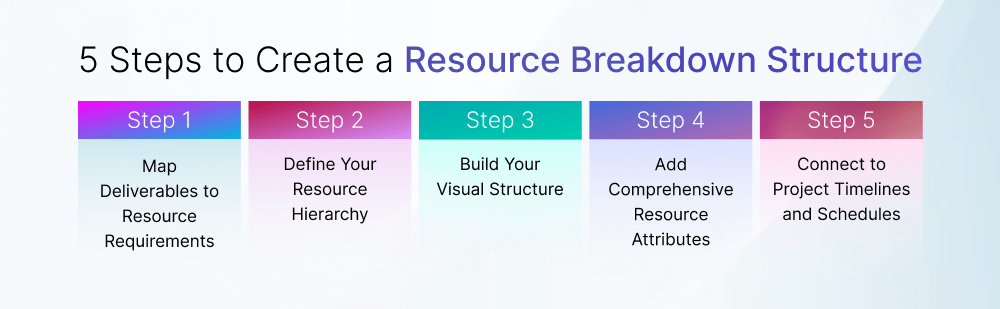
Building an effective RBS requires a systematic approach that grounds resource planning in operational reality rather than guesswork. Follow these five essential steps to create an RBS that supports both planning and execution.
Step 1: Map Deliverables to Resource Requirements
Begin by thoroughly reviewing your Work Breakdown Structure (WBS) or overall project scope to identify the resources required for each deliverable. Collaborate closely with subject matter experts, team leads, and department managers to validate assumptions around effort, skills, and supporting systems.
For example, a website redesign project might break down like this:
Deliverable: “Build landing page”
Resources Required:
- 10 hours of UI design work (Senior UX Designer)
- 15 hours of front-end development (React Developer)
- 5 hours of copywriting (Content Strategist)
- 3 hours of project management coordination
- 1 CMS license (WordPress or equivalent)
- Stock photography budget ($500)
This detailed mapping catches resource gaps and unrealistic expectations before they become problems during execution. It also helps you understand resource dependencies, for instance, copywriting must be complete before design can finalize.
Step 2: Define Your Resource Hierarchy
Next, establish a clear, consistent hierarchy that reflects how your organization manages resources in practice. This structure typically follows departments, functions, project types, or locations and should remain standardized across all projects to enable comparison and portfolio management.
A typical four-level hierarchy might look like this:
Level 1: Resource Categories
- Human Resources
- Technical Infrastructure
- Physical Resources
- External Partners
- Financial Resources
Level 2: Departments or Functions
- Engineering Department
- Marketing Department
- Operations Department
- External Consulting
Level 3: Teams or Specific Roles
- Front-End Development Team
- Back-End Development Team
- DevOps Team
- QA and Testing Team
Level 4: Individual Resources
- John Smith (Senior React Developer)
- Jane Doe (Python Backend Engineer)
- AWS Production Server (us-east-1)
- Conference Room A (Building 3)
| Pro Tip: Use standardized naming conventions throughout your RBS. This ensures clarity when comparing resource needs across multiple initiatives and enables effective reporting and analytics. |
Step 3: Build Your Visual Structure
Once your hierarchy is defined, translate it into a visual format that teams can easily navigate and understand. The visualization approach depends on project complexity:
For smaller initiatives: Simple tree diagrams or organizational charts work well. Tools like Microsoft Visio, Lucidchart, or even PowerPoint can create clear visual representations.
For complex portfolios: Dynamic dashboards, matrix-based views, or dedicated resource management platforms provide better functionality. These enable:
- Expanding and collapsing branches to see different levels of detail
- Filtering by resource type, department, skill, or availability
- Viewing relationships between resources and multiple projects
- Real-time updates as resource status changes
- Integration with project timelines and work management systems
Visual best practices:
- Use consistent color coding (e.g., green for available resources, yellow for partially allocated, red for overallocated)
- Include visual indicators for critical resources or bottlenecks
- Make the structure intuitive enough that stakeholders can understand it without extensive explanation
Step 4: Add Comprehensive Resource Attributes
With the structure in place, enrich each resource with accurate, relevant, and actionable data. These attributes drive scheduling, budgeting, and allocation decisions, so precision matters significantly. Keep this information up to date as circumstances change.
Essential attributes to capture for each resource:
For Human Resources:
- Availability: Working hours, time zones, vacation schedules, public holidays
- Capacity: Percentage allocated to different projects (e.g., 50% on Project A, 30% on Project B, 20% available)
- Cost: Hourly rates, overtime rules, benefits load, contractor fees
- Skills: Technical proficiencies, certifications, experience levels
- Constraints: Location restrictions, security clearances, equipment dependencies
- Preferences: Preferred work types, growth areas, development goals
For Equipment and Physical Resources:
- Availability: Usage schedules, maintenance windows, booking calendars
- Capacity: Maximum utilization (e.g., server capacity, room occupancy limits)
- Cost: Purchase price, depreciation, rental rates, maintenance costs
- Specifications: Technical capabilities, software versions, configuration details
- Location: Physical location, accessibility, transportation requirements
For External Resources:
- Contract terms: Start and end dates, renewal options, termination clauses
- Deliverables: Specific outputs, quality standards, acceptance criteria
- Communication: Primary contacts, escalation paths, preferred communication channels
- Performance: Historical performance data, reliability ratings, quality metrics
Step 5: Connect to Project Timelines and Schedules
The final critical step is linking your RBS to your project schedule. This integration reveals where resource constraints might impact deadlines and enables resource leveling adjusting task timing to resolve conflicts before work begins.
This connection enables you to:
- Validate Feasibility: Determine whether your project timeline is achievable given actual resource availability
- Identify Scheduling Conflicts: See when multiple tasks require the same resource simultaneously
- Optimize Resource Utilization: Smooth out peaks and valleys in resource demand
- Calculate Critical Path: Understand which resource dependencies could delay project completion
- Perform What-if Analysis: Model how schedule changes impact resource needs and vice versa
Modern project management platforms like monday.com Work Management, Smartsheet, Microsoft Project, and Jira synchronize resource data with live project schedules, providing dynamic visibility as plans evolve and helping teams evaluate feasibility in real time.
Industry-Specific RBS Examples
While core RBS principles remain consistent across industries, each sector requires customization reflecting its operational realities, regulatory requirements, and resource characteristics. Here are detailed examples:
Technology and Software Development
Software projects need specialized technical resources and infrastructure coordinated across iterative development cycles:
Human Resources:
- Development teams (Front-end: React/Vue specialists, Back-end: Python/Java developers, Mobile: iOS/Android engineers)
- Quality Assurance (Manual testers, automation engineers, performance testing specialists)
- Product Management (Product owners, business analysts, UX researchers)
- DevOps and Infrastructure (Site reliability engineers, cloud architects, security specialists)
Technical Infrastructure:
- Development environments (local dev machines, Docker containers, and IDE licenses)
- Staging and testing servers (QA environment, UAT environment, performance testing infrastructure)
- Production systems (cloud hosting, CDN services, database clusters)
- CI/CD pipelines (Jenkins, GitHub Actions, GitLab CI)
External Resources:
- Security consultants (penetration testing, security audits)
- UX design agencies (user research, interface design, prototyping)
- Cloud service providers (AWS, Azure, Google Cloud Platform)
Construction and Engineering
Construction projects require tight coordination of labor, equipment, and materials with zero tolerance for safety or compliance shortcuts:
Labor Resources:
- Project management (Project managers, site supervisors, safety officers)
- Professional services (Architects, structural engineers, civil engineers, MEP engineers)
- Skilled trades (Electricians, plumbers, HVAC technicians, carpenters, masons)
- Support staff (Administrative personnel, security guards, cleaners)
Equipment:
- Heavy machinery (Excavators, cranes, bulldozers, concrete mixers)
- Tools and implements (Power tools, hand tools, safety equipment, scaffolding)
- Vehicles (Dump trucks, pickup trucks, forklifts, personnel carriers)
Materials:
- Raw materials (Concrete, steel, lumber, insulation, drywall)
- Prefabricated components (Windows, doors, fixtures, HVAC units)
- Consumables (Fasteners, adhesives, paints, sealants)
Subcontractors:
- Specialized trades (Electrical contractors, plumbing contractors, HVAC contractors)
- Specialty services (Demolition, asbestos abatement, landscaping)
Marketing and Creative Campaigns
Marketing campaigns need diverse creative talent and distribution channels aligned to campaign timelines and brand standards:
Creative Talent:
- Design team (Graphic designers, art directors, brand designers, motion graphics specialists)
- Content creation (Copywriters, content strategists, video producers, photographers)
- Digital specialists (Social media managers, SEO specialists, email marketing coordinators)
Marketing Technology:
- CRM platforms (Salesforce, HubSpot, Marketo)
- Analytics tools (Google Analytics, Adobe Analytics, heat mapping tools)
- Automation software (Marketing automation, email platforms, social scheduling)
- Content management systems (WordPress, Contentful, Adobe Experience Manager)
Media Resources:
- Paid advertising budgets (Google Ads, Facebook Ads, LinkedIn Ads, display advertising)
- Influencer partnerships (Contracted influencers, affiliate partners, brand ambassadors)
- Media buying specialists (Media planning agencies, programmatic buying platforms)
Production Partners:
- Print vendors (Commercial printers, large format printing, promotional items)
- Event agencies (Event planning, booth design, experiential marketing)
- Public relations firms (PR strategy, media relations, crisis communications)
Advanced RBS Strategies for Enterprise Organizations
As project portfolios scale to dozens or hundreds of concurrent initiatives, resource management complexity grows exponentially. Enterprise organizations benefit from advanced approaches that maintain visibility without introducing unnecessary bureaucracy.
1. Portfolio-Level Resource Governance
Large portfolios need standardized frameworks that prevent resource hoarding and ensure priority projects receive first access to critical resources. Create a global resource pool that all projects draw from, using centralized, consistent data.
Effective governance strategies include:
- Standardized Templates: Ensure every project uses identical resource categories, naming conventions, and attribute structures
- Resource Ownership: Assign clear owners who manage allocation decisions for specific resource pools (e.g., the Engineering Resource Manager owns all development team allocations)
- Escalation Paths: Define how resource conflicts get resolved when multiple high-priority projects compete for the same resources
- Regular Reviews: Schedule monthly resource reviews where PMOs rebalance allocations based on changing priorities and emerging constraints
2. Dynamic Resource Optimization with AI
Artificial intelligence transforms static resource plans into adaptive systems that respond automatically to changing conditions. AI algorithms analyze skill profiles, availability patterns, historical performance data, and project requirements to suggest optimal team compositions for new initiatives.
For example, monday work management uses AI-powered features to match resources to projects based on multiple factors: technical skills, current capacity, experience level, past performance on similar work, and even team chemistry indicators. This dramatically reduces manual allocation work while improving assignment quality.
3. Real-Time Capacity Management
Static resource plans lose relevance quickly as schedules shift, priorities change, or unexpected events occur. Real-time capacity management systems continuously update availability as:
- Schedules are adjusted
- Strategic priorities shift
- Time-off requests are approved
- Tasks complete earlier or later than planned
- New projects are initiated or existing projects are canceled
This dynamic visibility allows leaders to assess capacity accurately at any moment and respond with confidence to questions like: “Can we take on this new client project?” or “Which team has bandwidth to support this strategic initiative?”
4. Cross-Project Resource Sharing
Shared resources, specialists like data scientists, legal counsel, security experts, or translation services, often support multiple teams simultaneously. Managing these shared resources effectively requires:
- Booking Systems: Projects reserve time slots based on priority and availability
- Queue Visibility: Shared resources can see and manage their queue of commitments across projects
- Priority-Based Allocation: Clear rules determine which projects get access when demand exceeds supply
- Utilization Tracking: Monitor to ensure shared resources aren’t consistently overallocated
This becomes especially critical given that offer-acceptance rates for new hires average just 56%, and hiring volatility creates additional resource planning challenges requiring dynamic rebalancing.
Best Practices for RBS Success
To maximize the value your RBS delivers, follow these proven best practices:
1. Keep Your RBS Current
An outdated RBS is worse than no RBS at all, it creates false confidence based on incorrect information. Update your RBS:
- Continuously: For active projects with rapidly changing conditions
- Weekly: For most ongoing projects during active execution phases
- Monthly: As a minimum standard for all projects in your portfolio
- Immediately: When significant changes occur (team member departures, equipment failures, scope changes)
2. Align RBS with WBS and OBS
Your RBS should align closely with both your Work Breakdown Structure (defines deliverables) and Organizational Breakdown Structure (defines reporting relationships). This alignment ensures:
- Resources map clearly to specific deliverables
- Responsibilities match organizational authority
- Communication flows follow established reporting lines
- Budget allocations match resource assignments
3. Start Simple, Then Expand
Don’t try to capture every possible resource attribute from day one. Begin with essential information:
- Resource name/identifier
- Category/type
- Basic availability
- Cost (approximate if exact isn’t available)
Then progressively add detail as you understand what information actually drives better decisions.
4. Use Dedicated Tools for Complex Portfolios
While simple spreadsheets work for small projects, they become unmanageable for complex portfolios. Invest in dedicated resource management platforms that provide:
- Centralized resource directories
- Automated availability calculations
- Real-time utilization dashboards
- Integration with scheduling and budgeting systems
- What-if scenario modeling
- AI-powered optimization suggestions
Top resource management tools for 2026:
- Monday work management
- Smartsheet
- Microsoft Project with Project Online
- Resource Guru
- Float
- Hub Planner
5. Establish Clear Resource Request Processes
Create standardized processes for how project managers request resources. This should include:
- Required lead time for resource requests
- Information that must be provided (skills needed, duration, dates, criticality)
- Approval workflows for different resource types
- Escalation procedures for urgent or contested requests
Conclusion
Effective resource management is a competitive advantage, not just an admin task. A clear Resource Breakdown Structure turns resource planning from guesswork and firefighting into proactive, data-driven decisions, helping you spot constraints early, reduce conflicts, and use people and assets where they create the most value.
You don’t need a perfect RBS on day one. Start with a simple structure, link it to real projects, refine it based on feedback, and keep iterating as your portfolio grows. Over time, a disciplined RBS approach will yield fewer bottlenecks, better utilization, stronger budget control, and more predictable project delivery.
If you want to build deeper capability in planning, estimating, and using tools like RBS in a structured way, consider Invensis Learning’s PMP® Certification Training and PRINCE2® Foundation & Practitioner Certification Training. Both programs reinforce practical techniques for resource planning and control across complex projects.
Frequently Asked Questions
Question 1: How often should you update a Resource Breakdown Structure?
Answer: Update your RBS whenever significant changes occur to team composition, project scope, or resource availability. At minimum, conduct monthly reviews for active portfolios. During high-intensity project phases, weekly or even continuous updates may be appropriate.
Question 2: What’s the difference between RBS and Organizational Breakdown Structure (OBS)?
Answer: An OBS shows corporate reporting relationships and internal hierarchy for HR and administrative purposes. An RBS focuses specifically on project resources and their allocation across work activities. The OBS is about organizational structure; the RBS is about project execution.
Question 3: Can you use RBS for agile projects?
Answer: Absolutely. RBS works excellently with agile methodologies by focusing on team capabilities and sprint capacity rather than rigid long-term assignments. It provides the resource visibility agile projects need while maintaining the flexibility agile teams require.
Question 4: What tools help create and maintain Resource Breakdown Structures?
Answer: While simple RBS models can use spreadsheets or diagramming tools, platforms like monday work management, Smartsheet, Microsoft Project, and specialized resource management software offer dynamic resource directories, automated updates, integration with project schedules, and AI-powered optimization insights.
Question 5: What types of resources should be included in an RBS?
Answer: Include all resources critical to project success: human resources (team members, contractors, external experts), technical resources (software, servers, cloud infrastructure), physical resources (equipment, facilities, materials), and financial resources (budgets, contingency funds, cost allocations).
Question 6: How do you manage shared resources across multiple projects?
Answer: Managing shared resources requires tracking allocation percentages across projects, using capacity management features to visualize total workload, establishing clear priority rules for allocation decisions, implementing booking systems for time slots, and monitoring utilization to prevent overallocation.