


When teams coordinate work through scattered emails, disconnected spreadsheets, and informal messages, critical information gets buried, deadlines get missed, and accountability becomes unclear. The larger the project, the more expensive that disorganization becomes.
Organizations lose an average of $97 million for every $1 billion invested due to poor project performance, according to PMI’s Pulse of the Profession report. Behind most of those losses is not a lack of talent or budget; it is a lack of structure.
Project management software exists to solve exactly this problem. By consolidating planning, communication, task tracking, and resource management into a single platform, these tools give teams the visibility and structure they need to deliver projects on time and within scope. This clearly explains the benefits of project management software and why using project management software has become a critical question for modern businesses.
In this article, we explore ten reasons why organizations across industries are adopting project management software, the Project management software benefits they gain, and why teams that rely on manual coordination methods are increasingly falling behind.
Table Of Contents:
- Reasons Why Top Organizations Use Project Management Software
- Real-World Example: How Spotify Uses Project Management Tools to Coordinate Product Development
- Conclusion
Reasons Why Top Organizations Use Project Management Software
Organizations increasingly adopt project management software to improve coordination, visibility, and efficiency across projects. As projects become more complex and teams become more distributed, relying on manual tracking methods such as spreadsheets or email threads can lead to delays, communication gaps, and reduced accountability.
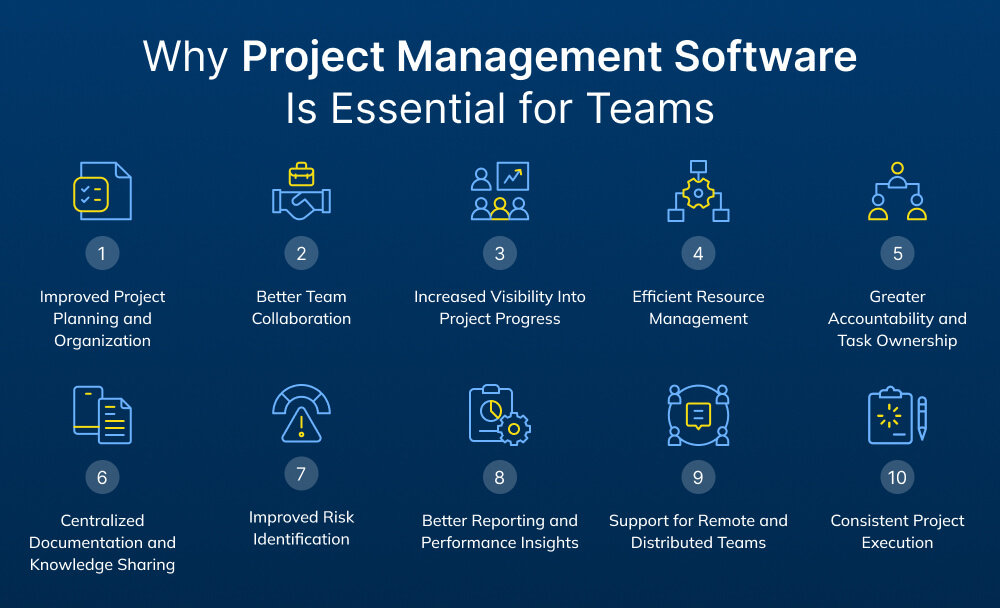
Project management platforms help organizations manage tasks, track progress, allocate resources, and coordinate teams through a centralized system. These Advantages of project management software make them essential for organizations aiming to improve project outcomes. Below are some key reasons organizations rely on project management software.
1. Improved Project Planning and Organization
One of the most important benefits of project management software is its ability to support structured project planning. These platforms allow project managers to break down complex initiatives into smaller tasks, define dependencies, and create realistic project timelines.
Features such as Gantt charts, Kanban boards, and project roadmaps help teams visualize project activities and understand how different tasks are connected. This structured approach makes it easier to identify potential scheduling conflicts and ensure that tasks are completed in the correct sequence.
| Before:
Tasks in emails, no clear start dates, conflicting priorities |
After
Sequenced tasks with dependencies and visual timelines |
PMI: Strong planning directly improves schedule and budget outcomes
2. Better Team Collaboration
Modern projects often involve collaboration between multiple teams, departments, or even organizations. When communication occurs across multiple channels, such as email, messaging apps, and spreadsheets, it can become difficult to maintain alignment across the project.
Project management software centralizes communication by allowing team members to discuss tasks, share documents, and update project progress within a single platform. This improves coordination and ensures that everyone involved in the project has access to the same information.
Productivity expert David Allen, author of Getting Things Done, emphasizes the importance of structured systems for managing work and responsibilities effectively:
“Your mind is for having ideas, not holding them.”
By organizing project tasks and communications within a digital system, teams reduce mental overload and focus more effectively on execution.
| Before:
Decisions buried in email chains, team members out of sync |
After
All communication in one place, everyone aligned in real time |
3. Increased Visibility Into Project Progress
Maintaining visibility into project progress is one of the biggest challenges faced by project managers. Without clear tracking systems, managers may struggle to determine whether a project is progressing according to schedule.
Project management software addresses this challenge by providing dashboards, reporting tools, and real-time progress indicators. These features allow managers to monitor project performance and identify potential issues early.
For example, dashboards may display key project metrics such as:
- Percentage of tasks completed
- Upcoming deadlines
- Overdue tasks
- Milestone completion status
- Resource utilization
These insights allow project managers to detect delays or bottlenecks before they escalate into major project risks.
| Before:
No idea what’s on track until a deadline is missed |
After
Dashboard shows progress, blockers, and risks in real time |
Wellingtone: Digital tools are now the standard for project performance monitoring
4. Efficient Resource Management
Projects often require coordination of multiple resources, including team members, equipment, budgets, and external vendors. Managing these resources manually can lead to scheduling conflicts, uneven workloads, and inefficient use of available resources.
| The Association for Project Management (APM) emphasizes that effective resource management ensures that people, time, and materials are used efficiently to support project objectives. |
Project management software helps managers allocate resources more effectively by providing visibility into team capacity and workload distribution.
For example, if one team member is already assigned several high-priority tasks, project management software can help managers redistribute work to prevent overload. Similarly, if certain resources are underutilized, tasks can be reassigned to maintain productivity.
Efficient resource planning not only improves project performance but also helps organizations control costs and avoid unnecessary delays.
| Before:
One person is overwhelmed, another is underutilised – no one knows |
After
Workloads are visible and balanced across the full team |
5. Greater Accountability and Task Ownership
One of the most common causes of project delays is unclear responsibility. When tasks are not assigned to specific individuals, it becomes difficult to track progress and hold team members accountable.
Project management software helps address this challenge by assigning tasks to individual team members and clearly defining deadlines, priorities, and dependencies.
Each team member can see the tasks they are responsible for and track their progress through the project dashboard. Managers can also monitor task completion and identify delays in real time.
Management expert Peter Drucker highlighted the importance of measurable performance in organizational success when he stated:
“What gets measured gets managed.”
Project management software supports this principle by providing measurable indicators for task completion, project progress, and team performance.
| Before:
Tasks assigned loosely in meetings, easily forgotten or duplicated |
After
Every task has an owner, a due date, and a trackable status |
6. Centralized Documentation and Knowledge Sharing
Projects generate large volumes of documentation, including requirements documents, design files, meeting notes, and project reports. When these materials are stored across multiple systems, teams may struggle to locate the most current version of important information.
| Improved knowledge sharing through digital collaboration tools can significantly improve productivity. According to a study by McKinsey, teams that actively share knowledge and collaborate show a 20% increase in overall productivity. |
Project management software solves this problem by providing centralized document storage within the project workspace. Files can be uploaded, organized, and shared within specific project tasks or folders.
This centralized repository ensures that team members always have access to the latest information and reduces the risk of errors caused by outdated documents.
| Before:
Docs scattered across drives, inboxes, and personal folders |
After
Single repository, everyone accesses the same current versio |
7. Improved Risk Identification
Every project involves uncertainty, and risks can arise at any stage of execution. These risks may include schedule delays, resource shortages, or unexpected technical challenges.
Project management software helps teams identify risks earlier by providing visibility into task dependencies and project timelines. When one task is delayed, the system can highlight how the delay may affect other activities within the project schedule.
Early identification of risks allows project managers to take corrective action, such as reallocating resources or adjusting project schedules.
Research by Oxford University professor Bent Flyvbjerg, known for studying large infrastructure projects, shows that many project failures occur because risks are underestimated during planning stages.
| Before:
Risks discovered only after deadlines are broken |
After
Dependency alerts flag risks early enough to act on them |
8. Better Reporting and Performance Insights
Project management software enables organizations to track project performance through detailed reporting and analytics tools. These reports provide valuable insights into how projects are progressing and where improvements may be needed.
Managers can generate reports on key performance indicators such as:
- Project completion rates
- Team productivity
- Milestone performance
- Budget utilization
- Schedule adherence
These insights allow organizations to make data-driven decisions and continuously improve project management practices.
| Before:
Status updates are prepared manually, always a week behind reality |
After
Live reports on KPIs, milestones, and budget, always current |
Gartner: Digital PM tools improve operational visibility and decision-making
9. Support for Remote and Distributed Teams
The shift toward remote and hybrid work has fundamentally changed how project teams operate. Many organizations now manage teams spread across multiple cities, time zones, and even continents. Coordinating work in this environment without a centralized digital system creates serious gaps in communication and accountability.
Project management software enables distributed teams to stay aligned by providing shared dashboards, task boards, real-time status updates, and integrated communication tools, all accessible from anywhere.
According to Buffer’s State of Remote Work report, one of the most consistently cited challenges among remote workers is difficulty with collaboration and communication. Project management platforms directly address this by ensuring that every team member, regardless of location, is working from the same task list, priorities, and project timeline.
For global organizations managing cross-functional projects, this capability is not optional; it is essential. A team in Bangalore and a stakeholder in London can review the same project dashboard, comment on the same task, and track the same milestone without a single email thread..
| Before:
Remote team members out of the loop; updates only via calls |
After
Every team member sees live progress regardless of location |
10. Consistent Project Execution
Organizations that manage multiple projects simultaneously often struggle to maintain consistency across teams. Without standardized workflows, each project team may follow different processes, leading to inefficiencies and inconsistent outcomes.
| Research from the Standish Group CHAOS Report, which analyzes project outcomes worldwide, highlights the importance of structured project management practices in improving project success rates. |
Project management software helps organizations establish standardized workflows, templates, and reporting structures that ensure projects follow consistent processes.
Standardization improves project governance and makes it easier for organizations to replicate successful practices across multiple projects.
| Before:
Each team runs projects differently; no shared standards |
After
Uniform workflows and templates across all teams and projects |
Real-World Example: How Spotify Uses Project Management Tools to Coordinate Product Development
Spotify runs hundreds of simultaneous product initiatives across engineering teams in Stockholm, New York, London, and Boston. Without a structured system, coordinating that volume of parallel work would be operationally impossible.
Their engineering org is built around squads, small cross-functional teams of 6 to 12 people, each owning a specific product area like search, personalization, or podcast discovery. To coordinate work across these teams, Spotify uses Jira for sprint and task tracking and Confluence for documentation and knowledge sharing.
In practice, this means:
- Squads run two-week sprints with clear task boards and milestone targets
- Product managers maintain live roadmaps showing development status across all squads
- Dependency tracking flags where one squad’s delay could block another team’s progress
- Release coordination happens through shared project timelines, not email chains
As Spotify scaled to 180+ countries, this structured approach allowed their engineering organization to grow in headcount without losing speed or alignment, a direct competitive advantage.
Source: Spotify Engineering Culture
Conclusion
Managing projects effectively requires more than simply assigning tasks and tracking deadlines. As projects become larger and more complex, teams must coordinate multiple activities, manage dependencies, allocate resources efficiently, and maintain clear communication across stakeholders. Without structured systems in place, organizations may face delays, communication gaps, and limited visibility into project progress. This is exactly why use project management software has become an important consideration for organizations aiming to improve execution.
For professionals who want to build strong project management capabilities and manage projects effectively using structured frameworks and tools, formal training can be highly valuable. Programs such as Project Management Professional (PMP) Certification Training offered by Invensis Learning provide comprehensive knowledge in project planning, scheduling, risk management, stakeholder communication, and project governance.