



Your DevOps pilot succeeded brilliantly. A small team of passionate engineers achieved remarkable results: deployment frequency increased tenfold, lead times dropped from weeks to hours, and the quality of releases improved dramatically. Leadership celebrated the win and issued a new mandate: scale DevOps across the entire organization. That’s when the real challenge began.
Scaling DevOps from a single team to hundreds of developers across multiple business units represents one of the most complex transformations enterprises undertake. According to the State of DevOps Report, while 83% of organizations have adopted DevOps practices in some capacity, only 28% report successfully scaling these practices enterprise-wide. The gap between pilot success and organizational transformation remains stubbornly wide.
The stakes couldn’t be higher. Organizations that successfully scale DevOps achieve 208 times more frequent code deployments, 106 times faster lead time from commit to deploy, and recover from incidents 2,604 times faster than low performers. Yet the path from isolated success to enterprise-wide transformation is littered with obstacles: entrenched legacy systems, organizational silos, security and compliance concerns, and cultural resistance to change.
This comprehensive guide presents 10 expert tips for scaling DevOps successfully, drawn from organizations that have navigated this journey. Whether you’re just beginning to expand beyond your initial DevOps team or struggling to overcome scaling plateaus, these proven strategies will help you build sustainable, enterprise-wide DevOps capabilities that deliver measurable business value.
Table of Contents:
- Understanding DevOps at Scale
- 10 Expert Tips for Scaling DevOps
- Essential Tools for Scaling DevOps
- Common Pitfalls When Scaling DevOps
- Conclusion
- Frequently Asked Questions
Understanding DevOps at Scale
What Does Scaling DevOps Mean?
Scaling DevOps extends far beyond simply adding more people to successful practices. True DevOps scaling means replicating the speed, quality, and collaboration achievements of high-performing teams across diverse technology stacks, organizational structures, and business contexts while maintaining the cultural principles that initially made DevOps successful.
At scale, DevOps must accommodate multiple simultaneous considerations: hundreds or thousands of developers working on interconnected systems, diverse technology platforms ranging from modern cloud-native applications to legacy mainframes, complex regulatory and compliance requirements spanning multiple jurisdictions, and distributed teams across geographies, time zones, and organizational boundaries. The challenge lies in maintaining DevOps’ core benefits, speed, quality, collaboration, and continuous improvement, while navigating this complexity.
Scaling DevOps also means evolving from artisanal, team-specific practices to standardized, repeatable patterns that work across the organization. This doesn’t mean rigid uniformity that stifles innovation, but rather establishing common platforms, guardrails, and practices that enable teams to move fast safely. Think of it as creating highways with clear lanes and rules rather than everyone forging their own paths through the wilderness.
Why Organizations Struggle to Scale DevOps
Despite DevOps’ proven benefits, most organizations encounter predictable obstacles when scaling. Cultural resistance tops the list; teams comfortable with traditional development approaches resist new ways of working, viewing DevOps as additional work rather than an improvement. Organizational silos persist, with development, operations, security, and business units maintaining separate priorities, metrics, and incentives that undermine collaboration.
Technical debt and legacy systems create enormous friction. Modern DevOps practices built for cloud-native microservices don’t translate easily to decades-old monolithic applications running on proprietary platforms. Organizations must simultaneously modernize legacy estates while building new capabilities, a dual transformation that strains resources and patience.
Toolchain proliferation becomes overwhelming at scale. What worked for one team, their specific CI/CD pipeline, monitoring solution, and collaboration tools, multiplies chaotically as more teams adopt DevOps. Soon, the organization supports dozens of overlapping tools, creating integration nightmares, security vulnerabilities, and escalating costs. Finally, skills gaps widen as scaling demands outpace the organization’s ability to develop DevOps expertise across engineering, operations, and leadership ranks.
10 Expert Tips for Scaling DevOps
1. Start with Culture, Not Tools
The most common mistake organizations make when scaling DevOps is leading with technology. They invest millions in CI/CD platforms, container orchestration, and monitoring tools, then wonder why transformation stalls. The uncomfortable truth is that tools amplify culture; they make good cultures better and dysfunctional cultures worse.
Successfully scaling DevOps requires cultivating specific cultural attributes across the organization. Psychological safety enables teams to take calculated risks, experiment, and learn from failures without fear of punishment. When engineers worry that incidents will result in blame and career damage, they become risk-averse, slowing innovation and hiding problems until they become crises.
Blameless post-mortems transform incidents from finger-pointing exercises into learning opportunities. After outages or issues, elite DevOps organizations focus exclusively on understanding what happened, why systems or processes failed to prevent it, and what improvements will reduce future risk. This requires leadership discipline—when executives demand someone’s head after major incidents, they destroy the trust required for continuous improvement.
Cross-functional collaboration breaks down silos between development, operations, security, and business teams. Scaling DevOps means embedding this collaboration into organizational structure through shared objectives and metrics, cross-functional teams with end-to-end ownership, regular informal communication channels, and rotation programs that build empathy and understanding. A developer who has spent time on-call supporting production systems makes different design decisions, ones that consider operational reality alongside functional requirements.
Continuous learning and experimentation must become organizational habits. Elite DevOps organizations dedicate time to learning, whether through formal training, conference attendance, or experimentation with emerging technologies. They celebrate intelligent failures that generate insights, not just successes. Scaling this culture means making learning expectations explicit, allocating resources for development, and modeling learning behaviors at leadership levels.
Leaders play a decisive role in cultural transformation. When executives talk about speed but punish reasonable risks, when they demand collaboration but maintain siloed incentives, when they praise learning but never allocate time for it, culture change fails. Scaling DevOps culture requires authentic leadership commitment demonstrated through decisions, resource allocation, and personal behavior, not just words.
2. Implement Platform Engineering
Platform engineering has emerged as the critical enabler for scaling DevOps beyond small teams. Rather than expecting every development team to become experts in Kubernetes, security scanning, observability, and infrastructure management, platform engineering creates curated, self-service capabilities that abstract complexity while maintaining flexibility.
A well-designed internal developer platform (IDP) provides golden paths, opinionated, well-supported ways to build and deploy applications that incorporate organizational standards for security, compliance, observability, and operations. Developers choose from these golden paths rather than building everything from scratch, dramatically accelerating delivery while ensuring consistency.
Effective platform engineering balances three competing demands: providing sufficient abstraction that developers focus on business logic rather than infrastructure, maintaining enough flexibility for teams with specialized needs, and ensuring the platform itself doesn’t become a bottleneck or single point of failure. The best platforms are thin layers that compose existing tools thoughtfully rather than monolithic systems that replace everything.
Platform teams should adopt product thinking, treating internal developers as customers. This means understanding developer pain points through research and feedback, measuring platform adoption and satisfaction, iterating based on usage patterns and requests, and providing documentation, training, and support. When platform teams view themselves as service providers rather than governance gatekeepers, adoption accelerates and scaling becomes sustainable.
Key platform capabilities include standardized CI/CD pipelines with templates for common application types, infrastructure as code patterns and modules, automated security scanning and compliance checks, integrated observability and monitoring, environment provisioning and management, secrets management and service authentication, and service mesh or API gateway capabilities. Critically, platforms should provide these capabilities as self-service, developers use them without requiring tickets, approvals, or hand-offs.
Organizations successfully scaling DevOps increasingly organize around platform engineering, dedicating teams to building and maintaining internal platforms that multiply the effectiveness of product development teams. This investment in developer experience and productivity pays dividends as the organization grows.
| PRO TIP
Don’t Build Your Platform from Scratch Many organizations waste years building custom internal platforms when excellent open-source foundations exist. Start with established platforms like Backstage (Spotify’s developer portal), Humanitec, or Port, then customize for your needs. Focus your engineering effort on organization-specific capabilities rather than rebuilding commodity functionality. This accelerates time-to-value and allows platform teams to concentrate on developer experience rather than infrastructure plumbing. |
3. Standardize with Flexibility: The 80/20 Approach
Scaling DevOps requires finding the delicate balance between standardization and flexibility. Pure standardization, mandating that every team use identical tools and processes, stifles innovation and ignores legitimate technical differences. Pure flexibility, letting every team choose their own tools and approaches, creates chaos, security vulnerabilities, and unsustainable operational complexity.
The 80/20 approach provides the answer: standardize the 80% of capabilities that are truly commodity and offer little competitive differentiation, while preserving flexibility for the 20% where innovation and specific technical requirements matter. For example, standardize CI/CD platforms, base container images, logging and monitoring infrastructure, authentication and authorization systems, and security scanning tools. These are foundational capabilities where duplication wastes resources without providing value.
Preserve flexibility where it matters: programming languages and frameworks suited to specific problems, application architectures aligned with business requirements, specialized tools for unique technical challenges, and experimentation with emerging technologies. The key is making flexibility intentional rather than accidental, teams should justify deviations from standards based on technical requirements, not just preference.
Implementation patterns that support this balance include creating approved technology stacks for common use cases with clear migration paths between them, establishing architecture review processes focused on learning and guidance rather than rigid gatekeeping, building platforms that support multiple programming languages and frameworks, and documenting decision frameworks that help teams evaluate when to use standards versus custom approaches.
Organizations should also establish paved roads and dirt paths. Paved roads are fully supported, well-documented golden paths where teams move fastest. Dirt paths are allowed but teams accept greater responsibility for support and maintenance. This gives teams real choice while making trade-offs explicit.
Regularly review standardization decisions as technology and organizational needs evolve. Standards that made sense three years ago may now create unnecessary constraints. Conversely, areas that once required flexibility may have matured to the point where standardization makes sense. Scaling DevOps successfully means maintaining living standards that adapt to changing reality.
4. Automate Security with DevSecOps
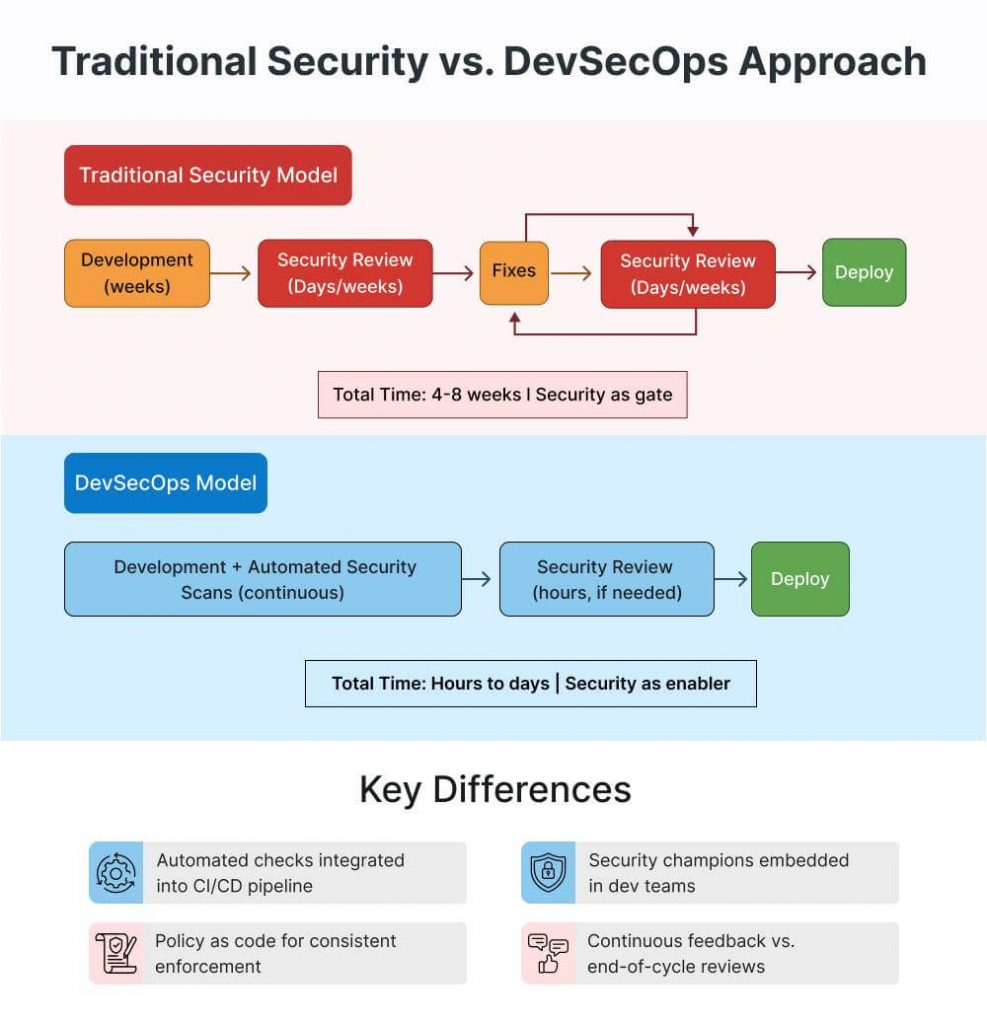
Security concerns consistently rank among the top barriers to scaling DevOps. Traditional security models, lengthy review processes before releases, security as a separate phase after development, and security teams as gatekeepers simply cannot keep pace with DevOps’ speed. The answer isn’t choosing between speed and security but integrating security directly into DevOps practices through DevSecOps.
Shift security left by integrating security checks early in development rather than at deployment time. This includes automated security scanning in CI/CD pipelines that fail builds when vulnerabilities exceed acceptable thresholds, secrets scanning that prevents credentials from being committed to repositories, dependency vulnerability scanning that flags risky open-source components, and infrastructure as code security scanning that catches misconfigurations before deployment.
These automated checks provide fast feedback, developers learn about security issues within minutes while context is fresh, not weeks later during a security review. Fast feedback enables fast fixes, keeping development velocity high while improving security outcomes.
Policy as code transforms security requirements from documents into executable tests. Instead of security teams manually reviewing configurations against lengthy PDFs, policies encode requirements that automatically evaluate every change. Tools like Open Policy Agent (OPA), Checkov, and cloud-native policy engines enable this approach. Policy as code ensures consistent application of security standards, provides audit trails automatically, and enables security to scale without growing security teams proportionally.
Security champions programs embed security expertise directly into development teams. Rather than centralizing all security knowledge in a separate team, security champions are developers who receive additional security training and serve as the first line of defense within their teams. They answer security questions, review risky changes, and facilitate communication with central security teams. This model scales security knowledge while maintaining development velocity.
Fundamentally, DevSecOps requires cultural shift alongside technical practices. Security teams must transition from gatekeepers to enablers, providing tools, training, and guidance that help developers build secure systems. Developers must accept security as their responsibility, not something delegated to specialists. When security becomes everyone’s job, supported by automation and expertise, organizations can scale DevOps without creating security vulnerabilities.
5. Embrace Infrastructure as Code (IaC) Enterprise-Wide
Infrastructure as Code transforms infrastructure from manual, snowflake configurations into version-controlled, testable, repeatable definitions. At small scale, IaC provides consistency and speed. At enterprise scale, IaC becomes essential, without it, managing diverse environments across multiple platforms becomes impossible.
Comprehensive IaC adoption means treating all infrastructure as code: compute resources (VMs, containers, serverless functions), network configurations (VPCs, subnets, security groups, load balancers), storage systems, databases and data platforms, monitoring and logging infrastructure, and security policies and access controls. When everything is code, everything becomes testable, reviewable, and reproducible.
Organizations successfully scaling DevOps typically standardize on IaC tools aligned with their infrastructure. Terraform dominates in multi-cloud environments thanks to its broad provider support and mature ecosystem. Cloud-native tools like AWS CloudFormation, Azure Resource Manager, or Google Cloud Deployment Manager work well for organizations committed to a single cloud. Pulumi attracts teams preferring general-purpose programming languages over domain-specific languages.
The choice matters less than consistent adoption and the development of organizational expertise. Platform engineering teams should provide IaC modules and patterns that encode best practices: reusable modules for common infrastructure patterns, templates for standard application environments, testing frameworks for validating IaC changes, and CI/CD pipelines that apply IaC through automated workflows.
GitOps extends IaC principles to application deployment and operations. Git becomes the single source of truth for both infrastructure and application desired state, with automated systems continuously reconciling the actual state with Git. GitOps provides powerful benefits at scale: complete audit trail of all changes, easy rollback to any previous state, consistent deployment patterns across environments, and separation of concerns between defining desired state and implementing it.
Critical to enterprise IaC success is establishing governance without gatekeeping. This means automated policy enforcement that prevents dangerous configurations, required reviews for infrastructure changes affecting shared resources, and establishes clear ownership boundaries for different infrastructure components. Teams should be able to provision infrastructure self-service within guardrails, not wait days for infrastructure teams to execute changes manually.
6. Invest in Observability, Not Just Monitoring
Traditional monitoring, collecting metrics, setting thresholds, and alerting when exceeded, served well in simpler times when applications were monolithic and deployment frequency measured in months. Modern distributed systems with hundreds of microservices deployed multiple times daily require a fundamentally different approach: observability.
Observability means understanding system internal states by examining external outputs. While monitoring answers known questions (“Is CPU usage above 80%?”), observability enables exploring unknown questions (“Why are checkout transactions suddenly slow for users in Europe?”). This distinction becomes critical at scale, where the variety of potential failure modes explodes beyond what predefined monitors can anticipate.
The three pillars of observability provide comprehensive visibility: Metrics aggregate numerical data over time (response times, error rates, throughput), enabling trend analysis and capacity planning. Logs capture discrete events with context, essential for debugging specific incidents and understanding behavior. Traces follow requests across distributed systems, revealing how different services interact and where delays occur.
Elite observability goes beyond collecting data to enabling rapid investigation. This requires structured logging with consistent formats and rich context that make logs machine-parsable, distributed tracing that connects related events across services, showing complete request flows, high-cardinality data that preserves detailed dimensions enabling precise filtering, and unified platforms that correlate metrics, logs, and traces, allowing investigators to move seamlessly between them.
Organizations scaling DevOps must democratize observability, make it accessible to all engineers, not just specialists. This means intuitive interfaces that don’t require learning complex query languages, pre-built dashboards for common questions and services, alerts that provide actionable context, not just symptoms, and documentation and training that build organizational capability.
Service Level Objectives (SLOs) provide the framework for meaningful observability at scale. Rather than monitoring everything, organizations define SLOs that capture the user experience from the customer perspective: latency (95th percentile response time under 200ms), availability (99.9% of requests succeed), and data freshness (reports reflect data that is less than 5 minutes old). Teams then monitor SLO compliance and establish error budgets that balance velocity with reliability.
Modern observability platforms like Datadog, New Relic, Dynatrace, or open-source solutions like Grafana, Prometheus, and Jaeger provide the foundation. The key is selecting platforms that integrate with your technology stack, scale to your data volumes, and enable self-service investigation without requiring observability expertise.
7. Establish a Center of Excellence (CoE) for Knowledge Sharing
Scaling DevOps across hundreds of teams inevitably leads to duplicated effort, inconsistent practices, and missed learning opportunities. Organizations that scale successfully establish DevOps Centers of Excellence (CoEs) that accelerate adoption while preserving team autonomy.
A DevOps CoE is not a command-and-control organization that mandates practices top-down. Instead, it serves as a hub for expertise, guidance, and community, multiplying effectiveness across teams. The CoE’s mission is enabling teams to succeed with DevOps, not enforcing compliance with rigid standards.
Core CoE responsibilities include curating and sharing best practices by documenting patterns that have proven successful across teams, publishing reference architectures and implementation guides, and maintaining a knowledge base of lessons learned and solutions to common problems. The CoE also provides training and enablement through workshops on DevOps practices and tools, pairing with teams during initial implementation, and coaching to help teams overcome specific challenges.
The CoE drives tool evaluation and governance by assessing tools and recommending solutions that fit organizational needs, negotiating enterprise licensing that achieves cost efficiency, and providing integration guidance for approved tools. They facilitate community and collaboration by organizing regular DevOps forums where teams share experiences, creating communication channels for real-time knowledge sharing, and celebrating successes to maintain momentum and morale.
Critically, successful CoEs maintain a servant leadership mindset. They exist to help teams succeed, not to control them. CoE members spend significant time embedded with product teams, understanding challenges firsthand rather than issuing guidance from ivory towers. This credibility, built through hands-on experience solving real problems, makes CoE advice trusted and adopted.
Measuring CoE effectiveness differs from traditional governance metrics. Instead of tracking compliance percentages, elite CoEs measure adoption velocity (how quickly teams implement recommended practices), self-sufficiency (decreasing need for CoE intervention over time), satisfaction (teams view CoE as valuable partner, not bureaucratic burden), and business outcomes (improved deployment frequency, reliability, and lead times across adopting teams).
Organizations should staff CoEs with practitioners, not just managers. The most effective CoE members are engineers who have successfully implemented DevOps, understand technical reality, and maintain respect among engineering ranks. Rotation programs that bring team members into the CoE for periods, then return them to product teams, keep CoE expertise current while spreading knowledge organizationally.
8. Implement Progressive Delivery with Feature Flags
At scale, traditional big-bang releases become impossibly risky. Elite DevOps organizations embrace progressive delivery, gradually rolling out changes while monitoring impact and retaining the ability to quickly revert if problems emerge. Feature flags provide the technical foundation for this approach.
Feature flags (also called feature toggles) decouple deployment from release. Code ships to production in a dormant state, activated selectively through configuration. This simple concept enables powerful capabilities at scale: deploying code continuously without exposing features to users, testing in production with real data and infrastructure, gradually rolling out features to percentage-based cohorts, and instantly disabling problematic features without redeploying code.
Progressive delivery patterns include canary releases that expose changes to a small percentage of users first, gradually increasing the percentage while monitoring metrics. If metrics degrade, automatic rollback protects most users. Blue-green deployments maintain two identical production environments, routing traffic to the new version only after validation, with instant rollback by redirecting to the previous environment.
A/B testing evaluates different feature implementations with real users, measuring impact on business metrics to guide decisions. Feature flags enable running A/B tests in production at scale, comparing not just user interfaces but entire implementation approaches. Ring-based deployment releases changes to progressively larger user populations: initially to internal users and beta testers, then to early adopters, then to general population. Each ring provides validation before expanding scope.
At enterprise scale, feature flag management requires dedicated platforms like LaunchDarkly, Split, or Harness Feature Flags that provide centralized flag management across services, targeting rules based on user attributes, team, region, etc., and integration with observability to correlate flag changes with metrics. Organizations should establish flag lifecycle governance to prevent flag proliferation that creates technical debt: require cleanup plans when creating flags, automatically alert when flags remain unchanged for extended periods, and mandate regular flag hygiene reviews removing obsolete flags.
Feature flags transform how organizations think about risk. Rather than trying to eliminate risk through exhaustive pre-production testing (impossible at DevOps speed), progressive delivery accepts that issues will occur but contains blast radius and enables rapid response. This mindset shift enables the deployment frequencies that characterize elite DevOps performance.
| PRO TIP
Separate Deployment Flags from Business Feature Flags Organizations often conflate two distinct types of flags: deployment flags (temporary, technical, removed after rollout) and business feature flags (long-lived, control business logic, may remain indefinitely). Treat these differently. Deployment flags should have automatic expiration and cleanup processes. Business feature flags need governance, documentation, and ownership. Mixing these creates confusion and technical debt. Consider using different flag naming conventions or even separate systems to maintain this distinction. |
9. Measure What Matters: DORA Metrics and Beyond
“What gets measured gets managed” applies powerfully to scaling DevOps. Without clear metrics, organizations cannot assess progress, identify bottlenecks, or demonstrate value to skeptical stakeholders. The DORA (DevOps Research and Assessment) metrics provide the gold standard framework, but effective measurement extends beyond these four core indicators.
The four DORA metrics capture DevOps performance comprehensively: Deployment Frequency measures how often organizations successfully release to production, with elite performers deploying on-demand, multiple times daily. Lead Time for Changes tracks the time from code commit to successful production deployment, with elite performers achieving less than one hour. Mean Time to Recovery (MTTR) measures how quickly service is restored after incidents, with elite performers recovering in less than one hour. Change Failure Rate calculates the percentage of changes that result in degraded service or require remediation, with elite performers maintaining rates below 15%.
Organizations scaling DevOps should establish baseline measurements before transformation, then track improvements over time. However, avoid common measurement pitfalls: gaming metrics by optimizing for measurements rather than outcomes, comparing teams to shame poor performers rather than share learnings, focusing solely on speed metrics while ignoring quality and stability, and collecting metrics without acting on insights they reveal.
Beyond DORA metrics, comprehensive DevOps measurement includes infrastructure metrics (infrastructure provisioning time, environment consistency, infrastructure as code coverage), quality metrics (automated test coverage, production bug escape rate, security vulnerability resolution time), team health metrics (developer satisfaction, on-call burden, toil percentage), and business outcome metrics (time to market for features, customer satisfaction impact, revenue per engineer).
Establishing measurement practices requires investment in tooling and data infrastructure that can automatically collect and aggregate metrics across teams, dashboards that make metrics visible to all stakeholders, regular metric review sessions that turn data into action, and correlation analysis that connects DevOps metrics to business outcomes.
Organizations should create different metric views for different audiences. Engineers need detailed, actionable metrics for specific services. Team leads need comparative metrics across teams to identify where help is needed. Executives need aggregate metrics showing organizational progress and ROI. Platform teams need metrics on platform adoption and effectiveness.
Finally, recognize that metrics evolve as DevOps maturity increases. Early-stage adoption focuses on deployment frequency and lead time. Can teams ship faster? Mid-stage focuses on reliability metrics. Can teams maintain quality while moving fast? Advanced stages incorporate business outcome metrics. Does DevOps velocity translate to market success? Adjust measurement frameworks as organizational needs evolve.
10. Build for Legacy: Strategies for Brownfield Transformation
The advice so far assumes modern, cloud-native applications. Reality for most enterprises includes significant legacy systems, mainframes, monolithic applications, proprietary platforms, that cannot be ignored during DevOps scaling. The “strangler fig pattern” and other brownfield strategies enable organizations to extend DevOps practices even to older systems.
The strangler fig pattern gradually replaces legacy systems by incrementally building new capabilities around old systems, intercepting calls and routing them to new implementations, gradually migrating functionality until legacy system serves minimal purpose, and eventually retiring legacy system completely. This approach allows organizations to deliver value continuously rather than waiting years for complete rewrites.
API-first modernization wraps legacy systems with modern APIs that expose functionality through well-defined interfaces, enable new applications to integrate without touching legacy code, allow gradual migration of functionality to modern implementations, and provide abstraction layer that makes future changes easier. Even systems that cannot be rewritten can participate in DevOps workflows through API integration.
Database refactoring patterns address one of the hardest brownfield challenges. Strategies include creating read replicas for reporting and analytics, implementing Change Data Capture (CDC) to stream changes to modern systems, using database views to present modern schemas over legacy structures, and gradually extracting bounded contexts into separate databases supporting microservices.
Organizations should also establish dual-track transformation: maintain “lights on” operations for legacy systems with stable, predictable processes, while building greenfield capabilities with modern DevOps practices, and creating interfaces between old and new that enable coexistence. This prevents transformation from grinding to halt while waiting for legacy modernization.
Cultural approaches matter as much as technical patterns. Teams maintaining legacy systems often feel left behind during DevOps transformations. Include them by applying DevOps principles where possible (automated testing, deployment automation, monitoring improvements), celebrating improvements to legacy systems, not just greenfield work, providing training and rotation opportunities into modern stacks, and establishing clear modernization roadmaps so teams understand the future.
Some legacy systems justify complete rewrites, but these are riskier and slower than incremental approaches. Before committing to rewrites, consider whether legacy system limitations actually block business objectives, new system can truly be built faster than incremental modernization, organization has successfully executed similar rewrites previously, and business can wait years for rewrite completion without competitive disadvantage.
The reality is that legacy systems will persist in most enterprises for decades. Organizations that successfully scale DevOps don’t let legacy systems prevent transformation—they develop strategies to include legacy in the DevOps journey while steadily modernizing where it makes business sense.
Success Story: DevOps at One of the World’s Largest BanksClient: Global Financial Services Corporation (45,000 employees) Industry: Banking & Financial Services Challenge: Scale DevOps practices across 400 development teams supporting a mix of modern cloud applications and 30-year-old mainframe systems Solution: Implemented a comprehensive scaling strategy, including a platform engineering team providing self-service capabilities, a DevOps CoE providing training and guidance, a strangler fig pattern wrapping mainframe functions with microservices, progressive delivery with feature flags across all applications, and a DORA metrics dashboard tracking progress across all teams Results:
|
Essential Tools for Scaling DevOps
While culture and practices matter more than tools, successful scaling requires thoughtful technology selection. Organizations scaling DevOps typically standardize on platforms in several categories.
CI/CD Platforms: Jenkins remains popular among organizations that require maximum flexibility and self-hosting. GitLab and GitHub Actions provide integrated experiences combining source control and CI/CD. CircleCI and Travis CI offer managed solutions. At enterprise scale, consider platforms like Harness, CloudBees, or Azure DevOps that provide governance, security, and visibility across hundreds of pipelines.
Container Orchestration: Kubernetes has become the de facto standard for container orchestration at scale. Managed Kubernetes services (Amazon EKS, Azure AKS, Google GKE) reduce operational burden. Organizations should implement service mesh technology (Istio, Linkerd) for advanced traffic management, security, and observability as they scale beyond dozens of microservices.
Infrastructure as Code: Terraform dominates multi-cloud IaC with its broad provider ecosystem. Pulumi attracts teams preferring general-purpose programming languages. Cloud-native tools (CloudFormation, Azure Resource Manager) work well for single-cloud organizations. Terragrunt or Terraspace adds enterprise features to Terraform.
Observability: Modern observability platforms such as Datadog, New Relic, and Dynatrace offer comprehensive solutions. Organizations seeking open-source alternatives typically combine Prometheus for metrics, Grafana for visualization, Loki for logs, and Jaeger or Tempo for tracing. Vendor selection should emphasize query performance at scale, cost predictability with high data volumes, and integration with existing technology stacks.
Security: Integrate tools like Snyk, Aqua Security, or Prisma Cloud for container and dependency scanning. HashiCorp Vault for secrets management. Open Policy Agent for policy as code. Cloud-native security tools (AWS Security Hub, Azure Security Center, Google Security Command Center) for cloud infrastructure.
Feature Flags: LaunchDarkly, Split, and Harness Feature Flags lead the managed solutions space. Open-source alternatives include Unleash and Flagsmith. Selection criteria should include SDKs for your programming languages, integration with observability platforms, and governance features for enterprise use.
The key is not selecting best-of-breed tools in every category but creating an integrated toolchain that works cohesively, provides unified visibility, and doesn’t overwhelm teams with complexity.
Common Pitfalls When Scaling DevOps
Even organizations following best practices encounter predictable obstacles. Recognizing these pitfalls helps avoid or overcome them.
Pitfall: Treating DevOps as a Team or Role
Creating “DevOps teams” that sit between development and operations recreates the silos DevOps aims to eliminate. DevOps is a culture and practice that all teams adopt, not a role or organizational unit. Build platform teams that enable DevOps, not DevOps teams that create new bottlenecks.
Pitfall: Tool Proliferation Without Standards
Allowing every team to choose their own tools creates integration nightmares, security gaps, and unsustainable complexity. Establish approved tool categories with clear selection criteria. Provide flexibility within guardrails while preventing chaos through thoughtful governance.
Pitfall: Ignoring the Human Side of Transformation
Technical changes without addressing culture, skills, and incentives create resistance that stalls transformation. Invest in training, coaching, and change management. Align incentives with desired behaviors. Create a culture of psychological safety that enables risk-taking and learning.
Pitfall: Scaling Too Fast
Attempting to transform hundreds of teams simultaneously spreads expertise too thin and creates overwhelming change fatigue. Start with high-performing teams, demonstrate success, build capabilities, then expand progressively. Sustainable transformation takes years, not months.
Pitfall: Measuring Vanity Metrics
Tracking metrics that look good but don’t reflect meaningful progress wastes effort and misleads stakeholders. Focus on outcomes, deployment frequency, reliability, lead time, that directly connect to business value. Ensure metrics drive action, not just reporting.
| ⚠ AVOID THIS MISTAKE
Mandating DevOps Without Providing Support The fastest way to kill DevOps transformation is issuing top-down mandates“Everyone will use Jenkins and Kubernetes” without providing training, documentation, support, or clear success criteria. Teams forced to adopt practices they don’t understand become frustrated and cynical. Why it’s problematic: Mandates without enablement create compliance theater, teams go through motions to check boxes without achieving real transformation. Frustration builds, quality suffers, and leadership loses credibility. What to do instead: Combine clear direction with robust support. Establish the “what” and “why” while providing flexibility on “how.” Invest in comprehensive training programs, hands-on coaching from experts, detailed documentation and reference implementations, and communities where teams can learn from each other. Make adopting DevOps easier than resisting it by removing obstacles and providing help. |
TAKE THE NEXT STEP
Master DevOps with Professional Certification Training
Transform your DevOps capabilities with industry-recognized certification programs from Invensis Learning. Our expert-led courses provide the skills, knowledge, and credentials to lead successful DevOps transformations.
What you’ll gain:
- DevOps Foundation Certification – Build a comprehensive understanding of DevOps principles and practices
- DevOps Master Certification – Master container orchestration at enterprise
- AWS DevOps Certification – Learn cloud-native DevOps on the world’s leading
- Azure DevOps Certification Training – Expert containerization skills for modern
- Hands-on labs with real-world scaling
- Best practices from instructors with enterprise DevOps experience
Conclusion
Scaling DevOps from pilot to enterprise-wide transformation is a complex yet highly rewarding journey. It requires a balance between culture, practices, technology, and organizational structure. The 10 expert tips provide a structured approach to success, emphasizing culture, platform engineering, flexibility, security, and observability. Successful organizations commit to building capabilities progressively, invest in their people, and focus on outcomes and business value, rather than simply adhering to processes.
Organizations that master DevOps scaling see tangible benefits: higher deployment frequency, faster recovery times, and increased focus on innovation. By following the strategies in this guide, you can start your scaling journey today, taking incremental steps and measuring progress using DORA metrics. Sustainable DevOps transformation is a marathon, but each step forward builds long-term competitive advantage.
Frequently Asked Questions
1. How long does it take to scale DevOps across an enterprise?
Enterprise DevOps transformation typically requires 2-4 years for meaningful, sustainable change across large organizations. This timeline includes 6-12 months for initial pilots and proof-of-concept, 12-24 months for expanding to multiple teams and business units, and 12-24 months for full organizational adoption and optimization. Organizations attempting faster timelines often achieve superficial compliance rather than genuine transformation. Factors affecting timeline include organization size and complexity, legacy system extent, leadership commitment and resources, and existing technical and cultural maturity.
1. What’s the difference between DevOps and SRE (Site Reliability Engineering)?
DevOps and SRE are complementary approaches with different emphases. DevOps focuses on cultural transformation breaking down silos between development and operations, increasing deployment frequency and velocity, and applying to entire software delivery lifecycle. SRE, pioneered by Google, is a specific implementation of DevOps principles that treats operations as software problems, establishes reliability through engineering approaches, uses error budgets to balance velocity and stability, and emphasizes measurement and automation. Many organizations implement SRE practices as part of broader DevOps transformation.
2. Do we need to move to microservices to scale DevOps?
No. While microservices architecture aligns well with DevOps practices, organizations can successfully scale DevOps with monolithic applications. Key considerations include applying DevOps practices (CI/CD, IaC, observability) to any architecture, using modular monoliths with clear internal boundaries, implementing progressive delivery even for monolithic deployments, and considering microservices where they solve specific problems, not as mandatory for DevOps. Start with your current architecture and improve practices, then evaluate whether architectural changes would deliver additional value.
3. How do we handle compliance and regulatory requirements when scaling DevOps?
Compliance and DevOps are not mutually exclusive. Successful approaches include implementing compliance as code with automated policy enforcement, maintaining audit trails automatically through version control and immutable infrastructure, using environment segregation that separates development, testing, and production appropriately, establishing automated controls that are more reliable than manual checks, and engaging compliance teams early as partners in designing secure, compliant DevOps processes. Many highly regulated industries (financial services, healthcare) have successfully scaled DevOps while meeting strict compliance requirements.
5. What skills do we need to develop for DevOps at scale?
Scaling DevOps requires diverse skills across technical and cultural domains. Technical skills include cloud platforms and services, container technologies and orchestration, infrastructure as code tools, CI/CD pipeline development, observability and monitoring, and security practices and tools. Cultural and organizational skills encompass collaboration and communication, systems thinking, product management, change management, and coaching and mentoring. Organizations should invest in training programs, create rotation opportunities for skill development, hire for potential and willingness to learn alongside experience, and build communities of practice for knowledge sharing.
6. How much does it cost to scale DevOps across an enterprise?
DevOps scaling costs vary significantly based on organization size and approach but typically include tooling and platform costs ranging from $500K to $5M+ annually depending on scale, training and consulting from $250K to $2M for comprehensive programs, additional headcount for platform teams, security, and CoE functions, and opportunity cost of engineering time during transformation. However, successful DevOps scaling delivers ROI through reduced incidents and outages, faster time-to-market for features, improved engineering productivity (30-50% common), reduced infrastructure costs through optimization, and improved talent retention. Most organizations see positive ROI within 18-24 months.
7. Should we build or buy our DevOps toolchain?
Most organizations should buy rather than build core DevOps tools. Build internal platforms that compose and configure commercial or open-source tools for your organization’s needs, but avoid building CI/CD engines, monitoring systems, or other commodity infrastructure from scratch. Use your engineering resources for business-differentiating work, not recreating tools that mature options exist for. Exceptions where building makes sense include highly specialized domain requirements, integration layers connecting tools, and developer experience improvements on top of existing platforms. Even then, start with existing solutions and build only what’s truly unique to your needs.