



Table of Contents:
- Introduction
- Who Is a SOC Analyst?
- Core Roles of a SOC Analyst
- Detailed Responsibilities of a SOC Analyst
- Key Skills Required for a SOC Analyst
- SOC Analyst vs Cybersecurity Analyst vs Security Engineer
- Comparison Table
- Conclusion
Introduction
Cyber threats are no longer isolated incidents; they are constant, automated, and increasingly sophisticated. From ransomware attacks and phishing campaigns to advanced persistent threats (APTs), organizations today operate in a landscape where security incidents are not a matter of if, but when. According to the IBM Cost of a Data Breach Report, the global average cost of a data breach continues to run into millions of dollars, underscoring the critical need for proactive threat monitoring and rapid incident response.
At the center of this defense strategy is the Security Operations Center (SOC), a dedicated team responsible for monitoring, detecting, investigating, and responding to cybersecurity incidents in real time. And at the front line of this operation is the SOC Analyst. These professionals act as digital first responders, continuously analyzing alerts, investigating suspicious activities, and preventing threats from escalating into full-scale breaches.
In this detailed guide, we will break down the roles and responsibilities of a Security Operations Center (SOC) Analyst, explore the different SOC tiers, examine the tools and skills required, and outline the career path for aspiring cybersecurity professionals. Whether you are exploring a career in cybersecurity or seeking clarity on SOC operations within your organization, this guide provides a structured, comprehensive understanding of the SOC Analyst role in 2026.
Who Is a SOC Analyst?
A Security Operations Center (SOC) Analyst is a cybersecurity professional responsible for monitoring, detecting, investigating, and responding to security threats within an organization’s IT environment. They serve as the frontline defenders in a SOC, analyzing security alerts and taking action to prevent potential incidents from escalating into full-scale breaches.
Cybercrime is projected to cost the global economy $10.5 trillion annually by 2025, according to Cybersecurity Ventures, making continuous monitoring and threat detection essential.
While tools and automation play a significant role in modern cybersecurity, it is the SOC Analyst who interprets data, identifies patterns, and makes critical decisions. Automated systems generate alerts, but analysts determine whether those alerts represent genuine threats or false positives.
| According to the IBM Cost of a Data Breach Report, faster detection and response significantly reduce breach impact and recovery costs. Organizations with mature monitoring capabilities consistently limit financial and operational damage compared to those without structured security operations. |
In simple terms, a SOC Analyst transforms raw security data into actionable intelligence.
Where a SOC Analyst Fits in the Cybersecurity Structure
Within an organization’s security hierarchy, SOC Analysts operate within the operational security layer. They work closely with:
- Security Engineers (who design and maintain security architecture)
- Incident Response Teams (who handle advanced breaches)
- Threat Intelligence Analysts (who research emerging threats)
- IT Operations Teams (who assist with remediation)
SOC Analysts focus on real-time monitoring and response. Their work directly influences an organization’s ability to detect threats early and reduce risk exposure.
SOC Analyst Tiers Explained
SOC teams are typically structured in tiers based on the complexity of responsibilities and expertise.
Tier 1 (Level 1) – Alert Monitoring & Triage
- Monitor security dashboards and SIEM tools
- Review and triage alerts
- Filter false positives
- Escalate confirmed incidents
Tier 1 analysts are the first point of contact. Their role emphasizes speed, accuracy, and structured documentation.
Tier 2 (Level 2) – Incident Investigation
- Perform deeper threat analysis
- Correlate logs from multiple systems
- Investigate suspicious behavior
- Recommend containment actions
Tier 2 analysts require stronger analytical skills and broader technical knowledge.
Tier 3 (Level 3) – Threat Hunting & Advanced Response
- Conduct proactive threat hunting
- Investigate sophisticated attacks
- Develop detection rules
- Improve SOC processes
Tier 3 analysts often have advanced certifications and significant experience. They operate at a strategic level within the SOC.
Is SOC Analyst an Entry-Level Role?
In many organizations, Tier 1 SOC Analyst positions are considered entry-level cybersecurity roles. However, they still require:
- Strong understanding of networking fundamentals
- Basic knowledge of security principles
- Familiarity with logs and operating systems
- Analytical thinking under pressure
As cyber threats become more sophisticated, even entry-level SOC roles demand structured training and hands-on practice.
Core Roles of a SOC Analyst
A SOC Analyst’s responsibilities extend far beyond simply “watching dashboards.” Their role is structured around continuous protection, rapid response, and risk mitigation. While responsibilities vary slightly depending on organization size and SOC maturity, the core operational roles remain consistent.
Below are the fundamental roles SOC Analysts play in modern cybersecurity environments.
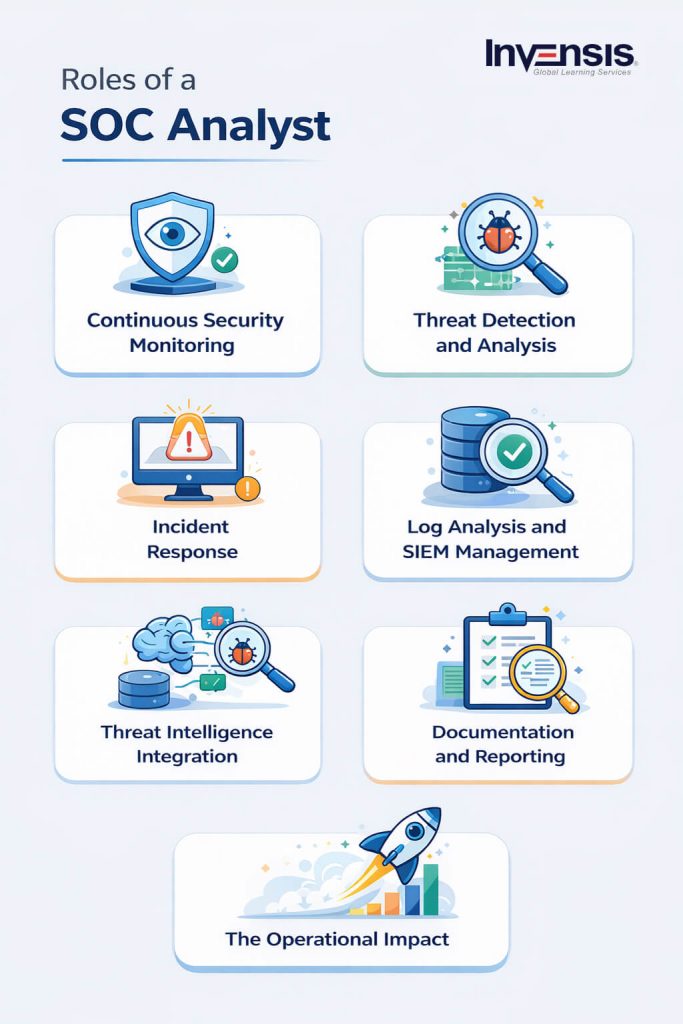
1. Continuous Security Monitoring
The primary responsibility of a SOC Analyst is to monitor security events 24/7 across the organization’s infrastructure.
| Expert Insight
“Companies spend millions on firewalls, encryption, and secure access devices, and it’s money wasted because none of these measures address the weakest link in the security chain.” |
This includes monitoring:
- Network traffic
- Endpoint activity
- Firewall logs
- Authentication events
- Cloud environments
- Application logs
| Effective threat detection depends on visibility across multiple systems. According to guidance from the National Institute of Standards and Technology (NIST), security operations require continuous monitoring across networks, endpoints, and cloud infrastructure to detect potential incidents. |
Using Security Information and Event Management (SIEM) platforms and endpoint detection tools, SOC Analysts analyze event streams to identify abnormal behavior. Monitoring is not passive; it requires contextual analysis and pattern recognition.
The goal is to detect suspicious activity before it escalates into a breach.
2. Threat Detection and Analysis
SOC Analysts evaluate alerts generated by automated systems to determine whether they represent legitimate threats.
This involves:
- Correlating logs across multiple systems
- Identifying indicators of compromise (IOCs)
- Recognizing patterns associated with known attack techniques
- Differentiating false positives from real incidents
Because automated tools generate high alert volumes, analysts must prioritize effectively. Strong analytical skills are critical to avoid both missed threats and alert fatigue.
3. Incident Response
When a security event is confirmed as malicious, SOC Analysts initiate incident response procedures.
| According to the IBM Cost of a Data Breach Report, the global average cost of a data breach reached $4.45 million, highlighting the importance of proactive monitoring and rapid incident response. |
Depending on their tier level, this may include:
- Isolating affected endpoints
- Blocking malicious IP addresses
- Disabling compromised accounts
- Escalating incidents to higher-level security teams
Incident response must be both fast and precise. Delays increase the potential damage of a breach.
4. Log Analysis and SIEM Management
Log analysis is central to SOC operations.
SOC Analysts:
- Review event logs from servers, firewalls, endpoints, and cloud platforms
- Configure alert rules within SIEM systems
- Adjust detection thresholds
- Identify anomalous behavior patterns
Effective log analysis helps identify early warning signs that automated systems might not flag independently.
5. Threat Intelligence Integration
Modern SOC environments incorporate threat intelligence feeds that provide real-time updates on emerging threats.
SOC Analysts:
- Compare internal logs against known threat indicators
- Update detection rules based on new attack vectors
- Track global threat trends
By integrating threat intelligence, SOC teams improve detection accuracy and response readiness.
6. Documentation and Reporting
Accurate documentation is essential for:
- Compliance requirements
- Audit readiness
- Post-incident analysis
- Executive reporting
SOC Analysts document:
- Incident timelines
- Investigation steps
- Containment actions
- Root cause findings
Clear documentation ensures accountability and supports continuous improvement.
7. The Operational Impact
Each of these roles helps reduce detection time, minimize breach impact, and strengthen the overall security posture. According to the IBM Cost of a Data Breach Report, organizations with faster incident detection and response cycles significantly reduce financial and operational damage.
SOC Analysts play a direct role in achieving that outcome.
In the next section, we’ll move deeper into the day-to-day responsibilities of SOC Analysts, examining practical tasks such as alert triage, investigation workflows, and escalation procedures.
Detailed Responsibilities of a SOC Analyst
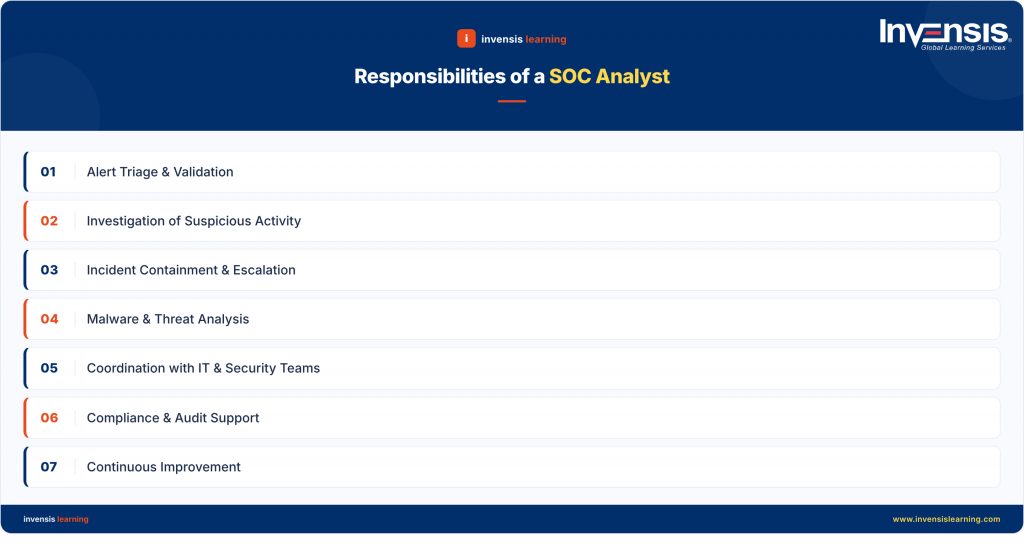
While the core roles define the broader function of a SOC Analyst, their day-to-day responsibilities are highly operational and process-driven. These tasks require discipline, technical knowledge, and the ability to make accurate decisions under time pressure.
Below is a deeper breakdown of what SOC Analysts actually do during a shift.
Alert Triage and Validation
SOC Analysts begin by reviewing alerts generated by SIEM platforms, EDR tools, intrusion detection systems (IDS), firewalls, and cloud security platforms.
The process typically involves:
- Reviewing alert severity
- Checking affected systems and users
- Validating whether the alert is a false positive
- Prioritizing based on risk level
Not every alert is a threat. In fact, many are benign anomalies. Effective triage prevents alert fatigue while ensuring real threats are not ignored.
Tier 1 analysts typically handle this stage.
Investigation of Suspicious Activity
When an alert appears legitimate, the analyst begins investigation.
This includes:
- Examining event logs
- Reviewing user activity patterns
- Checking IP reputation databases
- Analyzing endpoint behavior
- Correlating related alerts
The objective is to determine whether the activity represents:
- Malware infection
- Credential compromise
- Lateral movement
- Data exfiltration attempt
- Insider threat
This stage requires strong analytical skills and familiarity with attack frameworks such as MITRE ATT&CK.
Incident Containment and Escalation
Once a threat is confirmed, the analyst initiates response procedures.
Actions may include:
- Isolating compromised systems
- Blocking malicious domains or IP addresses
- Resetting user credentials
- Escalating to Tier 2 or Tier 3 teams
Clear escalation paths are essential. SOC Analysts must follow predefined incident response playbooks to ensure consistent and documented actions.
Malware and Threat Analysis (Basic Level)
In some cases, analysts conduct preliminary malware analysis.
This may involve:
- Reviewing suspicious file hashes
- Checking sandbox analysis results
- Identifying behavioral indicators
- Validating threat intelligence matches
Advanced reverse engineering is typically handled by specialized teams, but SOC Analysts must understand fundamental malware indicators.
Coordination with IT and Security Teams
SOC Analysts rarely work in isolation. They collaborate with:
- IT administrators for patching and remediation
- Network teams for firewall changes
- Security engineers for tool configuration
- Compliance teams for audit reporting
Clear communication is critical. Analysts must translate technical findings into actionable recommendations.
Compliance and Audit Support
Many organizations operate under regulatory frameworks such as ISO 27001, GDPR, HIPAA, or PCI DSS. SOC Analysts support compliance by:
- Maintaining incident logs
- Documenting response actions
- Providing evidence for audits
- Tracking remediation timelines
Accurate reporting protects the organization legally and operationally.
Continuous Improvement
High-performing SOC teams refine detection capabilities over time.
SOC Analysts contribute by:
- Suggesting improved detection rules
- Identifying recurring threat patterns
- Updating incident response playbooks
- Reducing false positives
This improves efficiency and reduces operational noise.
The Reality of the Role
SOC Analysts operate in high-pressure environments. They manage large volumes of alerts, make time-sensitive decisions, and respond to active threats.
According to the IBM Cost of a Data Breach Report, the faster an organization detects and responds to incidents, the lower the breach impact. SOC Analysts directly influence this outcome through disciplined monitoring and structured response.
In the next section, we’ll examine the tools and technologies SOC Analysts use daily and how those tools support their responsibilities.
Key Skills Required for a SOC Analyst
Tools enable security operations, but skills determine effectiveness. A SOC Analyst must combine technical expertise with analytical judgment and disciplined communication. The role demands both depth and adaptability, especially in environments where threats evolve continuously.
Below are the critical skills required to succeed in a SOC role.
Technical Skills
A strong technical foundation is non-negotiable. SOC Analysts operate across networks, systems, and applications, so they must understand how these environments function to detect abnormal behavior.
- Networking Fundamentals
Understanding TCP/IP, DNS, HTTP/HTTPS, firewalls, VPNs, and routing concepts is essential. Many security incidents originate from network-based activity such as unauthorized access attempts, port scans, or data exfiltration.
Without knowledge of networking, log analysis becomes guesswork.
- Log Analysis and SIEM Proficiency
SOC Analysts must interpret logs from various systems and correlate them effectively. This includes recognizing suspicious login attempts, unusual privilege escalations, or abnormal traffic patterns.
Skill in navigating SIEM dashboards and filtering data accurately is fundamental.
- Operating System Security (Windows & Linux)
Understanding system processes, registry changes, event logs, and user account behavior allows analysts to identify signs of compromise. - Threat Intelligence and Attack Frameworks
Familiarity with frameworks like MITRE ATT&CK helps analysts classify threats and understand attacker behavior patterns. - Basic Scripting Knowledge
While not always mandatory, knowledge of scripting languages such as Python or PowerShell helps analysts automate repetitive tasks and perform deeper analysis.
Analytical and Cognitive Skills
SOC Analysts operate in high-volume environments. The ability to analyze quickly and accurately separates average performance from strong performance.
- Critical Thinking
Analysts must distinguish between real threats and false positives without overreacting or underestimating risks. - Pattern Recognition
Recognizing behavioral anomalies across systems requires strong observational skills. - Decision-Making Under Pressure
Incidents often require immediate containment actions. Analysts must act decisively while following structured procedures.
Communication and Documentation Skills
Security operations are collaborative. Analysts must clearly communicate findings to technical teams, leadership, and sometimes non-technical stakeholders.
Responsibilities include:
- Writing incident reports
- Explaining threat impact
- Recommending remediation steps
- Maintaining audit-ready documentation
Clear documentation supports compliance and post-incident reviews.
Soft Skills That Matter
Cybersecurity roles are technically demanding, but soft skills influence long-term success.
- Attention to Detail
Small log entries can signal large threats. - Adaptability
Attack methods evolve rapidly. Continuous learning is essential. - Stress Management
SOC environments can be intense, particularly during active incidents.
SOC Analyst vs Cybersecurity Analyst vs Security Engineer
Cybersecurity roles often overlap in terminology, which creates confusion for aspiring professionals and even hiring managers. While a SOC Analyst is a cybersecurity role, it is not identical to a Cybersecurity Analyst or a Security Engineer. Each position serves a different function within the broader security ecosystem.
Understanding these differences is important for career planning and organizational clarity.
SOC Analyst
A SOC Analyst operates in a real-time monitoring and incident response environment. Their primary focus is detecting and responding to threats as they occur.
Core focus areas include:
- Continuous monitoring of alerts
- Log analysis and threat validation
- Incident triage and escalation
- Containment of active threats
SOC Analysts are operational defenders. Their work directly influences how quickly an organization identifies and mitigates attacks.
Cybersecurity Analyst
A Cybersecurity Analyst role is broader and often more strategic. While some responsibilities overlap with SOC Analysts, cybersecurity analysts typically focus on preventive measures and security posture improvement.
Responsibilities may include:
- Risk assessments
- Vulnerability management
- Security policy development
- Security control evaluations
- Compliance analysis
Unlike SOC Analysts, Cybersecurity Analysts may not work in a 24/7 monitoring environment. Their focus is often on strengthening long-term security architecture rather than responding to live incidents.
Security Engineer
A Security Engineer designs, implements, and maintains security infrastructure.
Their responsibilities include:
- Deploying firewalls and security appliances
- Configuring SIEM and EDR systems
- Designing secure network architecture
- Implementing identity and access controls
- Automating security workflows
Security Engineers build and optimize the tools that SOC Analysts use. They operate at a more architectural and technical configuration level.
Comparison Table
| Role | Primary Focus | Time Orientation | Key Responsibility |
| SOC Analyst | Monitoring and response | Real-time | Detect and contain threats |
| Cybersecurity Analyst | Risk and prevention | Strategic | Improve security posture |
| Security Engineer | Infrastructure and tools | Design-focused | Build and maintain security systems |
Career Progression Path
Many professionals begin as SOC Analysts and move into:
- Incident Response Specialist
- Threat Hunter
- Security Engineer
- Security Architect
- Cybersecurity Manager
The SOC role provides strong foundational exposure to real-world attack scenarios, making it a common entry point into cybersecurity careers.
| Expert Insight
“The global cybersecurity workforce gap continues to grow, highlighting the urgent need for trained security professionals.” |
As organizations strengthen security maturity, these roles work collaboratively rather than competitively. SOC Analysts detect threats, Security Engineers enhance tools, and Cybersecurity Analysts improve policies and governance.
In the next section, we will explore what a typical day looks like for a SOC Analyst and how shift-based security operations function in practice.
Conclusion
As cyber threats continue to evolve in speed, scale, and complexity, SOC Analysts remain a critical part of an organization’s cybersecurity defense. From monitoring alerts and investigating suspicious activity to supporting incident response and reducing the impact of breaches, they play a direct role in strengthening security operations. For aspiring cybersecurity professionals, the SOC Analyst role offers a strong entry point into the field and valuable exposure to real-world threat detection and response environments.
To succeed in this role, professionals need a solid foundation in cybersecurity concepts, network security, log analysis, incident response, and threat detection. Building these capabilities through practical, industry-relevant cybersecurity courses can help learners prepare for SOC responsibilities and grow into more advanced security roles over time. Explore our CRISC certification course to develop the skills needed for a successful career in security operations.