
A cybersecurity engineer plays a central role in protecting an organization’s systems, networks, applications, and data from cyber threats. If you have ever wondered what a cybersecurity engineer does, the short answer is this: they design, implement, monitor, and improve security controls that reduce risk and keep digital environments resilient. In many companies, the title may also appear as cybersecurity engineer or even cybersecurity-engineer, but the mission stays the same: build and maintain secure systems that can withstand real-world attacks. The demand for professionals in this space remains strong. The U.S. Bureau of Labor Statistics reports that employment for information security analysts, one of the closest benchmark roles to cybersecurity engineering, is projected to grow 29% from 2024 to 2034, with a median annual wage of $124,910 in May 2024. That makes cybersecurity one of the fastest-growing and most opportunity-rich technology career paths today.
What Does a Cybersecurity Engineer Do?
If you are asking what a cybersecurity engineer does, the role typically combines architecture, defense, monitoring, risk reduction, and incident readiness. Invensis Learning describes a cybersecurity engineer as a professional who helps design and implement methodologies to secure an organization’s cyberspace. That includes protecting infrastructure, responding to threats, finding weaknesses, and improving security standards over time.
| Research Insight Cybersecurity-related roles continue to expand as organizations face more complex threats, cloud exposure, compliance requirements, and resilience challenges. The NIST NICE Framework also emphasizes that cybersecurity work comprises defined roles, tasks, knowledge, and skills, not just generic job titles. |
From a broader labor-market view, the BLS says these professionals monitor networks for breaches, investigate incidents, maintain firewalls and encryption tools, identify vulnerabilities, develop security standards, document attacks, and support disaster recovery planning. In other words, what do cybersecurity engineers do? They turn security strategy into operational protection.
Key outcome of the roleA cybersecurity engineer is responsible for making systems harder to compromise, faster to detect issues, and easier to recover when something goes wrong. That is why the role sits at the intersection of prevention, detection, response, and continual improvement. |
What Are the Key Roles of a Cyber Security Engineer?
The role of a cyber security engineer goes beyond simply managing firewalls or reacting to threats. A cyber security engineer acts as a defender, builder, assessor, and advisor within the organization. They help design secure systems, strengthen infrastructure, detect weaknesses before attackers do, and support the business in maintaining a strong security posture. In practice, the role combines technical implementation with risk reduction, operational support, and continuous improvement.
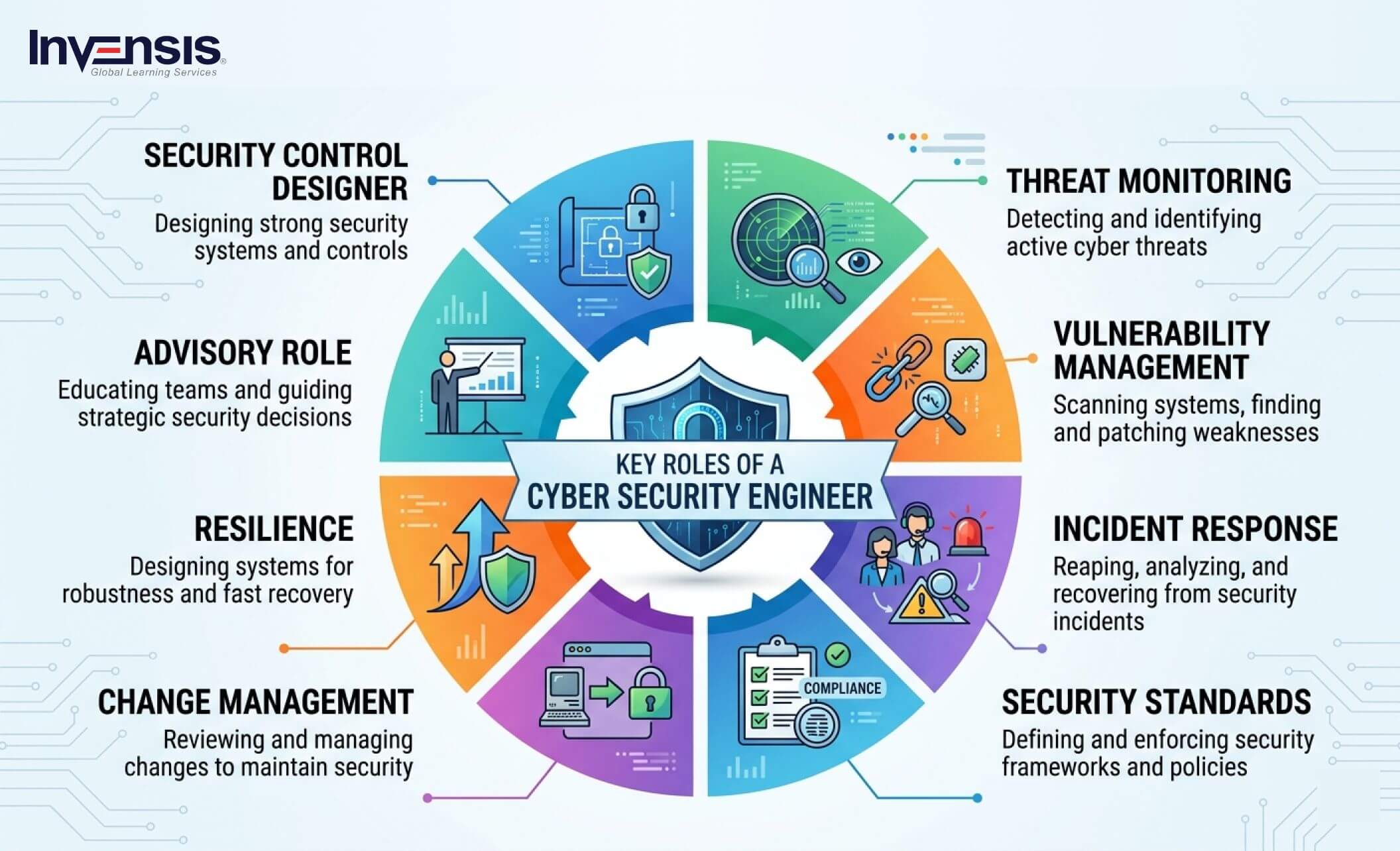
1. Security Control Designer
One of the most important cybersecurity engineer roles is designing and implementing security controls that protect data, systems, applications, and networks. This includes configuring firewalls, access controls, encryption, endpoint protection, and other defensive mechanisms that reduce the attack surface.
2. Threat Monitoring and Defense Specialist
A cyber security engineer also plays the role of an active defender by monitoring systems for suspicious behavior, investigating alerts, and helping prevent security breaches. This role supports day-to-day cyber defense by making sure threats are detected early and appropriate action is taken quickly.
3. Vulnerability Assessment and Remediation Lead
Another core role is identifying security gaps before they can be exploited. Cyber security engineers conduct scans, test systems for vulnerabilities, and support penetration testing to uncover weaknesses in networks, operating systems, applications, and configurations. Once risks are found, they help prioritize and implement remediation steps.
4. Incident Response Support Engineer
When a breach or suspicious event occurs, cyber security engineers play a critical response role. They help investigate incidents, contain threats, troubleshoot affected systems, and support recovery efforts. Their role is essential in minimizing damage and restoring secure operations as quickly as possible.
5. Security Standards and Best Practices Contributor
Cyber security engineers are not only technical implementers; they also help define and improve security standards. They evaluate organizational security needs, recommend best practices, support policy alignment, and help ensure that technical security measures match the company’s broader governance and risk goals.
6. Change Management and Configuration Security Partner
Modern infrastructure changes constantly, so cyber security engineers play a key role in secure change management. They review proposed changes, help prevent misconfigurations, support secure deployment practices, and oversee configuration-related security considerations so new technologies do not introduce unnecessary risk.
7. Business Continuity and Resilience Enabler
Cyber security engineers also contribute to resilience. Their role includes supporting disaster recovery planning, helping restore essential capabilities after failures, and ensuring that continuity measures include cybersecurity requirements. This makes them critical to both prevention and recovery.
8. Cross-Functional Security Advisor
A successful cyber security engineer works closely with IT teams, developers, operations staff, management, and end users. They communicate risks, recommend improvements, prepare reports, and help others adopt secure practices. In this way, the role is both technical and collaborative.
What Are the Core Cyber Security Engineer Responsibilities?
When discussing cybersecurity engineer responsibilities, it helps to break the role into practical areas of responsibility.
1. Protecting systems, data, and networks
Invensis Learning highlights that cyber security engineers plan, implement, manage, monitor, and upgrade security measures that protect organizational data, systems, and networks. This is the foundation of the role and often includes endpoint protection, segmentation, access controls, encryption, hardening, and secure configuration.
2. Finding and fixing vulnerabilities
A major part of the role is testing networks and systems for weaknesses. The BLS notes that security professionals check for vulnerabilities in computer and network systems, while Invensis adds that cyber security engineers conduct testing, scans, and even penetration testing to identify exploitable gaps.
3. Responding to security incidents
Engineers are expected to investigate suspicious activity, help contain breaches, and coordinate follow-up action. The BLS points to breach monitoring and investigation, while Invensis specifically mentions responding to system and network security breaches and troubleshooting security incidents.
4. Reporting, communication, and cross-team collaboration
Cybersecurity engineering is not a silo role. Engineers document metrics, attempted attacks, and security breaches; communicate with stakeholders; and partner with IT, compliance, procurement, engineering, and leadership teams. NICE/CISA also emphasizes maintaining communication channels with stakeholders and building cross-team relationships.
|
“One of the world’s most well-known security consultants noted that “the weakest link in the security chain is the human element.” This is why cybersecurity engineers must go beyond systems and work closely with teams to enforce secure practices and reduce human-driven risks. ” |
 |
5. Building standards and best practices
Cybersecurity roles and responsibilities are not limited to technical tooling. Engineers also help create secure processes, recommend enhancements, and define standards. The BLS says they develop security standards and best practices; CISA’s NICE work-role language also reflects responsibilities such as defining baseline security requirements, developing risk mitigation strategies, and reviewing policies for control gaps.
6. Supporting change management and resilience
Security engineering is closely tied to change. Invensis notes active participation in change management, while the NICE/CISA role examples include creating change management plans, overseeing configuration management, restoring essential system capabilities after failure events, and integrating cybersecurity into continuity planning.
| Pro Tip The best cybersecurity engineers do more than deploy tools. They translate threats into business risk, explain trade-offs clearly, and help teams adopt secure practices without slowing everything down. This is where engineering skill and communication skill meet. |
What Is Included in a Cyber Security Engineer Job Description?
A strong cybersecurity engineer job description usually covers system protection, vulnerability management, incident response, security tooling, reporting, and collaboration with IT and business stakeholders. The cybersecurity engineer job description may vary by company, but most employers expect the role to secure data, networks, applications, cloud environments, and user access. According to NIST’s NICE Framework, a work role is a grouping of work for which an individual or team is responsible or accountable. That matters because a real-world cybersecurity engineer job may combine several NICE-style work roles depending on the company’s size, industry, and maturity. One employer may emphasize engineering and architecture, while another may expect more incident response or compliance support.
Typical cybersecurity engineer job description elements
- Design and implement security controls
- Monitor systems and respond to incidents
- Identify vulnerabilities and recommend fixes
- Support change management and system hardening
- Maintain documentation, reports, and security standards
- Work with infrastructure, cloud, network, and development teams
- Improve resilience, recovery, and risk posture
What Skills and Tools Does a Cybersecurity Engineer Need?
Invensis lists several essential skills for a cybersecurity engineer: problem-solving, technical knowledge, platform security, attention to detail, communication, computer forensics awareness, and ethical hacking knowledge. These capabilities are important because cybersecurity engineers often work across networks, operating systems, identity systems, security tools, and incident processes.
|
“A globally recognized cybersecurity expert emphasizes that security is not a product, but a process.” This perspective reinforces why cybersecurity engineers are not limited to deploying tools; they continuously design, monitor, and improve security systems to adapt to evolving threats.” |
 |
The BLS reinforces this by describing work that involves firewalls, encryption, monitoring, reporting, disaster recovery, and security recommendations. In practice, the strongest cybersecurity engineers combine secure system design with hands-on familiarity in areas such as SIEM, IAM, EDR, vulnerability scanners, cloud security controls, scripting, and network defense.
Core skill areas
| Skill Area | Why It Matters |
| Network and system security | Needed to secure infrastructure and identify weak points |
| Vulnerability assessment | Helps detect misconfigurations and exploitable flaws |
| Incident response | Supports fast containment and recovery |
| Security architecture | Enables long-term control design and resilience |
| Risk and compliance awareness | Connects controls with business and regulatory needs |
| Communication | Helps explain threats, fixes, and priorities clearly |
How Do Cyber Security Roles and Responsibilities Differ Across Teams?
Not every company defines the role in the same way. NIST makes it clear that jobs and work roles are not identical; one job may include one work role, several work roles, or even only part of a work role. That means a cyber security engineer in a startup may handle architecture, monitoring, cloud hardening, and incident response, while someone in an enterprise may specialize more narrowly.
Common overlaps with nearby roles
- SOC Analyst: Focuses more on monitoring, detection, triage, and escalation
- Information Security Analyst: Often emphasizes monitoring, assessment, standards, and reporting
- Security Architect: Focuses more on security design and enterprise architecture
- DevSecOps Engineer: Embeds security into CI/CD and software delivery pipelines
- Cyber Security Engineer: Often bridges design, implementation, hardening, monitoring, and operational defense
| Avoid This Mistake A common mistake is treating the cybersecurity engineer as only a tool administrator. In reality, the role is broader: it includes design decisions, vulnerability reduction, incident coordination, resilience planning, and policy alignment. |
How Can You Become a Cyber Security Engineer?
Most employers look for a bachelor’s degree in a computer-related field, along with relevant technical experience. The BLS says information security professionals typically need a bachelor’s degree, and that employers may prefer candidates with professional certifications. That path often includes experience in networking, system administration, cloud, security operations, or infrastructure engineering before moving into a dedicated cybersecurity engineer role. Invensis also points readers toward formal training and certification in IT security and governance to build job-ready capabilities. For professionals planning their career path, cybersecurity engineering is strongest when built on a combination of technical depth, risk awareness, and hands-on exposure to live systems and security incidents.
A simple career path
- Learn networking, systems, cloud, and operating system fundamentals
- Build security basics in IAM, monitoring, vulnerabilities, and incident handling
- Practice with labs, hardening exercises, and real-world troubleshooting
- Earn relevant certifications and role-based training
- Move into analyst, security operations, or engineering-focused roles
- Grow into cloud security, architecture, detection engineering, or leadership
Conclusion
Cybersecurity engineering is not just about deploying tools or reacting to threats; it is about building resilient systems that can anticipate, withstand, and recover from attacks. As organizations become more digital, interconnected, and cloud-driven, the role continues to expand beyond technical execution into risk translation, business alignment, and proactive defense. The most effective cybersecurity engineers are those who can bridge the gap between security strategy and real-world implementation, ensuring that protection measures do not slow down business but strengthen it.
For professionals looking to enter or grow in this field, cybersecurity engineering offers a clear, high-demand career path with long-term relevance. However, the reality is that surface-level knowledge is not enough; hands-on skills, practical exposure, and structured learning are critical. This is where focused training programs, such as IT Governance Certification Training courses in network security, ethical hacking, and cloud security, can help build job-ready capabilities and accelerate career progression in this rapidly evolving domain.
Frequently Asked Questions
What does a cyber security engineer do every day?
A cyber security engineer typically monitors systems, improves controls, investigates alerts, remediates vulnerabilities, updates configurations, supports change management, and documents security issues and recommendations.
What is the difference between a cyber security engineer and a cybersecurity engineer?
Usually, none. The difference is mostly spelling and branding preference. Some organizations write it as "cybersecurity engineer," while others write it as "cyber security engineer."
What are the most important cybersecurity engineer responsibilities?
The most important responsibilities include protecting systems and data, identifying vulnerabilities, responding to incidents, implementing secure controls, supporting resilience, and maintaining security standards.
Is cybersecurity engineering a good career?
Yes. The job outlook is strong, compensation is competitive, and organizations across industries need professionals who can secure digital infrastructure. The BLS projects 29% growth for information security analysts from 2024 to 2034.
What qualifications are usually needed?
Most employers prefer a bachelor’s degree in a computer-related field, hands-on technical experience, and often professional certification or equivalent practical knowledge.