


Table of Contents:
- Introduction
- What Does a Business Analyst Actually Do?
- What Does a Project Manager Actually Do?
- What Are the Key Differences Between a Business Analyst and a Project Manager?
- Where Do the Two Roles Overlap on Real Projects?
- Which Skills, Certifications, and Tools Matter Most in Each Role?
- How Should You Choose Between Becoming a Business Analyst or a Project Manager?
- Conclusion
- Frequently Asked Questions
Introduction
If you’ve ever looked at a project team and wondered whether the business analyst or the project manager is really driving success, you’re not alone. These two roles often work side by side, attend the same stakeholder meetings, and influence scope, risk, and outcomes. But they are not the same job. According to PMI, the project manager is primarily responsible for meeting project objectives and managing constraints, while the business analyst is focused on understanding business needs and ensuring the solution delivers value to the organization.
That distinction matters more than ever. IIBA’s Global State of Business Analysis findings show that business analysis is increasingly recognized as a strategic function, while PMI’s research continues to show strong demand and compensation growth for project professionals. In other words, both paths are growing, but they solve different problems and reward different strengths.
What Does a Business Analyst Actually Do?
A business analyst exists to clarify the business need behind a project, define requirements, evaluate solution options, and ensure the final outcome delivers real value to stakeholders. In PMI’s comparison of the two roles, the BA is described as being focused on the end product or solution, not just the mechanics of delivery. That means the BA spends more time asking questions like: What problem are we solving? What does success look like for users? What requirements are essential versus optional?
IIBA reinforces that positioning by emphasizing business analysis as a strategic discipline, not just a documentation function. Its report highlights growing recognition of business analysis inside organizations, with 76% of respondents saying its impact is growing and 81% saying the role is formally recognized. That tells you something important: the modern BA is increasingly expected to connect business goals, stakeholder needs, and solution design.
| In practice, a business analyst typically works on requirement elicitation, stakeholder interviews, process mapping, gap analysis, user stories, acceptance criteria, solution validation, and traceability. The role often sits closest to the question, “Are we building the right thing?” |
What Does a Project Manager Actually Do?
A project manager is responsible for turning an approved objective into an organized, controlled delivery plan. PMI describes project managers as organized, goal-oriented professionals who plan tasks, manage resources, communicate with stakeholders, remove blockers, monitor risks, and ensure deliverables are completed on time. In short, the PM is accountable for the health of the project as a delivery vehicle
Where the BA asks whether the solution is correct, the PM asks whether the work is being executed correctly. That includes defining scope boundaries, coordinating team effort, keeping timelines realistic, managing dependencies, controlling changes, and keeping sponsors informed. PMI’s role comparison makes this especially clear: the PM focuses on project baselines, constraints, issues, resources, and delivery against objectives.
| This is why project managers are often measured by schedule performance, budget control, stakeholder communication, and successful completion of deliverables. Their role sits closest to the question, “Can we deliver this well under real-world constraints?” |
What Are the Key Differences Between a Business Analyst and a Project Manager?
The simplest way to understand the difference is this: the business analyst focuses on solution value, while the project manager focuses on delivery success. PMI states that the PM’s objective is to meet project objectives, while the BA’s role is to help the organization achieve broader goals through the right solution. That difference in objective changes how each role thinks, plans, and prioritizes work.
A BA usually spends more energy on discovery, requirements, process understanding, stakeholder needs, and solution fit. A PM usually spends more energy on planning, coordination, communication cadence, resourcing, issue resolution, and controlling the path to completion. Both can influence scope and risk, but they do so from different angles: the BA evaluates whether the scope solves the business problem, while the PM evaluates whether the scope can be delivered within constraints.
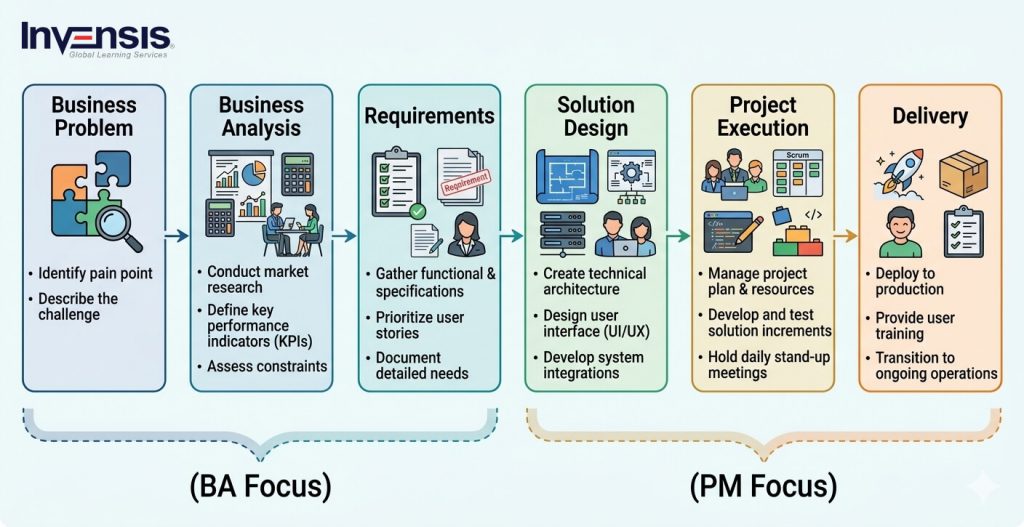
Another major difference is how each role defines success. For a BA, success often means clear requirements, fewer misunderstandings, stronger user adoption, and better business outcomes. For a PM, success usually means hitting deadlines, controlling cost, managing stakeholder expectations, and delivering agreed outputs with quality. These are complementary, not competing, definitions. In strong teams, they reinforce each other.
Comparison Snapshot
| Area | Business Analyst | Project Manager |
| Primary focus | Understands the business problem, identifies stakeholder needs, and defines a solution that delivers value. | Plans, coordinates, and controls the work required to deliver the solution successfully. |
| Main objective | Ensures the organisation is solving the right problem and implementing the right solution. | Ensures the project is delivered within agreed constraints of time, cost, scope, and quality. |
| Core question asked | What does the business actually need? | How do we deliver this successfully? |
| Ownership area | Requirements clarity, business rules, process understanding, stakeholder needs, and solution validation. | Project planning, schedule management, stakeholder communication, issue resolution, resource coordination, and risk control. |
| Success measure | The solution effectively solves the business problem and generates measurable business value. | The project is completed on time, within budget, and with acceptable quality and managed risks. |
| Approach to stakeholders | Engages stakeholders to discover needs, clarify expectations, resolve conflicts, and validate requirements. | Engages stakeholders to align expectations, provide updates, escalate issues, and maintain project momentum. |
| Key deliverables | Business requirements, user stories, process maps, use cases, gap analysis, acceptance criteria, and traceability artifacts. | Project charter, schedules, status reports, RAID logs, communication plans, resource plans, and change logs. |
| Time horizon | Works mainly during early and middle phases, continuing through validation and benefits alignment. | Works across the entire project lifecycle — initiation, planning, execution, monitoring, and closure. |
| Decision-making lens | Evaluates decisions based on business value, user needs, requirement feasibility, and solution fit. | Evaluates decisions based on impact to scope, schedule, cost, resources, and delivery risk. |
| Typical strengths | Analytical thinking, requirement elicitation, problem framing, stakeholder communication, process improvement, and solution evaluation. | Leadership, organisation, planning, coordination, prioritisation, conflict management, and delivery discipline. |
| Risk perspective | Focuses on misunderstood needs, poor requirements, low user adoption, and weak solution alignment. | Focuses on delays, budget overruns, resource shortages, dependency failures, and delivery blockers. |
| Role in change management | Evaluates how changes affect requirements, processes, and stakeholder expectations. | Manages how changes affect project scope, schedule, budget, and delivery commitments. |
| Career orientation | Often progresses toward product ownership, enterprise analysis, consulting, strategy, or solution leadership. | Often progresses toward program management, PMO leadership, portfolio management, or transformation leadership roles. |
Primary Focus: Solution vs Delivery
The business analyst focuses on the business problem and the solution that should address it. Their attention stays centered on whether the team is building something useful, relevant, and aligned with stakeholder needs. The project manager, by contrast, focuses on the work required to deliver that solution in a structured and controlled manner. This is why BAs often ask why and what, while PMs more often ask when, who, and how.
| Business Analyst | Project Manager |
| Understands the business problem, identifies stakeholder needs, and defines a solution that delivers value. | Plans, coordinates, and controls the work needed to deliver that solution successfully. |
Main Objective: Business Value vs Project Execution
A BA’s objective is tied to organizational value. They want to ensure the final output supports goals, improves processes, solves pain points, or enables better decisions. A PM’s objective is tied to project performance. They are accountable for ensuring the work is organized, controlled, and completed in accordance with expectations. Both are essential, but they measure different kinds of success.
| Business Analyst | Project Manager |
| Ensures the organisation is solving the right problem and implementing the right solution. | Ensures the project is executed within agreed constraints,time, cost, scope, and quality. |
Core Question: “What’s Needed?” vs “How Will It Get Done?”
This row is one of the clearest ways to separate the roles. The BA’s default question is, “What does the business need?” That leads to workshops, requirement analysis, stakeholder interviews, and solution validation. The PM’s default question is, “How do we execute this successfully?” That leads to planning, coordination, sequencing, tracking, and escalation. Together, these questions create a balance between vision and execution.
| Business Analyst | Project Manager |
| “What does the business actually need?” | “How do we deliver this successfully?” |
Ownership Area: Clarity vs Control
The BA owns the clarity of requirements and business understanding. If the team is confused about what users need, what the acceptance criteria are, or how the future process should work, the BA is usually the person expected to bring order. The PM owns the control layer around delivery. If deadlines slip, dependencies collide, or stakeholders need updates, the PM is the one expected to stabilize the effort.
| Business Analyst | Project Manager |
| Requirements clarity, business rules, process understanding, stakeholder needs, solution validation. | Project planning, schedule management, stakeholder communication, issue resolution, resource coordination, risk control. |
Success Measure: Right Solution vs Successful Delivery
BA may view a project as unsuccessful if it is delivered perfectly but does not solve the actual business problem. A PM may view a project as unsuccessful if the right idea exists, but execution is late, over budget, or chaotic. This difference is important because organizations often talk about “project success” as though it means one thing, when in reality it has both a solution dimension and a delivery dimension.
According to PMI’s Pulse of the Profession report, only 55% of projects are completed on time, highlighting the importance of strong project management practices.
| Business Analyst | Project Manager |
| The delivered solution solves the intended business problem and creates measurable value. | The project is delivered on time, within budget, with managed risks and acceptable quality. |
Approach to Stakeholders: Discovery vs Alignment
The BA works with stakeholders to extract information, clarify needs, uncover hidden assumptions, and reconcile conflicting viewpoints. The PM works with stakeholders to align schedules, decisions, priorities, and expectations. Both roles spend significant time communicating, but the intent differs: one seeks to understand, the other to orchestrate.
| Business Analyst | Project Manager |
| Engages stakeholders to discover needs, clarify expectations, resolve conflicts, and validate requirements. | Engages stakeholders to align expectations, provide updates, escalate issues, and keep decisions moving. |
Key Deliverables: Requirement Artifacts vs Delivery
Artifacts: A business analyst typically produces documents and models that help the team understand the solution: user stories, business requirements, process maps, use cases, acceptance criteria, and traceability matrices. A project manager typically produces the control documents that keep the project moving: plans, schedules, status reports, risk registers, communication plans, and change logs. These outputs complement each other; one defines the solution, the other governs the delivery.
| Business Analyst | Project Manager |
| Business requirements, user stories, process maps, use cases, gap analyses, acceptance criteria, traceability artifacts. | Project charter, schedule, status reports, RAID logs, communication plans, resource plans, change logs. |
Time Horizon: Deep Dive vs End-to-End Oversight
The BA often becomes heavily involved in discovery, requirements definition, and validation, though strong BAs remain active throughout delivery to ensure the solution continues to reflect the business need. The PM usually maintains responsibility across the full project lifecycle, from initiation to closure. This means the PM’s lens is generally broader across time, while the BA’s lens is often deeper into the substance of the solution.
| Business Analyst | Project Manager |
| Works deeply in early and middle phases, continuing through validation and benefits alignment. | Works across the full lifecycle, from initiation through planning, execution, monitoring, and closure. |
Decision-Making Lens: Value vs Constraint
When change requests, trade-offs, or priorities arise, the BA tends to assess them through the lens of business value, stakeholder benefit, and requirement integrity. The PM tends to assess them through the lens of scope impact, resource implications, and timeline feasibility. Neither view is more important; they protect different interests. A healthy project environment makes room for both.
| Business Analyst | Project Manager |
| Evaluates decisions based on business value, user needs, feasibility of requirements, and solution fit. | Evaluates decisions based on impact to scope, budget, timeline, resources, and delivery risk. |
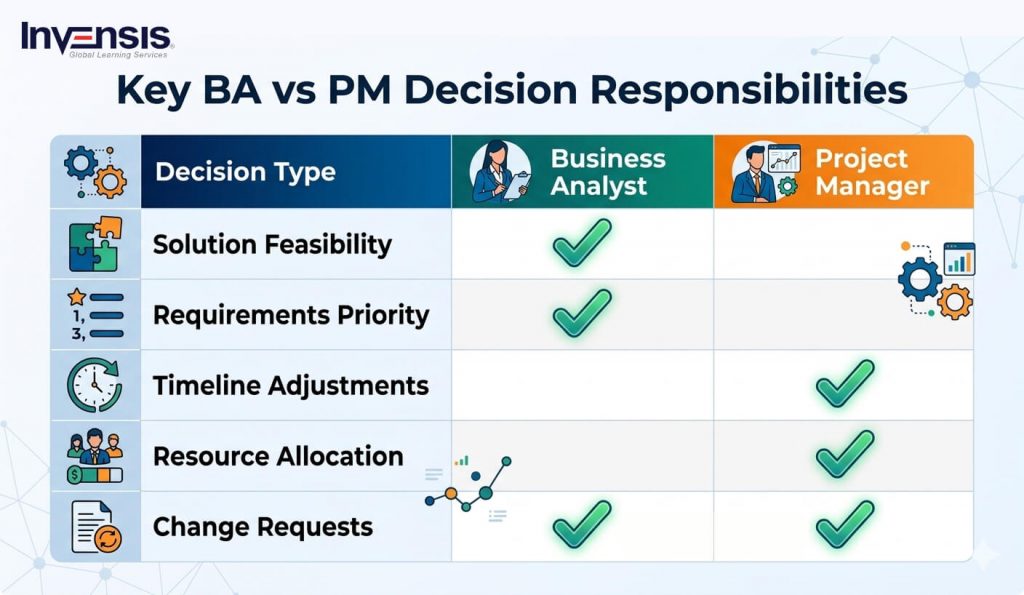
Typical Strengths: Analytical Rigor vs Execution Discipline.
A strong BA is usually skilled in structured thinking, elicitation, problem decomposition, and translating needs into usable requirements. A strong PM is usually skilled in planning, coordination, decision facilitation, priority management, and maintaining control under pressure. These strengths explain why some professionals feel naturally drawn to one role more than the other.
| Business Analyst | Project Manager |
| Analytical thinking, elicitation, problem framing, communication, process improvement, solution evaluation. | Leadership, organisation, planning, coordination, prioritisation, conflict management, delivery discipline. |
Risk Perspective: Value Risk vs Delivery Risk.
Business analysts often see risk in misunderstood requirements, misaligned stakeholder expectations, and solutions that users may reject. Project managers often see risk in missed milestones, unclear ownership, weak governance, or resource bottlenecks. Together, these perspectives provide a fuller understanding of project risk than either role could create alone.
|
“A report by McKinsey found that 17% of large IT projects go so badly they threaten the existence of the company.” |
 |
| Business Analyst | Project Manager |
| Focuses on misunderstood needs, poor requirements, low user adoption, and weak solution fit. | Focuses on delays, budget overruns, resource shortages, dependency failures, and delivery blockers. |
Role in Change Management: Requirement Impact vs Delivery Impact.
When a project changes direction, the BA usually evaluates how that affects business needs, processes, and solution logic. The PM evaluates how that change affects time, budget, scope, and resource commitments. This is one of the clearest examples of why the two roles should work together rather than be merged carelessly.
| Business Analyst | Project Manager |
| Assesses how business changes affect requirements, processes, and stakeholder expectations. | Controls how changes affect schedule, budget, scope, and delivery commitments. |
Career Orientation: Strategic Analysis vs Delivery Leadership
Business analysis often leads toward enterprise analysis, consulting, product strategy, or solution leadership. IIBA’s 2025 report supports this trend by highlighting the growing strategic recognition of the profession. Project management often leads to program management, PMO leadership, and portfolio or transformation roles, and PMI continues to highlight strong future demand for project professionals globally. IIBA PMI” how to represent it differently
| Business Analyst | Project Manager |
| Often grows toward product ownership, enterprise analysis, consulting, strategy, or solution leadership. | Often grows toward programme management, PMO leadership, portfolio management, or transformation roles. |
|
Research insight “IIBA’s findings show business analysis is becoming more strategic, with 76% of respondents reporting growing impact and 81% reporting formal recognition of the role. That reinforces why BAs are increasingly seen as business value leaders rather than just requirement writers.” |
 |
Where Do the Two Roles Overlap on Real Projects?
Even though the roles are different, there is meaningful overlap. PMI identifies requirements collection, planning business analysis work, scope management, defining the business need, and even parts of procurement or RFP activity as areas where both PMs and BAs may participate. On smaller teams, one person may even perform parts of both roles.
That overlap is one reason organizations sometimes confuse the two positions. But PMI’s broader integration paper argues that the relationship works best when both disciplines are treated as peers in a “dynamic duo.” Business analysis improves project management by enabling better elicitation, clearer requirements definition, stronger traceability, and better stakeholder alignment. Project management improves business analysis by providing structure, planning discipline, and a controlled route to implementation.
In Agile and hybrid environments, the overlap can become even more visible. A BA may help refine user stories and acceptance criteria while a PM manages dependencies, sequencing, and stakeholder communication. The boundary is not always rigid, but the intent still matters: one role protects solution clarity, the other protects delivery integrity.
| Avoid this mistake
Don’t assume the BA can automatically absorb project management duties or vice versa just because both roles attend the same meetings. Similar visibility does not mean identical accountability. When one role is overloaded with both responsibilities, the quality or delivery control usually suffers. |
Which Skills, Certifications, and Tools Matter Most in Each Role?
For business analysts, the center of gravity is shifting toward strategic thinking, communication, adaptability, and the smart use of AI. IIBA’s findings show that 74% of respondents say AI is positively impacting their careers, but also stress that human skills like communication and strategic thinking are becoming more important, not less. That’s a strong signal that modern BAs need both analytical rigor and business influence.
For project managers, PMI emphasizes leadership, adaptability, time management, communication, problem-solving, and team management. These are not just soft skills; they are execution skills. The PM has to keep people aligned under pressure while maintaining visibility into scope, risks, resources, and timing.
Certification can sharpen both career paths. IIBA reports that 95% of respondents recommend CBAP and 81% say they saw benefits such as salary increases or greater confidence within a year. PMI, meanwhile, reports that PMP-certified respondents earn significantly more than non-certified peers, with public findings showing a 33% higher median salary on average across 21 countries in one PMI salary survey, and a nearly 24% difference in U.S. median salary in PMI’s 2025 release.
| If you’re exploring formal training, relevant internal learning paths include Business Analysis Certification Training, Project Management Certification Courses, and Invensis resources such as the Business Analyst Career Path Guide and Technical Project Manager guide. |
How Should You Choose Between Becoming a Business Analyst or a Project Manager?
Choose business analysis if you enjoy ambiguity at the front end of work. BAs thrive when they are interviewing stakeholders, finding the real problem behind surface requests, breaking down processes, clarifying requirements, and improving solution fit. If you naturally ask “Why are we doing this?” and “How do we know this solves the right problem?” the BA role is likely to feel energizing.
Choose project management if you enjoy bringing order to complexity. PMs thrive when they are creating momentum, managing interdependencies, communicating across groups, reducing delivery risk, and guiding teams toward a finish line. If you naturally ask “What’s the plan?” and “How do we get this done successfully?” then project management is likely the better fit
If you’re still unsure, look at your strongest natural instinct in team settings. Do people rely on you more for clarity or for coordination? Clarity tends to point toward business analysis. Coordination tends to point toward project management. Both are high-value paths, and many professionals move between them over time as their strengths evolve
Conclusion
A business analyst and a project manager may look similar on the outside, but their missions differ. The BA protects business value and solution quality. The PM protects delivery performance and project success. When both roles are clearly defined and allowed to collaborate, projects are more likely to deliver the right solution effectively.
If you are choosing a career path, don’t ask which title is “better.” Ask which problem you want to own. If you want to shape what should be built, business analysis is the better fit. If you want to lead how work gets delivered, project management is the better fit. Either way, certifications, structured upskilling, and hands-on experience can significantly accelerate your growth.
Frequently Asked Questions
What is the main difference between a business analyst and a project manager?
A business analyst focuses on understanding business needs and defining the right solution, while a project manager focuses on organizing and delivering the work successfully within constraints such as time, budget, and resources
Can one person be both a business analyst and a project manager?
Yes, especially in smaller organizations or projects, but PMI notes that the roles have different objectives and can create tension if one person tries to own both without clear boundaries
Who earns more: business analysts or project managers?
Public salary benchmarks are not directly comparable across IIBA and PMI surveys, but both fields show strong earning potential. IIBA reported an average salary of USD 88,234 for BA professionals in its 2025 findings, while PMI continues to report strong salary premiums for PMP-certified project professionals.
Is business analysis more strategic than project management?
Business analysis is increasingly recognized as strategic because it links stakeholder needs and solution design to business outcomes. That said, project management is also strategic in a different way because it turns objectives into executable, governed delivery.
Which certification should I pursue first?
If your career goal is business analysis leadership, CBAP is a strong option. If your goal is formal project delivery leadership, PMP is the most widely recognized project management certification. Both organizations report strong career value from certification.
Do Agile teams still need both roles?
Often yes. Even when titles change, teams still need someone protecting the requirement quality and business value, and someone protecting sequencing, communication, and delivery coordination. In some environments, those responsibilities are redistributed, but the underlying needs remain.