



Table of Contents
- Introduction
- What Is a Line Manager?
- What Is a Project Manager?
- What Is the Core Difference Between a Line Manager and a Project Manager?
- Line Manager vs. Project Manager: How Do Their Responsibilities Compare?
- Where Do Their Skills Overlap?
- When Should You Approach a Line Manager Instead of a Project Manager?
- Can One Person Be Both a Line Manager and a Project Manager?
- Conclusion
Introduction
Many professionals use the terms “line manager” and “project manager” as if they mean the same thing. They do not. A line manager is primarily responsible for day-to-day operations and people management, while a project manager is responsible for planning, coordinating, and delivering a specific project successfully. That distinction sounds simple, but in real organizations, especially matrix structures, the two roles often overlap and interact closely.
Understanding the difference matters for career planning, reporting clarity, and team performance. If employees do not know who owns the workload, development, delivery, and decisions, confusion follows quickly. This blog explains what each role does, how they differ, where they overlap, and which one may fit your career goals better.
What Is a Line Manager?
According to CIPD, line managers are responsible for leading day-to-day operations while also managing people. They are also instrumental in implementing organizational policies and developing their teams. In other words, the line manager owns the ongoing performance of a department, function, or team and usually has direct responsibility for the people within it.
A line manager typically focuses on operational continuity. That includes assigning routine work, monitoring employee performance, handling leave and attendance, coaching team members, supporting development, and ensuring the team meets functional goals. Their work is usually continuous rather than temporary, and their success is tied to the team’s performance over time.
|
“Organizations rely on a formal hierarchy of authority, with power delegated through line managers. This supports the line manager’s role as a permanent part of the organizational structure, responsible not only for operational continuity but also for directing and coordinating people over time.” |
 |
What Is a Project Manager?
PMI describes project managers as organized, goal-oriented professionals who use innovation, creativity, and collaboration to lead projects that make an impact. Their role is to turn ideas into outcomes by defining goals and scope, planning tasks, managing resources, communicating with stakeholders, removing blockers, and ensuring deliverables are completed on time and to a high standard.
Unlike a line manager, a project manager works toward a specific temporary objective. A project has a start, a finish, a scope, constraints, and measurable deliverables. The project manager is accountable for guiding the team through the defined journey and ensuring the required result is delivered successfully.
What Is the Core Difference Between a Line Manager and a Project Manager?
The biggest difference is this: a line manager manages an ongoing function and the people in it, while a project manager manages a temporary initiative and the work needed to complete it. The line manager is usually part of the permanent organizational hierarchy. The project manager is usually accountable for delivering change, improvement, or a one-time outcome.
That means the line manager asks, “How do I keep my team performing well every day?” The project manager asks, “How do I deliver this project successfully within scope, time, and quality expectations?” Both are leadership roles, but they solve different business problems.
|
“A sharp distinction between operational responsibility and innovation-focused work, when he wrote that innovative efforts should never report to line managers charged with responsibility for ongoing operations. This insight fits well with the difference between line managers and project managers. A line manager is typically responsible for maintaining continuity and stability, and for day-to-day team performance, while a project manager is responsible for driving a defined initiative or change effort toward completion.” |
 |
Line Manager vs. Project Manager: How Do Their Responsibilities Compare?
Here is the clearest side-by-side view:
| Area | Line Manager | Project Manager |
| Main focus | Ongoing operations and people management | Temporary project delivery |
| Time horizon | Continuous, long-term | Temporary, project-based |
| Team relationship | Usually, the direct manager of employees | Often leads cross-functional team members |
| Key responsibility | Team performance, policy implementation, and development | Scope, schedule, resources, risks, stakeholders, deliverables |
| Success measure | Operational stability and team effectiveness | Project completion and outcome quality |
| Reporting structure | Part of the formal hierarchy | May work across departments and teams |
| People management | Usually yes | Often limited or shared, depending on the structure |
| End point | No fixed end date | Ends when the project is completed |
Is the Main Focus Daily Operations or Project Delivery?
A Line Manager is mainly focused on keeping the department or team running effectively every day. Their job is tied to operational continuity. They make sure work gets done consistently, employees are supported, policies are followed, and the team performs well over time. CIPD specifically describes line managers as responsible for leading day-to-day operations while also managing people.
A Project Manager, by contrast, is mainly focused on delivering a specific piece of work successfully. PMI explains that project managers lead projects by identifying goals and scope, planning tasks, managing resources, communicating with stakeholders, and ensuring deliverables are completed on time and with quality. Their work is tied to change, implementation, and completion rather than routine operations.
| A line manager asks, “How do I keep my team performing well every day?” A project manager asks, “How do I get this project completed successfully?” |
Is the Role Permanent or Temporary?
One of the clearest differences is the time horizon.
A Line Manager usually has an ongoing role. Their responsibilities do not end after a quarter or after one initiative is completed. They continue to lead the same function, supervise people, monitor performance, and improve operations over the long term. This makes the role stable, continuous, and deeply tied to the organization’s structure.
A Project Manager works in a temporary framework. A project has a start date, a finish date, a defined scope, and specific deliverables. Once the project is completed, the project manager may move to another initiative, another team, or another client need. Their work is intense and goal-driven, but it is not usually tied to a permanent functional team in the same way as line management.
Who Manages People Directly?
This is one of the most important differences for employees.
A Line Manager is usually the direct people manager. That means they handle team supervision, performance feedback, development discussions, leave approvals, workload balancing, and policy implementation. CIPD emphasizes that line managers are key to both operational leadership and people management, making them central to the employee experience and team growth.
A Project Manager may lead people in work coordination, deadlines, and deliverables, but often lacks formal people-management authority over them. In many organizations, project team members still report to their line manager for appraisals, career progression, and functional support. The project manager directs the work; the line manager often develops the person.
Who Decides Priorities?
A Line Manager usually decides priorities related to the team’s ongoing responsibilities. They decide how routine work is distributed, how the team should operate, and how departmental goals are met. Their decisions are often based on long-term function needs, staffing realities, and operational targets.
A Project Manager decides priorities related to project scope, deadlines, dependencies, and milestones. Their job is to make sure the project moves forward in the right sequence, risks are managed, and resources are aligned with delivery needs.
This becomes especially important in a matrix organization. PMI explains that a matrix structure involves dual or multiple managerial accountability, usually with one chain of command along functional lines and another along project lines. That means a team member may receive one set of priorities from the line manager and another from the project manager, which is why coordination between the two roles is critical.
Who Is Responsible for Team Development?
A Line Manager is usually responsible for developing the team over time. That includes coaching, capability-building, performance management, and helping employees grow in their roles. Since line managers remain connected to employees beyond any one assignment, they are the ones most closely tied to long-term skill development and career support.
A Project Manager is more focused on delivering results through available capabilities. While strong project managers often mentor and motivate team members, their primary obligation is to ensure the work gets done effectively within the project environment. Development may happen, but it is not always the formal core of their role.
| The line manager builds people capability.
The project manager applies people capability to achieve an outcome. |
Who Owns Success, and How Is Success Measured?
Success looks different in each role.
For a Line Manager, success is usually measured by operational consistency, employee performance, team stability, productivity, and the effective implementation of policies and processes. Their impact is often visible in how well a function performs over time.
For a Project Manager, success is usually measured by whether the project goals are met. PMI highlights responsibilities such as identifying scope, planning tasks, managing resources, communicating with stakeholders, and ensuring on-time, quality results. This means the project manager is judged more by delivery performance than by ongoing team structure.
Who Has More Authority?
This is where many readers get confused, because authority depends on the structure of the organization.
In a traditional hierarchy, a Line Manager often has more formal authority over employees because they control reporting relationships, team assignments, and performance evaluations. Their authority is embedded in the organizational chart.
A Project Manager may have strong authority over project direction, but in some organizations they rely more on influence than formal control. PMI’s matrix-organization guidance notes that project managers often depend on the cooperation and support of functional managers, and that the success of the system depends heavily on how those relationships are managed.
So the better question is not, “Who is more powerful?” The better question is, “What kind of authority does each role hold?”
| The line manager usually has formal authority over people. The project manager usually has delivery authority. |
Who Manages People and Performance?
In most organizations, the line manager is the person who directly manages employees. That includes performance conversations, development support, workload distribution, coaching, and implementation of people-related policies. CIPD specifically highlights line managers as central to both operations and people management.
A project manager, on the other hand, may lead the work of team members without being their formal people manager. They coordinate contributions, clarify deadlines, remove blockers, and keep stakeholders aligned, but they may not control promotions, salary decisions, or annual performance reviews. In many companies, project team members still belong to a functional department led by a line manager.
Research insightPMI defines a matrix organization as one with dual or multiple managerial accountability and responsibility, typically with one chain of command along functional lines and another along project lines. That is exactly why employees can simultaneously work with both a line manager and a project manager. |
Who Owns Daily Operations and Who Owns Change?
A line manager usually owns business-as-usual operations. Their responsibility is to keep the function productive, compliant, and aligned with company policy. If a department must continue serving customers, handling internal work, or maintaining output every day, the line manager is typically accountable for that continuity.
A project manager usually owns change. Their work often begins when the business needs to build, improve, launch, migrate, transform, or implement something new. Their attention is directed toward achieving a target outcome, not maintaining the ongoing department structure itself.
A useful way to think about it is this:
|
How Does Authority Differ in a Matrix Organization?
This is where many professionals get confused. In a matrix organization, employees may report functionally to one manager and operationally to another. PMI notes that success in a matrix depends heavily on the relationship between project managers and functional managers because project decisions and actions must be negotiated across that interface.
What this means in practice is that the line manager often controls people allocation, capability development, and functional priorities, while the project manager controls project direction, milestones, work coordination, and delivery expectations. Neither role can be fully effective without cooperation from the other.
| Pro tip
When working in a matrix structure, always clarify three things early:
|
How Do Their Goals and Success Metrics Differ?
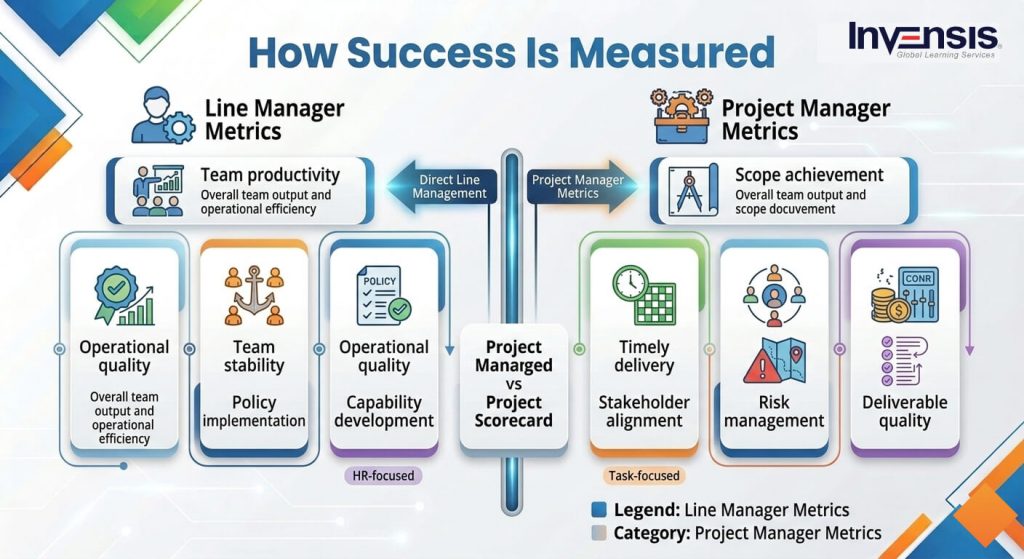
A line manager is usually measured on team productivity, operational quality, employee engagement, policy implementation, and long-term capability development. Their performance often reflects the health of the department or function they supervise.
A project manager is usually measured on scope achievement, timely delivery, resource coordination, stakeholder communication, risk reduction, and successful project outcomes. PMI specifically notes responsibilities such as identifying goals and scope, planning tasks, managing resources, communicating with stakeholders, and ensuring on-time, quality deliverables.
So even when both roles lead people, they are judged by different scorecards:
- The line manager is measured by operational consistency.
- The project manager is measured by project execution and results.
Where Do Their Skills Overlap?
Although the roles are different, they still share several important leadership skills. Both need communication, organization, problem-solving, and the ability to guide people toward goals. PMI lists leadership, adaptability, creative problem-solving, time management, communication, and team management among the core skills of project managers. CIPD emphasizes that line managers are key to people management and team development.
The overlap becomes even more obvious in dynamic workplaces. A strong line manager often needs project thinking when implementing change within a department, and a strong project manager often needs people leadership when coordinating teams through pressure, uncertainty, and competing priorities.
Shared skills
- Communication
- Stakeholder handling
- Prioritization
- Conflict resolution
- Decision-making
- Accountability
- Team leadership
When Should You Approach a Line Manager Instead of a Project Manager?
You would usually approach a line manager for issues related to:
- Career Development
- Performance Feedback
- Leave or Attendance
- Workload Balance Within the Department
- Role Clarity
- Long-term Team Expectations
You would usually approach a project manager for issues related to:
- Project Scope
- Deadlines
- Deliverables
- Dependencies
- Stakeholder Alignment
- Project Blockers or Risks
In organizations where both roles are active, employees should know which conversations belong in which space. That clarity saves time and prevents authority confusion.
Which Role Has More Authority?
There is no universal answer because authority depends on the organization’s structure. In a traditional hierarchy, line managers often have more formal authority over people, budgets, and ongoing work. In projectized or transformation-heavy environments, project managers may have more influence over immediate priorities, resource coordination, and deliverables.
PMI’s matrix organization guidance is useful here because it shows that the question is not simply “Who is higher?” but rather “How is authority distributed?” In many businesses, the real answer is shared accountability, which is why cooperation matters so much.
| Avoid this Mistake
Do not assume that the project manager is “just a coordinator” or that the line manager “owns everything.” In matrix environments, both roles hold legitimate responsibilities, and project success often depends on how well they negotiate and collaborate. |
Which Role Is Better for Your Career?
If you enjoy people leadership, long-term team development, and operational responsibility, the line manager path may suit you better. It tends to be ideal for professionals who want to build teams, strengthen departments, and lead stable business functions over time.
If you enjoy delivery, cross-functional coordination, deadlines, and structured change, the project manager path may be a better fit. It suits professionals who like creating plans, navigating constraints, working with multiple stakeholders, and bringing temporary initiatives to completion.
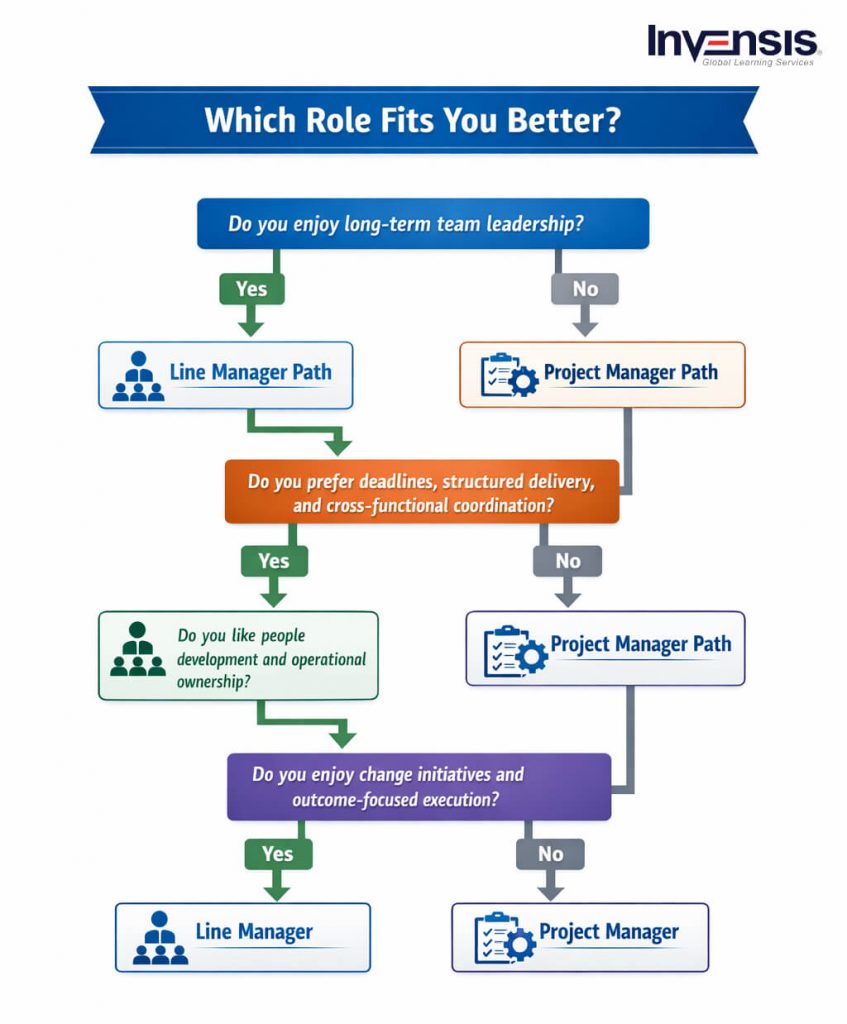
Neither path is inherently better. They simply create different forms of impact:
|
Can One Person Be Both a Line Manager and a Project Manager?
Yes, especially in smaller organizations or fast-moving teams. A department head might manage staff directly while also leading a strategic implementation project. In that case, the same person is wearing two different hats: one focused on functional leadership, the other on project delivery.
The challenge is not whether one person can do both. The challenge is whether the organization clearly distinguishes when that person is acting as a people manager and when they are acting as a project leader. Without that clarity, priorities can clash, and team members may not know which expectations come first.
Conclusion
Understanding the difference between a line manager and a project manager is not just about job titles. It is about understanding how organizations function, how authority is shared, and how work gets delivered effectively. A line manager focuses on sustaining team performance, people development, and operational continuity over time, while a project manager focuses on driving a defined initiative to successful completion within scope, time, and quality expectations. In many modern organizations, especially in matrix structures, both roles are essential, and confusion arises only when responsibilities are not clearly defined.
For professionals planning their next career move, the choice depends on the kind of impact they want to create. Those interested in team leadership, functional ownership, and long-term capability building may be better suited to line management. At the same time, those drawn to delivery, stakeholder coordination, and structured execution may find project management a stronger fit. For anyone looking to strengthen project leadership skills, Invensis Learning offers industry-recognized courses such as PMP Certification Training, PRINCE2 Foundation and Practitioner Training, and CAPM Certification Training to help professionals build the knowledge and confidence needed to lead projects successfully.