Projects rarely miss deadlines because teams lack effort. More often, delays occur when critical tasks take longer than expected, triggering a chain reaction that affects the entire project schedule. In complex projects involving multiple activities and dependencies, even a small delay in one task can push back the final delivery date.
To manage such risks, project managers rely on structured scheduling techniques to identify which activities directly affect the project timeline. One of the most widely used methods for this purpose is the Critical Path Method (CPM).
The Critical Path Method helps project teams determine the sequence of tasks that defines the shortest possible project duration and highlights the activities that must be carefully monitored to avoid delays.
In this blog, we will explore what the Critical Path Method is, how it works, the key steps involved in calculating the critical path, real-world examples of its application, and how it helps organizations manage complex project schedules more effectively.
What Is the Critical Path Method?
The Critical Path Method (CPM) is a project scheduling technique used to identify the sequence of tasks that determines the minimum time required to complete a project. It focuses on analyzing task dependencies and durations to determine which activities directly influence the project’s completion date.
In any project, some tasks can be delayed without affecting the overall timeline, while others must be completed exactly on schedule. The critical path represents the longest chain of dependent activities that must be completed on time to avoid delaying the entire project.
If a task on the critical path is delayed, the project’s final completion date will also be delayed.
The Critical Path Method was originally developed in the late 1950s by DuPont and Remington Rand to improve planning and scheduling in large industrial projects. Since then, CPM has become one of the most widely used scheduling techniques in modern project management.
| Project scheduling is a fundamental part of managing project timelines and constraints. As the Project Management Institute explains in the PMBOK Guide: “The critical path is the sequence of activities that represents the longest path through a project, which determines the shortest possible duration.” |
By identifying the tasks that directly affect project completion, CPM allows project managers to focus attention on the activities that matter most.
Why the Critical Path?
Understanding the critical path helps project managers answer several important questions during project planning:
- Which tasks directly control the project timeline?
- Which activities can be delayed without affecting project completion?
- Where should resources be prioritized to avoid schedule risks?
- How will delays in certain tasks affect the overall project schedule?
These insights allow teams to manage projects more effectively by focusing on the tasks that have the greatest impact on project delivery.
| As project management researchers, James E. Kelley Jr. and Morgan R. Walker, developers of CPM, demonstrated that when developing CPM, understanding task dependencies is essential for planning complex projects with multiple activities. |
Key Concepts in the Critical Path Method
Before calculating the critical path of a project schedule, it is important to understand the core elements of the Critical Path Method. These concepts help project managers analyze task relationships, estimate timelines, and determine which activities directly influence the final project delivery date.
Understanding these concepts also helps teams visualize how delays in one task may affect other activities within the project schedule.
Activities (Project Tasks)
Activities represent the individual tasks required to complete a project. Each activity contributes to the final deliverable and has a defined duration.
For example, in a website development project, activities might include:
- Requirements gathering
- Interface design
- Development
- Testing
- Deployment
Breaking projects into smaller activities makes it easier to track progress, assign responsibilities, and manage timelines.
Task Dependencies
Dependencies describe the relationships between tasks within a project schedule. In many cases, certain activities cannot begin until other tasks have been completed.
For example:
- System design can begin only after requirements are finalized
- Software testing can start only after development is completed
- Product launch occurs after testing and approvals are finished
Understanding these relationships allows project managers to map how tasks are connected and how delays might affect the overall project timeline.
Activity Duration
Duration refers to the estimated amount of time required to complete a specific activity. These estimates are typically based on past project experience, team expertise, and the complexity of the work involved.
Accurate duration estimates are important because they influence the entire project schedule and determine how activities align.
Critical Path
The critical path represents the longest sequence of dependent activities in the project schedule. This sequence determines the shortest possible time required to complete the entire project.
Activities that lie on the critical path must be completed exactly as planned because any delay in these tasks will directly impact the project completion date.
By identifying the critical path, project managers can focus on the activities that have the greatest impact on project delivery.
Slack (Float)
Slack, also known as float, refers to the amount of time an activity can be delayed without affecting the overall project completion date.
For example, if a task can be postponed by two days without impacting subsequent activities, that task has two days of slack.
Understanding slack helps project managers allocate resources more effectively and prioritize monitoring efforts on tasks that have no flexibility in the schedule.
How to Calculate the Critical Path (Step-by-Step)
Once the activities, dependencies, and durations of a project are identified, the next step is to determine the critical path. Calculating the critical path helps project managers understand which sequence of tasks controls the overall project timeline and where delays would have the greatest impact.
The calculation process typically involves mapping tasks, estimating durations, and analyzing how activities relate to one another within the project schedule. 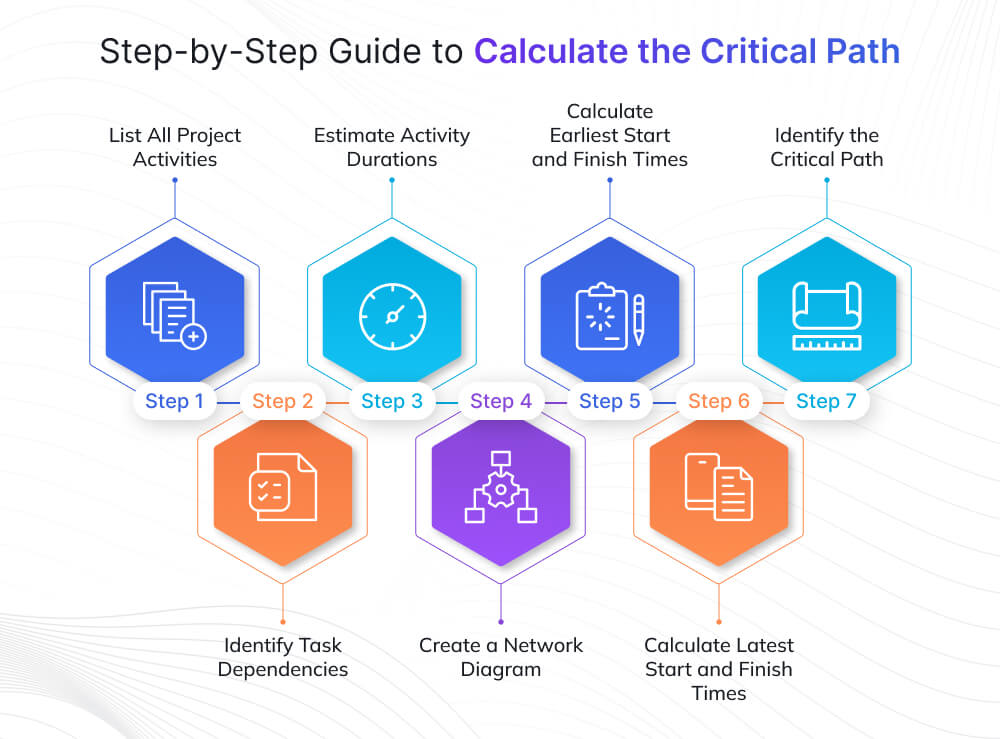
Step 1: List All Project Activities
The first step is to identify every task required to complete the project. These tasks are usually derived from the Work Breakdown Structure (WBS), which breaks the project into smaller, manageable components.
| Project planning experts emphasize that breaking a project into clearly defined activities is essential for effective scheduling. According to the Project Management Institute, developing a detailed Work Breakdown Structure helps teams identify all required deliverables and organize project work into manageable components. |
For example, in a simplified product development project, the activity list might include:
| Activity | Description |
| A | Market research |
| B | Product design |
| C | Prototype development |
| D | Testing |
| E | Production preparation |
Clearly defining project activities ensures that no essential work is overlooked when building the schedule.
Step 2: Identify Task Dependencies
After listing activities, the next step is to determine how tasks depend on each other. Dependencies define the order in which activities must occur.
Common types of dependencies include:
- Finish-to-Start (FS): A task cannot begin until the previous task is completed.
- Start-to-Start (SS): Two tasks can start at the same time.
- Finish-to-Finish (FF): Tasks must finish at the same time.
In most project schedules, the finish-to-start relationship is the most common. Example dependencies:
| Activity | Depends On |
| Product design | Market research |
| Prototype development | Product design |
| Testing | Prototype development |
| Production preparation | Testing |
These relationships form the structure of the project timeline.
Step 3: Estimate Activity Durations
Each activity must be assigned a duration estimate that represents the time required to complete the task.
Durations are typically estimated based on:
- Previous project data
- Team expertise
- Industry benchmarks
- Complexity of the work involved
For example:
| Activity | Duration |
| Market research | 3 days |
| Product design | 5 days |
| Prototype development | 8 days |
| Testing | 4 days |
| Production preparation | 3 days |
These estimates allow project managers to begin calculating the project schedule.
Step 4: Create a Network Diagram
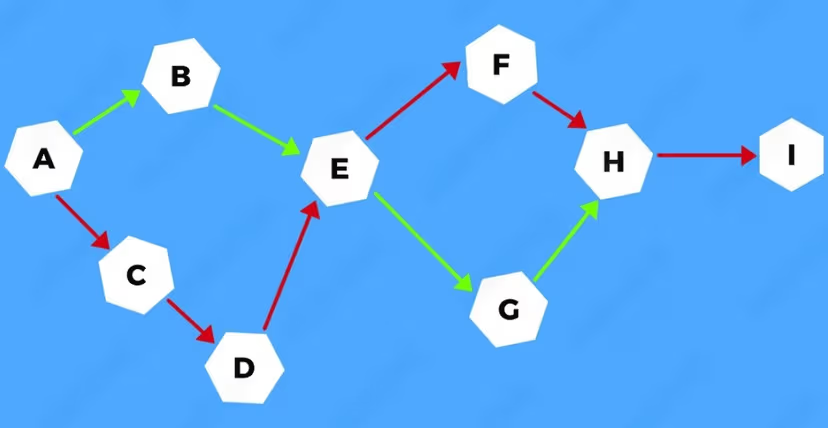
A network diagram visually represents the sequence of project activities and their dependencies. It shows how tasks are connected and which activities must be completed before others can begin.
| Network-based scheduling techniques became widely adopted after researchers James E. Kelley Jr. and Morgan R. Walker developed the Critical Path Method in the late 1950s to improve planning for complex industrial projects. |
Example sequence:
A → B → C → D → E
Network diagrams help project teams understand how the entire project flows from start to finish and provide a clear visual representation of task relationships.
Step 5: Calculate Earliest Start and Finish Times (Forward Pass)
In this step, project managers determine the earliest possible start and finish times for each activity.
This process is known as the forward pass.
- Earliest Start (ES): The earliest time an activity can begin.
- Earliest Finish (EF): The earliest time the activity can be completed.
The formula used is: EF = ES + Duration These calculations move forward through the network diagram from the first task to the final task.
Step 6: Calculate Latest Start and Finish Times (Backward Pass)
The next step is the backward pass, where project managers determine the latest time an activity can start or finish without delaying the project.
- Latest Start (LS): The latest time a task can begin without affecting project completion.
- Latest Finish (LF): The latest time the task can be completed without delaying the project.
Backward pass calculations start from the final activity and move backward through the project schedule.
Step 7: Identify the Critical Path
The critical path consists of activities where:
Earliest Start = Latest Start
These activities have zero slack, meaning they cannot be delayed without affecting the overall project timeline.
For example:
| Activity | Duration | Critical |
| Market research | 3 days | Yes |
| Product design | 5 days | Yes |
| Prototype development | 8 days | Yes |
| Testing | 4 days | Yes |
| Production preparation | 3 days | Yes |
In this case, the total project duration would be 23 days, and all tasks lie on the critical path.
Practical Tip for Project ManagersIn real projects, the critical path can change as tasks are completed or delayed. Therefore, project managers should regularly update project schedules and recalculate the critical path to reflect current progress. Continuous monitoring ensures that teams remain aware of schedule risks and can respond quickly when issues arise. |
Real-World Example of the Critical Path Method
Case Study: Housing Construction Project Scheduling Using CPM
A practical example of the Critical Path Method is construction project scheduling, where multiple activities must be coordinated to ensure projects are completed on time.
In a research study analyzing a housing construction project in Samarinda City, Indonesia, project planners used the Critical Path Method (CPM) to analyze the sequence of construction activities and identify tasks that directly affected the project timeline. The study mapped all construction activities, such as foundation work, structural construction, and finishing, into a project network and calculated the critical path to determine the minimum project duration.
By applying CPM analysis, the researchers identified the sequence of activities that determined the overall project completion time. The results showed that the original project schedule of 87 days could be reduced to 78 days by optimizing critical activities and adjusting the project schedule.
This example demonstrates how CPM helps project managers analyze task dependencies, identify schedule bottlenecks, and optimize timelines in complex construction projects where multiple activities occur simultaneously.
Source: Research Study
Critical Path Method vs PERT
The Critical Path Method (CPM) and the Program Evaluation and Review Technique (PERT) are two widely used project scheduling methods designed to help project managers plan, monitor, and control complex projects. While both techniques analyze task dependencies and project timelines, they differ in how they estimate activity durations and handle uncertainty.
Understanding the differences between CPM and PERT helps project managers choose the most appropriate method depending on the nature of the project and the level of uncertainty involved.
While both CPM and PERT analyze project schedules, they are used in different situations.
| Feature | Critical Path Method (CPM) | Program Evaluation and Review Technique (PERT) |
| Time Estimates | Single deterministic duration | Three probabilistic estimates |
| Project Type | Predictable projects | Uncertain or experimental projects |
| Focus | Scheduling and resource optimization | Managing uncertainty in project timelines |
| Common Industries | Construction, manufacturing | R&D, defense, technology development |
Many organizations use a combination of both techniques when planning large projects.
Conclusion
Managing complex projects requires more than simply listing tasks and assigning deadlines. Without a clear understanding of how activities depend on each other, even small delays can trigger a chain reaction that affects the entire project schedule. The Critical Path Method (CPM) helps project managers avoid this risk by identifying the sequence of tasks that directly determines the project’s completion time.
By mapping activities, estimating durations, and analyzing dependencies, CPM provides a structured approach to project scheduling. It enables teams to focus on critical activities, allocate resources more effectively, and detect schedule risks early in the project lifecycle. Whether used in construction, engineering, product development, or IT projects, the Critical Path Method remains one of the most reliable techniques for planning and controlling project timelines.
For professionals involved in project planning and delivery, understanding scheduling techniques such as CPM is essential. Learning how to analyze project activities, manage dependencies, and optimize timelines can significantly improve project outcomes and team efficiency.
If you want to build deeper expertise in project scheduling, risk management, and project execution frameworks, exploring professional training programs can be valuable. Programs such as Project Management Professional (PMP®) certification training and PRINCE2® Project Management training offered by Invensis Learning help professionals develop the practical knowledge required to plan, manage, and deliver projects successfully.
These courses cover essential project management concepts, including scheduling techniques, risk management strategies, stakeholder communication, and project governance, all of which are critical for managing complex projects in today’s dynamic business environment.