
Understanding the key project success factors is essential for achieving consistent positive outcomes. In project management, achieving core objectives is fundamental, but true success often depends on a combination of critical factors. These include detailed planning, effective communication, risk management, and stakeholder engagement. Strategic investments in experienced digital transformation services can boost project outcomes with advanced technologies and specialized expertise.
This blog post will explain these essential components of the project's success. Through practical insights and real-world examples, we'll explore how these factors work together to ensure projects are delivered on time, within budget, and to the highest quality standards. By gaining a comprehensive understanding of these critical factors, you'll be able to confidently navigate the project lifecycle and ensure your projects stay on track for success. Stay tuned as we discover the keys to mastering project management excellence.
What Makes a Project Successful?
A project is successful when it achieves its defined objectives while meeting expectations for scope, timeline, budget, and quality. In practice, project success depends on the effective coordination of planning, leadership, communication, stakeholder alignment, and risk management.
Projects succeed when teams establish clear goals, secure strong executive support, and implement structured planning processes. Equally important is the ability to monitor progress, address risks early, and adapt to changing requirements throughout the project lifecycle.
Organizations that consistently deliver successful projects usually apply several project success factors in project management, including skilled teams, transparent communication, and effective governance. When these elements work together, projects are far more likely to deliver measurable business value and long-term impact.
Top 10 Project Success Factors
Understanding the top 10 project success factors allows organizations to deliver projects more consistently and predictably. Projects rarely fail because teams lack effort; they fail because organizations overlook the structural drivers that support execution.
These project success factors in project management influence planning, governance, collaboration, and decision-making throughout the project lifecycle. When organizations systematically address these elements, they significantly improve the probability of project management success.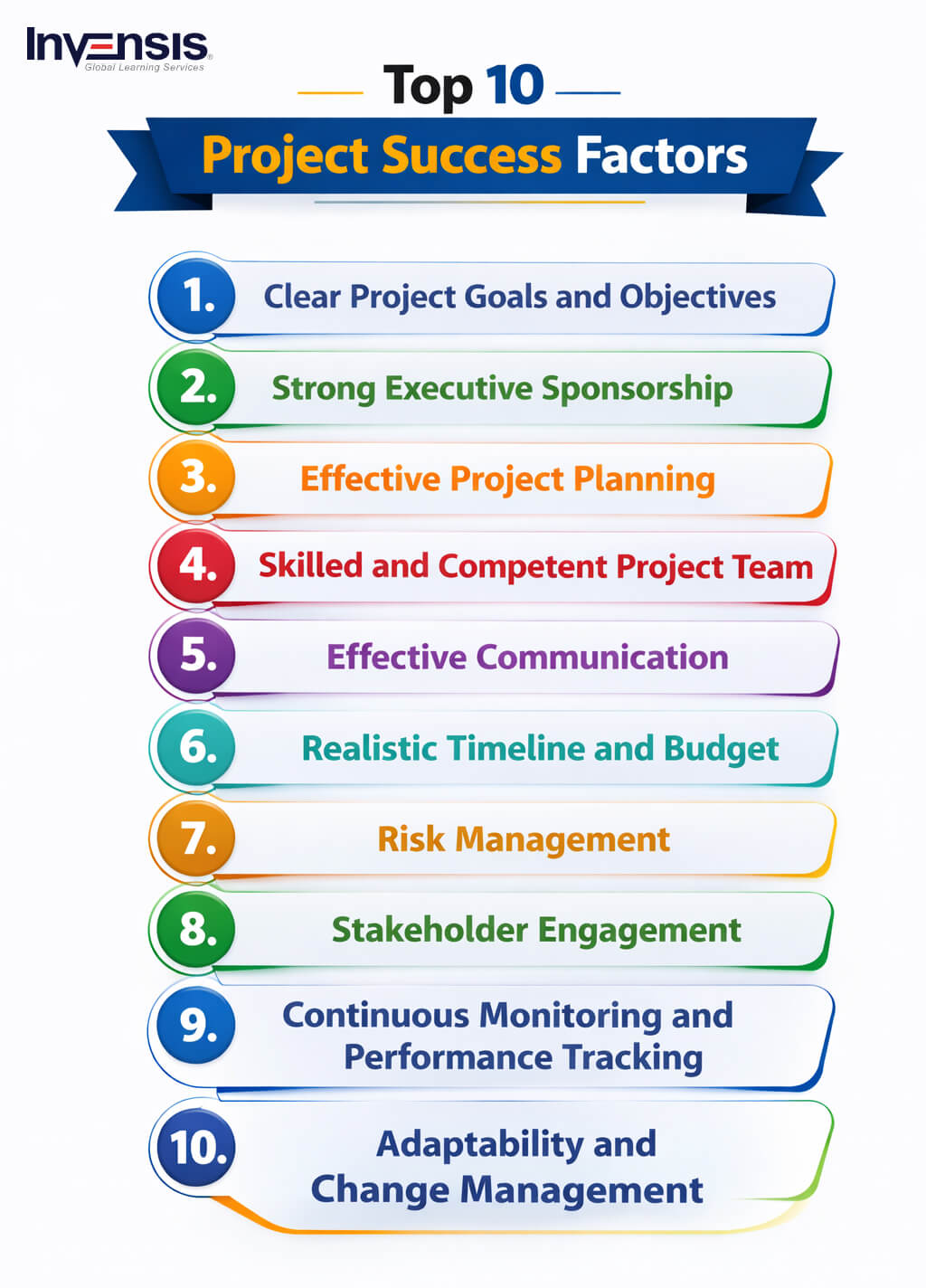
Clear Project Goals and Objectives
One of the most fundamental factors in project success is the clarity of project goals. When a project begins without clearly defined objectives, teams often operate with different assumptions about the expected outcomes. This leads to scope confusion, misaligned priorities, and inconsistent decision-making.
Clear project goals establish the foundation for the entire project lifecycle. They define what success looks like, what deliverables must be produced, and how performance will be measured. Organizations typically document these goals through project charters, scope statements, and defined success metrics.
Management thinker famously stated that “what gets measured gets managed.” Clearly defined goals and measurable outcomes help project teams maintain focus and evaluate whether the project is progressing toward success. |
|

Well-defined objectives also help ensure alignment between the project and broader business strategy. For example, a digital transformation initiative should not simply aim to deploy new technology; it should specify measurable outcomes such as improved operational efficiency, reduced processing time, or increased customer satisfaction.
When project objectives are specific, measurable, achievable, relevant, and time-bound (SMART), teams can maintain focus, reduce ambiguity, and make informed decisions throughout the project.
Strong Executive Sponsorship
Executive sponsorship is widely recognized as a critical success factor emphasized by project management frameworks. Senior leaders provide the strategic direction and organizational support required to move projects forward.
Projects frequently encounter barriers such as budget constraints, resource conflicts, or organizational resistance. Without strong leadership support, project managers may struggle to overcome these challenges. Executive sponsors play a critical role in removing obstacles, securing resources, and reinforcing the initiative's strategic importance.
Sponsors also help ensure that projects remain aligned with organizational priorities. By maintaining oversight and participating in major decision points, executives can guide projects through complex situations and prevent unnecessary delays.
Moreover, visible leadership support increases team confidence and stakeholder trust. When employees see senior leadership actively backing a project, it reinforces commitment across departments and improves overall project momentum.
Effective Project Planning
Comprehensive planning is one of the most important factors affecting project success. A well-developed project plan provides a structured roadmap that guides teams from initiation through completion.
Effective planning typically includes detailed schedules, defined milestones, resource allocation strategies, cost estimates, and risk mitigation plans. These components enable project managers to anticipate potential challenges and proactively establish mechanisms to manage them.
For example, creating a Work Breakdown Structure (WBS) helps break complex initiatives into manageable tasks. Similarly, scheduling tools such as Gantt charts or project management software enable teams to track progress and coordinate dependencies.
Without proper planning, projects often experience scope creep, budget overruns, and schedule delays. A structured planning process ensures that teams understand the sequence of activities required and have the necessary resources to execute them successfully.
Skilled and Competent Project Team
Even the most detailed plans cannot succeed without a capable team to execute them. A skilled project team is therefore a critical factor in project success.
Project teams must possess the technical expertise required for the project as well as essential collaboration and problem-solving skills. Complex projects often require cross-functional expertise, combining knowledge from engineering, operations, finance, and technology.
Project managers must ensure that team members clearly understand their roles and responsibilities. Defined accountability helps avoid confusion and ensures that tasks are completed efficiently.
In addition, organizations should invest in continuous training and capability development. As industries evolve rapidly, equipping teams with updated skills improves productivity and strengthens overall project performance.
Effective Communication
Communication consistently appears among the key success factors in project management identified by industry research. Projects involve multiple stakeholders, departments, and external partners, making clear communication essential.
Effective communication ensures that all participants understand project objectives, responsibilities, timelines, and progress updates. When information flows smoothly, teams can identify issues early and address them before they escalate.
Structured communication practices typically include regular project meetings, status reports, dashboards, and documented updates. These mechanisms help maintain transparency and keep stakeholders informed about progress and challenges.
Poor communication, on the other hand, often leads to misunderstandings, duplication of effort, and delayed decision-making. Establishing clear communication channels, therefore, significantly improves collaboration and project coordination.
Realistic Timeline and Budget
Setting realistic expectations for project timelines and budgets is another crucial factor in project success. Projects frequently fail when schedules are overly optimistic or financial resources are underestimated.
Accurate estimation requires analyzing historical data, assessing resource availability, and considering potential risks. Techniques such as bottom-up estimating, expert judgment, and contingency planning help improve accuracy.
A realistic timeline allows teams to maintain quality while meeting deadlines. Similarly, a well-planned budget ensures that necessary resources, tools, and personnel remain available throughout the project.
When organizations allocate sufficient time and financial resources, project managers can focus on delivering value rather than constantly addressing budget shortages or schedule pressures.
Risk Management
Uncertainty is unavoidable in project environments, making risk management one of the most critical factors affecting project success. Every project faces potential threats such as technical challenges, supply disruptions, regulatory changes, or stakeholder conflicts.
Effective risk management begins with identifying potential risks early in the project lifecycle. Teams then analyze the likelihood and potential impact of each risk and develop mitigation strategies.
Risk registers, scenario planning, and contingency plans help organizations prepare for unexpected events. By proactively managing uncertainty, teams can minimize disruptions and maintain project stability.
Organizations that integrate risk management into their project governance structures are far better positioned to handle challenges without derailing project outcomes.
Stakeholder Engagement
Stakeholders influence nearly every aspect of project success, including funding, approvals, and strategic direction. Engaging stakeholders throughout the project lifecycle helps maintain alignment and support.
Stakeholder engagement begins by identifying individuals or groups who have an interest in the project. This includes executives, customers, team members, regulators, and external partners.
Once identified, project managers must understand stakeholder expectations and establish appropriate communication strategies. Regular updates, consultation during major decisions, and transparent reporting help build trust and collaboration.
Active stakeholder engagement reduces resistance to change and ensures that the project continues to deliver value aligned with organizational goals.
Continuous Monitoring and Performance Tracking
Monitoring project performance ensures that teams remain aligned with their objectives. Effective monitoring involves tracking key performance indicators, evaluating progress against milestones, and identifying deviations from the plan.
Project managers often use dashboards, reporting tools, and performance metrics to maintain visibility over project activities. These tools help detect delays, resource shortages, or budget variances early.
Continuous monitoring also enables organizations to implement corrective actions before issues escalate. By regularly reviewing progress and adjusting strategies when necessary, teams can maintain control and improve delivery outcomes.
Consistent performance tracking strengthens accountability and ensures that projects stay focused on achieving their intended goals.
Adaptability and Change Management
Modern projects operate in environments characterized by rapid technological advancements and evolving business requirements. Adaptability and structured change management therefore, play important roles in project success.
Projects often experience shifts in scope, stakeholder expectations, or external conditions. Organizations that resist change may struggle to respond effectively, leading to delays or project failure.
Effective change management processes ensure that modifications are evaluated, approved, and implemented in a controlled manner. This prevents disruptions while keeping projects responsive to new opportunities or challenges.
Adaptability also encourages innovation and continuous improvement. Teams that embrace flexibility can adjust strategies, optimize processes, and maintain progress even in uncertain environments.
Factors Affecting Project Success in Modern Organizations
While the top 10 project success factors provide a strong foundation for project delivery, several broader organizational and environmental elements also influence outcomes. These factors affecting project success determine how effectively teams can apply project management practices in real-world situations.
Understanding these influences helps organizations create conditions that support consistent project management success.
Organizational Culture
Organizational culture significantly influences how projects are managed and executed. A culture that encourages collaboration, accountability, and transparency creates an environment where project teams can perform effectively.
In contrast, organizations with siloed departments, unclear authority structures, or resistance to change often experience delays and communication breakdowns. When employees feel empowered to share ideas and address problems openly, projects benefit from faster decision-making and stronger teamwork.
Leadership plays a crucial role in shaping this culture. Companies that promote learning, innovation, and continuous improvement are more likely to achieve sustainable project outcomes.
Leadership and Governance
Strong governance frameworks are among the most important project success factors in project management. Governance structures establish clear accountability, decision-making processes, and oversight mechanisms.
Effective governance ensures that projects remain aligned with strategic objectives while maintaining transparency across stakeholders. Steering committees, project boards, and defined escalation processes help organizations manage risks and resolve conflicts efficiently.Without proper governance, projects often suffer from unclear responsibilities and inconsistent decision-making.
Leadership should focus on removing barriers for teams rather than controlling their work. Strong executive sponsorship ensures that project teams receive the support and resources required to deliver results. |
|

Technology and Project Management Tools
Technology has become an essential enabler of modern project delivery. Project management platforms allow teams to track progress, manage tasks, collaborate in real time, and maintain documentation across distributed environments.
Digital tools also improve data visibility. Dashboards and analytics enable project managers to monitor key metrics, including resource utilization, budget performance, and schedule adherence.
Organizations that leverage modern project management technologies are better equipped to coordinate complex initiatives and maintain control over project activities.
Resource Availability
Resource constraints remain one of the most common factors affecting project success. Projects require skilled personnel, financial investment, infrastructure, and time to achieve their objectives.
When resources are insufficient or poorly allocated, teams may struggle to complete tasks on schedule or maintain quality standards. Effective resource planning ensures that projects have the necessary capabilities and capacity to execute their plans.
Organizations often address this challenge by implementing portfolio management practices that prioritize initiatives based on strategic importance and resource availability.
Stakeholder Alignment
Projects frequently involve multiple stakeholders with differing expectations and priorities. Ensuring alignment among these groups is essential for maintaining project momentum.
Stakeholder misalignment can lead to scope changes, delayed approvals, and conflicting requirements. Regular engagement, clear communication, and structured feedback mechanisms help maintain consensus throughout the project lifecycle.
When stakeholders share a common understanding of project goals and benefits, decision-making becomes faster, and project delivery becomes more efficient.
External Environmental Factors
External conditions such as market changes, regulatory requirements, economic conditions, and technological disruptions can also influence project outcomes.
For example, regulatory changes in highly regulated industries like finance or healthcare may require adjustments to project scope or timelines. Similarly, rapid technological innovation can alter project priorities or introduce new opportunities.
Organizations that continuously monitor external factors and adapt their strategies accordingly are more likely to maintain project stability and achieve successful results.
Real Use Cases of Project Success Factors
Understanding the theory behind project success factors is essential, but seeing how these factors are applied in real-world scenarios provides deeper insight and practical knowledge. Here, we have explored various use cases where project success factors have been effectively implemented.
NASA Mars Pathfinder Mission
Project: NASA Mars Pathfinder Mission
Industry: Aerospace / Space Exploration
NASA’s Mars Pathfinder mission is widely cited as a successful example of complex project management. The mission aimed to land a robotic rover on Mars and conduct scientific exploration. Despite extremely high technical risks, the project was delivered successfully and later received the Project Management Institute (PMI) “Project of the Year” award.Several key project success factors contributed to the mission’s outcome:
rigorous planning and systems engineering
strong leadership and governance
extensive risk management and testing
cross-disciplinary team collaboration
NASA used structured project management frameworks to coordinate engineers, scientists, and mission planners, enabling the rover to land successfully and transmit valuable scientific data from Mars.
Source: PMI
Cadbury ERP Implementation
Project: SAP ERP Implementation
Industry: Manufacturing / Supply Chain
Cadbury implemented an enterprise resource planning (ERP) system to improve supply chain management and production coordination. The project required major operational transformation across manufacturing and distribution.The company focused on several project success factors in project management:
clear requirements gathering
alignment between business needs and ERP functionality
strong stakeholder involvement across departments
After implementation, Cadbury achieved improved operational efficiency and better supply chain coordination across its production network.
Source: ERP Implementation Case Study
Conclusion
Understanding and implementing the top factors for project success are crucial steps toward achieving exceptional outcomes in project management. From detailed planning and systematic approaches to utilizing experienced leadership and effective communication, each factor is pivotal in projects toward success. These principles enhance project efficiency, minimize risks, and foster a collaborative team environment that is essential for sustained success. By prioritizing these factors, project managers can effectively navigate challenges, optimize resources, and deliver results that exceed expectations.
Ready to Master Project Success? Explore our comprehensive Project Management certification courses at Invensis Learning and equip yourself with the skills and strategies to ensure project success.
Frequently Asked Questions
What are the most important project success factors?
The most important project success factors include clear goals, strong executive sponsorship, effective planning, skilled project teams, open communication, realistic budgets and timelines, risk management, stakeholder engagement, performance tracking, and adaptability. These elements work together to improve project execution and increase the chances of delivering successful outcomes.
Why are clear goals important for project success?
Clear goals are important because they define what the project is expected to achieve, how success will be measured, and what priorities the team should follow. Without clearly defined objectives, projects often suffer from scope confusion, misalignment, and poor decision-making. Well-structured goals help teams stay focused and aligned throughout the project lifecycle.
How does stakeholder engagement affect project success?
Stakeholder engagement affects project success by ensuring that key decision-makers, users, and sponsors remain aligned with the project’s objectives. When stakeholders are actively involved, teams can gather better requirements, reduce resistance to change, speed up approvals, and maintain support throughout the project. Poor stakeholder engagement often leads to delays, rework, and conflicting expectations.
What role does risk management play in project management success?
Risk management plays a critical role in project management success because it helps teams identify potential problems before they disrupt delivery. By assessing risks early and creating mitigation plans, project managers can reduce uncertainty, control unexpected issues, and protect project timelines, costs, and quality. Strong risk management improves stability and decision-making across the project lifecycle.
Can a project still be successful if changes happen during execution?
Yes, a project can still be successful even if changes occur during execution, provided those changes are managed effectively. Modern projects often face shifting business needs, market conditions, or stakeholder requirements. A structured change management process helps teams evaluate, approve, and implement changes without losing control over scope, budget, or timelines.