



In today’s rapidly evolving business landscape, program managers have emerged as strategic orchestrators who drive organizational transformation and deliver sustained business value. As we navigate through 2026, the role of a program manager has transcended traditional boundaries, incorporating artificial intelligence, sustainability considerations, and hybrid work methodologies into their core competencies.
But what exactly does a program manager do, and how has this role evolved to meet the demands of modern business? A program manager is a strategic leader responsible for overseeing multiple related projects that collectively achieve broader organizational objectives. Unlike project managers who focus on delivering specific outputs within defined constraints, program managers think bigger, they align initiatives with business strategy, manage interdependencies, and ensure that the sum of individual projects creates transformative organizational value.
The demand for skilled program managers has never been higher. According to the Project Management Institute (PMI), organizations are recognizing the critical importance of program management, with 54% now using generative AI in 16-50% of their projects, fundamentally transforming how programs are planned and executed. This shift represents not just technological adoption but a complete reimagining of the program manager’s role in the digital age.
In this comprehensive guide, we’ll explore the core roles and responsibilities of program managers in 2026, examine the essential skills required for success, discuss emerging technologies reshaping the profession, and provide actionable insights for both aspiring and experienced program management professionals.
Table Of Contents
- Core Roles and Responsibilities of a Program Manager
- Program Manager vs Project Manager: Key Distinctions
- Essential Skills for Program Managers in 2026
- AI and Technology Tools Transforming Program Management
- Career Path and Salary Expectations in 2026
- Certifications and Professional Development
- Challenges Facing Program Managers in 2026
- Best Practices for Program Management Success
- Future Trends and the Evolution of Program Management
- Conclusion
Core Roles and Responsibilities of a Program Manager
The program manager’s role in 2026 is multifaceted and strategically critical. While the fundamentals remain rooted in leadership and coordination, modern program managers must navigate an increasingly complex ecosystem of technology, stakeholder expectations, and organizational change. Let’s explore the core responsibilities that define this pivotal role.
Strategic Program Planning and Alignment
At the heart of program management lies strategic planning, the ability to envision how multiple projects interconnect to achieve transformational business outcomes. Program managers in 2026 serve as the bridge between executive vision and operational execution, translating high-level strategic objectives into actionable program roadmaps.
Strategic program planning begins with deep organizational understanding. Program managers must comprehend not just what the business does, but why it exists, where it’s heading, and what competitive advantages it seeks to maintain or develop. This requires engaging with C-suite executives, understanding market dynamics, and identifying how the program portfolio can create sustainable competitive advantage.
The alignment process involves several critical activities. First, program managers conduct comprehensive business case analyses, evaluating potential programs against strategic priorities, resource availability, and expected return on investment. They develop detailed program charters that articulate vision, scope, objectives, and success criteria in language that resonates with both technical teams and executive stakeholders.
Cross-Functional Leadership and Team Coordination
Program managers function as organizational orchestrators, bringing together diverse teams, departments, and sometimes even external partners to work toward unified objectives. This coordination responsibility represents one of the most challenging yet rewarding aspects of program management in 2026.
Leading cross-functional teams requires a fundamentally different skillset than managing single-discipline groups. Program managers must speak multiple “languages,”understanding the concerns of software developers, the priorities of marketing professionals, the constraints of finance teams, and the strategic imperatives of senior leadership. They serve as translators, ensuring that each functional group understands how their work contributes to the broader program vision.
The coordination challenge has intensified with the normalization of hybrid and remote work environments. According to the World Economic Forum, remote work is projected to increase by 25% globally by 2030, reaching an estimated 92 million remote workers worldwide. This distributed workforce requires program managers to master virtual collaboration tools, establish clear communication protocols, and create engagement strategies that maintain team cohesion across time zones and geographies.
Program Governance and Risk Management
Establishing and maintaining effective governance frameworks is perhaps the program manager’s most critical responsibility for ensuring sustained program success. Governance provides the structure through which programs are directed, controlled, and held accountable to organizational standards and strategic objectives.
Program governance in 2026 encompasses multiple dimensions. First, program managers design governance structures that define roles, responsibilities, and authorities across the program hierarchy. This includes establishing steering committees composed of executive sponsors, identifying program board members who provide oversight, and clarifying the relationship between program managers, project managers, and functional leaders.
The governance framework also defines how decisions get made. Program managers establish decision-making criteria, identify which decisions require steering committee approval versus program manager authority, and create escalation paths for issues that exceed defined thresholds. This clarity prevents bottlenecks while ensuring appropriate oversight of high-impact decisions.
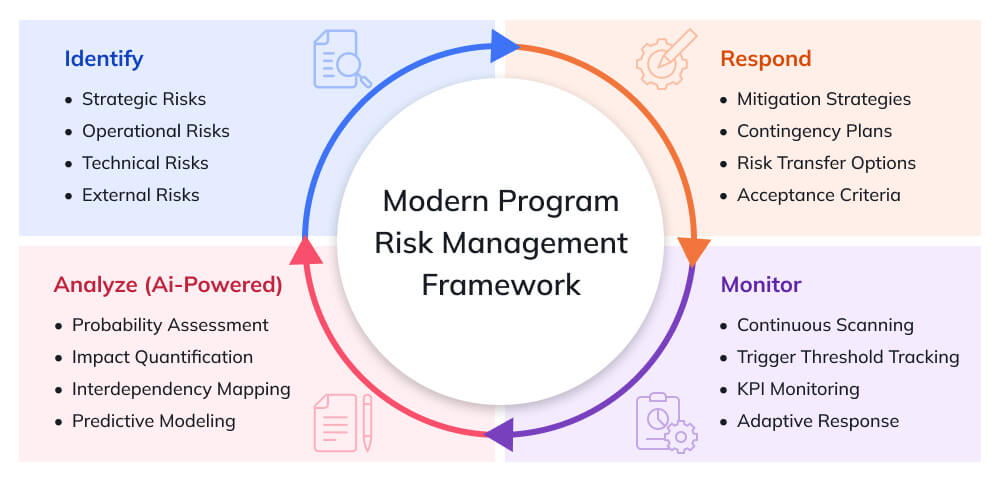
Risk management has evolved significantly with the integration of AI and predictive analytics. Modern program managers don’t just identify and document risks, they use sophisticated tools to predict risk probability, simulate potential impacts, and develop data-driven mitigation strategies.
Compliance and regulatory oversight have become increasingly complex in 2026. Program managers must navigate an expanding landscape of regulations, from data privacy requirements like GDPR and CCPA to environmental regulations driving corporate sustainability commitments. The EPA’s 2024-2027 National Enforcement and Compliance Initiatives have heightened focus on environmental protection, requiring program managers to ensure their programs meet stringent environmental standards.
Quality assurance across the program portfolio requires establishing consistent standards, conducting regular quality reviews, and implementing continuous improvement processes. Program managers define quality criteria for each project within the program, establish gates where quality is formally assessed, and ensure that deliverables meet both technical specifications and business requirements.
Performance monitoring in 2026 relies heavily on real-time dashboards and automated reporting systems. Program managers establish key performance indicators (KPIs) that measure progress toward strategic objectives, not just project completion metrics. These might include business value realized, customer satisfaction scores, time-to-market improvements, or innovation metrics that capture the program’s contribution to organizational capabilities.
Financial Oversight and Budget Management
Financial stewardship represents a cornerstone responsibility for program managers, who typically oversee budgets ranging from millions to hundreds of millions of dollars. Unlike project managers who focus on individual project budgets, program managers manage financial portfolios, balancing investments across multiple initiatives to optimize overall program ROI.
Program-level budgeting requires sophisticated financial modeling capabilities. Program managers develop comprehensive financial plans that account for direct project costs, shared resources, overhead allocations, risk reserves, and change management investments. They create financial scenarios that model different funding approaches, helping executives understand trade-offs between program scope, timeline, and budget.
Cost-benefit analysis has evolved beyond simple ROI calculations. Modern program managers evaluate programs across multiple value dimensions, financial returns, strategic positioning, capability development, risk reduction, and innovation potential. They use balanced scorecards and value realization frameworks to demonstrate how programs create value beyond immediate cost savings or revenue generation.
Key Takeaways: Core Program Manager Responsibilities
Program managers in 2026 are not just coordinators; they are strategic business leaders who orchestrate complex initiatives to create measurable, transformational value. |
Program Manager vs Project Manager: Key Distinctions
While program managers and project managers share foundational competencies, understanding the distinctions between these roles is critical for career planning and organizational design. The confusion between these roles persists, yet the differences are significant and impact how each professional approaches their work.
- Scope and Focus: Project managers concentrate on delivering specific output, a product, system, or service, within defined time, cost, and quality parameters. Their scope is bounded and tactical. Program managers, conversely, oversee multiple related projects that collectively achieve strategic business objectives. Their scope is expansive and strategic, focused on benefits realization rather than just deliverable completion.
- Time Horizons: Projects have defined start and end dates, typically spanning weeks to months. Programs are longer-term initiatives, often lasting years, with projects launching and closing at different times throughout the program lifecycle. Program managers maintain strategic continuity even as individual projects within their program portfolio come and go.
- Strategic vs. Tactical Orientation: Project managers optimize execution, how to deliver requirements most efficiently. Program managers optimize strategy, which projects to pursue, how to sequence them, and how to adapt the program portfolio as business conditions change. As one analysis notes, “program managers define the strategy, while project managers ensure flawless execution.”
- Stakeholder Complexity: Project managers primarily interface with project teams, functional managers, and immediate sponsors. Program managers engage at executive levels, managing relationships with C-suite leaders, board members, and external partners. Their stakeholder landscape is broader and more politically complzx.
| Dimension | Project Manager | Program Manager |
| Primary Focus | Deliverable completion | Strategic benefit realization |
| Typical Duration | 3–18 months | 2–5+ years |
| Budget Range | $100K – $10M | $10M – $500M+ |
| Team Size | 5–50 members | 50–500+ across multiple projects |
| Reporting Level | Department/Division leaders | C-suite executives |
| Success Metrics | On-time, on-budget, quality | Business value, strategic objectives |
| Key Skills | Tactical planning, execution | Strategic thinking, change leadership |
| Scope Changes | Minimize and control | Anticipate and adapt strategically |
| Risk Approach | Project-specific mitigation | Portfolio-level risk management |
| Career Salary (2026) | $75K – $140K | $107K – $157K |
Both roles are essential to organizational success, and many professionals progress from project management to program management as they develop strategic thinking capabilities and demonstrate leadership at broader organizational levels. Understanding these distinctions helps professionals identify which path aligns with their skills, interests, and career aspirations.
Essential Skills for Program Managers in 2026
The skill requirements for program managers have expanded dramatically as technology, work environments, and business expectations evolve. Success in 2026 requires a sophisticated blend of technical proficiency, leadership excellence, and business acumen. Let’s explore the critical competencies that separate exceptional program managers from average performers.
Technical and Digital Skills
Technology literacy is no longer optional for program managers, it’s fundamental to the role. The digital transformation sweeping across industries has made technical competency a prerequisite for effective program leadership.
- AI and Automation Literacy: tops the list of emerging technical requirements. Program managers don’t need to code AI algorithms, but they must understand AI capabilities, limitations, and applications within their programs. They should know how to leverage generative AI tools like ChatGPT and Gemini for content creation, analysis, and problem-solving. They must also understand how AI-powered project management platforms can automate scheduling, resource allocation, and risk monitoring.
The integration of AI into program management is accelerating rapidly. Research from McKinsey’s 2025 State of AI report shows that organizations are redesigning workflows to embed generative AI into scheduling, reporting, and resource allocation processes. Program managers who understand these capabilities can drive efficiencies that traditional management approaches cannot achieve.
| By 2030, 80% of the work of today’s project management discipline will be eliminated as artificial intelligence (AI) takes on traditional PM functions such as data collection, tracking and reporting. |
- Data Analytics and Interpretation: capabilities enable program managers to make evidence-based decisions. Modern programs generate massive amounts of data, schedule information, resource utilization, financial performance, quality metrics, and stakeholder feedback. Program managers must know how to access this data, analyze trends, identify patterns, and translate insights into actionable strategies.
Data visualization skills complement analytical capabilities. Program managers must present complex information to diverse audiences, from technical teams who appreciate detailed analyses to executives who need high-level dashboards. Creating compelling visualizations that tell clear stories from data has become an essential communication skill. - Cloud Computing Proficiency is increasingly important as program infrastructure migrates to cloud platforms. Program managers should understand cloud service models (IaaS, PaaS, SaaS), appreciate the benefits and risks of cloud adoption, and know how to evaluate cloud-based program management tools. Cloud platforms enable the distributed collaboration that hybrid work environments require, making cloud literacy essential for modern program leadership.
- Agile and Hybrid Methodology Expertise represents another critical technical competency. While traditional waterfall approaches still have their place, most programs in 2026 incorporate agile principles, use iterative development approaches, or blend methodologies to match project characteristics. Program managers must understand Scrum, Kanban, SAFe (Scaled Agile Framework), and other agile approaches. More importantly, they must know when to apply which methodology and how to manage programs where different projects use different approaches.
- Project Management Software Mastery extends beyond basic tool usage to strategic platform selection and integration. Leading platforms in 2026 include Asana, ClickUp, Wrike, Motion, and Microsoft Project, each with AI-enhanced features for intelligent scheduling, resource optimization, and predictive analytics. Program managers should evaluate which platforms best fit their organizational context and ensure effective integration across the program portfolio.
Leadership and Interpersonal Skills
Technical skills enable program execution, but leadership skills determine program success. The human dimensions of program management, motivating teams, influencing stakeholders, navigating organizational politics, and driving change, require sophisticated interpersonal capabilities that distinguish exceptional program leaders.
- Emotional Intelligence (EI) has emerged as perhaps the most critical leadership competency for program managers in 2026. A Capterra survey revealed that 85% of project managers have increased their use of emotional intelligence over the past two years, recognizing its growing importance in the face of emerging technologies and remote work arrangements.
Emotional intelligence encompasses four domains: self-awareness (understanding your own emotions and their impact), self-management (controlling disruptive emotions and maintaining composure under pressure), social awareness (reading others’ emotions and organizational dynamics), and relationship management (influencing, coaching, and building bonds). Program managers with high EI navigate stakeholder conflicts more effectively, build stronger team cohesion, and adapt their leadership style to different situations and individuals.
- Strategic Thinking enables program managers to see beyond immediate tactical concerns to understand how their programs fit within broader business contexts. Strategic thinkers anticipate market shifts, identify emerging opportunities and threats, and adapt program direction proactively rather than reactively. They connect dots that others miss, seeing how disparate initiatives can create synergies when properly orchestrated.
Developing strategic thinking requires cultivating several sub-skills: systems thinking (understanding how components interact within complex systems), scenario planning (envisioning multiple potential futures and planning accordingly), pattern recognition (identifying trends from incomplete information), and business model analysis (understanding how organizations create and capture value).
- Change Management Capabilities have become increasingly critical as organizations undergo continuous transformation. According to Prosci research, the top organizational changes expected in 2025 include technology and digital transformation (37%), regulatory changes and compliance (9%), and environmental sustainability initiatives (9%). Program managers must lead teams through these changes, managing resistance, building commitment, and ensuring sustainable adoption of new ways of working.
Effective change management involves stakeholder analysis, communication planning, training design, and reinforcement strategies. Program managers must identify change impacts, anticipate resistance, engage sponsors effectively, and create conditions where people embrace rather than resist change.
- Communication and Influence skills enable program managers to align diverse stakeholders behind program objectives. This requires adapting communication style to audience, using technical language with engineers, financial language with CFOs, and strategic language with CEOs. It means mastering multiple communication channels, from formal presentations to informal hallway conversations, from written reports to video conferences.
Influence without direct authority is particularly important. Program managers often must gain cooperation from individuals and teams they don’t directly control. This requires building credibility through expertise, creating reciprocal relationships, appealing to shared interests, and sometimes leveraging organizational politics strategically.
- Adaptive Leadership reflects the capacity to remain effective despite changing circumstances. The pace of change in 2026 is unprecedented, technologies evolve rapidly, market conditions shift unexpectedly, and organizational priorities realign frequently. Program managers must maintain program momentum while adapting to these dynamics, knowing when to persist with current approaches and when to pivot to new strategies.
Business Acumen and Domain Knowledge
Program managers operate at the intersection of strategy and execution, requiring deep understanding of business fundamentals and industry-specific expertise that enables them to make decisions serving organizational interests.
- Financial Literacy: extends beyond budget management to understanding income statements, balance sheets, cash flow dynamics, and how programs impact financial performance. Program managers should comprehend concepts like ROI, NPV (net present value), payback periods, and total cost of ownership. They must communicate program value in financial terms that resonate with CFOs and executive committees.
- Industry-Specific Expertise: provides context for program decisions. A program manager leading healthcare initiatives needs different domain knowledge than one managing financial services programs or manufacturing transformations. Industry expertise helps program managers understand regulatory requirements, competitive dynamics, customer expectations, and operational constraints that shape program parameters.
- Cybersecurity Awareness: has become essential as programs increasingly rely on cloud platforms, generate sensitive data, and create potential vulnerabilities. Program managers don’t need to be security experts, but they must understand common threats (phishing, malware, injection attacks), appreciate security requirements, and ensure their programs incorporate appropriate security controls. With cyber threats costing organizations billions annually, security literacy is a fiduciary responsibility.
- Sustainability and ESG Considerations: reflect stakeholder expectations that programs contribute to environmental, social, and governance goals. Consumers increasingly prefer organizations demonstrating environmental responsibility. Regulators impose stricter environmental standards. Investors incorporate ESG factors into valuation models. Program managers must understand how their programs impact sustainability goals and ensure alignment with organizational ESG commitments.
KEY TAKEAWAYS: Essential Program Manager Skills for 2026
Skill Development Priority: According to the World Economic Forum’s Future of Jobs Report 2025, organizations report a 87% increase in demand for AI skills, a 68% increase in demand for technological literacy, and a 92% increase in demand for creative and analytical thinking. |
AI and Technology Tools Transforming Program Management
The technology landscape supporting program management has evolved dramatically, with artificial intelligence, automation, and cloud-based platforms fundamentally changing how program managers plan, execute, and monitor their programs. Understanding and leveraging these tools has become a competitive necessity.
AI-Powered Project Intelligence Platforms represent the cutting edge of program management technology. These platforms use machine learning algorithms to analyze historical program data, identify patterns, and provide predictive insights. For example, they can forecast completion dates with greater accuracy than traditional critical path methods by analyzing team velocity trends, resource availability patterns, and historical variance data.
Leading AI-enhanced platforms in 2026 include:
- Asana: Offers AI-powered productivity recommendations, suggesting optimal task assignments based on team member skills, availability, and past performance.
- ClickUp: Enables natural language queries about project status, allowing program managers to ask questions like “Which projects are at risk?” and receive AI-generated answers.
- Wrike: Provides predictive risk analytics, using AI to identify projects likely to encounter problems before issues become critical.
- Motion: Uses AI for intelligent scheduling, automatically adjusting project timelines based on dependencies, resource constraints, and priorities.
Tool Comparison Widget
| Platform | Best For | AI Features | Pricing (Indicative) | Team Size |
| Asana | Cross-functional teams | Smart recommendations, workload balancing | Free – ~$24.99/user/month | 5–500+ |
| ClickUp | Customization needs | Natural language queries, automated reporting | Free – ~$19/user/month | 5–1,000+ |
| Wrike | Enterprise programs | Predictive risk scoring, resource optimization | From ~$9.80/user/month to custom | 50–5,000+ |
| Motion | Schedule optimization | AI-powered scheduling, priority management | From ~$19/user/month | 5–200 |
| Microsoft Project | Traditional PM needs | AI forecasting, resource leveling | ~$10 – $55/user/month | 10–500+ |
- Selection Criteria: Consider team size, delivery approach (agile vs. traditional or hybrid), integration needs (e.g., Jira, Slack, Teams, CRM), and how mature/advanced the AI features actually are in real use, not just what’s on the marketing site.
- Automation Tools for Task Management: Eliminate repetitive work, allowing program managers to focus on strategic activities. Modern platforms automate status reporting, send notifications when milestones are missed, update dashboards in real-time, and trigger workflows based on predefined conditions. For example, when a project slips beyond acceptable variance, automation can escalate to steering committees, trigger risk assessments, and initiate recovery planning workflows without manual intervention.
According to research from McKinsey, 35% of current projects are considered successful, while 65% suffer from wasted resources and unrealized benefits partly due to outdated management technology. AI and automation address this gap by improving efficiency, reducing human error, and enabling program managers to handle greater complexity without proportional increases in administrative burden.
- Predictive Analytics and Forecasting: Tools analyze program data to project future performance. These tools use statistical models and machine learning to answer questions like: When will the program actually complete based on current velocity? What is the probability of staying within budget? Which resources are likely to become bottlenecks? This foresight enables proactive management rather than reactive problem-solving.
- Collaboration Tools for Remote Teams: have become essential infrastructure for hybrid work environments. Platforms like Microsoft Teams, Slack, Zoom, and Miro facilitate synchronous and asynchronous collaboration across distributed teams. These tools integrate with program management platforms, creating unified digital workspaces where teams access project information, communicate, and collaborate without switching between disconnected systems.
The rise of remote work, projected to reach 92 million workers globally by 2030, makes these collaboration tools not just convenient but necessary. Program managers must master virtual facilitation techniques, establish communication norms for distributed teams, and leverage collaboration technologies to maintain program cohesion across geographies and time zones.
- Integration and Data Flow: between tools represents another critical consideration. Modern program management ecosystems typically include project management platforms, financial systems, HR systems, customer relationship management (CRM) tools, and various specialized applications. Program managers must ensure data flows seamlessly between these systems, avoiding manual data entry, reducing errors, and creating single sources of truth for program information.
Career Path and Salary Expectations in 2026
Program management offers attractive career prospects for professionals seeking strategic roles with significant organizational impact. Understanding the career trajectory, compensation expectations, and factors influencing earning potential helps professionals make informed career decisions.
Salary Trends and Statistics
Program management compensation in 2026 reflects the strategic value these professionals deliver to organizations. Current salary data indicates robust earning potential with significant variation based on experience, location, industry, and certification status.
- Average Salary Ranges: According to multiple authoritative sources, program managers in the United States earn median salaries between $107,460 and $119,852 annually, with top earners reaching $157,000 or more. Research.com reports that the average salary for program managers in 2025 is $107,460, with top earners making up to $157,000 per year. Salary.com indicates median compensation around $119,852 for experienced program managers.
- Regional Variations: Geographic location significantly impacts compensation. Program managers in major metropolitan areas and technology hubs command premium salaries. For example, program managers in San Francisco, New York, Seattle, and Boston typically earn 20-30% above national averages, reflecting higher costs of living and concentrated demand for program management talent in these innovation centers.
- Experience-Based Progression: Entry-level program managers (1-3 years) typically earn $75,000-$95,000. Mid-career professionals (5-10 years) range from $100,000-$130,000. Senior program managers (10+ years) with proven track records managing large, complex programs earn $130,000-$157,000+. Executive-level program directors and PMO leaders can exceed $200,000 in total compensation.
- Industry Impact: Certain industries offer premium compensation for program management expertise. Technology companies, financial services firms, healthcare organizations, and management consulting firms typically pay above-average salaries. Government and non-profit organizations generally offer lower compensation but may provide other benefits like pension plans, job security, and mission-driven work.
- Certification Premium: Professional certification dramatically impacts earning potential. The data is compelling: PgMP-certified program managers earn 42% more than their non-certified peers. Even foundational PMP certification drives 16% salary premiums globally. This certification advantage reflects market recognition that certified professionals have demonstrated competence through rigorous examination and experience requirements.
Career Progression Pathways
Program management careers typically follow progression patterns, though individual paths vary based on organization size, industry, and personal goals.
- Entry Points: Most professionals enter program management from project management roles after demonstrating leadership capability and strategic thinking. Typical entry points include senior project manager positions, where individuals manage increasingly complex projects, or lead project manager roles coordinating multiple project managers. Some professionals transition from business analysis, product management, or technical leadership roles.
- Mid-Career Advancement: As program managers gain experience, they take on larger programs, more complex stakeholder environments, and strategic initiatives with higher organizational visibility. Mid-career professionals often specialize in particular domains (technology transformation, organizational change, product development) or industries (healthcare, financial services, manufacturing).
- Senior Program Manager Roles: Senior program managers lead strategic programs critical to organizational success, enterprise-wide transformations, market entry initiatives, merger integration programs. They interact regularly with C-suite executives, influence organizational strategy, and mentor less experienced program and project managers.
- PMO Director and Executive Positions: The career apex for many program managers involves leading Program Management Offices (PMOs) or advancing to executive roles like Vice President of Program Management, Chief Program Officer, or even Chief Operating Officer. These positions involve portfolio-level leadership, establishing organizational program management capabilities, and driving enterprise-wide project governance.
Alternative career pivots from program management include product management (leveraging strategic thinking and stakeholder management skills), operations management (applying process optimization and execution capabilities), and general management (building on broad business exposure and leadership experience).
Certifications and Professional Development
Professional certification provides validated evidence of program management expertise, enhances career prospects, and significantly impacts compensation. Understanding certification options helps professionals invest wisely in their development.
Program Management Professional (PgMP®) Certification
The PgMP credential from the Project Management Institute represents the gold standard for program management certification. It validates experience managing multiple, related projects to achieve strategic business objectives.
- Eligibility Requirements: PMI establishes rigorous prerequisites. Candidates with bachelor’s degrees need 48 months (4 years) of project management experience AND 84 months (7 years) of program management experience within the past 15 years. Candidates with high school diplomas require 48 months of project management experience AND 84 months of program management experience. All candidates must document their experience through a detailed application describing their program management achievements.
- Exam Structure: The PgMP examination is computer-based, consisting of 170 multiple-choice questions covering five performance domains: Strategic Program Management (24%), Program Life Cycle Management (31%), Benefits Management (16%), Stakeholder Engagement (15%), and Governance (14%). The exam duration is 4 hours, and candidates must demonstrate comprehensive understanding of program management principles and practices.
- Benefits and ROI: The investment in PgMP certification delivers substantial returns. Beyond the 42% salary premium, certification demonstrates commitment to professional excellence, validates expertise to employers, provides access to exclusive professional networks, and enhances credibility with stakeholders. Many organizations require or prefer PgMP certification for senior program management roles.
- Preparation Strategies: Successful PgMP candidates typically invest 100-150 hours in preparation. Effective strategies include enrolling in PgMP training courses (like those offered by Invensis Learning), studying the PMI Standard for Program Management, joining study groups, practicing with sample questions, and reviewing case studies. Many candidates find that structured training programs significantly improve pass rates.
Other Relevant Certifications
PMP® (Project Management Professional): While focused on project rather than program management, PMP certification provides foundational knowledge and is often a prerequisite for program management roles. Many professionals earn PMP certification earlier in their careers before pursuing PgMP as they move into program leadership positions.
SAFe® Program Consultant (SPC): For professionals in organizations using Scaled Agile Framework, the SPC certification validates expertise implementing SAFe at program and portfolio levels. This certification is particularly valuable in technology organizations and product development environments.
MSP® (Managing Successful Programmes): This UK-based certification from AXELOS offers an alternative to PgMP, particularly popular in European and Commonwealth countries. MSP emphasizes transformational change and benefits realization using structured frameworks.
Agile Certifications: Various agile credentials complement program management expertise. Certifications like Certified Scrum Master (CSM), PMI Agile Certified Practitioner (PMI-ACP), and SAFe certifications validate understanding of agile principles increasingly important in modern program management.
Continuing professional development extends beyond formal certification. Program managers should engage in continuous learning through industry conferences, professional associations (PMI chapters, program management communities of practice), executive education programs, and self-directed learning covering emerging trends in AI, sustainability, and organizational change.
Challenges Facing Program Managers in 2026
Despite sophisticated tools and established methodologies, program managers face significant challenges that test their skills, resilience, and adaptability. Understanding these challenges helps professionals prepare strategies for navigating them successfully.
Managing Distributed and Remote Teams: The normalization of hybrid work creates coordination challenges. Program managers must maintain team cohesion, ensure effective communication, and foster collaboration when team members rarely or never meet face-to-face. Time zone differences complicate scheduling. Cultural differences require sensitivity and adaptation. Building trust and relationships proves more difficult in virtual environments.
Successful remote program management requires establishing clear communication protocols, leveraging collaboration technologies effectively, creating opportunities for informal interaction (virtual coffee chats, team-building activities), and being intentional about inclusion, ensuring remote participants have equal voice in discussions and decisions.
Rapid Technological Change Adaptation: The pace of technological evolution creates constant learning demands. New AI capabilities emerge regularly. Cloud platforms add features continuously. Methodology frameworks evolve. Program managers must stay current while leading programs, creating time management challenges and sometimes generating anxiety about falling behind.
Building learning habits, dedicating time weekly to professional development, participating in professional communities, experimenting with emerging tools, and maintaining curious mindset, helps program managers keep pace with change.
Resource Constraints and Competing Priorities: Organizations rarely provide unlimited resources for programs. Program managers must deliver ambitious objectives with constrained budgets, limited specialist availability, and competing demands for shared resources. Difficult prioritization decisions are inevitable, sometimes disappointing stakeholders whose initiatives receive fewer resources.
Effective resource management requires transparent priority frameworks, clear decision criteria, strong executive sponsorship to enforce prioritization decisions, and creative approaches to resource optimization (sharing resources across projects, leveraging external partners strategically, building internal capabilities progressively).
Stakeholder Alignment Across Silos: Large organizations operate through functional silos, IT, finance, operations, marketing, each with distinct priorities, metrics, and cultures. Program managers must gain cooperation across these boundaries, often without direct authority. Political dynamics, conflicting incentives, and communication barriers complicate alignment efforts.
Success requires understanding each stakeholder’s priorities and constraints, finding common ground, building coalitions, leveraging executive sponsors effectively, and sometimes making compromises that serve overall program success even if individual functions sacrifice their preferred approaches.
Regulatory and Compliance Complexity: Expanding regulatory requirements create compliance burdens. Data privacy regulations (GDPR, CCPA), environmental standards, industry-specific regulations, and corporate governance requirements all impose constraints on program approaches. Non-compliance carries significant risks, financial penalties, reputational damage, legal liability.
Program managers must understand relevant regulatory requirements, incorporate compliance considerations into program planning, engage legal and compliance experts appropriately, and build governance structures ensuring ongoing compliance throughout program execution.
Key Takeaways: Overcoming Program Management Challenges
|
Best Practices for Program Management Success
While every program presents unique challenges, certain practices consistently distinguish high-performing program managers from their peers. These evidence-based approaches increase the probability of program success and professional advancement.
- Establish Clear Governance Structures: Define roles, responsibilities, and authorities explicitly from program inception. Create steering committees with appropriate executive representation. Document decision-making processes and escalation paths. Establish regular governance cadences (steering committee meetings, program reviews, project synchronization sessions). Clear governance prevents confusion, enables efficient decision-making, and ensures appropriate oversight without micromanagement.
- Embrace Data-Driven Decision Making: Replace intuition and opinion with evidence and analysis. Leverage program management platforms’ reporting capabilities. Create dashboards visualizing key metrics. Conduct regular data reviews identifying trends. Use A/B testing when possible to evaluate alternative approaches. Data-driven decisions demonstrate rigor, reduce political bias, and improve outcomes.
- Foster Continuous Learning Culture: Encourage experimentation within defined risk parameters. Conduct regular retrospectives identifying lessons learned. Share knowledge across project teams. Celebrate both successes and intelligent failures that generate insights. Create psychological safety where team members raise concerns without fear of punishment. Learning cultures adapt faster, innovate more, and attract top talent.
- Leverage AI and Automation Strategically: Identify repetitive, time-consuming activities suitable for automation. Implement AI tools that enhance decision-making quality. Use predictive analytics to anticipate problems before they escalate. However, maintain human judgment for complex, ambiguous situations where context and nuance matter. Technology should augment human capability, not replace human leadership.
- Prioritize Stakeholder Communication: Develop stakeholder-specific communication plans. Tailor message content and delivery to audience needs, executives need high-level strategic updates, project teams need tactical guidance, end-users need change management support. Use multiple communication channels. Establish feedback mechanisms ensuring two-way dialogue. Over-communicate during periods of change or uncertainty. Effective communication prevents misalignment, builds trust, and accelerates decision-making.
- Implement Change Management Frameworks: Treat change management as integral to program success, not optional add-on. Use structured approaches like ADKAR (Awareness, Desire, Knowledge, Ability, Reinforcement) or Kotter’s 8-Step Change Model. Conduct change impact assessments. Develop training and support resources. Engage change champions within affected groups. Monitor adoption metrics and adjust approaches based on feedback. Programs that neglect change management often fail despite technical success because organizations don’t adopt new ways of working.
- Build Strategic Partnerships: Cultivate relationships with key executives, influential middle managers, subject matter experts, and external partners. Invest time understanding their priorities, constraints, and success criteria. Find opportunities for mutual benefit. Strategic partnerships provide advocates during difficult periods, resources when needed, and insights that improve program decisions.
- Balance Short-Term Wins with Long-Term Value: Identify early wins that demonstrate program value and build momentum. However, don’t sacrifice strategic objectives for quick wins. Maintain focus on benefits realization, the ultimate measure of program success. Use balanced scorecards tracking both immediate outputs and longer-term outcomes. This balance maintains stakeholder confidence while staying true to strategic intent.
Future Trends and the Evolution of Program Management
Program management continues evolving rapidly, shaped by technological innovation, changing work models, and shifting societal expectations. Understanding emerging trends helps professionals prepare for future demands and position themselves for continued relevance.
- Increased AI Integration by 2030: Gartner predicts that artificial intelligence, the Internet of Things (IoT), and smart machines will play significant roles in program management activities like data collection and analysis by 2030. This evolution will fundamentally change the program manager’s role, shifting emphasis from data gathering and analysis toward interpretation, judgment, and stakeholder engagement. Program managers who develop AI literacy now will lead this transition.
The impact extends beyond tools to methodology. AI enables adaptive program planning that continuously optimizes schedules, resources, and approaches based on real-time performance data. Program managers will move from creating static plans to curating dynamic plans that AI systems adjust automatically within defined parameters.
- Sustainability-Focused Programs: Environmental, social, and governance (ESG) considerations will increasingly drive program priorities. Organizations face growing pressure from consumers, investors, and regulators to demonstrate environmental responsibility and positive social impact. Program managers will need to incorporate sustainability metrics into program success criteria, evaluate programs through ESG lenses, and lead initiatives specifically targeting environmental goals like carbon neutrality, circular economy adoption, and social equity.
The EPA’s heightened enforcement focus on environmental protection signals that regulatory compliance around sustainability will only intensify. Program managers must understand environmental regulations, incorporate environmental impact assessments into program planning, and ensure programs meet evolving environmental standards.
- Hybrid Methodology Dominance: The artificial divide between agile and traditional methodologies continues blurring. Most programs in the future will use hybrid approaches, selecting methodology elements based on project characteristics rather than adhering rigidly to single frameworks. Some projects within programs will use agile sprints while others use traditional phased approaches. Program managers must become methodology-agnostic, understanding various approaches and knowing how to blend them effectively.
This trend reflects maturation of the profession, moving beyond methodology debates toward pragmatic problem-solving using whatever approaches work best for specific contexts.
- Emotional Intelligence Emphasis: As AI assumes more analytical and administrative tasks, uniquely human capabilities become more valuable. Emotional intelligence, understanding and managing emotions in self and others, represents a capability AI cannot replicate. Future program managers will spend more time on relationship building, conflict resolution, motivation, and political navigation as technology handles data analysis, scheduling, and reporting.
Organizations will increasingly select and develop program managers based on EI assessments, providing training in self-awareness, empathy, and social skills alongside traditional technical training.
- Remote Work Optimization: Hybrid and remote work models are here to stay, but organizations continue optimizing these approaches. Future trends include asynchronous collaboration tools reducing meeting burden, virtual reality technologies creating more immersive remote interactions, and AI-powered coordination assistants handling routine scheduling and synchronization tasks.
Program managers must become experts in virtual leadership, building culture remotely, reading emotional cues through screens, managing performance without physical presence, and creating team cohesion despite physical distance.
- Outcome-Based Program Management: The future shifts focus from outputs (deliverables completed) to outcomes (business value realized). Programs will be evaluated not by whether they finished on time and on budget but by whether they achieved intended business results, increased revenue, improved customer satisfaction, enhanced operational efficiency, or strategic positioning.
This shift requires program managers to think beyond project completion to benefits realization, establishing measurement frameworks that track outcomes long after project teams disband and maintaining accountability for ensuring organizations actually achieve the value that justified program investment.
Conclusion
The role of program manager in 2026 represents one of the most dynamic, challenging, and rewarding careers in modern business. These strategic leaders orchestrate complex initiatives that transform organizations, deliver measurable business value, and position enterprises for competitive success in rapidly evolving markets.
Throughout this comprehensive guide, we’ve explored the multifaceted responsibilities that define program management: strategic planning and alignment, cross-functional leadership and coordination, governance and risk management, and financial stewardship. We’ve examined the essential skills required for success, from AI literacy and data analytics to emotional intelligence and change leadership. We’ve discussed the technologies transforming the profession, from AI-powered platforms to predictive analytics tools. And we’ve looked ahead to emerging trends that will shape the future of program management.