The project management profession is experiencing unprecedented growth. According to the U.S. Bureau of Labor Statistics, employment of project management specialists is projected to grow 6% from 2024 to 2034, creating approximately 78,200 job openings annually. Yet despite this expansion, only 47% of projects are currently handled by professional project managers, revealing a significant leadership gap, and an extraordinary opportunity for ambitious PMs.
If you’re currently a project manager with 2-5 years of experience, you’re standing at the most critical juncture of your career. The next 5-10 years will determine whether you remain an individual contributor managing single projects or ascend to executive leadership, overseeing enterprise portfolios and commanding salaries exceeding $190,000.
This comprehensive roadmap breaks down your journey into four distinct career stages, complete with salary benchmarks at each level, essential certifications that boost earnings by 33%, leadership competencies you must develop, and strategic moves that separate those who plateau from those who advance. Whether your goal is Senior Project Manager, Program Manager, or Head of Projects, this guide provides the actionable blueprint to get there.
Understanding the Project Management Career Landscape
Before mapping your individual journey, you need to understand the structural forces reshaping project leadership in 2025 and beyond.
The Growing Demand for Project Leadership
The project management profession isn’t just growing, it’s exploding. The Project Management Institute (PMI) projects that the project management-oriented labor force will expand by 33%, nearly 22 million new jobs, through 2027. This surge is driven by digital transformation initiatives, infrastructure investments, and the increasing complexity of organizational change.
For individual practitioners, this translates to unprecedented advancement opportunities. With median annual wages for project management specialists reaching $100,750 in May 2024 and senior leadership roles commanding $130,000-$195,000+, the financial incentive for strategic career planning has never been clearer.
Typical Career Progression Timeline
Your advancement isn’t random; it follows predictable patterns. Industry research reveals a consistent progression are:
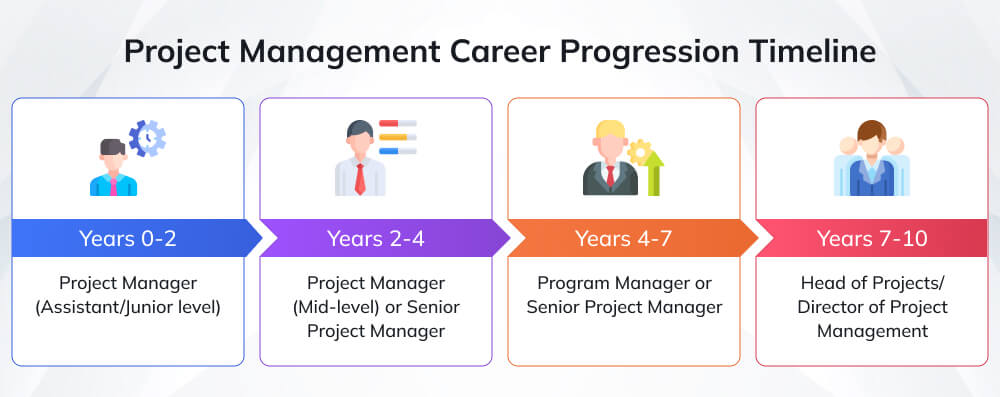
- Years 0-2: Project Manager (Assistant/Junior level) – $70,000-$78,000
- Years 2-4: Project Manager (Mid-level) or Senior Project Manager – $95,000-$115,000
- Years 4-7: Program Manager or Senior Project Manager – $115,000-$129,000
- Years 7-10: Head of Projects/Director of Project Management – $133,000-$193,000+
This timeline reflects professionals who strategically build competencies, earn relevant certifications, and deliberately seek expanded scope. Those who passively wait for promotion typically take 40-60% longer to reach each milestone.
What Sets Successful Career Climbers Apart
After analyzing hundreds of project management career trajectories, three differentiating factors consistently emerge:
- Certification Strategy: Professionals who earn PMP certification earn 33% higher median salaries globally, and over 1.5 million practitioners worldwide hold this credential. Strategic timing matters, earning PMP at year 2-3 maximizes ROI.
- Scope Expansion: High performers deliberately seek projects with increasing complexity, budget size, and cross-functional stakeholder groups. They don’t wait to be “ready”, they grow through stretch assignments.
- Leadership Identity Shift: The transition from PM to Head of Projects requires fundamentally reconceptualizing your role, from task executor to strategic architect, from individual contributor to team builder.
Year 0-2: Solidifying Your Project Manager Foundation
The first two years of your project management career establish the bedrock for everything that follows. This phase isn’t about rapid advancement, it’s about building unshakeable fundamentals that will support increasingly complex responsibilities.
Core Skills to Master First
Your early-career focus should center on five foundational competency areas:
- Project Execution Excellence
Master the fundamentals: scope definition, schedule development using Critical Path Method (CPM), risk identification and mitigation, and budget tracking with Earned Value Management (EVM). At this stage, your credibility derives entirely from your ability to deliver projects on time, within budget, and to stakeholder expectations. According to research published on project success rates, organizations with mature project management practices report success rates 28% higher than those with ad hoc approaches, demonstrate you can execute systematically.
- Stakeholder Communication
Develop the ability to translate technical complexity into executive-friendly language. Practice creating status reports that emphasize business impact over task completion. Learn to manage difficult conversations around delays, budget overruns, or scope changes with transparency and solutions-oriented framing. These communication patterns become exponentially more important as you advance.
- Technical Tool Proficiency
Become expert-level in your organization’s project management tools, whether Microsoft Project, Jira, Asana, Monday.com, or enterprise PPM solutions. At this career stage, you should be the person teammates consult for advanced features and workflow optimization. This technical fluency frees cognitive capacity for strategic thinking in later roles.
- Risk and Issue Management
Cultivate the discipline of proactive risk identification. Create risk registers from day one, even on small projects. Learn to distinguish between risks (potential future problems) and issues (current problems requiring immediate action). Build your pattern recognition for warning signs that precede common project failures.
- Team Coordination
Even without formal authority over team members (typical in matrix organizations), develop your ability to coordinate cross-functional contributors. Learn influence without authority, a skill that remains critical throughout your entire career, including at director level.
Building Your Project Portfolio
Your career advancement case begins now, not when you’re ready to apply for the next role. Implement these portfolio-building strategies:
Quantify Everything
Track metrics for every project: schedule performance index (SPI), cost performance index (CPI), scope change percentage, stakeholder satisfaction scores, and business value delivered. When you pursue promotion in 2-3 years, you’ll present data like: “Delivered 15 projects with average SPI of 1.08, generating $2.3M in measurable business value.”
Seek Variety
Deliberately pursue diverse project types, technology implementations, process improvements, product launches, infrastructure upgrades. This variety prevents pigeonholing and demonstrates adaptability, a key trait for program and director-level roles.
Document Lessons Learned
Create a personal repository of lessons learned from each project. This practice serves triple duty: it demonstrates maturity to current leadership, provides material for future interviews, and genuinely accelerates your learning curve.
Delivering Consistent Results
Consistency matters more than occasional brilliance. Research from the PMI Pulse of the Profession 2025 Report emphasizes that organizations value reliability, the predictable delivery of business value over sporadic hero moments.
Build a reputation for:
- Realistic commitments: Never overpromise. Under-commit and over-deliver builds trust.
- Transparent reporting: Bad news doesn’t improve with age. Surface problems early with proposed solutions.
- Stakeholder management: Meet or exceed stakeholder satisfaction targets consistently, not just on high-visibility projects.
Measuring Your Success
Use these benchmarks to assess your readiness for advancement to the Senior PM level:
- Managed 8-12+ projects successfully across multiple domains.
- Consistently achieve schedule and budget variance within ±10%.
- Received positive stakeholder feedback (satisfaction scores 4+/5).
- Demonstrated ability to recover troubled projects.
- Mentored junior team members or project coordinators.
- Completed 35 contact hours of PM education (preparing for PMP eligibility).
| PRO TIP BOX
Track Your Metrics From Day One Your promotion case starts now, not when you apply for senior roles. Create a “Career Evidence File” that documents:
When you interview for senior positions, you’ll have concrete evidence while others offer vague generalities. This preparation alone can differentiate you from 70% of candidates. |
SALARY BENCHMARK – Early Career PM
- Entry-level PM (0-2 years): $70,000-$78,000 average.
- Mid-level PM (2-4 years): $95,000 average.
Salary growth accelerators: PMP certification, specialized industry expertise (IT, construction, pharmaceuticals), and demonstrated project recovery capabilities.
Year 2-4: Transitioning to Senior Project Manager
The transition from Project Manager to Senior Project Manager represents your first major career inflection point. This isn’t merely a title change, it signals your readiness to handle enterprise-complexity projects, mentor junior PMs, and contribute to organizational project management maturity.
Expanding Project Scope and Complexity
Senior Project Manager roles typically involve:
- Larger budgets: Projects exceeding $1M-$5M+ (varies by industry).
- Extended timelines: Multi-year initiatives requiring phased delivery.
- Greater stakeholder complexity: C-level involvement and external partner coordination.
- Higher risk tolerance: Business-critical initiatives where failure has significant consequences.
Don’t wait until you feel “ready” for these challenges. Research on leadership development consistently shows that 70% of growth happens through stretch assignments, not formal training. When opportunities arise to lead more complex projects, even if you feel 70% prepared rather than 100%, pursue them aggressively.
Leading Cross-Functional Teams
At the Senior PM level, your team sizes typically expand from 5-10 members to 15-30+ contributors spanning multiple departments. This scale requires fundamentally different leadership approaches:
From Individual Relationships to Team Dynamics
You can no longer maintain deep individual relationships with every team member. Instead, you must:
- Design team structures that promote self-organization.
- Establish clear decision rights and escalation paths.
- Create communication cadences that keep distributed teams aligned.
- Build psychological safety, so team members surface problems proactively.
Navigating Matrix Organization Politics
Senior PMs often manage team members who report to different functional managers. Master these influence strategies:
- Stakeholder mapping: Identify the interests, priorities, and influence networks of all functional leaders.
- Win-win framing: Position the project needs in terms of each leader’s goals and success metrics.
- Social capital investment: Build relationships before you need favors, not when crises emerge.
Developing Business Acumen
The PMI Pulse of the Profession 2025 Report emphasizes that business acumen is now the critical differentiator that transforms project professionals from “tactical troubleshooters to strategic value creators.”
Business acumen means understanding:
- Financial fundamentals: How projects impact P&L, balance sheets, and cash flow.
- Strategic context: How your projects support broader organizational objectives.
- Competitive dynamics: How project outcomes position the organization vs. competitors.
- Value realization: Ensuring projects deliver promised business benefits post-implementation.
Practical development strategies:
- Request financial reviews: Ask finance partners to walk you through project accounting.
- Attend strategy meetings: Seek invitations to business unit planning sessions.
- Study annual reports: Read your organization’s 10-K filings to understand strategic priorities.
- Cross-functional rotations: Pursue temporary assignments in strategy, operations, or product management.
Getting PMP Certified: The 33% Salary Advantage
If you haven’t already earned PMP certification, years 2-4 represent the optimal window. Here’s why:
The Financial ROI is Irrefutable
- 33% higher median salary globally for PMP holders vs. non-certified peers.
- In the United States specifically, PMP holders earn up to 44% more, with median salaries around $120,000-$135,000.
- Over 12% of project management job postings globally list PMP as a requirement, making it a gatekeeper for premium opportunities.
PMP Eligibility Requirements:
To sit for the PMP exam, you need:
Option 1
- A four-year degree along with 35 Hours of Project Management training or CAPM certification.
- 36 months experience in leading projects.
Option 2
- A high school diploma or an associate’s degree (or global equivalent).
- An additional 35 hours of Project Management training or CAPM certification.
- 60 months of experience leading projects.
Strategic timing: Most professionals pursue PMP at the 3-4 year career mark, using it as leverage for promotion to Senior PM or first-time Program Manager roles. The certification validates your experience and signals readiness for increased scope.
| AVOID THIS MISTAKE BOX
Mistake: Waiting for the “Perfect” Project Many mid-career PMs delay pursuing stretch assignments because they want to feel fully prepared. This perfectionism creates a career trap: you never get the experience that makes you ready because you’re waiting to be ready. Reality: Senior leadership doesn’t expect perfection; they expect learning agility and problem-solving capability. When offered a challenging project:
The pattern: Those who advance fastest take calculated risks on stretch assignments, while those who plateau wait for certainty that never arrives. |
DATA VISUALIZATION: Salary Progression by Certification
Average Project Management Salaries by Certification Level
| Career Stage | No Cert | PMP Only | PMP + PgMP |
| PM (0-2 yrs) | $74,000 | $88,000 | N/A |
| PM (2-4 yrs) | $85,000 | $108,000 | N/A |
| Senior PM (5-7 yrs) | $95,000 | $122,000 | $135,000 |
| Program Mgr | $110,000 | $129,000 | $145,000 |
| Director/Head | $125,000 | $152,000 | $175,000+ |
Sources: Glassdoor
Year 4-7: The Program Manager Pivot
The transition from project management to program management marks a fundamental shift in how you create value. You’re no longer optimizing the execution of a single initiative, you’re orchestrating multiple interdependent projects to achieve strategic business outcomes.
When to Make the Program Manager Leap
Not every project manager should pursue program management, and timing matters critically. Consider this transition when:
You’ve Outgrown Single-Project Scope
If you find yourself thinking, “This project is part of a bigger picture, but I can only influence my piece,” you’re ready for program management. Program managers own that “bigger picture”, they define how multiple projects integrate to deliver strategic objectives.
You’re More Interested in Strategy Than Execution
Program managers spend 40-50% of their time on strategic alignment, stakeholder leadership, and benefits realization, compared to 15-20% for project managers. If you’re energized by business strategy more than task management, this signals readiness.
You Can Influence Without Direct Authority
Program managers typically influence project managers, functional leaders, and senior executives without direct reporting relationships. If you’ve already demonstrated the ability to shape decisions and drive alignment across organizational boundaries, you possess a core program management competency.
Multi-Project Coordination Skills
Program management is not “managing multiple projects”, it’s creating synergies that make the whole greater than the sum of parts.
This requires distinct capabilities:
- Dependency Management
Identify and manage interdependencies between projects. When Project A’s deliverable is a prerequisite for Project B, and Project C’s resource needs conflict with Project A, you orchestrate sequencing, resource allocation, and risk mitigation across all three.
- Benefits Realization Management
Unlike project managers who deliver outputs (a new system, a product launch), program managers ensure outcomes (increased revenue, improved customer satisfaction). You define benefits metrics upfront, track realization during execution, and sustain value post-program.
- Governance and Decision-Making Architecture
Design decision-making structures that allow rapid resolution of cross-project conflicts. Establish steering committees, define decision rights, and create escalation protocols that prevent paralysis when projects compete for resources.
- Strategic Roadmap Development
Translate high-level business strategies into sequenced program roadmaps. Determine which projects to initiate, in what order, with what resource profiles, and when to expect cumulative value realization.
Building Strategic Thinking Capabilities
Strategic thinking is the single most important differentiator between successful program managers and those who revert to glorified project coordinators. Develop this competency through:
- Business Model Fluency
Understand how your organization creates and captures value. Study business model canvases, competitive positioning, and unit economics. Frame every program decision in terms of business model impact: “This sequencing reduces time-to-market by 4 months, accelerating revenue realization by $1.2M.”
- Systems Thinking
Cultivate the ability to see complex organizations as interconnected systems where changes propagate in non-obvious ways. Use tools like causal loop diagrams and system maps to visualize feedback loops and leverage points within programs.
- Long-Range Planning
Shift your planning horizon from 6-12 months (typical for projects) to 18-36 months for programs. Develop scenario planning capabilities to prepare for multiple future states rather than optimizing for a single predicted outcome.
- Executive Communication
At the program level, you brief C-suite leaders and board members. Master the “executive summary” format: situation, complication, resolution, supported by 1-3 key data points. Executives make decisions in minutes, not hours, your communication must match their cadence.
PgMP Certification: Advanced Credentialling
For program managers seeking to differentiate themselves, the Program Management Professional (PgMP) certification provides advanced credentialling.
PgMP is significantly more rigorous than PMP:
- Eligibility requirements: 4+ years of project management plus 4+ years of program management experience.
- Application process: Multi-step panel review of your program management experience.
- Exam difficulty: Lower pass rates than PMP due to advanced strategic content.
Career impact: PgMP certification strongly correlates with senior leadership roles. Many Head of PMO and Director of Project Management positions list PgMP as preferred or required. While only a fraction of the 1.5 million PMP holders worldwide have earned PgMP, those who do command significant salary premiums and leadership opportunities.
| PRO TIP BOX
Think Portfolio, Not Projects, Align Everything to Business Outcomes As you transition to program management, fundamentally reconceptualize success metrics: Project Manager Thinking: Program Manager Thinking: The difference: You’re accountable for business outcomes (revenue, customer satisfaction, market share), not just project outputs (systems, processes, training). Every program decision should trace directly to these outcome metrics. Start practicing this framing immediately, even while still in project roles. When stakeholders ask about project status, add: “…and here’s how this contributes to [business objective].” |
Year 7-10: Ascending to Head of Projects/Director Level
The final leap to Head of Projects or Director of Project Management represents the culmination of your individual contributor journey and your entry into executive leadership. This role fundamentally differs from program management in one critical dimension: you’re no longer primarily managing work, you’re managing managers and building organizational capability.
Director vs. Manager: The Leadership Shift
The transition to director level requires identity transformation, not just skill addition. Here’s what changes:
From Doing to Enabling
As a program manager, you still “do the work”, you analyze dependencies, facilitate decisions, manage stakeholders. As a director, your primary job is enabling others to do this work more effectively. Your success is measured by your team’s collective output, not your individual contributions.
From Technical Expert to Strategic Leader
Directors spend 60-70% of their time on strategic activities:
- Organizational design: Structuring PM teams and PMOs for maximum impact.
- Talent development: Recruiting, coaching, and retaining high-performing PMs.
- Governance architecture: Designing stage-gate processes, investment decision frameworks, and portfolio prioritization mechanisms.
- Executive influence: Shaping business strategy to incorporate portfolio management best practices.
From Project Authority to Enterprise Influence
You’re no longer advocating for a specific project or program, you’re advocating for project management as an organizational capability. You influence capital allocation processes, strategic planning cycles, and operational decision-making at the highest levels.
Building High-Performing PM Teams
Your greatest leverage as a director is through the people you hire, develop, and retain. Build your team with these strategies:
Talent Architecture
Design a project management team structure that balances specialization and flexibility:
- Project Managers (Junior/Mid): Focus on execution excellence, typically 2-5 years experience.
- Senior Project Managers: Handle enterprise complexity, mentor junior PMs.
- Program Managers: Orchestrate strategic initiatives, manage interdependencies.
- Project Management Specialists: Focus on specific methodologies (Agile, Waterfall, Hybrid) or domains (IT, operations, product).
Competency Development Systems
Create structured development paths:
- Skill assessments: Regular evaluation against PM competency models.
- Learning pathways: Curated training, certifications, and developmental assignments.
- Mentorship programs: Pair junior PMs with senior practitioners.
- Communities of practice: Forums for peer learning and methodology sharing.
Retention Through Growth
Top PM talent leaves organizations where they’ve stopped growing. Provide:
- Clear career paths: Transparent promotion criteria and timeline expectations.
- Stretch assignments: Opportunities to tackle increasing complexity.
- External visibility: Conference speaking, blog contributions, industry networking.
- Compensation competitiveness: Benchmark against market rates and adjust accordingly.
Developing Organizational Project Maturity
Mature project management organizations deliver 28% higher success rates than ad hoc practitioners. As director, you drive this maturity through:
PMO Design and Evolution
Establish or refine your Project Management Office (PMO) with these considerations:
- PMO type: Supportive (provides templates/training), Controlling (ensures compliance), or Directive (directly manages projects).
- Governance frameworks: Stage-gate processes, portfolio review cadences, investment decision criteria.
- Standardization vs. flexibility: Balance methodology consistency with project-specific tailoring.
Research from The PMO Squad’s PMO Research Report reveals that 61% of project practitioners cite their PMO as successful, yet 23% lack a formal success definition, define what PMO success means in your organization upfront.
Methodology and Tool Strategy
Select and implement project management methodologies and tools:
- Agile/Scrum: For product development and iterative delivery.
- Waterfall/PRINCE2: For compliance-heavy or fixed-scope initiatives.
- Hybrid approaches: Combining methods based on project characteristics.
- PPM tooling: Enterprise platforms like Microsoft Project Online, Smartsheet, Workfront, or Planview.
Metrics and Performance Management
Establish enterprise-level project performance metrics:
- Portfolio health indicators: On-time delivery %, budget variance, strategic alignment scores.
- Business value realization: Revenue generated, costs avoided, efficiency improvements.
- Organizational capability: PM skill assessments, certification rates, resource utilization.
- Stakeholder satisfaction: Executive sponsor and project team feedback.
Executive Communication and Influence
At director level, your ability to influence C-suite decision-making determines your impact. Master these executive engagement strategies:
Strategic Business Partnership
Position project management as strategic business enablement, not administrative overhead. Frame conversations in terms of:
- Competitive advantage: “Our portfolio management discipline allows us to launch products 30% faster than competitors”.
- Risk mitigation: “Enterprise governance prevents the $5M+ write-offs from failed projects we saw three years ago”.
- Value maximization: “Strategic portfolio prioritization redirected $8M to highest-ROI initiatives this year”.
Board-Level Communication
When presenting to boards or executive committees:
- Start with the headline: “We’re on track to deliver $42M in portfolio value this year, with 2 of 15 initiatives at risk”.
- Provide context briefly: High-level portfolio composition and strategic alignment.
- Address decision needs: “We need board input on investment priorities given resource constraints”.
- Data-driven recommendations: “Analysis suggests reallocating $3M from Initiative C to Initiative A will maximize ROI”.
Building Cross-Functional Executive Relationships
Cultivate relationships with peer executives (CFO, CIO, COO, Chief Strategy Officer):
- Schedule regular 1:1s to understand their priorities and pain points.
- Position PM capabilities as solutions to their specific challenges.
- Collaborate on strategic initiatives that span multiple functions.
- Create mutual wins where project management success enables their success.
|
“The best project directors don’t manage projects, they architect the organizational systems that enable hundreds of projects to succeed simultaneously.” Jennifer Park, |
 |
Essential Competencies for Head of Projects / Director Roles
Reality Check: You won’t master all eight before promotion, most directors develop 5-6 competencies in senior PM/program roles, then accelerate learning on the remaining areas once in the director seat. |
Critical Certifications and Continuous Learning
Your career trajectory from PM to Head of Projects requires continuous investment in formal credentials and strategic learning. Here’s your certification and education roadmap.
The Certification Ladder
Phase 1: Foundation (Years 0-3)
- CAPM (Certified Associate in Project Management): Optional entry-level certification for those with <3 years experience.
- PMP (Project Management Professional): The gold standard, pursue at year 2-4 of your career.
- Requirements: 3 years PM experience (with bachelor’s) + 35 contact hours of PM education.
- ROI: 33% salary premium, industry-wide recognition, requirement for 12%+ of PM job postings.
Phase 2: Advanced (Years 4-7)
- PgMP (Program Management Professional): For program managers managing related projects.
- Requirements: 4 years PM + 4 years program management experience.
- ROI: Differentiation for director-level roles, significantly higher complexity than PMP.
- Agile/Scrum credentials: Certified Scrum Master (CSM), PMI-ACP for hybrid PM roles.
Phase 3: Executive (Years 7-10+)
- Portfolio Management Professional (PfMP): Pinnacle PMI certification for portfolio leadership.
- Executive certifications: SAFe Program Consultant (SPC), PRINCE2 Agile for international roles.
Beyond Credentials: Executive Education
Director-level roles increasingly require strategic business knowledge beyond project execution. Consider these executive education investments:
Strategy and Business Acumen
- Harvard Business School Online: Strategy Execution
- MIT Sloan: Strategic Leadership and Management
- Wharton Executive Education: Strategic Thinking and Management
Leadership Development
- Center for Creative Leadership (CCL): Leadership Development Program
- Stanford Graduate School of Business: Executive Leadership Development
- INSEAD: Leading Organizational Change
Financial Acumen
- Cornell: Finance for Senior Executives
- London Business School: Finance for Executives
- Chicago Booth: Finance for Executives
ROI Considerations: Executive education programs range from $3,000-$15,000+ for 3-5 day intensives. Organizations often sponsor these for high-potential leaders, negotiate for development funding as part of promotion discussions.
Staying Current with Industry Trends
Project management is evolving rapidly with AI, remote work, and changing organizational structures. Maintain currency through:
- PMI Pulse of the Profession: Annual research reports on PM trends and best practices.
- PM conferences: PMI Global Conference, Gartner PPM Summit, Project Management Symposium.
- Professional communities: Local PMI chapters, LinkedIn groups, PM-specific Slack communities.
- Thought leadership: Follow PM influencers, read Harvard Business Review, contribute your own insights.
CERTIFICATION COMPARISON TABLE
| Certification | Target Role | Experience Required | Exam Difficulty | Salary Impact | Renewal |
| PMP | Senior PM, Program Mgr | 3-5 years PM | Moderate | +33% | 60 PDUs/3 years |
| PgMP | Program Mgr, Director | 4 years PM + 4 program | High | +15-20% over PMP | 60 PDUs/3 years |
| PfMP | Director, VP | 8+ years portfolio | Very High | +10-15% over PgMP | 60 PDUs/3 years |
| CSM | Agile PM, Scrum Master | None required | Low-Moderate | +10-15% (Agile roles) | 20 SEUs/2 years |
| PMI-ACP | Agile PM | 2,000 hours agile experience | Moderate | +18-22% (Agile roles) | 30 PDUs/3 years |
Conclusion
Your journey from Project Manager to Head of Projects isn’t random luck; it’s the result of deliberate choices about skills, scope, and credentials over 5–10 years. The pattern is clear: build a rock-solid execution foundation in years 0–2, use years 2–4 to expand project size, deepen business acumen, and secure your PMP for that ~33% salary boost, then pivot in years 4–7 to program-level responsibility where you’re accountable for outcomes, not just outputs. By years 7–10, the real differentiator is your ability to build high-performing PM teams, shape portfolio decisions, and talk in the language of revenue, risk, and strategy at the executive table.
What separates directors from stalled Senior PMs is simple: they track and quantify impact, aggressively pursue stretch assignments, and invest in targeted learning instead of random certificates. If you align each career stage with the right mix of experience and credentials, using focused programs like our project management certification courses to formalize your growth, the jump from $70K to $193K+ becomes a logical next step, not a fantasy. The only question now is what you’ll do in the next 90 days to move one step closer to the role you say you want.
Frequently Asked Questions
1. How long does it realistically take to become a Head of Projects or Director of Project Management?
The typical timeline is 7-10 years from your first project management role, though this varies based on organizational size, industry, and your strategic career moves. High performers in fast-growing organizations may reach director level in 6-7 years, while those in smaller companies or who plateau at Senior PM may take 12-15 years. Key accelerators include PMP/PgMP certifications, demonstrated business impact, and willingness to change organizations for advancement opportunities. According to industry research, professionals who earn PMP certification early (years 2-4) and actively seek stretch assignments advance 25-40% faster than those who passively wait for promotion.
2. Is PMP certification absolutely required to become a project director?
While not universally mandatory, PMP certification is strongly recommended and often preferred for director-level roles. Research from PMI shows that PMP holders earn 33% higher median salaries, and over 12% of project management job postings list PMP as a requirement. More importantly, many organizations use PMP as a screening criterion for senior leadership roles, without it, you may never make it past applicant tracking systems or initial HR reviews. The investment (~$2,000-$3,100 total for training and exam) typically pays for itself within 3-6 months through increased compensation. If you’re serious about reaching director level, treat PMP as essential rather than optional.
3. What’s the difference between a Program Manager and a Head of Projects?
Program Managers manage multiple interdependent projects that collectively achieve strategic business objectives. They’re individual contributors (though senior ones) responsible for program execution, dependency management, and benefits realization. Head of Projects (or Director of Project Management) is a people leadership role responsible for building and managing teams of project and program managers, designing PMO capabilities, establishing governance frameworks, and influencing organizational strategy. The key difference: Program Managers do the strategic work; Heads of Projects enable others to do it while building organizational capability. Salary ranges reflect this: Program Managers average $129K, while Directors average $133K-$193K+ with larger total comp packages.
4. What salary can I expect as a Senior Project Manager?
Senior Project Manager salaries typically range from $95,000 to $122,000 depending on industry, geography, and certification status. According to Indeed (December 2024), the national average is $122,337, while The Digital Project Manager reports $115,214. PMP-certified Senior PMs earn the higher end of this range. Geography significantly impacts compensation: Senior PMs in San Francisco, New York, and Seattle often exceed $135,000, while those in smaller markets may earn $85,000-$100,000. Industry also matters, technology, financial services, and pharmaceutical Senior PMs command premiums of 15-25% over construction, non-profit, or government roles.
5. Should I specialize in a specific industry or stay a generalist?
The optimal approach is “T-shaped” expertise: deep specialization in one domain (the vertical line) combined with broad experience across multiple domains (the horizontal line). Pure generalists struggle to demonstrate depth required for director roles, while narrow specialists risk career stagnation when organizational priorities shift. By years 5-7, aim to have led projects in at least 3 different domains or methodologies. For example: specialize in IT transformation while also gaining experience in operational excellence and product development. This versatility signals readiness to lead diverse portfolios at director level while maintaining credibility through deep expertise. Note: Some highly specialized industries (pharmaceutical R&D, aerospace, construction) do reward deep specialization, but even there, cross-functional experience differentiates director candidates.
6. How important is an MBA for reaching director level in project management?
An MBA can be advantageous for project management director roles, but it is not a strict requirement in most cases. Industry surveys indicate that only 30–40% of project management directors hold an MBA, meaning the majority—60–70%—have advanced without one.
The return on investment (ROI) of an MBA largely depends on several key factors:
- Organizational culture: Certain industries and employers, particularly consulting firms and investment banks, place a strong preference on MBAs for senior leadership positions.
- Career stage: An MBA delivers the greatest value during the mid-career window (approximately 4–7 years of experience), when professionals are positioning themselves for director-level roles.
- Alternative credentials: In many cases, a PgMP certification combined with executive education from institutions such as Harvard, Wharton, or MIT can serve as a highly effective substitute, offering comparable credibility with significantly lower time and financial investment.
For those who choose to pursue an MBA, the most impact comes from programs with a strong focus on strategy, operations, and leadership. The degree is best leveraged for career pivots, such as transitions into consulting or corporate strategy, or major organizational advancements, rather than incremental, linear promotions within the same company.