
Minitab is one of the most widely recognized statistical software platforms used in quality improvement, process analysis, and data-driven decision-making. For professionals working in manufacturing, healthcare, operations, Lean, or Six Sigma, Minitab helps turn raw data into insights that can guide better decisions. Its appeal lies in a practical mix of powerful statistical methods, visualizations, predictive tools, and a user-friendly interface built for real business problems rather than only academic statistics.
If you have heard Minitab mentioned in the context of Lean Six Sigma, quality control, hypothesis testing, or process capability studies, this guide explains exactly why. Below, you will learn what Minitab is, why it matters, what advantages it offers, and how different industries use it to improve performance, reduce variation, and solve operational problems.
What Is Minitab?
Minitab is a statistical software platform designed to help users collect, organize, analyze, visualize, and interpret data. On its official product page, Minitab describes its software as a way to “visualize, analyze, and harness the power of your data” to solve business challenges, discover trends, predict patterns, uncover relationships between variables, and create visualizations that support decision-making.
Unlike general spreadsheet tools, Minitab is built specifically for statistical work. That means users can go beyond simple tables and charts to perform structured analysis such as hypothesis testing, regression, analysis of variance, design of experiments, measurement system analysis, capability analysis, and control charting. Its support documentation also provides step-by-step guidance for collecting data, setting up worksheets, performing analyses, and interpreting results, making it accessible to beginners while still being strong enough for experienced analysts.
What makes Minitab especially relevant in business is that it connects statistical methods directly to improvement work. It is not just for lab analysts. It is commonly used by quality engineers, process improvement teams, operations managers, manufacturing leaders, healthcare professionals, and Six Sigma practitioners who need to identify root causes, reduce defects, and sustain gains over time.
Why Is Minitab Important For Modern Organizations?
Organizations generate enormous volumes of process, customer, quality, and operational data, but data alone does not improve performance. Businesses need a way to translate numbers into evidence. That is where Minitab becomes valuable. It gives teams a structured way to test assumptions, verify root causes, and make process changes based on facts rather than opinion.
|
Expert Perspective “As a quality expert said, “Without data, you’re just another person with an opinion.” This highlights why tools like Minitab are essential; they help organizations move from assumptions to evidence-based decision-making.” |
 |
Its value is particularly strong in continuous improvement environments. Minitab states that statistics and analytics are critical to continuous improvement because improvement cannot be verified unless it is measured, analyzed, and monitored after implementation. The platform is positioned not only as an analysis tool, but as part of an end-to-end improvement ecosystem that supports access to data, analysis, progress measurement, and ongoing monitoring.
This matters because many business problems are really variation problems. A process may seem acceptable on average while still producing defects, delays, inconsistencies, rework, or avoidable cost. NIST explains that process capability compares the output of an in-control process to specification limits using capability indices, making it possible to assess how well a process meets requirements and where variation must be reduced or the process centered more effectively NIST. Minitab makes these kinds of analyses easier to perform in practice.
| Research Insight Minitab states that it has been working on continuous improvement for over 50 years, positioning itself as a long-established solution in quality and process improvement disciplines
- Minitab |
What Are The Main Advantages Of Minitab?
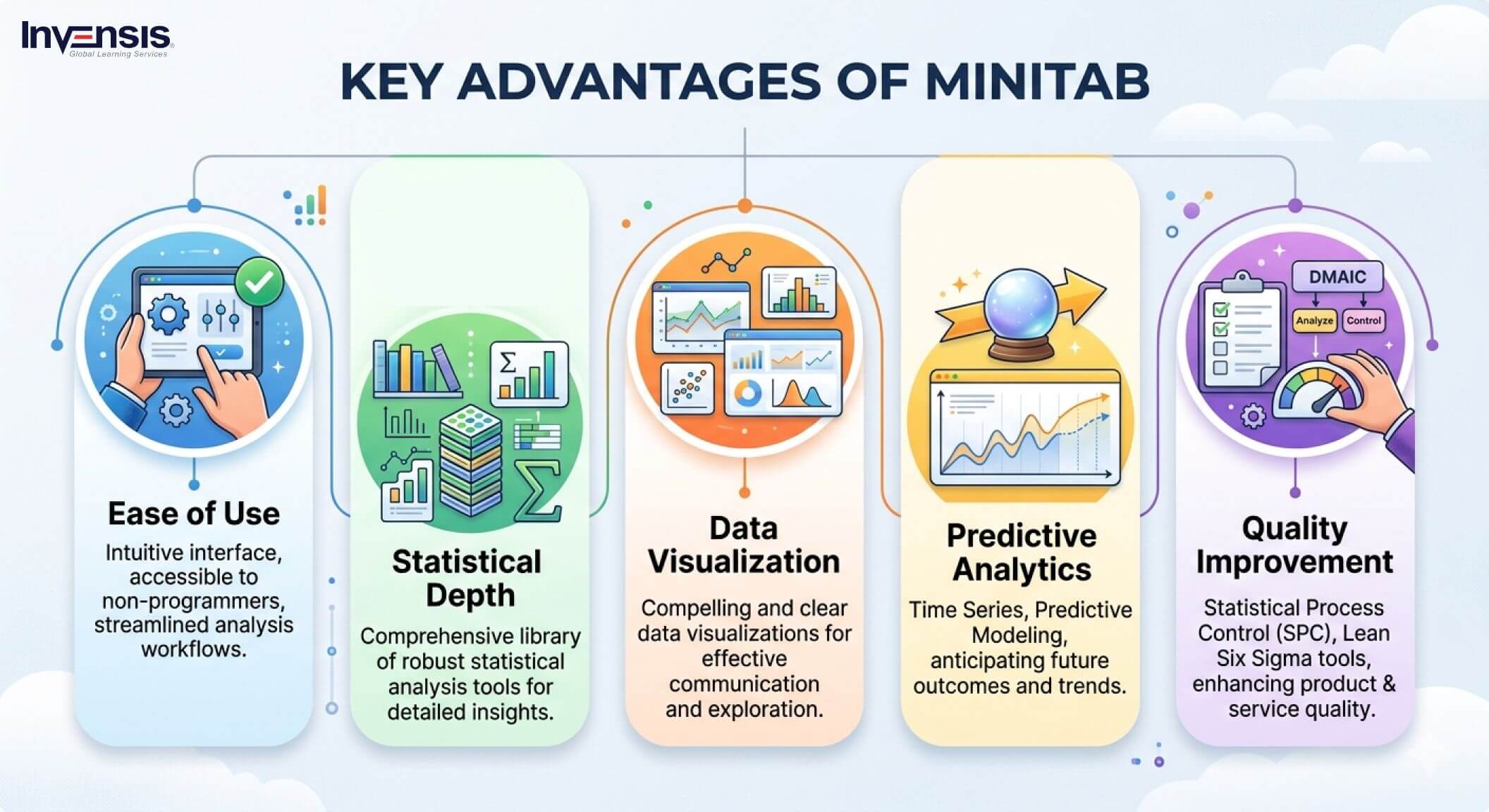
Ease Of Use
One of Minitab’s biggest advantages is that it makes complex analyses easier for non-specialists. Its help center provides step-by-step support for worksheet setup, analysis execution, and result interpretation, which lowers the learning curve compared with coding-first statistical tools
Strong Statistical Depth
Minitab includes a broad range of statistical methods. According to its official product information, users can work with measurement system analysis, control charts, capability analysis, distribution analysis, design of experiments, regression, multivariate methods, time series analytics, power and sample size studies, and predictive analytics methods such as CART, TreeNet, and Random
Better Visualization For Decision-Making
Minitab emphasizes dynamic visualizations and graphing tools, including Graph Builder, which helps users compare chart types and communicate findings clearly. This is a major advantage because statistics only become useful when teams can explain results in a way that stakeholders understand
Practical Support For Quality Improvement
The software is designed around improvement use cases, not just generic analysis. Minitab specifically connects its tools to Lean, Lean Six Sigma, Kaizen, process monitoring, project tracking, and sustainability of results. That makes it relevant for professionals solving quality and efficiency problems in real organizations.
Integration With Python And R
For more advanced teams, Minitab offers integration guides for Python and R. Its support documentation notes that users can bring data from Minitab into these languages and return results back into Minitab, giving organizations flexibility when they want both usability and extensibility.
What Can You Do With Minitab?
Minitab is often introduced as “statistical software,” but in practice, it supports many different types of work.
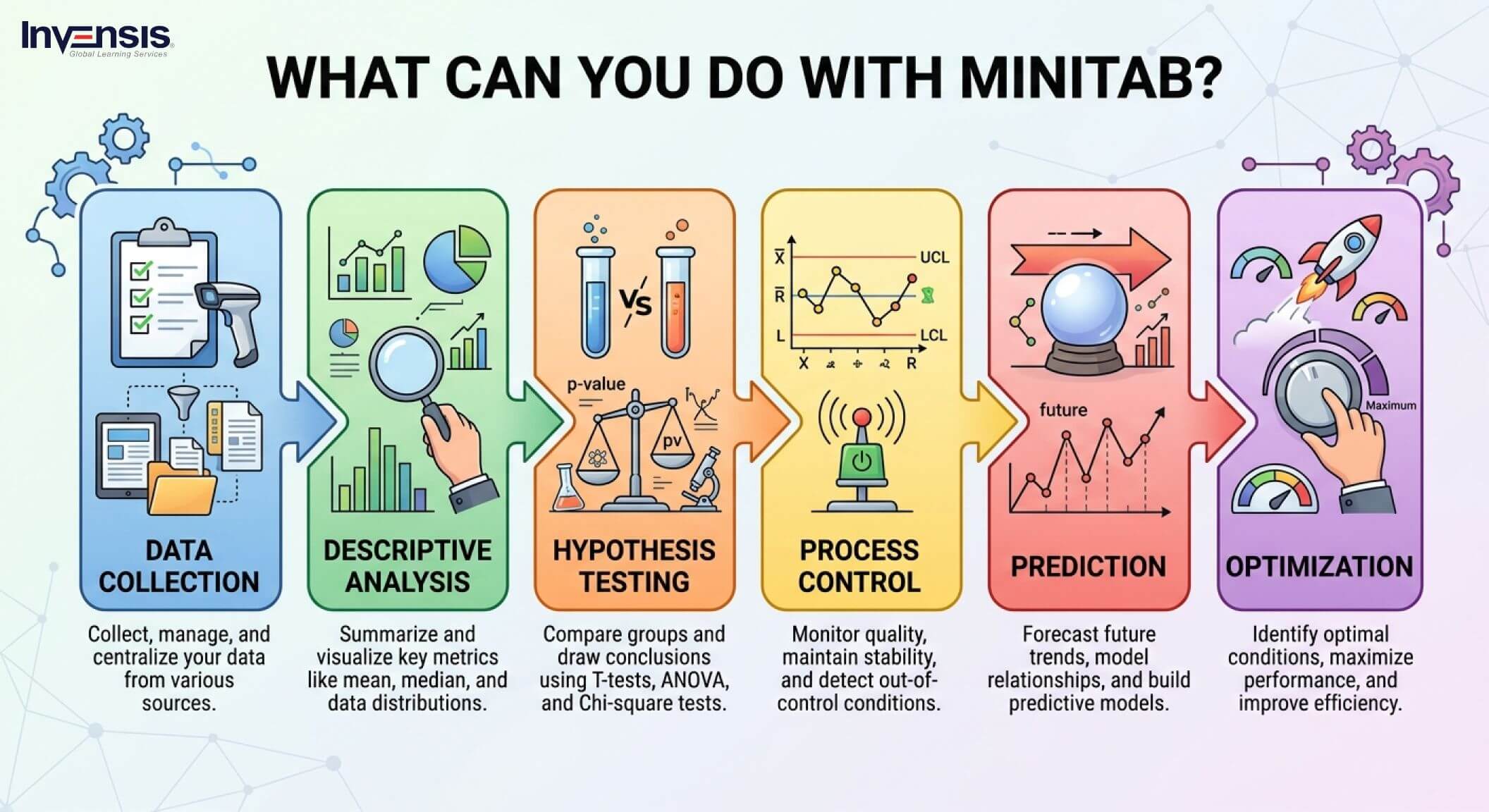
Analyze Process Stability
Process stability is foundational to improvement. NIST explains that control charts help determine whether a process is in a state of statistical control, meaning it produces consistent output over time. Minitab supports variable, attribute, multivariate, time-weighted, and rare event control charts, making it useful for ongoing monitoring and early problem detection.
Measure Process Capability
Capability analysis helps teams understand whether a stable process can meet customer or engineering specifications. NIST notes that this requires comparing process spread with specification width and using indices such as Cp and Cpk. Minitab includes capability analysis tools, including capability sixpack outputs, making it practical for quality and manufacturing teams.
Run Hypothesis Tests And Regression
Teams often need to determine whether a process change actually made a difference or whether a relationship between variables is statistically significant. Minitab supports hypothesis testing, regression, ANOVA, nonlinear regression, and other modeling methods that help answer such questions with evidence.
Conduct Design Of Experiments
Minitab supports DOE methods, including screening designs, full and fractional factorial designs, response surface designs, mixture designs, and Taguchi designs. This is especially useful when organizations want to optimize settings, identify critical factors, and improve output without costly trial-and-error experimentation.
Build Forecasts And Predictive Models
Modern Minitab capabilities extend beyond classical statistics into predictive analytics. Its product page highlights forecasting, time series analysis, and machine learning methods including CART, TreeNet, and Random Forests. That makes the tool useful not only for explaining what happened, but for anticipating what may happen next.
| Pro Tip The best use of Minitab is not running every available statistical test. It is selecting the right method for the question you are trying to answer: stability, capability, relationship, comparison, or prediction. |
Where Is Minitab Commonly Used?
Manufacturing And Industrial Operations
Minitab positions its manufacturing solutions around process monitoring, defect detection, prediction of machinery or process problems, and real-time action before quality issues spread across production lots. This makes it highly relevant for yield improvement, scrap reduction, downtime analysis, and supplier quality management.
|
Automotive manufacturers such as Ford Motor Company rely on statistical quality control methods to ensure production consistency and reduce defects. Tools like Minitab are commonly used for capability analysis and process monitoring in such environments. |
Healthcare
Minitab also has strong healthcare applications. Its healthcare solutions page highlights use cases such as improving patient care, reducing wait times, predicting readmission rates, optimizing bed utilization, reducing patient length of stay, and monitoring rare adverse events such as patient falls or infections. The platform is framed as a way for healthcare professionals to improve KPIs like cost, utilization, safety, and satisfaction through fact-based analysis.
|
In healthcare, organizations like the National Health Service have used statistical analysis and process improvement techniques to reduce patient waiting times and improve service delivery. Tools like Minitab support these initiatives by helping teams analyze variation and monitor performance over time. Source: NHS |
Lean And Continuous Improvement Programs
Minitab describes itself as a market leader in continuous improvement and notes that it supports brainstorming, data collection, analysis, and ongoing monitoring for methodologies including Lean, Kaizen, Design for Six Sigma, and Quality Function Deployment.
Six Sigma Projects
Minitab is especially popular among Six Sigma practitioners because it supports the statistical side of DMAIC work. Minitab’s continuous improvement content specifically references toolkits and roadmaps for Lean Six Sigma projects, including project charters, fishbone diagrams, cause-and-effect matrices, process maps, and value stream maps.
|
In the service sector, Bank of America applied Six Sigma methodologies to reduce transaction errors and improve customer experience, resulting in significant cost savings and efficiency gains. Source: ASQ |
How Does Minitab Support Lean Six Sigma Work?
Minitab is closely associated with Lean Six Sigma because the methodology depends on data, measurement, and statistically sound decision-making. During DMAIC projects, teams need to validate measurement systems, identify critical factors, test causes, quantify variation, evaluate capability, and confirm that changes produced measurable gains. Minitab directly supports these analytical needs with tools such as measurement system analysis, regression, hypothesis testing, control charts, and capability analysis.
Minitab’s own continuous improvement content explicitly states that it provides users with the tools needed to execute Lean Six Sigma projects efficiently and connects analytics with infrastructure and governance, so teams can spend less time managing projects and more time moving them forward.
For professionals who want to build these skills, Invensis Learning offers a relevant set of programs, including Minitab Essentials Training, Lean Six Sigma Green Belt Certification Training, Lean Six Sigma Yellow Belt Certification Training, Lean Six Sigma Black Belt Certification Training, and 7 QC Tools Training. Invensis describes its Minitab Essentials course as a program that helps professionals build confidence in sophisticated data analysis and data-driven decision-making, while its Green Belt training focuses on identifying inefficiencies, reducing waste, and enhancing quality.
What Are The Limitations Professionals Should Keep In Mind?
Minitab is powerful, but it is not magic. Users still need to understand the business problem, choose the right method, and interpret output correctly. Statistical software can speed up analysis, but poor data quality, weak sampling, or incorrect assumptions can still produce misleading conclusions.
It is also important to remember that not every problem needs an advanced model. In some cases, descriptive statistics, a control chart, a Pareto chart, or a capability study may provide more value than a complex predictive model. The strongest users are usually the ones who combine software proficiency with process knowledge and statistical judgment.
|
Avoid This Mistake Do not treat Minitab as a tool that “solves” problems by itself. Why It Is Problematic: Software can run tests quickly, but it cannot replace good problem definition, sound data collection, or thoughtful interpretation. What To Do Instead: Start with the business question, then choose the simplest valid analysis that answers it. |
How Can Beginners Start Learning Minitab?
Beginners should start by learning the interface, worksheet structure, basic graphs, descriptive statistics, and fundamental tests before moving into capability analysis, control charts, regression, and DOE. Minitab’s support site offers help content, data set libraries, macros, and integration guides that make it easier to practice and expand skills gradually.
A guided course can accelerate the learning curve. Invensis Learning positions its Minitab Essentials Training as an entry point for professionals who want to build analytical proficiency and apply Minitab more confidently in quality and performance improvement settings.
Suggested Learning Path
- Learn worksheet setup and data import
- Practice descriptive statistics and charts
- Study hypothesis testing and confidence intervals
- Move into control charts and capability analysis
- Learn regression and DOE
- Apply Minitab to a real process improvement case
Conclusion
Minitab is a specialized statistical and quality improvement software platform that helps organizations analyze data, visualize results, monitor processes, predict outcomes, and support structured decision-making. Its biggest strengths are its practical usability, breadth of statistical methods, strong visual outputs, and close alignment with quality, continuous improvement, and Six Sigma work.
For manufacturing teams, it supports process control and defect reduction. For healthcare teams, it helps improve patient care, throughput, and operational performance. For Lean Six Sigma professionals, it provides the analytical engine behind many of the most important tools in DMAIC and process optimization.
In short, if your role requires you to move from opinion-based decisions to evidence-based improvement, learning Minitab can be a major professional advantage.
Frequently Asked Questions
Is Minitab Only For Six Sigma Professionals?
No. While it is very popular in Six Sigma, Minitab is also widely used in manufacturing, healthcare, engineering, operations, and business analytics for process improvement and decision support.
Is Minitab Hard To Learn?
Not compared with many coding-based tools. Its guided help resources, worksheet structure, and menu-driven interface make it easier for beginners to start using statistical methods effectively.
Can Minitab Be Used Outside Manufacturing?
Yes. Minitab provides industry-specific use cases in healthcare and other sectors, including patient flow, readmission prediction, and monitoring rare events.
What Is The Difference Between Minitab And A Spreadsheet?
A spreadsheet mainly stores and displays data, while Minitab is purpose-built for structured statistical analysis, quality tools, predictive modeling, and process improvement workflows.