Introduction
Project management vs. operations management is one of the most commonly misunderstood comparisons in business and management. While both involve planning, resource allocation, and performance tracking, they serve fundamentally different purposes within an organization.
At a high level, project management focuses on delivering temporary, goal-oriented initiatives, whereas operations management ensures the smooth, ongoing functioning of business processes. Understanding the difference between project management and operations management is essential for professionals seeking the right career path and for organizations aiming to optimize efficiency and execution.
In today’s dynamic business environment, the lines between operations and project management often overlap. Many organizations rely on both disciplines to drive growth, projects introduce change, while operations sustain it. This makes it even more important to clearly distinguish operations management vs project management in terms of scope, duration, and objectives.
What is Operations Management?
Operations management is a significant factor in any organization focused on efficiently managing the processes of producing and delivering goods or services. It involves a range of activities such as planning, organizing, coordinating, and controlling all the resources required to produce a company’s products or services. The primary objective of operations management is to ensure that business operations are efficient, effective, and capable of meeting customer demands.
Key responsibilities within operations management include managing the supply chain, overseeing production processes, maintaining quality control, and optimizing inventory levels. Operations managers strive to minimize costs while maximizing productivity and quality. They also work to improve processes through continuous improvement initiatives and the implementation of best practices. By effectively managing these operational aspects, businesses can achieve higher levels of customer satisfaction, reduce waste, and improve overall profitability. 
What is Project Management?
Project management is the application of knowledge, skills, tools, and techniques to project activities to meet project requirements. It involves a systematic approach to planning, organizing, and executing the tasks necessary to turn a brilliant idea into a tangible product, service, or deliverable. This structured methodology ensures that projects are completed on time, within budget, and to the specified quality standards.
Key aspects of project management include:
- Defining Project Scope: Outlining the project’s boundaries, objectives, and deliverables to manage stakeholder expectations and prevent scope creep
- Identifying Deliverables: Specifying the tangible and intangible outputs the project will produce, including requirements, acceptance criteria, and timelines
- Managing Risks: Identifying potential risks, assessing their likelihood and impact, and developing strategies to mitigate or avoid them
- Effective Communication Across Teams: Ensuring clear and consistent communication among team members, stakeholders, and external partners to foster collaboration and keep everyone aligned toward the project’s goals
By focusing on these key aspects, project management provides a framework that enhances the likelihood of project success, enabling organizations to deliver value, achieve strategic objectives, and drive innovation.
What are the Differences Between Operations Management vs Project Management?
When comparing project management vs operations management, the differences become clear when you look at how each function is structured, executed, and measured. While both are essential for organizational success, they operate in fundamentally different ways.
The table below provides a quick overview of the difference between operations management and project management, helping you understand their core distinctions at a glance.
| Aspect | Project Management | Operations Management |
| Nature | Temporary and unique | Ongoing and repetitive |
| Objective | Deliver a specific outcome or goal | Maintain and optimize business processes |
| Timeframe | Defined start and end | Continuous with no fixed end |
| Focus | Change, innovation, and transformation | Stability, efficiency, and consistency |
| Scope | Limited to project goals | Broad, covering entire operations |
| Success Metrics | Completion on time, within scope and budget | Process efficiency, productivity, and quality |
| Work Type | Dynamic and evolving | Structured and standardized |
| Example | Launching a new product | Managing daily manufacturing operations |
1. Nature of Work
The most basic difference between project management vs operations management is the type of work involved. Project management focuses on temporary initiatives created to achieve a unique outcome, while operations management deals with continuous activities that are repeated to keep the business functioning smoothly.
Uniqueness of Output
Every project is designed to produce something specific, such as a new product launch, software implementation, office relocation, or process redesign. Operations, by contrast, are not built around one-time outputs. They are designed to deliver the same business function consistently over time, such as customer support, manufacturing, payroll, or logistics.
2. Objectives and Goals
The difference between project management and operations management becomes clearer when you look at their purpose. Project management is centered on achieving a defined objective within set constraints, whereas operations management is focused on sustaining performance, efficiency, and continuity.
Business Intent
Projects exist to create change. Operations exist to preserve and improve routine business performance. In simple terms, project goals are about reaching a destination, while operational goals are about maintaining and improving the journey every day.
3. Timeframe
A major distinction in operations management vs project management is duration. Projects are temporary and follow a planned lifecycle, while operations are ongoing and usually have no defined finish line.
Lifecycle Structure
Projects move through stages such as initiation, planning, execution, monitoring, and closure. Operations do not end after a cycle is complete; they continue as long as the organization exists. This is why project teams are often deadline-driven, while operations teams are rhythm-driven. 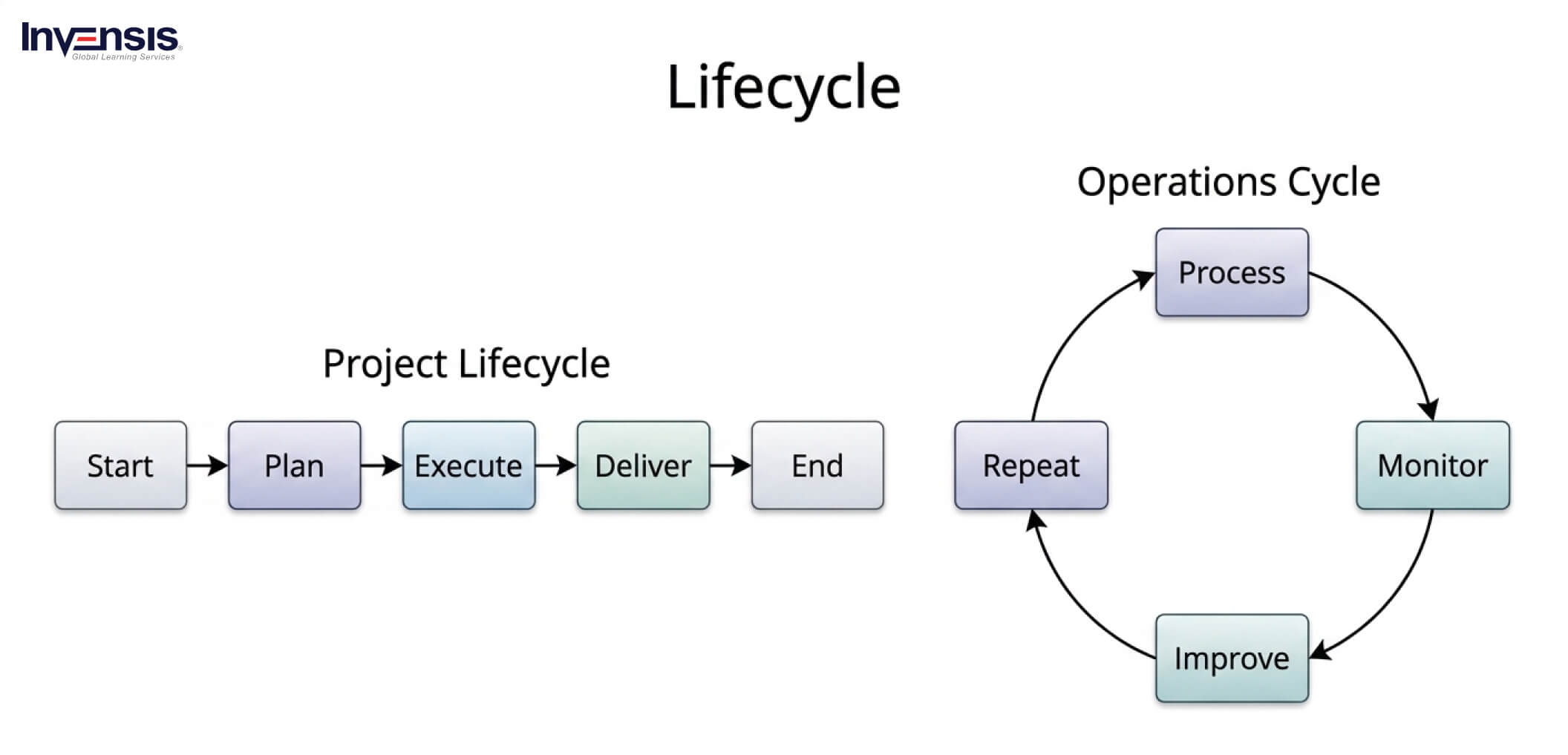
4. Focus and Approach
Another important aspect of operations and project management is where attention is directed. Project management is focused on implementing change and achieving a targeted result. Operations management is focused on maintaining control, reducing variation, and improving daily efficiency.
Change vs Stability
Projects are introduced when an organization wants to build, fix, upgrade, or transform something. Operations take over when that change must be run reliably at scale. This makes project teams more flexible and adaptive, while operations teams tend to rely more heavily on established workflows and process discipline.
|
“Without change, there is no innovation, creativity, or incentive for improvement.” |
 |
5. Success Measurement
In project management vs operations management, success is not judged by the same standards. Projects are typically measured by whether they are completed on time, within scope, and within budget. Operations are measured through long-term performance indicators.
Performance Criteria
A project may be considered successful if it delivers the expected output within the agreed timeline and cost. Operations, however, are evaluated using metrics such as quality consistency, turnaround time, productivity, customer satisfaction, utilization, and cost efficiency. This is one of the biggest reasons the difference between operations management and project management matters in practice.
6. Risk Profile
A less obvious but important difference between project and operations management is the kind of risk each function handles. Projects usually face uncertainty because they involve new goals, changing requirements, and multiple dependencies. Operations face risk in the form of disruption, inefficiency, non-compliance, or service failure.
Type of Uncertainty
Project risks often come from what is unknown: unclear scope, changing stakeholder expectations, budget overruns, or scheduling delays. Operational risks usually come from what goes wrong in repeatable systems: equipment failure, process bottlenecks, quality issues, or resource shortages. So while both deal with risk, the nature of that risk is very different.
7. Resource Utilization
The way resources are assigned in operations management vs project management also differs significantly. Projects often pull together temporary, cross-functional teams for a defined goal. Operations rely on stable teams and recurring roles to support continuity.
Team Structure
A project team may include people from different departments working together for a short period until the objective is achieved. In operations, people usually work in fixed roles with ongoing responsibilities. This is why project environments tend to be more collaborative across functions, while operational environments are more process-centered and role-based.
8. Work Environment
The working style in project management operations is also different. Projects usually operate in fast-moving environments where priorities can shift quickly. Operations function in structured environments where consistency and predictability are critical.
Daily Rhythm
Project work often changes from week to week depending on milestones, approvals, deliverables, and stakeholder input. Operational work typically follows regular cycles, standard procedures, and service expectations. This creates a very different management mindset in each discipline.
9. Decision-Making Style
The difference between project management and operations management can also be seen in how decisions are made. Project decisions are often milestone-based and tied to timelines, scope, and stakeholder approval. Operational decisions are usually process-based and tied to efficiency, service continuity, and quality standards.
Management Priorities
In project settings, decisions are frequently made to move work forward and remove blockers. In operational settings, decisions are made to maintain consistency, reduce errors, and improve repeatable performance. That makes project management more outcome-driven, while operations management is more control-driven.
10. End Result
At the highest level, project management vs operations management differs in what each ultimately delivers. A project delivers a completed change. Operations deliver sustained business value through ongoing execution.
Output vs Continuity
The result of a project is usually a finished deliverable, such as a new platform, facility, service model, or campaign. The result of operations is not a single deliverable but the continued functioning of the business itself. This is why operations vs project management should not be treated as interchangeable, even though they often support each other.
This version is better because each point has a different sub-point angle:
- Uniqueness of Output
- Business Intent
- Lifecycle Structure
- Change vs Stability
- Performance Criteria
- Type of Uncertainty
- Team Structure
- Daily Rhythm
- Management Priorities
- Output vs Continuity
Relationship Between Project Management and Operations Management
While the difference between project management and operations management is clear, they are not isolated functions. In reality, both are closely connected and often depend on each other to drive business success.
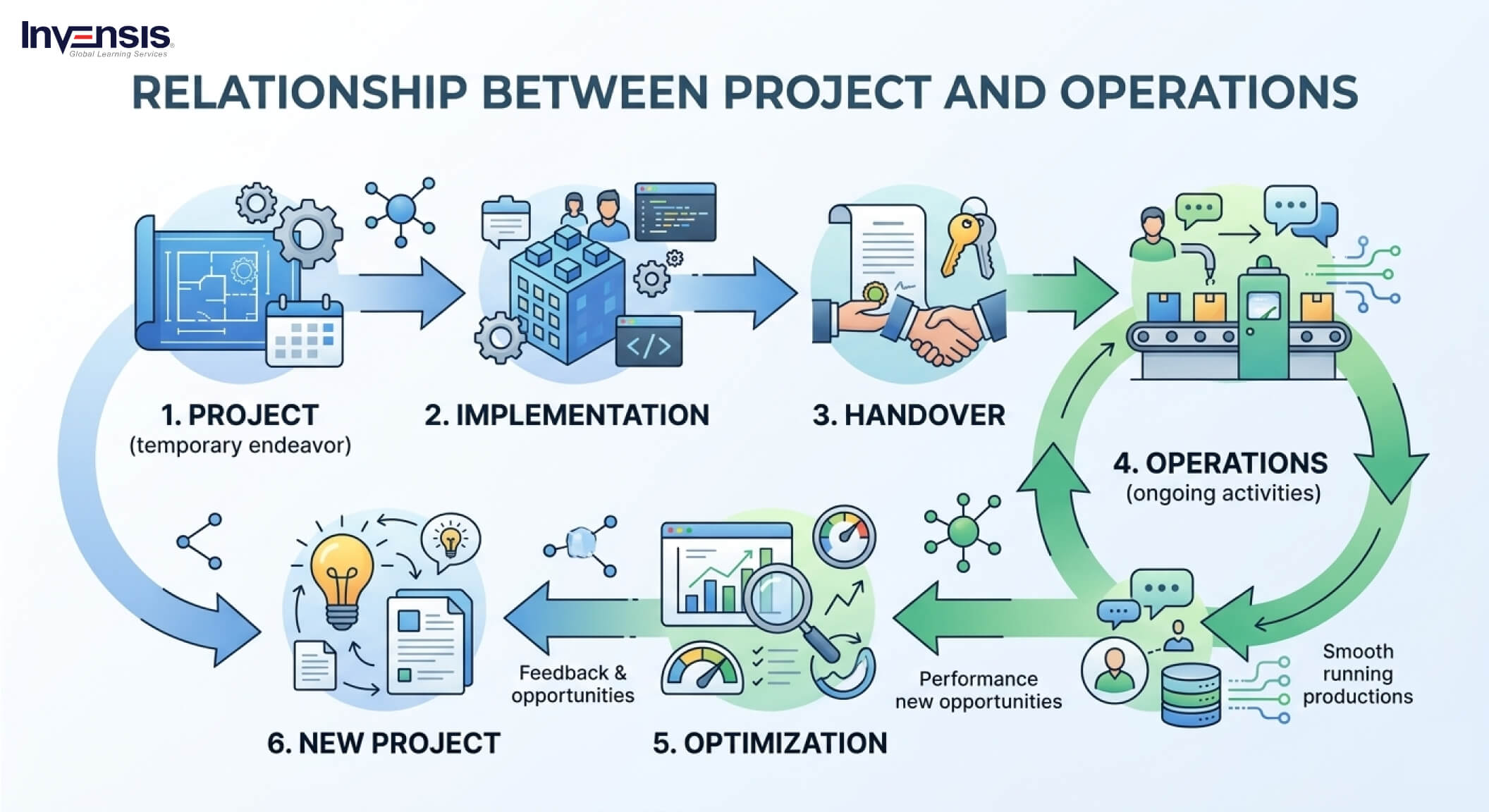
Project management and operations management form a continuous cycle: projects introduce change, and operations sustain and optimize it over time.
How Project Management and Operations Work Together
1. Projects Create, Operations Sustain
In the context of project management vs operations management, projects are responsible for building or implementing new systems, processes, or products. Once the project is completed, operations take over to ensure consistent performance and long-term value.
For example, implementing a new CRM system is a project. Once deployed, managing customer data and system usage becomes part of operations.
2. Operations Identify the Need for Projects
Operations teams are often the first to identify inefficiencies, bottlenecks, or performance gaps in existing processes. These challenges then trigger new projects aimed at improvement or transformation.
This is where operations and project management intersect; operations highlight the problem, and projects are initiated to solve it.
3. Transition from Project to Operations
A critical phase in operations management vs project management is the handover process. Once a project is completed, its outcomes must be smoothly transferred to operations for ongoing execution.
Poor transition can lead to:
- operational inefficiencies
- system failures
- lack of adoption
A well-managed transition ensures continuity and long-term success.
Real Case Example: Amazon Fulfillment CentersA verifiable example of both project management and operations management being used together is Amazon’s rollout and running of robotic fulfillment centers. Amazon treats new fulfillment-center designs and automation deployments as staged initiatives. An AWS supply-chain article describes how Amazon uses a systematic approach to capital investments in new automation technology and refers to fulfillment centers by “generations,” such as a current site under construction being a “Gen 13” design, and future “Gen 14” centers featuring updated layouts, robotics, and automation. That is a clear project-management element: planned implementation, phased rollout, and defined deliverables. Once those systems are launched, the work shifts into operations management. Amazon’s operations content explains that its robots work inside fulfillment centers and warehouses to support day-to-day package fulfillment, and that systems such as Sequoia help store inventory faster and support order transactions closer to customers. Amazon also states it has more than 1 million robots across its fulfillment network, showing this is not a one-off pilot but an operational model running at scale. In simple terms, the project is designing and deploying the robotic fulfillment capability; operations is using that capability every day to process inventory, pick, pack, and ship customer orders efficiently and consistently. Source: AWS |
4. Continuous Improvement Loop
The relationship between project and operations management is not linear, it is cyclical. Operations generate insights through daily performance, which can lead to new projects for innovation or optimization.
This creates a continuous improvement loop:
- Operations identify issues
- Projects implement solutions
- Operations sustain improvements
What are the Similarities Between Project Management and Operations Management?
Although the difference between project management and operations management is significant, both functions share several core principles that contribute to organizational success. Understanding these similarities helps clarify why both disciplines often work closely together.
Key Similarities
1. Resource Management
Both operations and project management involve planning and allocating resources such as people, time, and budget. Effective resource utilization is critical in both cases to ensure efficiency and avoid waste.
Allocation Discipline
Whether managing a project timeline or running daily operations, both functions require careful coordination of limited resources to meet objectives without overutilization or delays.
2. Process Orientation
In project management vs operations management, both rely heavily on structured processes to achieve desired outcomes. While projects follow defined methodologies, operations depend on standardized workflows.
Structured Execution
Projects may use frameworks like Agile or Waterfall, while operations use standard operating procedures (SOPs). In both cases, success depends on how well processes are designed and followed.
3. Performance Monitoring
Both disciplines require continuous tracking and evaluation of performance to ensure goals are being met. Monitoring helps identify issues early and supports informed decision-making.
Data-Driven Decisions
Project managers track milestones, timelines, and deliverables, while operations managers monitor KPIs such as productivity, quality, and efficiency. In both, data plays a central role in improving outcomes.
4. Risk Management
Risk is a shared concern in both operations management vs project management. While the type of risk may differ, both require proactive identification and mitigation strategies.
Preventive Approach
Projects focus on anticipating uncertainties before they impact delivery, while operations focus on preventing disruptions in ongoing processes. Both require structured risk management practices.
5. Stakeholder Involvement
Both project and operations functions involve coordination with multiple stakeholders, including teams, managers, clients, and leadership.
Communication Importance
Clear communication ensures alignment, reduces misunderstandings, and improves execution, whether delivering a project or managing ongoing operations.
What Is the Difference Between Project Management vs Operations Management?
Choosing between project management vs operations management depends on your working style, career goals, and the type of impact you want to create within an organization. While both roles are essential, they require different mindsets and strengths.
If You Prefer Project Management
You may be better suited for project management if you enjoy working in dynamic environments where goals, priorities, and challenges evolve.
You Might Be a Good Fit If You:
- Enjoy working on new initiatives
You prefer building something from scratch to maintaining existing systems.
- Thrive under deadlines
You are comfortable working within timelines, milestones, and structured deliverables.
- Like solving complex, unique problems
Each project presents new challenges that require creative thinking and adaptability.
- Prefer variety in your work
Your work changes frequently depending on the project phase and requirements.
In operations vs project management, this path suits individuals who prefer change, innovation, and goal-driven execution.
If You Prefer Operations Management
Operations management is a better fit if you prefer stability, consistency, and long-term impact through continuous improvement.
You Might Be a Good Fit If You:
- Enjoy optimizing processes
You like improving efficiency and making systems work better over time.
- Prefer structured and predictable work
You are comfortable working within established systems and workflows.
- Focus on long-term performance
You are interested in sustaining and improving results rather than delivering one-time outcomes.
- Value consistency and control
You prioritize reliability, quality, and process stability. In operations management vs project management, this path is ideal for individuals who prefer structure, efficiency, and operational excellence.
Career Perspective
From a career standpoint, both operations and project management offer strong growth opportunities, but lead to different paths.
- Project management roles often progress into Program Manager, Portfolio Manager, or PMO leadership roles
- Operations management roles can evolve into OperationLifecycles Head, Business Unit Leader, or COO positions
Key Decision Factor
If you enjoy:
- Building and delivering change [symbol]rarr[/symbol] Project Management
- Running and improving systems [symbol]rarr[/symbol] Operations Management
That single distinction captures the core difference between project management and operations management from a career perspective.
Conclusion
Understanding project management vs operations management is essential for both professionals and organizations aiming to improve efficiency and execution. While project management focuses on delivering change through time-bound initiatives, operations management ensures stability by managing ongoing processes. The real value lies in how these two functions complement each other, projects introduce innovation, and operations sustain and optimize it over time. Recognizing the difference between project management and operations management helps in making better strategic, operational, and career decisions.
For professionals looking to build expertise in these areas, pursuing structured learning can make a significant difference. Certifications such as PMP® (Project Management Professional), PRINCE2®, or PgMP® are ideal for those aiming to excel in project management, while programs in Operations Management, Lean Six Sigma, or ITIL® 5 help strengthen operational efficiency and process improvement skills. Choosing the right learning path based on your career goals can help you master both operations and project management and drive meaningful business outcomes.
Frequently Asked Questions
1. What is the difference between project management and operations management?
The key difference between project management and operations management lies in their purpose and duration. Project management focuses on temporary initiatives with a defined goal and timeline, while operations management deals with ongoing activities that ensure business continuity and efficiency.
2. Is project management part of operations management?
Project management is not a direct subset of operations management, but both are closely related. In many organizations, projects are initiated to improve or transform operations, making them complementary functions within the broader business framework.
3. Which is better: project management or operations management?
There is no clear “better” option between operations vs project management. The choice depends on your career preferences. Project management is ideal for those who enjoy dynamic, goal-oriented work, while operations management suits individuals who prefer stability and continuous improvement.
4. Can operations management include projects?
Yes, operations management can involve projects, especially when improvements or changes are needed. However, these projects are usually temporary efforts within a larger operational structure, highlighting the relationship between operations and project management.
5. What are examples of project management and operations management?
Examples of project management vs operations management include:
- Project Management: Launching a new product, implementing a software system, or opening a new office
- Operations Management: Managing daily production, handling customer service, or maintaining supply chain processes
6. Why is it important to understand the difference between operations management and project management?
Understanding the difference between operations management and project management helps organizations allocate resources effectively, improve efficiency, and ensure that both change initiatives and daily operations are aligned with business goals.
7. How do project management and operations management work together?
In operations management vs project management, both functions are interconnected. Projects introduce changes or improvements, while operations sustain and optimize those changes over time, creating a continuous cycle of improvement.