

Table of Contents:
- Introduction
- What Is Project Management, and Why Does It Matter for Businesses?
- What Are the Key Benefits of Project Management?
- Why Is Project Management Important Across Different Industries?
- Advantages of Social Project Management
- How Does Project Management Training Improve Business Outcomes?
- What Happens When Organisations Neglect Project Management?
- Conclusion
- Frequently Asked Questions
Introduction
Almost every organization runs projects. New product launches, system migrations, process improvement programs, and office expansions are all projects. What separates those who deliver from those who drag on, overspend, and eventually get quietly canceled is rarely the quality of the idea. It is the quality of the project’s management.
Project management is not paperwork. It is not Gantt charts for the sake of it. It is the discipline that turns a goal into a plan, a plan into coordinated action, and coordinated action into a measurable result. When it works well, it is nearly invisible. When it fails, everyone notices, in the budget, in the timeline, and in the stakeholder meeting where someone has to explain what went wrong.
What Is Project Management, and Why Does It Matter for Businesses?
Project management is the process of planning, organizing, and controlling resources to achieve a specific goal within defined constraints, typically scope, time, and budget. The project manager coordinates people, manages risk, tracks progress, and keeps the work connected to business objectives.
The reason it matters to businesses is straightforward: most strategic work takes place in project form. A company’s ability to execute on its priorities depends directly on how well it manages those projects. Organizations that treat project management as an administrative formality consistently underperform those that treat it as a core operational capability.
According to PMI’s Pulse of the Profession, organizations with mature project management practices waste 28 times less money than those without, $1M per $1B spent versus $122M per $1B. That is not a marginal difference. For mid-to-large enterprises running dozens of concurrent projects, the cost of poor project management is one of the most preventable sources of financial waste in the business.
What Are the Key Benefits of Project Management?
The landscape of PM is changing by the day. It is crucial to keep pace with the trends if you are interested in understanding the benefits of project management. While project management skills are not easy to learn in theory alone, doing a course does come with benefits. Investing your time in learning project management skills is worth it, as all employers prioritize PM. Project management also brings leadership and direction to projects.
Here are a few reasons why project management is essential:
 1. It Gives Everyone A Shared Definition Of Success
 1. It Gives Everyone A Shared Definition Of Success
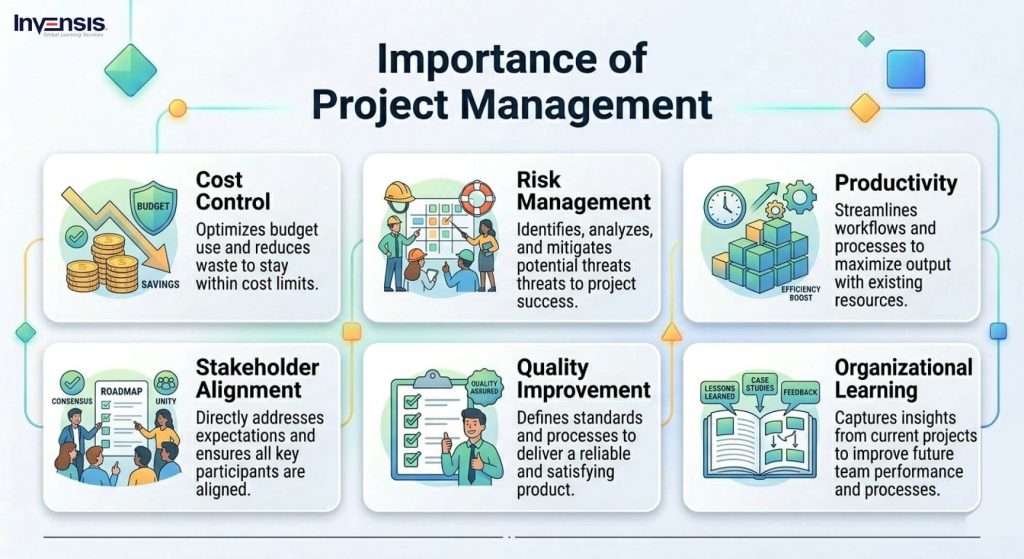
One of the most common reasons projects fail is not technical; it is definitional. Different stakeholders have different expectations about what “done” looks like. Project management forces that conversation early. A proper project charter defines scope, deliverables, success criteria, and constraints before the first task is assigned. That alignment saves enormous amounts of rework and conflict downstream.
2. It Keeps Costs Under Control
Budget overruns are not inevitable. They are usually the result of scope creep, poor estimation, or changes that were never formally assessed for cost impact. Project management provides the framework to track spend against plan, raise flags when costs drift, and make deliberate decisions about trade-offs rather than discovering them at the end.
3. It Makes Risk Visible Before It Becomes A Crisis
Every project carries risk. Market conditions change. Key people leave. Dependencies get delayed. The difference between a project that absorbs these shocks and one that collapses under them is whether the risks were identified, assessed, and planned for in advance. Risk management is a core component of project management, not an optional extra only for complex projects.
4. It Improves Team Productivity
When roles, priorities, and dependencies are unclear, people work hard and still move slowly. They duplicate effort, wait on information they did not know they needed, and attend meetings that answer questions the project plan should have already resolved. Clear project structure removes that friction. Teams know what they own, when it is needed, and who to escalate to when something blocks them.
5. It Protects Stakeholder Relationships
Projects involve people who have a stake in the outcome, sponsors, clients, end users, and senior leadership. Project management creates the communication cadence that keeps those stakeholders informed, involved at the right moments, and confident that the team is in control. A stakeholder who feels informed tends to be supportive. One who feels ignored tends to become a problem.
6. It Builds Organisational Learning
Projects that close without a retrospective repeat the same mistakes. Post-project reviews, what went well, what did not, what will change next time, are how organisations get better at delivery over time. Project management embeds that learning loop into the way work gets done.
Why Is Project Management Important Across Different Industries?
Project management matters across industries because the most important business work does not happen through routine operations. It happens through projects, work with a clear goal, a deadline, a budget, multiple stakeholders, and real consequences if things go wrong. The industry may change, but the core challenge stays the same: people, timelines, resources, risks, and expectations must be coordinated in a disciplined way.
Construction
In construction and engineering, project management is essential because the work is sequential, high-cost, and hard to reverse. One delayed approval, one late material shipment, or one missed compliance step can affect the entire schedule and trigger expensive claims or legal disputes. Project management keeps contractors, suppliers, regulators, and site teams aligned so the project moves safely and on schedule.
IT and Software Development
The IT and software development project management brings control to environments that are constantly changing. Business priorities shift, customer expectations evolve, and technical issues can expand scope quickly. Whether the team uses Agile, Scrum, or a hybrid approach, project management helps teams prioritize the right work, manage dependencies, and deliver value without losing focus. Without that structure, software teams can stay busy while still drifting away from business goals.
Heathhcare
In healthcare project management, the stakes are even higher because delays and errors can affect patient care, compliance, and operational continuity. Hospital expansions, digital health record rollouts, process redesign, and regulatory programs all involve tight coordination across clinical, administrative, and technology teams. Project management ensures these initiatives are implemented in a controlled manner, with quality, timing, and risk closely monitored.
Manufacturing
The manufacturing project management supports initiatives that directly affect profitability through efficiency and consistency. Launching a new product, upgrading equipment, changing suppliers, or improving production processes all require careful planning. A missed dependency or poorly timed shutdown can create downtime, quality issues, and lost revenue. Project management reduces that risk by making timelines, responsibilities, and trade-offs visible before they become costly problems.
Professional Services
In professional services, project management is often included in what the client pays for. Consulting, implementation, transformation, and advisory engagements succeed only when scope is controlled, milestones are met, and stakeholders stay aligned. Subject matter expertise alone is not enough. Clients expect structured delivery, predictable communication, and disciplined execution, and that is exactly what project management provides.
The context may differ across industries, but the fundamentals remain the same. Every industry depends on project management to translate goals into coordinated action, reduce delivery risk, and improve the chances of getting the intended result. That is why project management is not industry-specific. It is execution-specific.
What Role Does Project Management Play in Strategic Execution?
This is where project management often gets undersold. It is presented as a delivery tool, a way to get things done on time and on budget. That framing is accurate but incomplete.
Strategic execution is fundamentally a project management problem. An organization can have an excellent strategy and still fail to execute it. The gap between strategy and results is almost always a planning and coordination gap: priorities are not sequenced correctly, resources are spread too thin, dependencies are not managed, and progress is not tracked against the objectives that actually matter.
|
“Management is doing things right; leadership is doing the right things.” |

|
PMI research consistently shows that organizations with high strategic alignment between project management and business objectives have better outcomes on every measure, including delivery speed, budget performance, and realized business value. That alignment does not happen by accident. It requires project managers who understand the business context of their work, not just the operational mechanics.
For learning and development leaders, this has a direct implication. Teams that invest in project management training, whether through PMP certification, Agile frameworks, or structured in-house programs, are not just improving delivery efficiency. They are building the capability to execute the strategy.
Advantages of Social Project Management
Global Communication
The use of social media has a tremendous impact on global communication. According to PMI’s ‘Pulse of the profession: The High Cost of Low Performance’, effective communication enhances organizational performance. In a geographically dispersed project environment, where teams may be working across countries, social project management tools and techniques help all team members stay on the same page.
Collective Intelligence
Collaboration involves contributions by people from different backgrounds. Collective intelligence evolves from collective contribution and competition among individuals. This kind of work structure also allows team members to probe into the decision-making process, thanks to the transparency of social media platforms. The executives and project managers select the appropriate decision based on the team members’ input.
Building New Customer Intelligence
The collective influence of social media tools also helps strengthen customer relations. Customers and clients can actively use social media tools to provide input on specific products and services. Based on customer feedback, project strategies can be changed immediately through transparent communication channels with all team members. Customer feedback through direct channels helps quickly adjust project strategies and plans.
Utilize the Skills of People Outside the Team
Although team members contribute to a project’s success, sometimes those outside the team may also have valuable input. Social project management makes it easy to gather input from external entities. You can post a query on a social forum that an entire organization or a specific department can access. Your query will be read and answered by people from various backgrounds. Hence, you will have a variety of inputs.
Accomplish Goals Faster
Social project management enables everyone to keep track of the various activities undertaken as part of a project. The relevant parties can also ask questions without having to send numerous emails when in doubt. By optimizing communication among team members, stakeholders, and other relevant parties, productivity is enhanced, and goals are accomplished faster.
Team Empowerment
Social project management brings the organization closer. Everyone inside and outside the team can share their views, discuss, and interact.
Networking
In a multinational giant like IBM or Accenture, one project manager hardly knows another in another corner of the world. For example, a project manager in San Francisco who is managing a team posts a query about his project on the organization’s business collaboration software. Someone with expertise in the same field replies to his post and helps with his project. This type of networking is essential for project managers to enhance their visibility and boost their careers.
Partners with Agile
A significant change in project management is the adoption of the Agile technique. One of the main elements of this technique is collaboration. Social project management can facilitate achieving this objective.
Social project management has taken networking and information sharing to a new level. Gone are the days when you had to open your email or attend a meeting to be a part of a discussion and express your views. Today, you can be part of the discussions on the other side of the world with just a click of your mouse. Social networking forums are widely used by organizations today owing to their transparency, ease of communication, and efficiency in sharing information.
How Does Project Management Training Improve Business Outcomes?
The evidence that structured project management training improves outcomes is strong. PMI’s Talent Triangle identifies technical, leadership, and strategic skills as the three domains project managers need to develop, and organizations that invest across all three see measurably better project results.
Certification programs like PMP (Project Management Professional) give practitioners a common language, a structured decision-making framework, and the credibility to lead cross-functional teams with authority. For organizations building out an internal PM function, certification provides a globally recognized quality standard.
For teams already running Agile delivery, training in frameworks like Scrum, SAFe, or PRINCE2 Agile builds the specific competencies needed to operate well inside iterative environments, sprint ceremonies, backlog management, release planning, and retrospective facilitation.
The return on PM training investment is not hard to see. Projects delivered on time cost less than projects that drag. Teams that communicate well make fewer expensive mistakes. Project managers who understand business strategy make better trade-off decisions when constraints change. All of these translate directly to business performance.
What Happens When Organisations Neglect Project Management?
The short answer: things still get done, but not reliably, not efficiently, and often not in ways that match what the business actually needed.
Projects without clear ownership tend to drift. The scope expands because no one is actively managing it. Budgets are overrun because changes are absorbed without cost assessment. Timelines slip because dependencies were not mapped. Key stakeholders are surprised at the end because nobody was communicating throughout.
None of this is theoretical. PMI’s Pulse of the Profession found that 48% of projects still fail to meet their original goals or business intent. The leading causes, poor communication, undefined success criteria, inadequate change management, and insufficient risk management, are all symptoms of weak or absent project management practice.
The cost of underinvestment in project management is not just the failed project. It is the opportunity cost of the strategic priority that did not get delivered, the team credibility that was damaged, and the organisational learning that was never captured because no one ran the retrospective.
Conclusion
Project management is often discussed as though it is primarily about the people who have “Project Manager” in their job title. That misses the point. Project management is an organizational capability, a way of planning, coordinating, and delivering work that any team can apply and any leader should understand.
Organisations that take it seriously, that train their people, build their PM culture, and connect delivery to strategy, consistently outperform those that treat it as a formality. That is not an argument for bureaucracy. It is an argument for discipline: the kind that gives people clarity about what they are building, confidence that resources are being used well, and the structures to adapt without collapsing when things change.
In a business environment where execution speed and strategic agility matter as much as strategy itself, project management is no longer a support function. It is a competitive capability.
Frequently Asked Questions
1. Why Is Project Management Important For Businesses?
Project management ensures that business initiatives are delivered on time, within budget, and aligned with strategic goals. It reduces risk, improves coordination, and helps organizations avoid costly delays and rework.
2. What Happens If A Company Does Not Use Project Management?
Without project management, projects often suffer from unclear goals, missed deadlines, budget overruns, and poor communication. This leads to wasted resources, failed initiatives, and loss of stakeholder trust.
3. Is Project Management Only Useful For Large Organizations?
No. Project management is equally important for small and mid-sized businesses. Even smaller teams benefit from clear planning, defined roles, and structured execution to improve efficiency and outcomes.
4. How Does Project Management Improve Team Productivity?
Project management clarifies responsibilities, timelines, and priorities. This reduces confusion, eliminates duplicate work, and allows teams to focus on high-impact tasks instead of reacting to constant changes.
5. Why Is Project Management Critical In Agile Environments?
In Agile environments, project management ensures that teams stay aligned with business goals while adapting to change. It helps manage backlogs, prioritize work, and deliver value incrementally without losing direction.
6. What Industries Benefit The Most From Project Management?
All industries benefit from project management, including construction, IT, healthcare, manufacturing, and professional services. Any industry that handles complex tasks, timelines, and resources requires structured project management.
7. How Does Project Management Help In Risk Management?
Project management identifies potential risks early, assesses their impact, and creates mitigation plans. This proactive approach prevents issues from becoming major disruptions during execution.
8. Can Project Management Improve Customer Satisfaction?
Yes. When projects are delivered on time, meet expectations, and maintain clear communication, customer satisfaction improves significantly. Project management ensures consistent delivery and transparency.
9. What Skills Are Essential For Effective Project Management?
Key skills include planning, communication, risk management, leadership, time management, and stakeholder management. Strong project managers combine technical knowledge with decision-making and people skills.
10. How Does Project Management Support Business Growth?
Project management enables organizations to execute strategies effectively. By successfully delivering projects, businesses can launch new products, expand operations, and improve processes, driving long-term growth.