

Table of Contents:
- Introduction
- What is Agile, and Where Did It Come From?
- What is Six Sigma, and How Does it Work?
- Agile vs. Six Sigma: What are the Key Differences Between Agile and Six Sigma?
- What does Lean Agile Six Sigma mean?
- When Should Your Organization Choose Agile over Six Sigma?
- Conclusion
Introduction
Agile and Six Sigma are often compared as if they solve the same problem. They don’t. One is built for speed and adaptability; the other is built for precision and consistency. Confusing the two leads to poor decisions; teams either move fast and break things unnecessarily or move so cautiously that nothing meaningful gets delivered.
Agile focuses on delivering value quickly through iterative cycles, continuous feedback, and evolving priorities. Six Sigma, on the other hand, is a data-driven approach aimed at reducing defects and eliminating process variation through structured analysis. Both are powerful, but only when applied in the right context.
This guide breaks down Agile vs. Six Sigma in practical terms, how they differ, where each fits, and when combining them actually makes sense. The goal isn’t to declare a winner, but to help you choose the right approach based on the problem you’re trying to solve.
What is Agile, and Where Did It Come From?
Agile started in software development. The Agile Manifesto, published in 2001 by seventeen software practitioners, was a reaction to heavyweight, waterfall-style processes that left teams slow, bureaucratic, and disconnected from what customers actually wanted.
The core idea is iterative delivery. Instead of planning a full product over twelve months and shipping it all at once, Agile teams work in short cycles called sprints, usually one to four weeks, and release working increments continuously. Feedback shapes the next sprint. Priorities can shift. The plan is a living document, not a contract.
Scrum is the most widely used Agile framework. It organizes work into sprints, assigns roles (Product Owner, Scrum Master, Development Team), and runs ceremonies: sprint planning, daily standups, sprint reviews, and retrospectives. Kanban is another popular approach that uses a visual board to manage flow without fixed sprint boundaries.
Agile is about responding to change. That is what makes it powerful in software, and occasionally frustrating in environments where change itself is the problem.
What is Six Sigma, and How Does it Work?
Six Sigma is a data-driven methodology for reducing defects and process variation. It was developed by Motorola in the mid-1980s and later popularised by General Electric under Jack Welch in the 1990s. The name comes from the statistical concept of standard deviation (sigma): a Six Sigma process produces fewer than 3.4 defects per million opportunities.
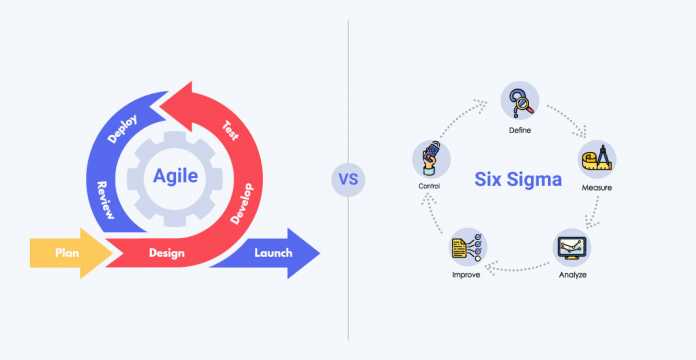
Where Agile uses sprints, Six Sigma uses DMAIC:
- Define what problem we are solving, and for whom?
- Measure: What does the current process look like in data?
- Analyze, what the root causes of variation or defects?
- Improve, what changes will address those root causes?
- Control, how do we sustain the improvement over time?
Six Sigma also has a belt structure borrowed loosely from martial arts. Green Belts work on projects part-time. Black Belts lead full-time improvement projects. Master Black Belts coach and mentor. Champions are business leaders who sponsor projects and remove barriers.
Six Sigma projects tend to run for months. They require significant data collection, statistical analysis tools (control charts, regression, FMEA), and a formal tollgate review at each DMAIC phase. The payoff is measurable, documented, and sustained, which is exactly what manufacturing, healthcare, and financial services operations need.
Agile vs. Six Sigma: What are the Key Differences Between Agile and Six Sigma?
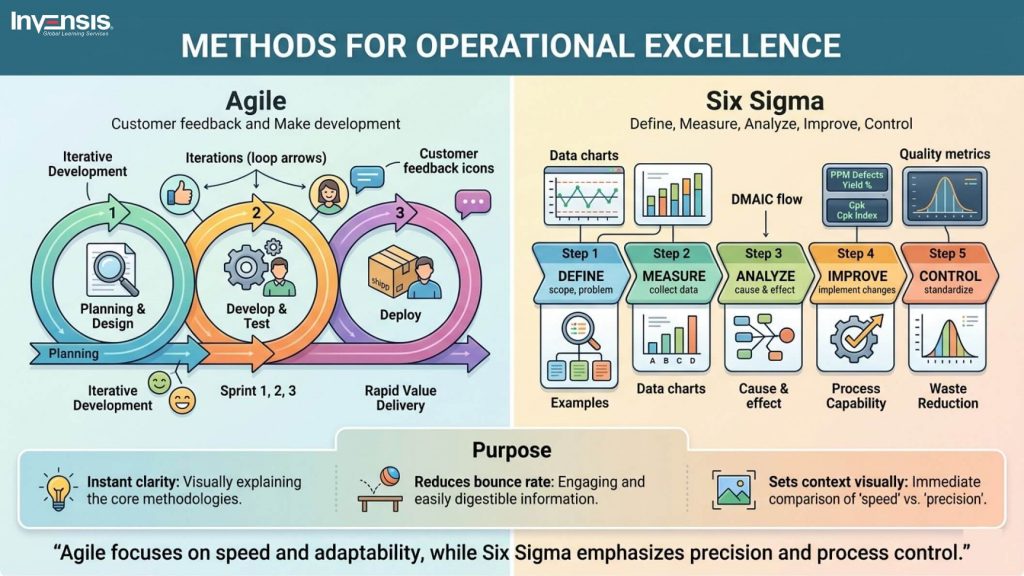
Agile and Six Sigma are built on fundamentally different assumptions about how improvement happens. Agile assumes that requirements will change, customers will surprise you, and the best way to deliver value is to ship fast and course-correct. Six Sigma assumes that defects have root causes, that those causes can be measured, and that sustained quality comes from eliminating variation, not from moving faster.
Neither assumption is wrong. They just apply to different kinds of problems.
| Dimension | Agile | Six Sigma |
| Core Goal | Deliver working output quickly through short, iterative cycles | Eliminate defects and reduce process variation using data |
| Approach | Sprints, retrospectives, and continuous customer feedback | DMAIC, Define, Measure, Analyze, Improve, Control |
| Timeframe | Short cycles: typically 1–4 weeks’ sprints | Long projects: typically 3–6 months per DMAIC cycle |
| Data Use | Customer feedback, velocity tracking, and burndown charts | Statistical tools like control charts, regression, and sigma levels |
| Flexibility | High, scope adapts sprint to sprint based on priorities | Low-quality targets are fixed; processes adapt to achieve them |
| Team Structure | Flat, cross-functional, self-organizing teams | Structured hierarchy: Champion, Black Belt, Green Belt |
| Best Suited For | Software development, product innovation, creative environments | Manufacturing, healthcare, finance, operations |
| Change Driver | Customer needs and real-time market feedback | Root cause analysis backed by statistical validation |
The differences run deeper than methodology. Here is what each dimension means in practice:
|
“Without data, you’re just another person with an opinion. |
 |
Core goal. Agile teams optimize for speed of learning; the faster you ship, the faster you find out what works. Six Sigma teams optimize for precision; the goal is not to move faster, but to measure more carefully and eliminate the causes of failure.
Approach and structure. Agile uses Scrum or Kanban ceremonies: sprint planning, standups, retrospectives. Six Sigma uses DMAIC, a phased framework that gates each step behind data. You cannot move from Measure to Analyze until the measurement system is validated. That rigor takes time but produces durable results.
Timeframe. A Scrum team ships something every two weeks. A Six Sigma project might spend the first six weeks just defining the problem and validating how it will be measured. For teams used to Agile velocity, Six Sigma timelines can feel slow. That friction is intentional; rushing the analysis phase is exactly how improvement projects produce solutions that do not hold.
Data use. Both frameworks use data, but in different ways. Agile uses qualitative and operational data, user feedback, story points completed, and defect counts from the last sprint. Six Sigma uses statistical data, control charts, process capability indices, and hypothesis testing. A Green Belt working on a billing error problem is not looking at sprint burndowns; they are running a regression analysis on transaction records.
Flexibility. Agile’s strength is adaptability. Priorities can change between sprints without derailing the framework. Six Sigma is more rigid by design; once a quality target is defined in the Define phase, the project does not pivot mid-DMAIC based on stakeholder preference. That rigidity is a feature, not a bug, in environments where “close enough” causes real harm.
Team structure. An Agile team typically has no formal hierarchy beyond the Product Owner and Scrum Master roles, both of which are facilitative rather than directive. Six Sigma teams have a structured belt hierarchy that determines who leads projects, who executes analysis, and who sponsors the project at an executive level. Neither model is universally better; it depends on whether your organization needs autonomy or accountability as its primary culture driver.
Use Agile when the problem is about what to build and how fast; use Six Sigma when the problem is about why something keeps failing and how to stop it permanently.
How Does Scrum Compare to Six Sigma Specifically?
The question of Scrum vs. Six Sigma comes up often in organizations that already run Scrum and are considering Six Sigma training to improve quality.
The honest answer: they are not in direct competition. Scrum manages product delivery. Six Sigma manages process quality. A software team can run Scrum sprints to ship features while a separate quality team runs a Six Sigma project to reduce the defect rate in production deployments. The two workstreams operate in parallel, not in opposition.
Where they clash is when people try to apply Six Sigma’s DMAIC rigor to a Scrum sprint, or try to apply Scrum’s “good enough, ship it” philosophy to a process that genuinely needs statistical control. Context determines which is appropriate.
What is Lean Six Sigma, and How is it Different from Both?
Lean and Six Sigma are often grouped together, which causes confusion. They are related but distinct.
Lean comes from the Toyota Production System. Its core goal is to eliminate waste, removing any activity that does not add value to the customer. The seven wastes (overproduction, waiting, transportation, over-processing, inventory, motion, defects) form the framework of Lean. Tools such as value stream mapping, 5S, and kaizen events help teams identify and remove waste.
Six Sigma addresses variation and defects through statistical analysis.
Lean Six Sigma combines both: eliminate waste and reduce variation. A Lean Six Sigma project might start with value stream mapping to identify waste, then move into DMAIC to address the root causes of specific defects.
Lean vs Six Sigma in practice: Lean projects tend to move faster because they rely more on observation and process redesign than on deep statistical analysis. Six Sigma projects take longer but can achieve tighter, more precisely measured results. Lean Six Sigma sits between them, more rigorous than pure Lean, more practical than pure Six Sigma.
What does Lean Agile Six Sigma mean?
Lean Agile Six Sigma, sometimes written as agile lean six sigma or agile six sigma, refers to hybrid operating models that draw from all three frameworks. There is no single agreed-upon definition or certification body behind the combined term, so it means different things in different organisations.
In practice, a lean agile six sigma approach might look like this:
- Agile sprints manage delivery cadence and team coordination.
- Lean tools (value stream mapping, kaizen) identify and remove waste in the process.
- Six Sigma (DMAIC, control charts) addresses specific quality or defect problems with statistical depth.
This combination tends to work well in large enterprises where different parts of the business need different things. A product team runs Agile. An operations team runs Lean Six Sigma. A shared improvement office coordinates across both using a unified framework.
The risk is complexity. Trying to apply all three frameworks to the same team simultaneously often produces process overhead that defeats the purpose of each. The most effective lean agile six sigma implementations tend to be deliberate about which framework owns which type of problem.
When Should Your Organization Choose Agile over Six Sigma?
Choose Agile when:
- You are building or iterating on a software product.
- Requirements are unclear or likely to change.
- Customer feedback needs to drive development direction.
- Speed to market matters more than eliminating all variation.
- Teams are small, cross-functional, and need autonomy.
Agile is a poor fit when the process itself is the problem. If your call center has a 12% error rate on customer records, no amount of sprint planning will fix that; you need to understand the root cause, which is a Six Sigma problem.
Is there a case for Combining Agile and Lean Six Sigma?
Yes, and a growing number of large organizations do it. The case rests on the idea that speed and quality are not mutually exclusive. Agile handles the delivery problem. Lean Six Sigma addresses quality and waste issues. Together, they cover the full improvement surface.
That said, the combination only works when the boundaries are clear. Teams need to know which framework governs which decisions. Without that clarity, the result is a methodology salad that produces meetings without outcomes.
If your organization is already running Agile at the team level and is seeing systemic quality or efficiency problems that sprint retrospectives cannot solve, that is a reasonable signal to introduce Lean Six Sigma at the process level, not as a replacement for Agile, but alongside it.
Which Framework Produces Better Results: Agile, Six Sigma, or a Combination?
There is no universal winner. Results depend on the problem, the industry, and the maturity of the organisation.
Six Sigma has decades of documented ROI in manufacturing and operations. GE famously attributed over $10 billion in savings to Six Sigma in its first five years of implementation. In healthcare, Six Sigma has reduced medication error rates and operating room inefficiencies at scale.
Agile has transformed software delivery. Organizations that adopt Agile consistently report faster release cycles, better product-market fit, and higher team morale, though the evidence is more qualitative than Six Sigma’s controlled studies.
Lean Agile Six Sigma combinations are newer and harder to measure because the implementations vary widely. The strongest cases tend to come from financial services and complex manufacturing, where both speed and precision are non-negotiable.
The honest conclusion: the best framework is the one that fits the problem you actually have, not the one that looks most impressive on a training calendar.
Conclusion
Agile and Six Sigma are not competing philosophies; they are different tools built for different problems. Agile solves the delivery problem: how do you build the right thing fast, with a team that can adapt? Six Sigma solves the quality problem: how do you find the root cause of defects and eliminate them with measurable, sustained results?
Lean Six Sigma adds waste elimination to Six Sigma’s focus on defects. Lean Agile Six Sigma combines all three in organisations that are complex enough to need them simultaneously.
For most teams, the right starting point is simpler: Identify the actual problem, then match the framework to it. Chasing a certification because it sounds comprehensive is how organizations end up with heavy processes that nobody uses.