

Choosing between PRINCE2 vs Scrum is rarely a theoretical debate; it’s usually triggered by real constraints: executives want predictability, teams want flexibility, customers want faster value, and compliance teams want traceability. The challenge is that PRINCE2 and Scrum were built to solve different layers of delivery. PRINCE2 is a structured project management method that emphasizes governance and control, while Scrum is a lightweight framework built on empiricism (transparency, inspection, adaptation) for complex product development work.
This expanded guide gives you a clear, usable comparison: how each approach works, where they differ in practice, and how to decide what to use, PRINCE2, Scrum, or a hybrid that keeps both intact.
Table of Contents:
- What is PRINCE2?
- What is Scrum?
- The Key Differences Between PRINCE2 vs Scrum
- When to Use PRINCE2?
- When to Use Scrum
- PRINCE2 with Scrum: A Hybrid Framework Explained
- Conclusion
What is PRINCE2?
PRINCE2 (Projects IN Controlled Environments) is widely used for managing projects in a structured way. It provides a process model that guides a project from start-up through initiation, stage-by-stage control, and closure. A practical way to view PRINCE2 is as a governance-first approach: it emphasizes who makes which decisions, what gets authorized, how progress is monitored, and how exceptions are escalated, so that delivery remains controlled and justified.
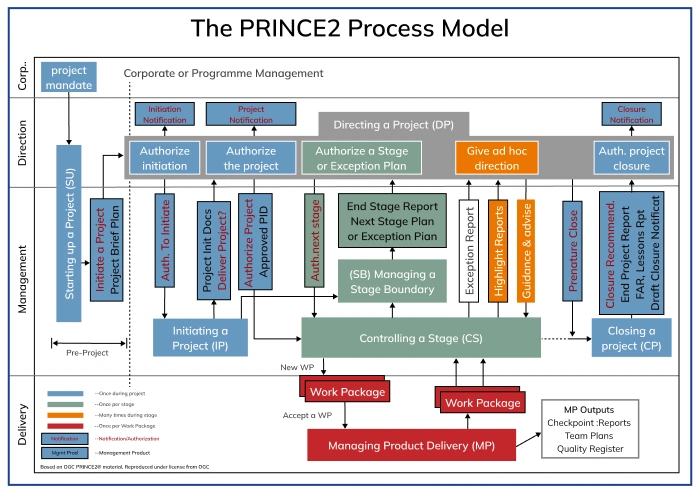
The PRINCE2 Process Model
PRINCE2 process model describes seven processes that map across the project lifecycle: Starting Up a Project, Directing a Project, Initiating a Project, Controlling a Stage, Managing Product Delivery, Managing a Stage Boundary, and Closing a Project. This model highlights the interaction between project direction (Project Board), day-to-day management (Project Manager), and delivery (teams).
Visual Reference (PRINCE2 Process Model):
 Why Teams Choose PRINCE2 in the Real World
PRINCE2 tends to show its value when:
- Stakeholders need formal governance and reporting
- Delivery must be controlled across stages and suppliers
- The organization wants structured initiation and closure
- Decision-making must be transparent and auditable
This is reinforced by PRINCE2’s emphasis on management layers and management products within the process model.
What is Scrum?
Scrum is a lightweight framework for generating value through adaptive solutions for complex problems. It’s built on empiricism and lean thinking, and it relies on transparency, inspection, and adaptation. Scrum defines a minimal set of components, three accountabilities, five events, and three artifacts, so that teams can learn fast and deliver usable increments frequently.
Scrum’s Core Operating System: Pillars, Events, Artifacts
The Scrum Guide explains:
- Transparency enables inspection.
- Inspection enables adaptation.
- Adaptation keeps work aligned with reality as new learning emerges.
- Scrum events provide cadence (Sprint, Sprint Planning, Daily Scrum, Sprint Review, Sprint Retrospective) and artifacts provide visibility (Product Backlog, Sprint Backlog, Increment + Definition of Done).
Why Teams Choose Scrum in the Real World
Scrum is a strong fit when:
- Requirements are evolving or partially unknown (complex work)
- Feedback cycles need to be short and frequent
- Teams can be empowered to self-manage
- Value must be delivered incrementally rather than “big bang”
The Key Differences Between PRINCE2 vs Scrum
PRINCE2 vs Scrum comparisons often get stuck at a surface level (“PRINCE2 is traditional, Scrum is agile”). That’s not precise enough to make a good decision. The useful comparison is: what do they control, how do they control it, and who is accountable for decisions?
1. What each Framework is Designed to Manage: Project Governance vs Product Delivery
PRINCE2 is fundamentally a project management method: it structures the project lifecycle and emphasizes proper start-up, staged management, and formal closure. The process model describes how governance and management flow from the corporate/program context to the Project Board direction, to the Project Manager’s control, to the delivery teams.
Scrum is a framework for delivering product value through iterative learning cycles. The Scrum Guide emphasizes that Scrum is lightweight and “purposefully incomplete,” and that teams use Sprints to turn ideas into value and inspect/adapt frequently.
| What this means for you: If your biggest risk is a lack of governance, unclear decision-making, and uncontrolled change, PRINCE2 helps. If your biggest risk is building the wrong thing because requirements are uncertain, Scrum helps mitigate that risk. |
2. Control Mechanism: Stage Gates & Management Products vs Empiricism and Cadence
PRINCE2’s Process Model Supports:
- Controlled progression through stages
- Decisions authorized at boundaries
- Oversight through governance roles
Scrum’s Control Mechanism is Empiricism:
- Transparency through artifacts (Product Backlog, Sprint Backlog, Increment)
- Inspection in events (Review, Retro, Daily Scrum)
- Adaptation based on what’s learned
| Reality check: PRINCE2’s strength is predictable governance. Scrum’s strength is predictable learning and adaptation. |
3. Roles and Accountability: Project Board/PM vs Product Owner/Scrum Master/Developers
PRINCE2 clarifies governance levels and interfaces, Project Board directs and authorizes, Project Manager manages day-to-day, teams deliver. This is visible in the process model discussion of management levels and responsibilities.
Scrum defines three accountabilities:
- Product Owner: maximizes value and owns Product Backlog management
- Scrum Master: accountable for Scrum effectiveness
- Developers: create a usable Increment each Sprint
And Scrum Teams are cross-functional and self-managing, with no sub-teams or hierarchies.
4. Planning Approach: Upfront Planning by Stage vs Rolling Planning Per Sprint
PRINCE2 planning typically aligns to stages, where initiation and stage boundary management support planned control and progressive authorization.
Scrum planning is intentionally “rolling”:
- Sprint Planning answers why, what, and how for the Sprint.
- The Product Backlog evolves continuously.
- Scope may be clarified and renegotiated during the Sprint as more is learned (without endangering the Sprint Goal).
- This is described directly in the Sprint and Sprint Planning sections of the Scrum Guide.
| Practical Takeaway If stakeholders demand a predictable stage-based roadmap with authorization points, PRINCE2 aligns. If you need fast learning cycles with frequently revised priorities, Scrum aligns. |
5. Change Handling: Controlled Change vs Change-as-Normal
PRINCE2’s structured model is suited to controlled environments where changes must be reviewed, managed, and authorized appropriately within governance.
Scrum assumes change is normal in complex work. The Product Backlog is emergent and continuously updated; Sprint boundaries create a short-term commitment window while still allowing adaptation over time.
In Practice:
|
6. Progress Measurement: Reporting vs Working Increments
In PRINCE2 environments, progress is often communicated through formal mechanisms embedded in management layers and in the model’s artifacts.
In Scrum, progress is anchored on actual delivery of value:
- Each sprint should produce a usable Increment
- Sprint Review is where stakeholders inspect results and discuss what to do next
This helps avoid “green reporting” while the value isn’t actually usable.
PRINCE2 vs Scrum: Strategic Comparison for Decision Makers
| Dimension | PRINCE2 | Scrum |
| Designed to optimize | Governance & controlled delivery | Empirical learning & incremental value |
| Cadence | Stages + boundaries | Sprints + inspect/adapt events |
| Core roles | Project Board, Project Manager, Delivery teams | Product Owner, Scrum Master, Developers |
| Work definition | Defined products/deliverables | Product Backlog items + Increment |
| Best for | Predictable, regulated, multi-stakeholder projects | Complex work with evolving needs |
When to Use PRINCE2?
Choose PRINCE2 when the environment rewards structure, governance, and stage-based control, such as:
You should Strongly Consider PRINCE2 if:
- You need explicit direction and management layers (board-level oversight and day-to-day project control).
- Your project has multiple suppliers and you need consistent coordination and controls.
- You have fixed constraints (time/cost) and require clear escalation when things deviate.
- You must deliver a project with a clear end state (formal closure matters).
- Your organization expects predictable reporting and decision points.
A Realistic PRINCE2 Example
Think of a government program delivering a new compliance reporting system with multiple vendors, strict approvals, and a mandated go-live date. PRINCE2’s staged approach and governance helps ensure responsibilities and authorizations are explicit, reducing delivery risk from uncontrolled decisions.
When to Use Scrum
Choose Scrum when you are solving complex problems where learning drives success, such as:
You Should Strongly Consider Scrum If:
- Your requirements are uncertain and will evolve through feedback. Scrum is designed for complex work and iterative value delivery.
- You want frequent delivery of usable increments (not just “progress reports”).
- You can support a self-managing Scrum Team and respect Product Owner decisions.
- You need a rhythm for inspection and adaptation (Sprint Review/Retro cadence).
A Realistic Scrum Example
A product team building a customer-facing mobile experience where user behavior is uncertain, and feature value must be validated frequently. Scrum enables teams to deliver increments, observe outcomes, and quickly adapt the backlog.
PRINCE2 with Scrum: A Hybrid Framework Explained
In many enterprises, the most practical solution isn’t “PRINCE2 or Scrum” it’s PRINCE2 for governance + Scrum for delivery, without trying to merge them into a single mutated process.
A Simple Hybrid Pattern that Works
- Use PRINCE2 to define and manage:
- Project initiation and justification
- Stage boundaries and authorization
- Governance reporting to senior stakeholders
- Use Scrum within delivery stages to manage:
What “Hybrid” Should NOT Mean
Hybrid should not mean “do Scrum ceremonies but keep PRINCE2 documents and approvals unchanged.” That often causes:
- Slow decision-making (Product Owner authority gets overridden)
- Reduced transparency (increments don’t get truly usable)
- Frustration (Scrum becomes a meeting schedule, PRINCE2 becomes bureaucracy)
If you need governance, keep it, but don’t suffocate the delivery system that provides learning and speed. Scrum’s structure is intentionally minimal, and PRINCE2’s value is in structured control; use each where it fits.
| AVOID THIS MISTAKE
Mistake: “We’re doing Scrum, so we don’t need governance.” What to do instead: Keep Scrum for delivery and add lightweight governance outside the Scrum Team, or use PRINCE2-style stages for oversight when appropriate. |
Conclusion
When deciding between PRINCE2 and Scrum, it’s not about which one is “better,” but rather about selecting the methodology that best suits the nature of your work. PRINCE2 is ideal for projects that require strong governance, clear management layers, and structured control with stage-by-stage progression and formal closure. On the other hand, Scrum thrives in environments where work is complex, requirements are dynamic, and frequent feedback loops and incremental delivery are essential for progress.
For organizations that need the governance and structure of PRINCE2 but require the flexibility and adaptability of Scrum, a hybrid approach may be the solution, applying both methodologies at the appropriate layers for optimal results. At Invensis Learning, we offer certifications to equip you for both approaches, PRINCE2® Foundation & Practitioner and PRINCE2® Agile, for those seeking structured project management, as well as Agile Scrum Master / Certified ScrumMaster Certification Training for professionals looking to excel in Agile environments. Whether you choose PRINCE2, Scrum, or a hybrid approach, investing in the right certifications ensures you have the skills to implement them effectively, no matter your project’s scope or complexity.