

In the world of product development, two titles frequently appear, and are just as frequently confused: Product Manager and Product Owner. While these roles sound similar and often work toward common goals, they serve distinct functions within an organization.
Whether you’re a professional considering a career in product management, a hiring manager evaluating which role your team needs, or a stakeholder seeking clarity on who does what, understanding the differences between these roles is essential.
The confusion is understandable: some organizations use these titles interchangeably, while others have both roles working side by side. In 2026, as product development methodologies continue to evolve and AI transforms the landscape, the distinction between these roles matters more than ever.
Table of Contents:
- What is a Product Manager?
- What is a Product Owner?
- Product Manager vs Product Owner: Side-by-Side Comparison
- Strategy vs. Execution: The Core Distinction
- Skills & Competencies: What Each Role Requires
- Salary Comparison: Product Manager vs Product Owner
- Career Path & Progression
- When to Hire a Product Manager vs Product Owner
- Can One Person Be Both Product Manager and Product Owner?
- How Product Managers and Product Owners Collaborate
- The Future: AI Product Management in 2026
- Key Takeaways: Product Manager vs Product Owner
- Conclusion
By the end of this guide, you’ll have a crystal-clear understanding of both roles and how they contribute to product success.
What is a Product Manager?
A Product Manager (PM) is the strategic leader responsible for a product’s entire lifecycle, from conception through market launch and beyond. Often called the “CEO of the product,” Product Managers own the what and why behind product decisions.
Core Focus: Strategy & Vision
Product Managers operate at the strategic level, focusing on:
- Long-term product vision: Where should the product be in 1, 3, or 5 years?
- Market positioning: How does the product compete and differentiate in the market?
- Business outcomes: How does the product drive revenue, customer acquisition, or other business goals?
- Product-market fit: Are we building something customers actually need and will pay for?
Key Responsibilities of a Product Manager
| Responsibility | Description |
| Product Strategy | Define the product roadmap aligned with company objectives and market opportunities |
| Market Research | Conduct competitive analysis, customer interviews, and market trend identification |
| Stakeholder Management | Coordinate with marketing, sales, engineering, customer support, and executive leadership |
| Feature Prioritization | Determine which features to build based on business value, customer needs, and feasibility |
| Go-to-Market Planning | Partner with marketing and sales to launch products effectively |
| Success Metrics | Define and track KPIs like revenue, user growth, retention, and customer satisfaction |
| Customer Discovery | Conduct user research, gather feedback, and validate assumptions |
| Business Case Development | Build financial models and ROI projections for product investments |
Who Product Managers Work With
Product Managers operate at the intersection of multiple departments:
- Externally: Customers, partners, market analysts, industry experts.
- Internally: Executive leadership, marketing, sales, engineering, design, and customer success.
Key Characteristic: Product Managers are outward-facing, constantly monitoring the market, competition, and customer needs.
What is a Product Owner?
A Product Owner (PO) is a role specific to Agile frameworks (particularly Scrum) who serves as the liaison between stakeholders and the development team. Product Owners focus on execution, translating strategy into actionable tasks the team can deliver in sprints.
Core Focus: Execution & Delivery
Product Owners operate at the tactical level, focusing on:
- Sprint-by-sprint delivery: What features will we build this sprint?
- Backlog management: Ensuring the team always has prioritized, well-defined work.
- Development team collaboration: Removing blockers and clarifying requirements.
- Maximizing value: Ensuring each sprint delivers the highest value to customers.
According to the Scrum Guide, the Product Owner is accountable for maximizing the value of the product delivered by the Scrum Team.
Key Responsibilities of a Product Owner
| Responsibility | Description |
| Product Backlog Management | Create, prioritize, and refine user stories and acceptance criteria |
| Sprint Planning | Work with the development team to define sprint goals and commitments |
| Stakeholder Representation | Act as the voice of the customer and business within the Scrum team |
| Requirement Clarification | Answer questions and provide context for user stories during sprints |
| Acceptance Testing | Review completed work and determine if it meets acceptance criteria |
| Sprint Reviews | Demonstrate completed work to stakeholders and gather feedback |
| Backlog Refinement | Continuously groom backlog items to keep them ready for upcoming sprints |
| Trade-off Decisions | Make real-time decisions on scope, technical debt, and feature adjustments |
Who Product Owners Work With
Product Owners are team-focused, working primarily with:
- Scrum Team: Developers, QA engineers, designers.
- Scrum Master: Partner to remove impediments and improve team processes.
- Internal Stakeholders: Business analysts, subject matter experts, department heads.
Key Characteristic: Product Owners are inward-facing, deeply embedded with the development team to ensure efficient delivery.
Product Manager vs Product Owner: Side-by-Side Comparison
| Dimension | Product Manager | Product Owner |
| Primary Focus | Strategy, vision, market | Execution, delivery, backlog |
| Time Horizon | Long-term (quarters, years) | Short-term (sprints, weeks) |
| Decision Level | Strategic “what to build.” | Tactical “how to build it” |
| Methodology | Methodology-agnostic | Agile/Scrum-specific |
| Key Deliverable | Product roadmap | Product backlog |
| Success Metrics | Business outcomes (revenue, market share, NPS) | Delivery metrics (velocity, sprint completion) |
| Stakeholder Focus | External (customers, market, executives) | Internal (development team, Scrum Master) |
| Typical Reporting | VP of Product, CPO, CEO | Product Manager or Engineering Manager |
| Market Research | Extensive | Limited |
| Daily Activities | Meetings with customers, competitive analysis, and roadmap planning | Sprint planning, backlog refinement, story clarification |
| Authority | High-level product decisions | Sprint-level scope decisions |
Strategy vs. Execution: The Core Distinction
The simplest way to understand the difference:
- Product Managers define the “WHAT” and “WHY”
- Product Owners define the “HOW” and “WHEN”
Example Scenario: E-commerce Mobile App
Product Manager’s Perspective:
- Strategic Question: “Should we build a mobile app to increase customer lifetime value?”
- Activities: Conducts market research showing 70% of customers prefer mobile shopping; builds business case projecting 25% increase in purchases; defines success metrics (app downloads, mobile conversion rate, retention)
- Decision: Adds “Mobile App Development” to product roadmap for Q2 launch
Product Owner’s Perspective:
- Tactical Question: “What features go into Sprint 15 to move us closer to mobile app MVP?”
- Activities: Creates user stories (“As a shopper, I want to save payment methods for faster checkout”); prioritizes stories based on technical dependencies; clarifies acceptance criteria with developers
- Decision: Commits Sprint 15 to authentication, product catalog, and shopping cart features
The Handoff: The Product Manager sets the direction and success criteria; the Product Owner translates that into executable work packages and ensures the team delivers high-quality features sprint by sprint.
Skills & Competencies: What Each Role Requires
Product Manager Skills
Strategic Skills:
- Market analysis and competitive intelligence
- Business strategy and financial modeling
- Vision articulation and roadmap development
- Stakeholder influence without authority
Customer-Centric Skills:
- User research and discovery methodologies
- Customer empathy and problem identification
- Data analysis and A/B testing
- Product analytics (Google Analytics, Mixpanel, Amplitude)
Communication Skills:
- Executive presentations and business case development
- Cross-functional collaboration
- Persuasion and negotiation
- Public speaking and product evangelism
Typical Background: MBA, business analysis, consulting, or technical backgrounds with business acumen
Product Owner Skills
Agile Execution Skills:
- Scrum/Agile methodologies (certified CSPO or PSPO)
- Backlog management and prioritization frameworks (MoSCoW, WSJF)
- User story writing and acceptance criteria definition
- Sprint planning and estimation techniques
Technical Skills:
- Understanding of software development lifecycle
- Technical feasibility assessment
- API/integration concepts (for technical products)
- Basic SQL or data querying (for data-driven decisions)
Collaboration Skills:
- Developer communication (speaking “tech”)
- Conflict resolution within the team
- Quick decision-making under pressure
- Facilitation and workshop leading
Typical Background: Business analysis, technical writing, software development, or Agile coaching
Salary Comparison: Product Manager vs Product Owner
Compensation varies by geography, industry, and experience level, but general trends show Product Managers earning higher salaries due to their broader strategic scope.
United States Average Salaries (2026)
| Role | Entry-Level | Mid-Level | Senior-Level | Average |
| Product Manager | $95,000 – $115,000 | $125,000 – $160,000 | $175,000 – $250,000+ | $146,980 |
| Product Owner | $80,000 – $100,000 | $105,000 – $135,000 | $145,000 – $185,000 | $125,809 |
Source: PayScale
Key Insights:
- Product Managers earn approximately 17% more on average than Product Owners.
- At senior levels, the gap widens: VP of Product roles command $250,000+, while Principal Product Owners typically cap around $185,000.
- Tech hubs (San Francisco, New York, Seattle) offer 20-30% higher compensation than national averages.
- Product Managers in AI/ML product roles command premium salaries (often $200,000+ at mid-level).
Global Salary Comparison (Mid-Level, 2026)
| Country/Region | Product Manager | Product Owner |
| United States | $145,000 | $125,000 |
| United Kingdom | £75,000 | £65,000 |
| Germany | €85,000 | €72,000 |
| India | INR 20-25 Lakhs | INR 15-20 Lakhs |
| Australia | A$130,000 | A$115,000 |
Source: PayScale
Career Path & Progression
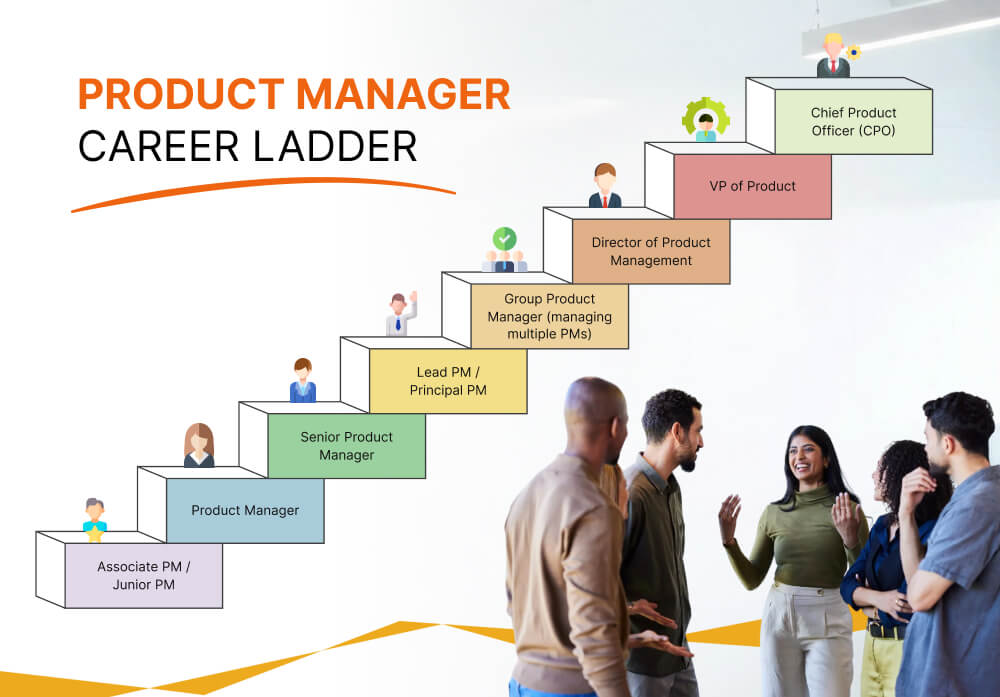
Career Trajectory: Product Managers typically move into leadership and strategy roles, eventually owning entire product portfolios or becoming C-suite executives.
Lateral Moves: Product Marketing Manager, General Manager, Chief Operating Officer, Entrepreneur/Founder
Product Owner Career Ladder
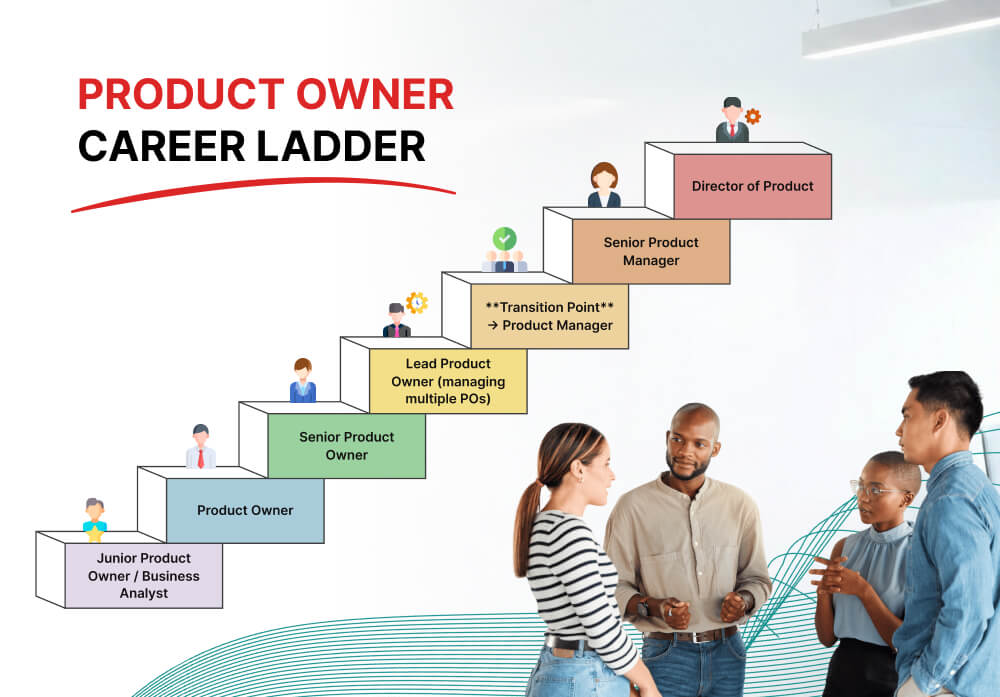
Career Trajectory: Product Owners often transition into Product Manager roles as they gain strategic experience. Many organizations view Product Owner as a stepping stone to Product Management.
Lateral Moves: Scrum Master, Agile Coach, Engineering Manager, Technical Program Manager
Key Insight: According to research, the most common next step for a Product Owner is becoming a Product Manager, which opens significantly higher earning potential and strategic influence.
When to Hire a Product Manager vs Product Owner
The decision to hire a Product Manager, Product Owner, or both depends on several factors:
Hire a Product Manager When:
- Your product lacks a strategic direction or a clear roadmap.
- You need someone to conduct market research and identify opportunities.
- You’re launching a new product requiring business case development.
- You need to coordinate cross-functional teams (marketing, sales, and engineering.
- Your organization is not using Agile/Scrum exclusively.
- You need someone to represent the product to executives and external stakeholders.
Scenario Example: A SaaS startup has built an MVP and needs to determine product-market fit, create a go-to-market strategy, and set a 12-month roadmap. Hire a Product Manager first.
Hire a Product Owner When:
- You have a Scrum/Agile development team needing backlog.
- Your Product Manager is overwhelmed with execution details.
- Developers need daily clarification on requirements and acceptance criteria.
- You have a clear product vision but struggle with sprint-by-sprint delivery.
- Your team needs someone embedded with engineering to unblock issues.
- You’re scaling and need dedicated tactical execution support.
Scenario Example: A growing tech company has a Product Manager defining strategy, but the development team lacks prioritized user stories and sprint goals. Hire a Product Owner to support execution.
Hire Both When:
- Your organization is large enough to support specialized roles
- You’re building multiple products or complex product suites
- You follow Agile at scale (SAFe, LeSS, Scrum@Scale)
- Strategic and tactical workloads are too much for one person
- You need a distinct separation between market strategy and delivery execution
Organizational Structure Example:
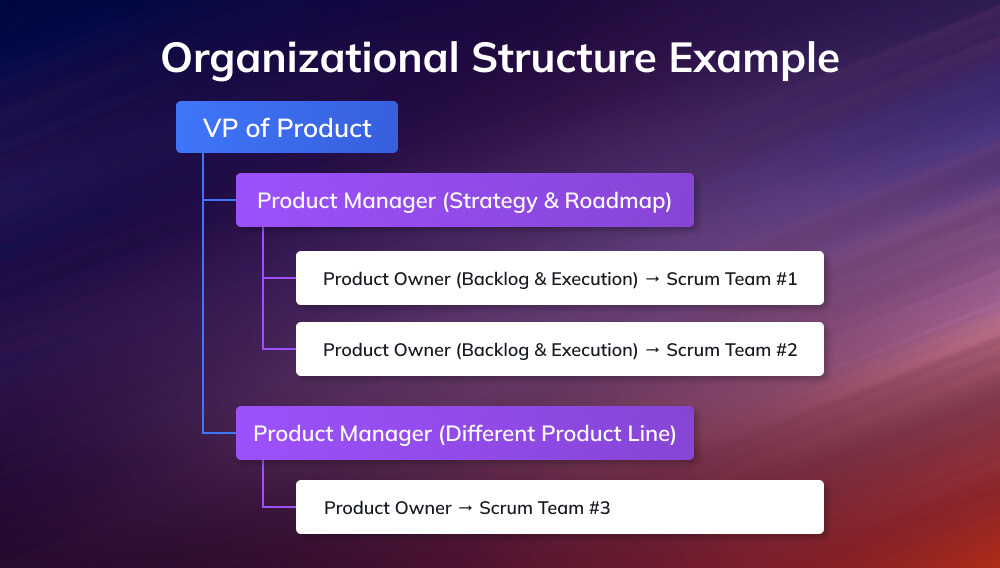
Can One Person Be Both Product Manager and Product Owner?
Short Answer: Yes, especially in small organizations or startups, but it comes with challenges.
Pros of Combining Roles:
- Cost-effective: One salary instead of two.
- Alignment: No communication gap between strategy and execution.
- Faster decisions: One person owns end-to-end product decisions.
- Startup agility: Small teams benefit from multi-hat roles.
Cons of Combining Roles:
- Bandwidth constraints: Strategic work suffers when buried in sprint planning.
- Context switching: Constant toggling between long-term thinking and daily execution.
- Burnout risk: High workload with conflicting priorities.
- Skill gaps: Few people excel at both strategic and tactical execution.
- Neglected responsibilities: Either strategy or execution typically suffers.
When Combining Makes Sense:
- Seed-stage startups (pre-Series A) with <10 engineers.
- Small product teams with a simple, focused product scope.
- Temporary arrangements during hiring gaps.
- Individual has experience in both roles and strong time management.
When to Separate Roles:
- Series B+ companies with multiple Scrum teams
- Enterprise organizations with complex product portfolios
- High-velocity teams requiring constant backlog refinement
- Strategic initiatives demanding significant market research and planning
Best Practice: Most organizations find that separating roles at 15-20 engineers or when managing 2+ Scrum teams yields better outcomes.
How Product Managers and Product Owners Collaborate
In organizations with both roles, effective collaboration is essential. Here’s how they work together:
Division of Labor
| Product Manager | Product Owner |
| Conducts customer interviews to identify pain points | Translates findings into user stories with acceptance criteria |
| Creates a quarterly roadmap with strategic initiatives | Breaks initiatives into epics and prioritizes backlog |
| Defines success metrics and OKRs | Tracks sprint velocity and delivery metrics |
| Presents product vision to stakeholders | Communicates sprint goals to the development team |
| Approves major scope changes | Makes day-to-day prioritization decisions |
| Monitors market trends and competition | Monitors team capacity and technical constraints |
Communication Cadence
Daily: Product Owner updates Product Manager on sprint progress, blockers, and trade-off decisions
Weekly: Joint roadmap review and backlog prioritization sessions
Quarterly: Strategic planning and OKR alignment meetings
As Needed: Major feature scoping, customer escalations, go-to-market planning
Decision-Making Framework
Product Manager Has Final Say On:
- Product strategy and vision
- Feature inclusion on the roadmap
- Go-to-market timing
- Success metrics and KPIs
Product Owner Has Final Say On:
- Sprint scope and capacity
- Backlog item priority within sprints
- Acceptance criteria details
- Technical trade-offs with engineering
Conflict Resolution: When PM and PO disagree, escalate to the VP of Product or use data-driven decision frameworks.
The Future: AI Product Management in 2026
As artificial intelligence transforms product development, both Product Managers and Product Owners must adapt their skills.
AI’s Impact on Product Management
Product Managers in AI Products:
- Understanding AI/ML capabilities and limitations
- Navigating ethical considerations (bias, privacy, transparency)
- Defining success metrics for non-deterministic systems
- Balancing model accuracy with user experience
- Managing data requirements and labeling workflows
AI Tools for Product Managers :
- AI-powered user research: Automated analysis of customer interviews (tools like Dovetail AI, Notably)
- Predictive roadmapping: AI suggests feature priorities based on market trends
- Competitive intelligence: AI monitors competitor moves and market shifts
- A/B test optimization: AI-driven experimentation platforms
AI’s Impact on Product Ownership
Product Owners in AI-Augmented Teams:
- Managing backlogs with AI copilots (GitHub Copilot, Cursor)
- Faster development cycles require more frequent backlog refinement
- New acceptance criteria for AI-generated code
- Ethical considerations in AI-assisted development
AI Tools for Product Owners:
- Backlog optimization: AI suggests story priorities based on dependencies and value
- Automated user story generation: AI drafts stories from product requirements
- Sprint forecasting: Predictive analytics for team velocity and capacity
Critical Skill for Both Roles: Understanding how to prompt, evaluate, and integrate AI capabilities into products while maintaining human judgment on ethical and strategic decisions.
Key Takeaways: Product Manager vs Product Owner
Remember the Core Distinction:
| Aspect | Product Manager | Product Owner |
| Focus | WHY and WHAT to build | HOW and WHEN to build it |
| Time Horizon | Quarters to years | Sprints to months |
| Orientation | Market and customer | Team and delivery |
| Success | Business outcomes | Delivery efficiency |
| Methodology | Any framework | Agile/Scrum |
Career Considerations:
For aspiring PMs: Start as a Business Analyst or Product Owner; develop strategic and market skills
For aspiring POs: Get Scrum certification (CSPO/PSPO); develop Agile and technical skills
For career growth: Product Owner → Product Manager is a common and valuable progression
For compensation: Product Managers earn ~17% more, with greater long-term earning potential
For Hiring Managers:
- Small startups: Hire a Product Manager who can wear both hats initially.
- Growing companies: Add a Product Owner when you have 2+ Scrum teams or PM is overwhelmed.
- Enterprises: Maintain separate roles with clear responsibilities and collaboration models.
- Agile-focused: Product Owner is essential; Product Manager is optional, depending on strategy needs.
Conclusion
Product Managers and Product Owners are not interchangeable titles; they are two sides of the same product engine. Product Managers own the why and what at a strategic level, market opportunity, positioning, roadmap, and commercial success. Product Owners own the how and when at the delivery level, translating that vision into clear backlog items, prioritization, and value delivery sprint after sprint. When either side is missing, you feel it immediately: great vision that never ships, or fast shipping that doesn’t actually move the needle.
The strongest product organizations in 2026 are the ones that treat these as complementary roles, not a turf war. They create crisp boundaries, shared goals, and tight collaboration so that discovery, strategy, and execution reinforce each other rather than compete for attention. If you’re shaping your own career, that clarity helps too: lean toward Product Manager if you’re energized by market analysis, business cases, and long-term product bets; lean toward Product Owner if you enjoy working closely with engineering, owning the backlog, and turning strategy into working software week after week.
If you want to build serious credibility in these roles, certifications like Certified Scrum Product Owner (CSPO) and Invensis Learning’s Agile Scrum Master program are a strong next step. Together, they deepen your skills in backlog management, value-driven prioritization, stakeholder collaboration, and Agile delivery practices, so you’re not just debating “PM vs PO” in theory, but actually equipped to perform whichever role you step into with confidence.